


TL;DR: Fintech AI cost forecasts fail because teams model inference as a line item instead of a system property. The fix is not a better spreadsheet. It is cost-to-serve measurement built before the model goes live, so the forecast reflects what AI actually costs to run, govern, and recover value from.
Key Takeaways: - A forecast that survives month four treats AI as a system, not a billable API. Hidden costs, including governance, drift remediation, and human review, are larger than raw inference. - Inference costs compound non-linearly because context windows grow, guardrails multiply model calls, and agentic loops burn tokens unpredictably. - Building cost-to-serve instrumentation before deployment is the single move that separates teams whose forecasts hold from teams that overspend past the point of no return.
Your Forecast Models the Wrong System
Your cost forecast for fintech AI is not slightly wrong. It is structurally broken. About 30% of generative AI projects are abandoned after proof of concept. The top two reasons: escalating costs and unclear business value.
That is not a technology failure. It is a financial planning failure dressed up as one.
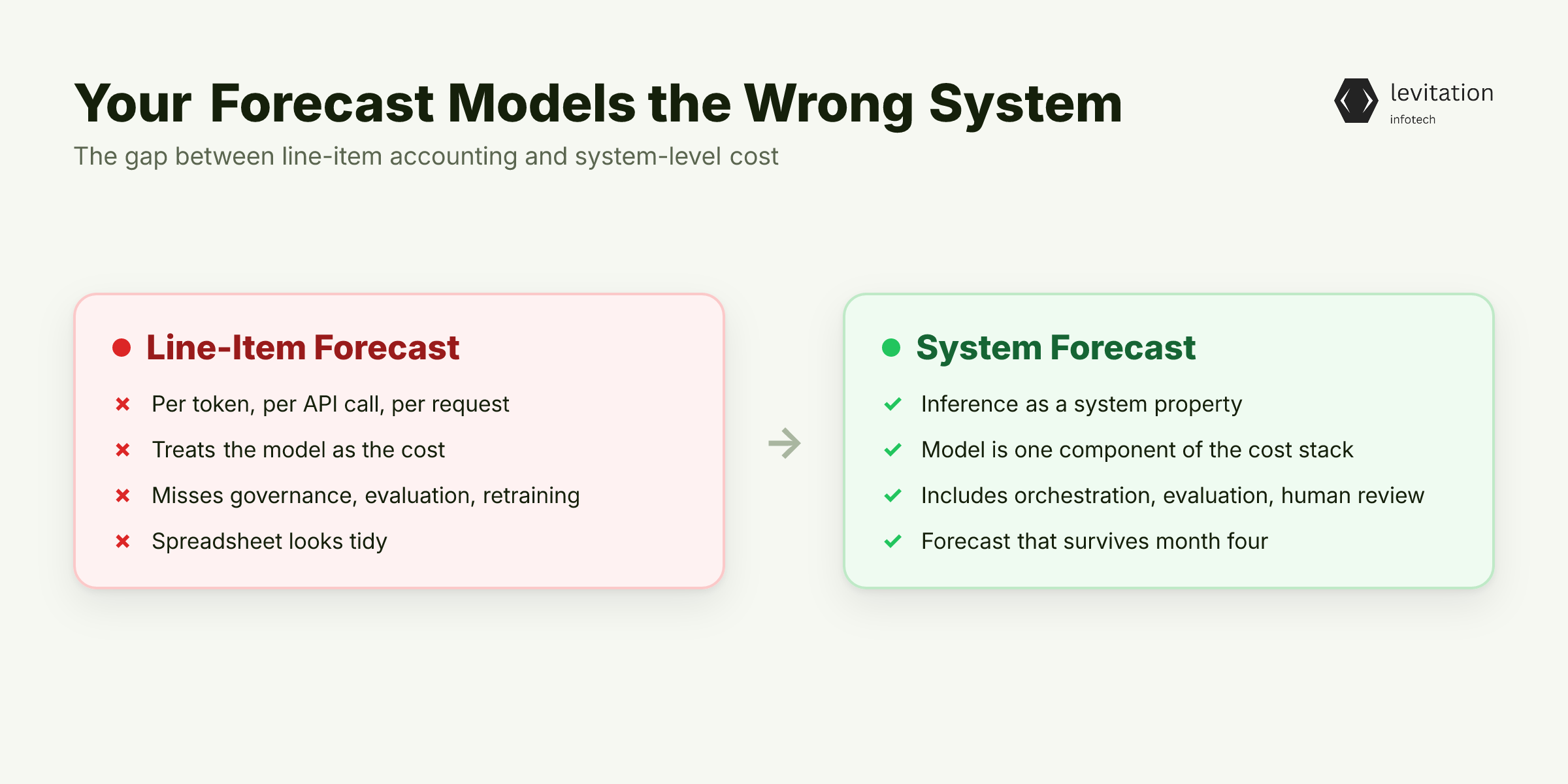
Most CTOs forecast AI spend the way they forecast cloud spend. Per token, per API call, per request. The spreadsheet looks tidy.
It also misses the point. Inference is a system property, not a line item. It emerges from how the model is wrapped, governed, retrained, and reviewed. Not from how many prompts you send.
The forecast that survives month four is not a better spreadsheet. It is a different mental model of what AI actually costs.
The teams that win on cost treat the model as one component inside a larger cost stack. The teams that lose treat it as the cost.
A useful anchor: when a finance leader asks "what does this AI feature cost per customer?", the right answer includes inference, orchestration, evaluation, and human review. The wrong answer is the API bill.
The problem is not that your numbers are off. The problem is that the costs you are not modeling are larger than the costs you are.
The Hidden Cost Stack Nobody Budgets For
Once you start looking past the invoice, the cost stack gets ugly fast. Governance now consumes 8-12% of the average enterprise AI budget, a line item most forecasts treat as zero.
Data quality remediation, drift-triggered retraining, evaluation infrastructure, and human-in-the-loop review are recurring costs that scale with usage, not model size. The more your product is used, the more these compound.
This is the layer that kills budgets in month four. Pilots run on clean data and hand-curated prompts. Production runs on messy data, real user behavior, and drift that triggers retraining on a cadence nobody planned for.
The AI companies for fintech that survive this phase are the ones who treat governance, evaluation, and retraining as first-class cost centers, not afterthoughts. The pattern is consistent: the teams that build measurement in early never have to explain a budget overrun later.
The 30% PoC abandonment rate is not a technology problem. It is a financial governance problem masked as a technology problem. Fix the governance first, and most of the "AI is too expensive" complaints quietly disappear. And the visible line item, raw inference, hides a second problem: it does not scale the way any spreadsheet assumes.
Why Inference Costs Compound Non-Linearly
Inference does not scale the way a CTO expects. A cloud bill grows with usage, more or less linearly. An AI bill grows with complexity, and complexity compounds.
A RAG pipeline that starts as one embedding call and one completion can grow to three model calls. Add guardrails, reranking, and fallback logic, and it does.
Context windows grow silently as teams add more retrieved documents, conversation history, and tool outputs to prompts. Every added document does not just add one token. It multiplies the cost of every downstream call.
Agentic workflows can loop. A workflow designed for three steps can execute ten when the model hallucinates a missing parameter, and you pay for every step. There is no static upper bound on what a single user request can cost.
This is why a per-request forecast goes sideways. The unit cost of a single inference is not a property of the model. It is a property of the workflow, the context, and the failure modes you have not yet seen.
We covered similar compounding patterns in Why Fintech AI Costs Vary Three-Fold. The same model produced wildly different bills across teams with similar traffic.
The compounding effect explains the overrun. But it does not explain why two well-funded fintechs end up in different places. The bill tells very different stories.
JPMorgan vs Klarna: The Strategic Fork in Month Four
By month four, every fintech AI program has to answer a strategic question that the cost forecast cannot answer for you. The two most-cited examples in 2026 make the fork visible.
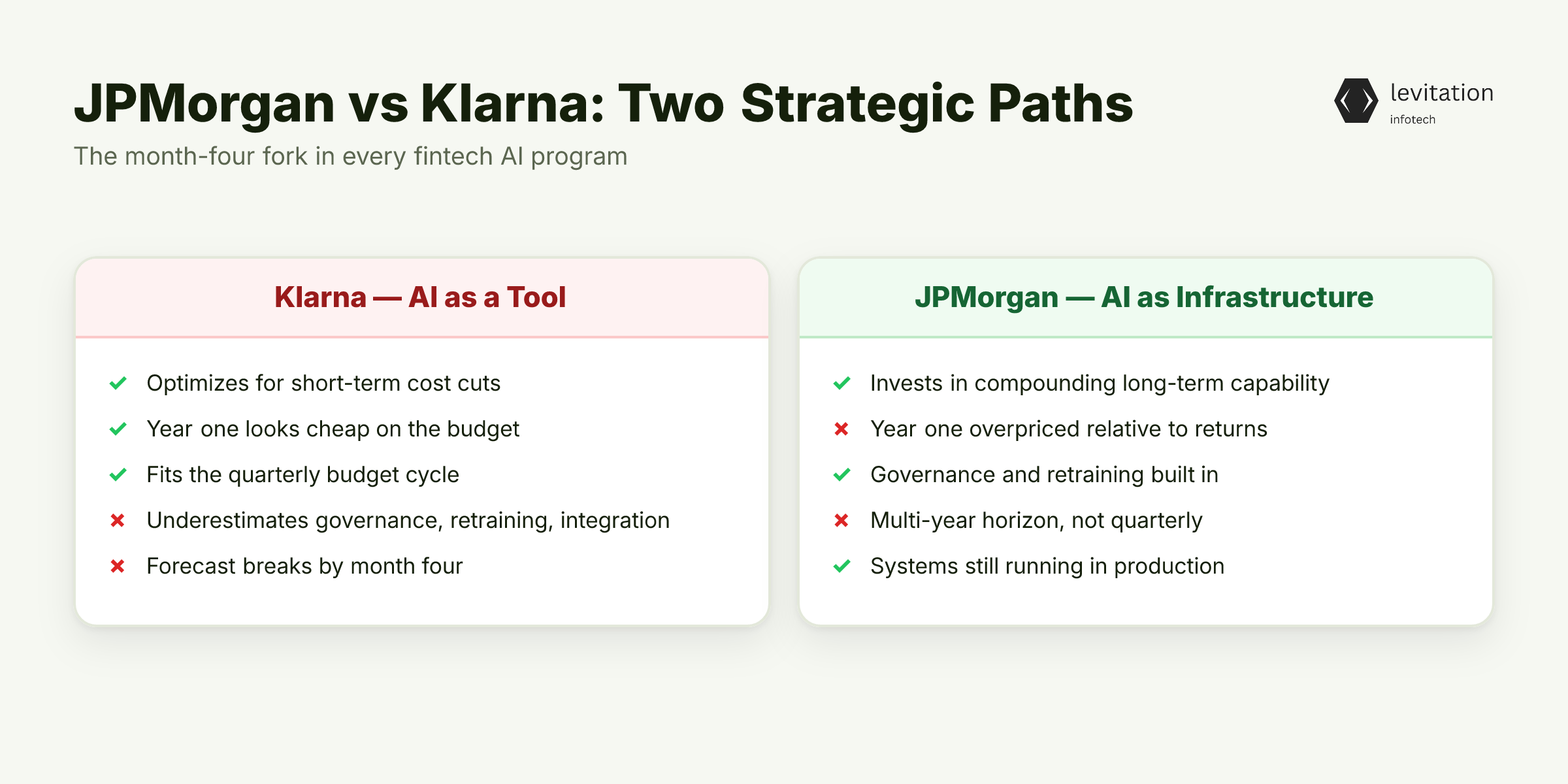
Klarna achieved short-term cost savings. JPMorgan Chase is investing in AI with strong leadership support, expecting long-term benefits. The research framing puts these side by side. It shows the tradeoff between optimizing for short-term cost cuts and investing for compounding long-term capability.
The CTO decision is not "spend less" or "spend more." It is whether your forecast assumes AI as a tool to optimize or AI as infrastructure to build.
Each has a different cost curve, a different depreciation schedule, and a different governance burden. The enterprise AI implementation partners who have shipped systems still running in production almost always pick the second path.
Forecasts that assume "AI as a tool" underestimate governance, retraining, and integration costs. Forecasts that assume "AI as infrastructure" overprice year one and underprice the compounding returns from year three onward.
Most teams pick the first model because it fits a quarterly budget cycle. That is the choice that breaks by month four.
Choosing the right curve is useless without a way to measure it. And measurement is exactly the infrastructure most teams skip.
Build the Cost-to-Serve Model Before You Build the AI
The fix is unsexy and unglamorous. Build the cost-to-serve model before you build the AI. Three metrics to instrument from day one: - Cost per inference: the raw model call, including retries and fallbacks - Cost per workflow: the full orchestrated path, including all guardrail calls - Cost per resolved business outcome: cost per verified KYC, cost per processed payment, cost per closed support ticket
Place budget controls at the request path, not in month-end reviews. A runaway agent can burn a quarterly budget in a weekend, and a finance meeting three weeks later is useless. The control has to live where the spend happens.
Tag every inference call with the feature, customer segment, and workflow that triggered it. Treat AI spend the way FinOps teams treat cloud spend: by tag, by owner, by unit economics. If you cannot answer "what did this customer segment cost us in AI spend last month?", your forecast is fiction.
The pattern works. Teams that built cost-to-serve measurement before deployment exposed waste invisible in invoice-level tracking.
They identified which workflows burned tokens without returning value. The savings did not come from renegotiating vendor rates. They came from seeing what the invoice never showed.
Similar work is detailed in The Hidden Cost Killing Fintech AI Scaling, where the same lesson applies to teams still scaling up. The critical path is instrumentation and tagging, not the model itself. Governance built after the AI is live costs more and catches less.
When measurement exists before the model, something unexpected happens: the cost forecast stops breaking.
What Changes When Your Forecast Stops Breaking
Three things change, and they compound.
First, cost forecasts become defendable to the board because they are tied to business outcomes, not vendor invoices.
The conversation shifts from "the AI bill grew faster than we modeled" to "the AI cost us a defined amount per resolved business outcome." The unit economics become clear. Finance and product speak the same language.
Second, teams can run pricing experiments on AI products because they know the true marginal cost of serving a customer. Without cost-to-serve, every pricing decision is guesswork. With it, every pricing decision is a margin trade-off you can actually evaluate.
Third, the governance overhead that felt like tax in month one becomes the moat in month twelve. Competitors who skipped governance cannot answer basic ROI questions. You can.
That gap shows up in every board meeting, every procurement conversation, and every product roadmap decision. For banking software and payment systems where partners instrument from day one, this is the entire game.
Frequently Asked Questions
How much should AI governance cost as a percentage of total AI budget?
Research from August 2026 shows governance now consumes 8-12% of the average enterprise AI budget. If your forecast allocates less than 5%, expect the gap to surface as unexpected overrun by month four.
Why do AI projects exceed budget after the pilot phase?
Pilots run on controlled inputs and manual oversight. Production runs on messy data, real user behavior, and drift that triggers retraining cycles. The 30% PoC abandonment rate comes from teams who budgeted for the pilot. They discovered the production cost stack is structurally different.
How do you forecast AI inference costs when model pricing keeps changing?
Do not forecast per-model. Forecast per business outcome, like cost per verified KYC, cost per resolved support ticket, or cost per processed payment. Let the model layer underneath change. This is the cost-to-serve approach, and it survives vendor price shifts.
What is cost-to-serve for AI products?
Cost-to-serve is the fully loaded cost of delivering one unit of business value through AI. It includes inference, orchestration, fallback, human review, and governance overhead. The approach exposes unit economics that invoice-level tracking hides, giving teams a real number to reprice around.
How long does it take to build AI cost governance for a fintech?
The critical path is instrumentation and tagging, not the model itself. Most teams can stand up cost-to-serve tagging in 4-6 weeks using existing observability tooling, then refine over the next two quarters. Governance built after the AI is live costs more and catches less.
If you want to stop explaining forecast misses and start pricing AI like the system it is, the work starts before the model ships.
Sources
Research and references cited in this article:
- AI Cost Statistics 2026: Forecasting, ROI, and Budget Risk
- Predicting AI Spending in 2026: What the Data Actually Tells Us
- Why Companies Overspend on AI: The 2026 Cost Visibility ...
- 🧠 AI's Cost Crisis: How Fintech Could Save Billions | Brainfood
- AI Bill Shock Hits the Boardroom: 40% of Companies Escalated Surprise AI Costs, 1 in 4 Cancelled a Program | Press Releases | wboc.com
- AI ROI Statistics 2026: Returns, Timelines & Industry Data
- Enterprise AI ROI Shifts as Agentic Priorities Surge
- Getting Real ROI from Enterprise AI in 2026
- AI ROI Reckoning: Why 95% of Enterprises Still Can't Measure Returns (And How to Fix It) | AI Magicx Blog | AI Magicx
- The AI Playbook for Financial Services
- How Does AI Reduce Costs? Save 5–20% Across Operations
- 2026 AI Business Predictions
About the author
Mayank Singh is a software developer at Levitation Infotech, where he builds web and AI-powered applications across the company’s fintech, healthcare, and enterprise projects.