


TL;DR: Traditional canary rollouts spread a fix over many tiny traffic bumps. This stretches the time to full remediation and hides failures. Mis-configured resources and routing turn a safety net into a bottleneck. Progressive delivery shapes traffic by real-time health data and automated gating. As a result, it lets you ship fixes faster without sacrificing reliability.
Key Takeaways - Incremental traffic shifts extend mean-time-to-recovery when a bug slips through early canary pods. - Missing resource limits or split-brain routing make health signals noisy and delay full rollouts. - Adaptive rollouts driven by SLO-aware algorithms cut latency and reduce outage risk.
Why “Safer” Canary Deployments Often Delay Critical Fixes
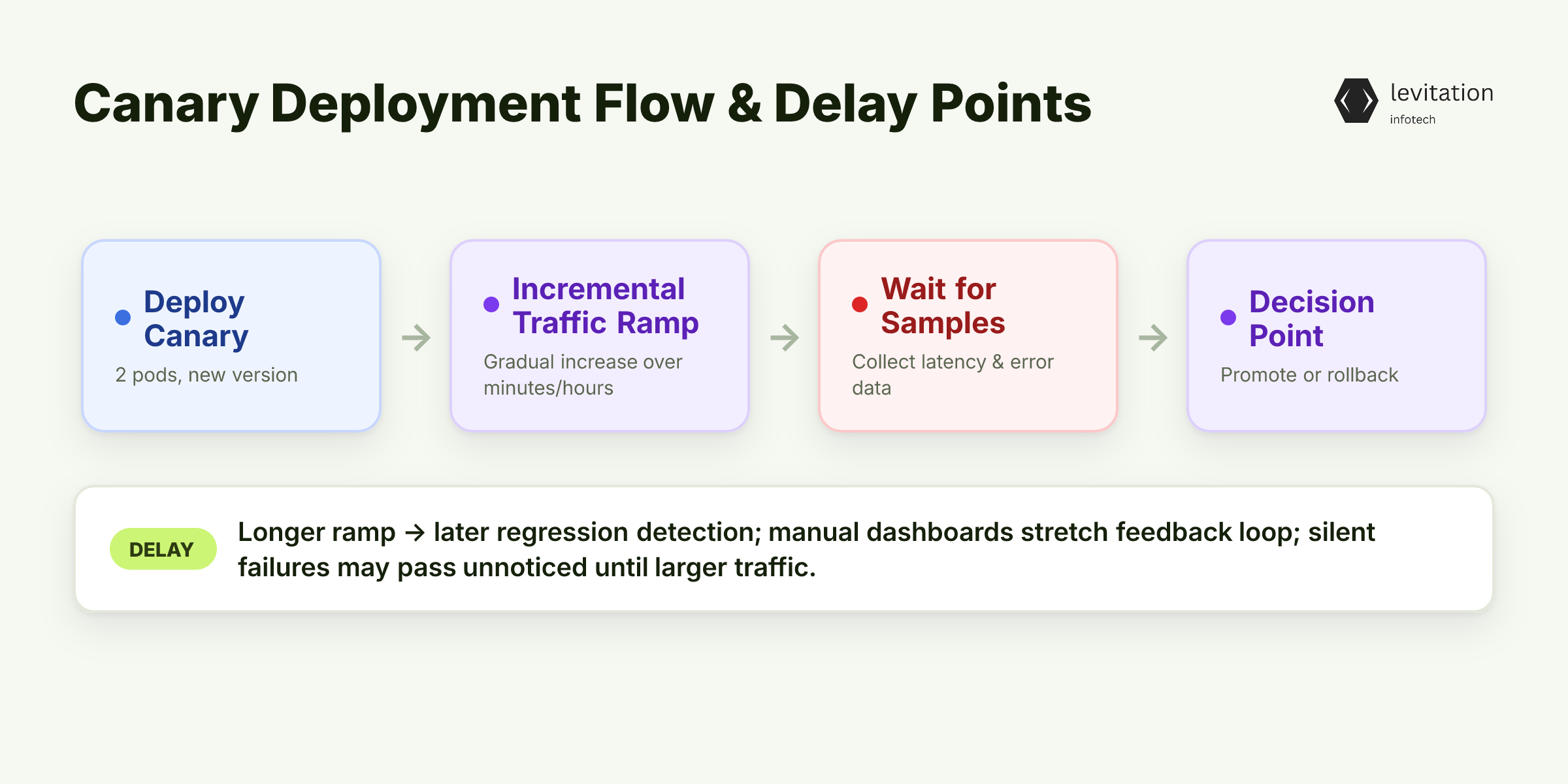
Most SRE teams trust canary releases to keep production safe. However, that safety can stall bug fixes and raise outage risk. A typical canary moves traffic in incremental steps over minutes or hours. Each step adds a waiting period while the fix lives only on a fraction of the fleet. If the bug appears only under load, the limited traffic may never trigger it. The team then proceeds to the next step unaware.
1apiVersion: apps/v12kind: Deployment3metadata:4 name: myapp-canary5spec:6 replicas: 2 # small canary replica set7 selector:8 matchLabels:9 app: myapp10 template:11 metadata:12 labels:13 app: myapp14 version: canary15 spec:16 containers: - name: myapp17 image: myrepo/myapp:v218 resources:19 requests:20 cpu: "250m"21 memory: "256Mi"
Only two pods serve the new version, so any latency spike is averaged out by the stable pods. The team must wait for enough samples before deciding to promote. - Latency of detection: The longer the traffic ramp, the later you notice a regression. - Feedback loop stretch: Manual dashboards often refresh at intervals, so a traffic bump may sit idle before an alert surfaces. - Risk of silent failures: Errors that affect a small fraction of requests can pass unnoticed until the canary reaches a larger share. Then, the blast radius expands.
These delays are not just timing issues. Misconfigurations can turn a simple canary into a reliability nightmare. What hidden costs can turn a canary into a bottleneck?
The Hidden Costs: Misconfigurations That Turn Canaries Into Bottlenecks
When a canary’s pod spec omits CPU or memory limits, the scheduler may evict it. This can happen under pressure from the stable replica set. An evicted canary never sees real traffic, so the rollout stalls while the operator retries. The same pattern appears in service-mesh routing. A mis-written VirtualService can split traffic unevenly, sending most requests to the stable version. However, the intended weight is balanced.
1apiVersion: networking.istio.io/v1alpha32kind: VirtualService3metadata:4 name: myapp5spec:6 hosts: - myapp.example.com7 http: - route: - destination:8 host: myapp9 subset: stable10 weight: 80 - destination:11 host: myapp12 subset: canary13 weight: 20
Common pitfalls - Missing limits → pod eviction → rollout pause. - Incorrect mesh rules → split-brain traffic → diluted health signals. - Lack of readiness probes → traffic sent to pods that aren’t ready, inflating error rates.
These issues make metrics unreliable. If you can’t trust the metrics, you’ll never know whether to accelerate or abort. How does progressive delivery avoid these traps?
Progressive Delivery: The Smarter Alternative to Traditional Canaries
Progressive delivery replaces static percentages with data-driven traffic shaping. A controller reads SLO-related metrics (latency, error rate, business KPIs) and adjusts the weight in real time. When the error budget is intact, the controller nudges traffic upward; a spike triggers an immediate pause.
1apiVersion: flagger.app/v1beta12kind: Canary3metadata:4 name: myapp5spec:6 targetRef:7 apiVersion: apps/v18 kind: Deployment9 name: myapp10 service:11 port: 8012 targetPort: 808013 analysis:14 interval: 30s15 metrics: - name: request-success-rate16 interval: 1m
Flagger watches Prometheus for `request_success_rate`. If the rate falls below the threshold, it rolls back the traffic weight to the previous safe level. The algorithm is simple: probability of SLO breach → traffic weight. This removes manual dashboards and reduces the time a buggy version spends in the wild.
Why it works: - Fine-grained control - traffic shifts in small increments, reacting quickly to metric changes. - Automated gating - health checks become actionable policies, not just charts. - Reduced exposure - failures are caught at very low traffic levels, not after a large rollout.
What does a production-safe adaptive rollout look like?
Designing a Production-Safe Canary with Adaptive Rollouts
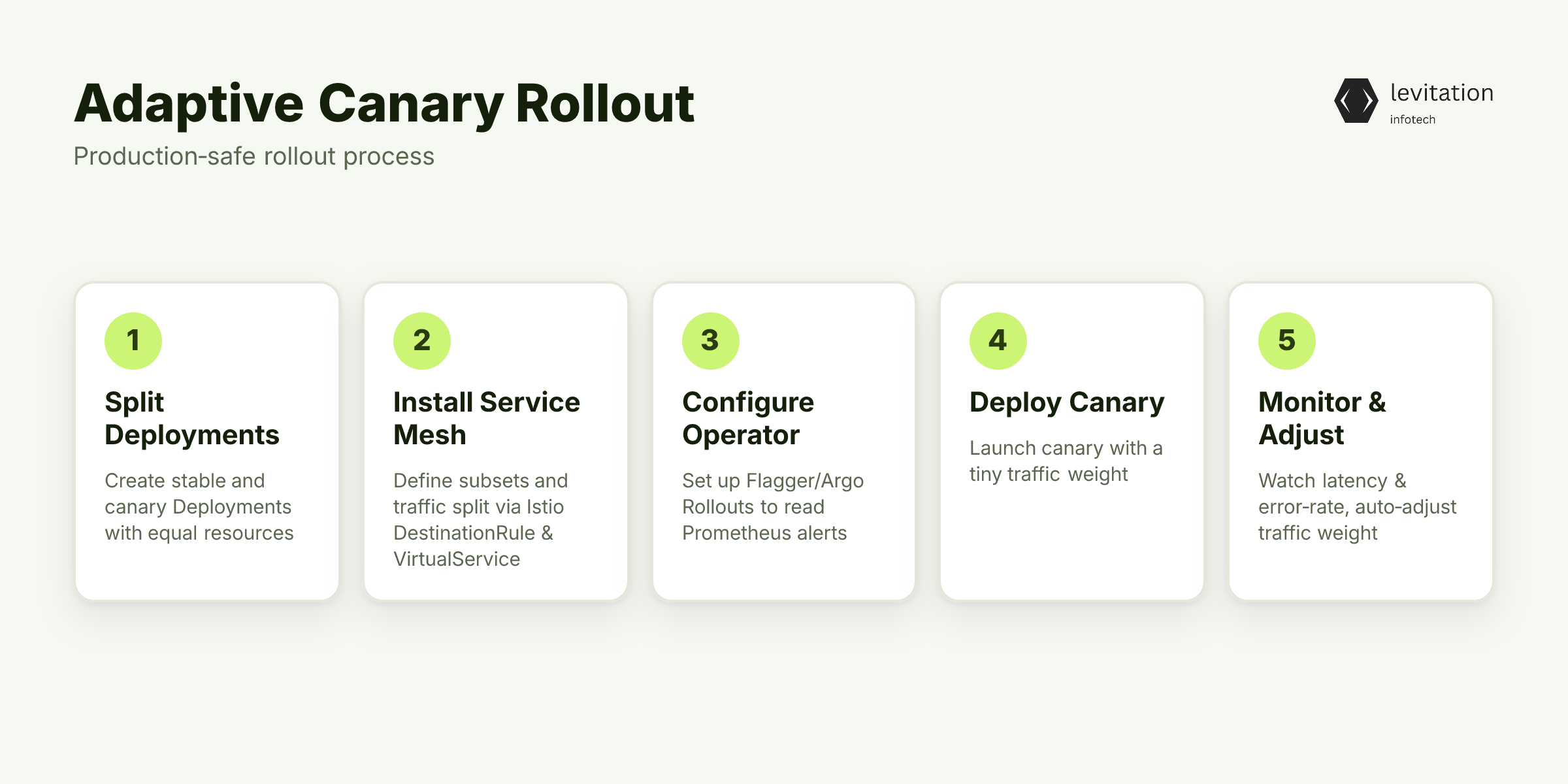
First, split your workload into two explicit Deployments: a stable baseline and a canary that carries the fix. Both must declare resource requests and limits so the scheduler treats them equally.
1apiVersion: apps/v12kind: Deployment3metadata:4 name: myapp-stable5spec:6 replicas: 57 selector:8 matchLabels:9 app: myapp10 version: stable11 template:12 metadata:13 labels:14 app: myapp15 version: stable16 spec:17 containers: - name: myapp18 image: myrepo/myapp:v119 resources:20 requests:21 cpu: "500m"22 memory: "512Mi"23 limits:24 cpu: "1"25 memory: "1Gi"26---27apiVersion: apps/v128kind: Deployment29metadata:30 name: myapp-canary31spec:32 replicas: 233 selector:34 matchLabels:35 app: myapp36 version: canary37 template:38 metadata:39 labels:40 app: myapp41 version: canary42 spec:43 containers: - name: myapp44 image: myrepo/myapp:v245 resources:46 requests:47 cpu: "500m"48 memory: "512Mi"49 limits:50 cpu: "1"51 memory: "1Gi"
Next, install a service-mesh that can split traffic by weight. Istio’s `DestinationRule` defines the subsets, while a `VirtualService` controls the split. The mesh also injects health checks (e.g., HTTP 200 on `/healthz`) that Flagger can query.
1apiVersion: networking.istio.io/v1alpha32kind: DestinationRule3metadata:4 name: myapp5spec:6 host: myapp7 subsets: - name: stable8 labels:9 version: stable - name: canary10 labels:11 version: canary
Finally, configure the Kubernetes Operator (Flagger or Argo Rollouts) to read Prometheus alerts. Then, it adjusts the traffic weight automatically.
1apiVersion: flagger.app/v1beta12kind: Canary3metadata:4 name: myapp5spec:6 targetRef:7 apiVersion: apps/v18 kind: Deployment9 name: myapp-stable10 canaryRef:11 name: myapp-canary12 service:13 port: 8014 analysis:15 interval: 15s16 metrics: - name: latency - name: error-rate
The controller will:
- Deploy the canary with a tiny weight.
- Watch latency and error-rate (or other SLO-related metrics).
- Increase weight after the interval if metrics stay within thresholds.
- Pause or rollback on any breach.
This design removes the manual “wait-and-watch” loop that slows traditional canaries. How can you tell when the rollout should accelerate or abort?
Monitoring & Observability: Knowing When to Accelerate or Abort
Adaptive rollouts depend on trustworthy signals. Instrument each replica set with the same set of metrics. This lets you compare stable vs. canary side by side. - Latency per pod - expose via `/metrics` and label with `version`. - Error rate per pod - count 5xx responses, also label with `version`. - Business KPI - for a payment service, track `transaction_success_rate`.
Prometheus query example:
1sum(rate(http_request_duration_seconds_sum{app="myapp",version="canary"}[1m]))2/3sum(rate(http_requests_total{app="myapp",version="canary"}[1m]))
Set SLO-based alert thresholds that Flagger’s pause/resume hooks can consume:
1groups: - name: myapp-slo2 rules: - alert: HighErrorRate3 expr: |4 sum(rate(http_requests_total{app="myapp",code=~"5..",version="canary"}[2m]))5 /6 sum(rate(http_requests_total{app="myapp",version="canary"}[2m]))7 > <your_error_rate_threshold>8 for: 1m9 labels:10 severity: critical11 annotations:12 summary: "Canary error rate exceeds acceptable level"13 description: "Investigate canary pods; rollout will pause."
Distributed tracing (e.g., OpenTelemetry) adds a view into request paths. When a latency spike appears, you can see whether it originates from the canary’s new code path. Or it may come from an upstream dependency.
With this data in hand, you can finally measure the payoff of an adaptive canary strategy. What real-world impact does this approach deliver?
Real-World Impact: Faster Fixes, Lower Outage Risk
Teams that replace static canaries with progressive delivery report a noticeable shrinkage in mean-time-to-recovery. The fix reaches the whole fleet as soon as health metrics stay within budget. Often, this happens after only a small fraction of traffic. Conversely, a buggy version is caught early, preventing a larger blast radius. - Reduced exposure: Failures surface at very low traffic, giving you a narrow window to react. - Quicker remediation: Once the canary passes, the controller ramps to full traffic without manual steps. - Higher confidence: Automated health checks replace noisy dashboards, so you trust the rollout decision.
The payoff is not just speed; it’s a measurable reduction in outage risk. When you can prove a new release will not jeopardize compliance or availability, you win the trust of compliance-first leaders and growth-focused executives alike. What questions remain about adopting this pattern?
Frequently Asked Questions
Q: Do canary deployments increase mean-time-to-recovery?
A: Yes. Incremental rollout delays the point at which a fix reaches all users, extending MTTR if the issue isn’t detected early.
Q: How does progressive delivery differ from a traditional canary?
A: Progressive delivery adds automated, data-driven traffic adjustments and health-based gating, while classic canaries rely on static percentages and manual monitoring.
Q: What Kubernetes tools support adaptive canary rollouts?
A: Flagger, Argo Rollouts, and the Flagger-Istio integration let you define SLO-based policies that automatically scale traffic up or pause the rollout.
Q: Can I use these patterns with existing service meshes?
A: Yes. Both Istio and Linkerd expose traffic-splitting APIs that Flagger or Argo Rollouts can control without redesigning your services.
Q: Is there a risk that adaptive rollouts hide failures?
A: Only if observability is insufficient. Proper metrics, alerts, and tracing are required to ensure the system reacts to real failures, not just statistical noise.
*Explore related reliability patterns in our posts on Why Multi-Stage Docker Builds Are Slowing Your CI and NetworkPolicy: The Hidden HA Saboteur.
Sources
Research and references cited in this article:
- Top Kubernetes Security Mistakes in 2026 - Server Management
- Top 15 Kubernetes Security Mistakes To Avoid In 2026 | AccuKnox
- Ten Common Kubernetes Misconfigurations That Cause Outages ...
- Kubernetes Mistakes: A Beginner’s Guide to Avoiding Common Pitfalls
- Troubleshooting Kubernetes’ most common errors - Spectro Cloud
- Progressive Delivery Explained - Big Bang (Recreate), Blue-Green ...
- Canary Deployment Strategies: Mitigating Outages and Enhancing ...
- Progressive Delivery Strategies for Efficient Deployment | ConfigCat Blog
- Rolling vs Canary Deployment: Continuous Delivery Strategies
- Why progressive delivery is essential for modern software ...
- Canary Deployments: Pros, Cons, And 5 Critical Best Practices
- Canary Deployment - Cloud Native Glossary
About the author
Mayank Singh is a software developer at Levitation Infotech, where he builds web and AI-powered applications across the company’s fintech, healthcare, and enterprise projects.