


TL;DR: A VPAT is a self-attested template, not a certification. US federal procurement officers don't accept a completed Accessibility Conformance Report at face value. Instead, they audit the evidence behind it. Indian SaaS vendors bidding on US federal contracts need conformance testing, not documentation services. That distinction is the difference between a signed purchase order and a procurement rejection.
Key Takeaways: - A VPAT documents what a vendor claims about their product. The evidence pack behind it is what Section 508 actually requires. - The 508 Edition of VPAT 2.5 is the only template US federal buyers accept. Submitting the WCAG Edition triggers a re-submission cycle. - Section 508 includes six functional performance criteria. These cover vision, hearing, speech, dexterity, reach, and limited cognition. No checkbox captures them. - A defensible audit produces test artifacts. These include screen reader transcripts, keyboard-only recordings, and remediation tickets. They are not just a PDF. - A low-cost VPAT deliverable usually signals template completion. It is not conformance testing against a live product.
Why a Completed VPAT Is Not Section 508 Compliance
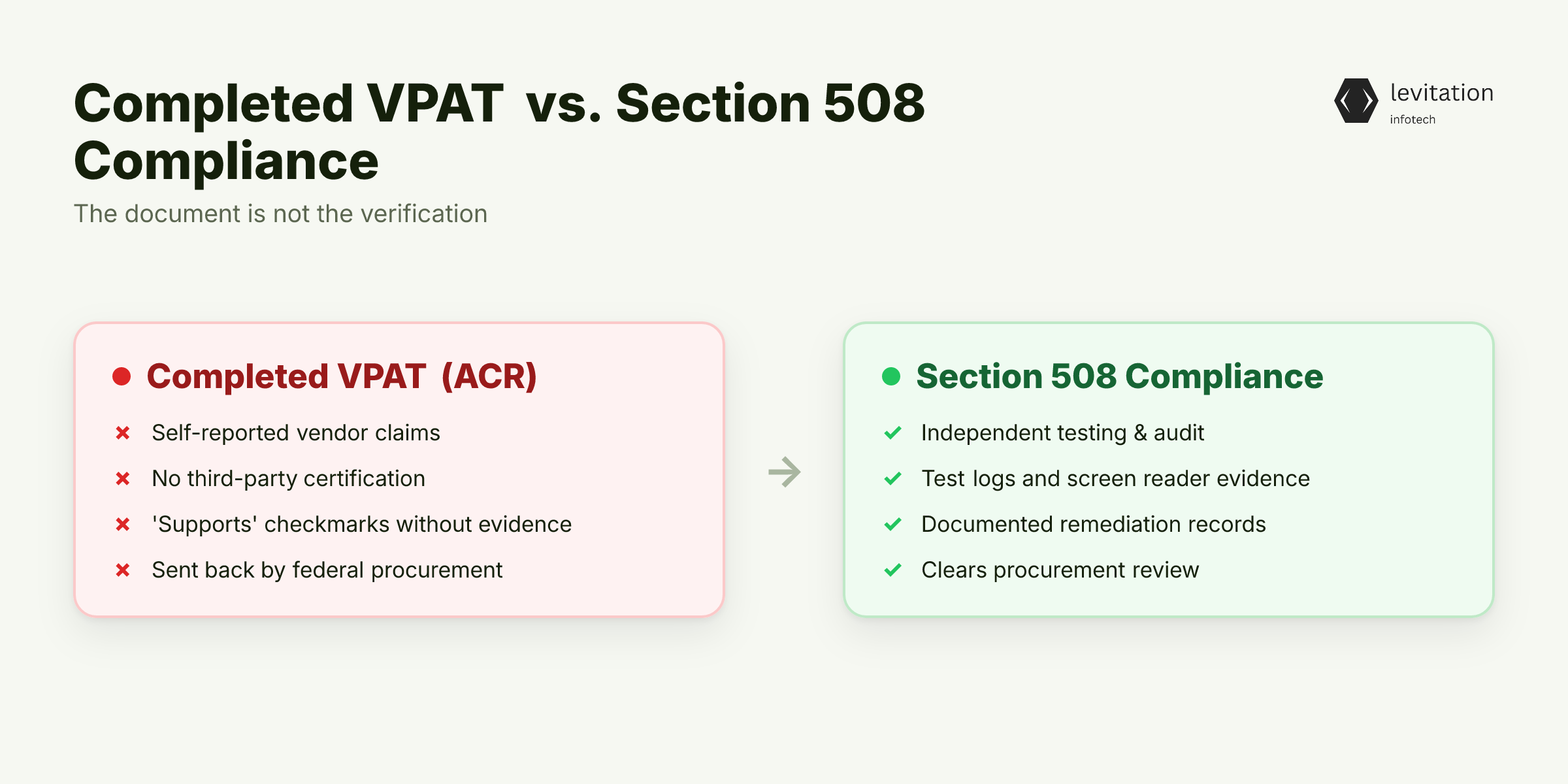
The name itself is the giveaway. "Voluntary." The VPAT is a template published by the Information Technology Industry Council (ITI). Vendors use it to document accessibility claims. When the template is filled in, the result is called an Accessibility Conformance Report, or ACR. That ACR is a written record of what the vendor says their product does. It is not independent verification.
The ITI guidance is clear: there is no certification for a VPAT. No pass/fail stamp. No third-party body issues a "Section 508 certified" seal. The ACR tells the vendor's claims to prospective buyers. It does not certify them.
US federal procurement officers know this. They treat the ACR as a starting point, not an endpoint. When a federal buyer receives an ACR full of "Supports" checkmarks, they look for evidence. Without test logs, screen reader evidence, or remediation records behind those marks, they send it back. The document does not buy procurement. The testing behind the document does. accessibility audit
The price tag on a VPAT audit tells you nothing about what was actually tested. That is where the low-cost audit problem begins.
The Cheap Audit Usually Tests the Wrong Document
Most low-cost VPAT audits start from the wrong end. The vendor sits down with a blank template. They walk through the product once, filling cells based on what they think the product does. No test plan. No assistive technology setup. No recorded evidence. The output is a clean PDF that looks complete.
The four VPAT editions (508, WCAG, EU, INT) each map to different standards. A vendor filling out the WCAG edition for a US federal buyer is solving the wrong problem. Federal procurement requires the 508 Edition. This edition incorporates WCAG 2.2 Level A and AA. It also adds the six functional performance criteria. These sit in Chapter 4 of the Section 508 standards. Submitting the wrong edition is an instant re-submission cycle. - The 508 Edition maps to US Section 508 standards (federal procurement) - The WCAG Edition maps to W3C WCAG 2.2 (general web accessibility) - The EU Edition maps to EN 301 549 (European procurement) - The INT Edition combines all three for international buyers
The deeper problem sits in the "Supports" column. A vendor writes "Supports" next to a WCAG criterion. What does that mean? Did they test with a screen reader? Did they verify keyboard-only navigation? Did they capture a video of a user with limited dexterity completing a core task? If the answer is no, the cell is a transcription, not a test result.
Even when the right edition is selected, federal buyers measure something Section 508 treats as non-negotiable. They look for functional performance criteria. These don't appear as a single line item on any template. wcag compliance
What Section 508 Actually Demands Beyond the Checklist
Section 508 is not WCAG. It borrows WCAG 2.2 Level A and AA as a baseline. Then it layers six Chapter 4 functional performance criteria on top. A product can pass every WCAG success criterion. It can still fail Section 508. This happens if it blocks a user with limited reach or dexterity from filing a form.
The six criteria cover users with: - Limited vision (not just screen reader compatibility; magnification, contrast, and text resizing to 200% all count) - Hearing loss (captions, transcripts, visual alerts for audio signals) - Speech limitations (alternative input for voice-driven flows) - Limited dexterity (keyboard-only paths, switch control, no time-pressured gestures) - Limited reach (target sizes, spacing, no controls needing simultaneous two-hand operation) - Limited cognition (consistent navigation, error prevention, plain language)
Federal buyers test against real assistive technologies. JAWS, NVDA, VoiceOver, switch controls, not just code-level automated scans. A button with the right ARIA label but broken focus order under NVDA fails. A drag-and-drop interaction that works with a mouse but not with switch controls fails.
The ITI's own guidance, and the Section 508 refresh, are clear. Automated scans catch a fraction of the actual conformance surface. Manual testing on real assistive technologies is the work, not the documentation.
This is the part the template can't capture. It is also where low-cost audits quietly disappear from federal pipelines. section 508
The pattern looks familiar to anyone who has watched Indian AI systems clear internal evals. Then they fail external audits. The same testing gap shows up in LLM evaluation suites that approve failing models. It also shows up in VPAT audits. The result is a clean checkbox with no real evidence behind it.
The Testing Gap Indian Vendors Keep Missing
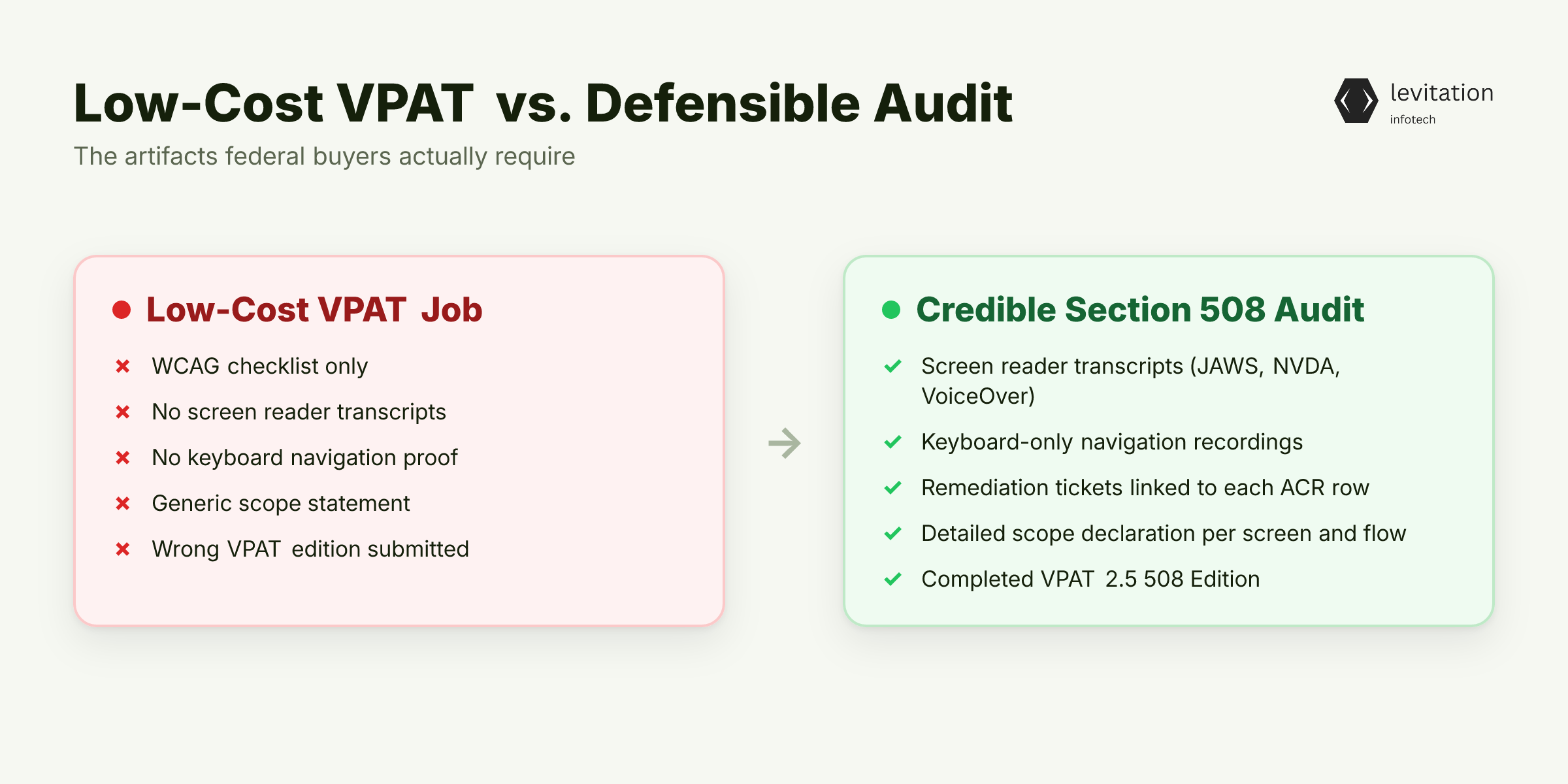
Internal QA teams rarely have Section 508 expertise. They might know WCAG from a checklist. However, Section 508 adds the functional performance layer plus the procurement-specific evidence pack. The ITI guidance says plainly that internal teams lack enough Section 508 and accessibility testing expertise. It also says that vendor self-assessment is not enough for federal procurement. Federal buyers want independent testing.
A credible Section 508 audit produces artifacts that a low-cost VPAT job skips: - Screen reader transcripts showing what JAWS, NVDA, or VoiceOver actually announce on each interactive element - Keyboard-only navigation recordings proving every flow completes without a mouse - Remediation tickets linked to every "Partially Supports" or "Does Not Support" row in the ACR - A scope declaration listing every screen, flow, and content type covered (not just "the application") - A completed VPAT 2.5 508 Edition; the current version, the 508 edition, not a WCAG-only or older template
Submitting the wrong edition is the single most common procurement delay. The 508 Edition of VPAT 2.5 is the only template federal buyers accept. The WCAG Edition triggers a re-submission cycle, which in turn delays contract award. A re-submission cycle that pushes the procurement past its funding window kills the deal outright.
The same dynamic plays out in other regulated procurement. Indian SaaS teams that have watched RBI reject AI systems that passed internal QA know the cost. They see what happens when teams conflate internal sign-off with external acceptance. The buyer, not the vendor, defines the evidence standard. The same lesson shows up in WCAG 2.2 conformance that still gets rejected at procurement. The checkbox isn't the contract.
Once you see what auditors should be producing, the difference becomes obvious. A low-cost deliverable and a defensible audit are very different things. vpat
What a Defensible Section 508 Conformance Audit Looks Like
A defensible audit follows a standardized method. The difference between it and a low-cost VPAT job is clear. A low-cost VPAT job is filling in a form. A defensible audit is running a structured test program. - Step 1: Scope declaration. Every screen, flow, and content type covered, not just "the application." If your product has five user roles, the scope lists flows for each. - Step 2: Automated scan plus manual WCAG 2.2 AA testing. Automated tools (axe, WAVE) catch baseline issues. Manual testing on every interactive component catches what automation misses: focus order, error handling, semantic structure. - Step 3: Assistive technology testing. Use at least three screen readers (JAWS, NVDA, VoiceOver). Also use one alternative input device (switch control or voice control). Real testers who know the AT, not a one-time install. - Step 4: Functional performance walkthrough. Can a user with limited dexterity actually file the form? Can a user with limited reach operate every control? This is the Section 508-specific work that doesn't map to a WCAG criterion. - Step 5: Evidence pack. Test logs, screenshots, screen reader transcripts, remediation backlog, and a completed VPAT 2.5 508 Edition ACR. The ACR is the deliverable, but the evidence pack is what the buyer actually reviews.
This is the same discipline that applies across Section 508 conformance testing. It covers any ICT product heading into US federal procurement. The method doesn't change. The shortcuts do, and that is where vendors lose.
The method is standardized. The harder question is which Indian audit partner can actually run it. This is because the market is split between document vendors and conformance testers. ada compliance
How to Tell a Document Vendor From a Conformance Tester
The market has two kinds of accessibility audit vendors. One sells documents. The other sells conformance evidence. Most low-cost engagements come from the first kind.
Four questions separate them: - Ask for a sample prior ACR with redactions. If every cell says "Supports" and there are no "Partially Supports" or "Does Not Support" rows, the vendor didn't test. They transcribed instead. Real products have partials. A clean ACR is a red flag. - Verify the auditor's credentials. IAAP CPACC or WAS certification. Named, not pooled, testers on your engagement. A vendor who can't name the testers running your audit is outsourcing the work. They hand it to whoever is available. - Demand a fixed-scope deliverable list. WCAG 2.2 AA pass/fail per criterion, AT test logs, remediation tickets, and a 508 Edition ACR. Not a PDF and a handshake. - Confirm the VPAT version and edition. VPAT 2.5 is current. 508 Edition is what federal buyers need. If the vendor quotes the WCAG Edition or an older VPAT version, walk away.
A conformance tester will have answers to all four. A document vendor will hedge.
Founders who get this right don't just pass procurement. They unlock the category of US federal contracts that competitors can't even bid on. wcag audit
This is the same vendor-evaluation discipline that separates working enterprise deployments from shelfware. Systems that hold up through long procurement cycles usually trace back to a real standard. The vendor actually met that standard, not a document they shipped.
What Changes When Your ACR Actually Holds Up
A defensible ACR changes the procurement conversation.
Federal procurement officers stop sending remediation memos. They start sending purchase orders. The same evidence pack travels across agencies. GSA Schedule, Department of Defense, and civilian agency buyers all accept the same artifact set. One audit, multiple buyers.
The audit becomes a sales asset beyond federal procurement. Enterprise and Fortune 500 buyers increasingly need the same evidence for vendor risk reviews. A defensible ACR short-circuits accessibility questionnaires that otherwise eat weeks of pre-sales engineering time.
The vendors who get this right treat accessibility as a sales advantage. They win federal contracts because the procurement officer trusts the evidence. They win enterprise deals because the CISO's risk review stops being a blocker.
The vendors who don't get this right keep paying for cheap VPATs. They also keep watching their federal pipeline dry up. accessibility compliance
The accessibility audit market in India is split. It is split the same way as the rest of the enterprise software market. Some vendors sell documents. Some ship production-grade systems. The same engineering depth that runs core banking and clinical AI also runs Section 508 conformance audits. These audits hold up under federal review. The difference is method, not branding.
Frequently Asked Questions
Is a VPAT the same as Section 508 certification?
No. A VPAT is a self-attested template, not a certification. The completed document is called an Accessibility Conformance Report (ACR). It documents how a product claims to conform. It does not independently verify that claim. Section 508 compliance requires the testing evidence behind every row of the ACR. It is not just the document itself.
Do US federal agencies actually verify VPAT claims?
Yes. Federal procurement officers can, and increasingly do, request the underlying test artifacts. They can also run their own accessibility checks. They can reject ACRs that lack screen reader test logs, keyboard-only navigation evidence, or remediation tickets. A self-attested "Supports" column with no backing evidence is the most common reason for rejection.
How much does a legitimate Section 508 audit cost?
Pricing depends on scope (number of screens, flows, and content types). However, a defensible audit for a mid-sized SaaS product costs much more than a basic VPAT documentation job. This is because it includes manual WCAG 2.2 AA testing. It also includes assistive technology validation across multiple screen readers. And it includes functional performance criteria walkthroughs. A low-cost price tag usually signals template completion, not conformance testing.
Which VPAT edition do US federal buyers require?
US federal buyers require the 508 Edition of VPAT 2.5. This edition maps to the Section 508 standards. Those standards themselves incorporate WCAG 2.2 Level A and AA. Submitting the WCAG Edition or the EU/INT Edition for a federal RFP typically triggers a re-submission cycle. It also delays the procurement timeline.
Can a WCAG 2.2 AA audit substitute for Section 508?
Partially. WCAG 2.2 AA is embedded within Section 508, so passing WCAG is needed but not enough. Section 508 also requires the six Chapter 4 functional performance criteria. For example, it must ensure users with limited dexterity or reach can complete core tasks. These criteria sit outside the WCAG success criteria and must be tested separately.
About the author
Mayank Singh is a software developer at Levitation Infotech, where he builds web and AI-powered applications across the company’s fintech, healthcare, and enterprise projects.