


TL;DR: BenchLM.ai's October 2026 ranking puts Inkling first on cost-adjusted task volume. Inkling completed 71.93% more tasks than MiniMax M3 at lower cost, but it did not lead on quality. CTOs should rank stacks by cost per verified outcome, set a quality floor, and route work between cheap and strong paths.
Key Takeaways: - Task volume per dollar and task quality answer different procurement questions. - Agent economics include retries, tools, runtime, review, and observability. - Public rankings become useful when reproduced against your own acceptance tests.
The 71% Headline Is About Value, Not Quality
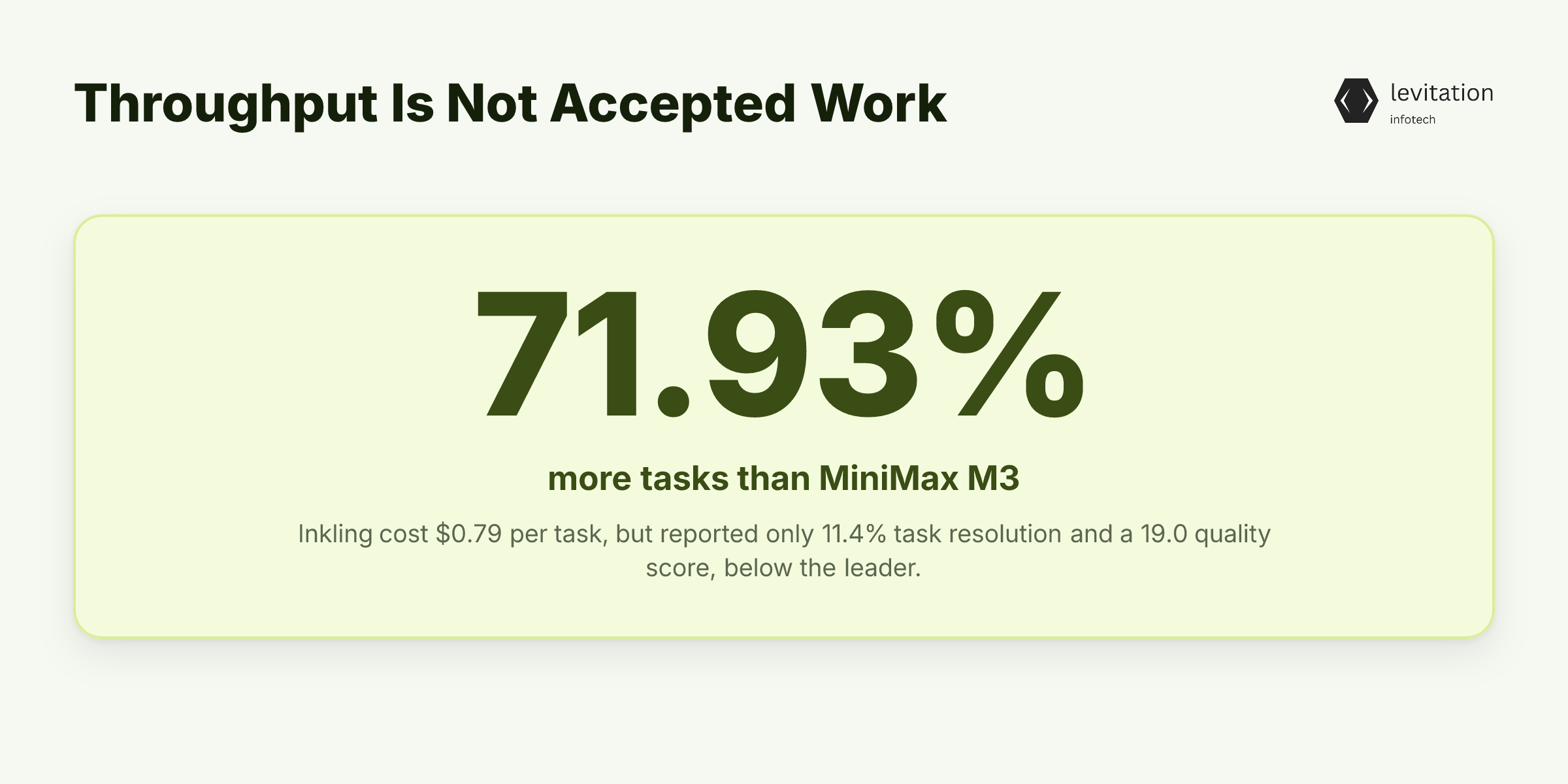
Inkling, a $0.79-per-task agent, completed 71.93% more tasks than MiniMax M3. MiniMax M3 was the second-most-affordable option, yet Inkling still had a lower quality score than the benchmark leader. That result makes "pick the winner" the wrong CTO instinct.
Evidence box - Inkling's reported cost was $0.79 per task, with 11.4% task resolution. - Its reported quality score was 19.0, below the leader but above the third-place model. - MiniMax M3 recorded 39.2 tasks per million dollars. - BenchLM's published cost-adjusted comparison showed Inkling completing 71.93% more tasks than MiniMax M3.
The decisive gap is between task volume and accepted work.
The counterintuitive result
BenchLM.ai's October 2026 cost-adjusted ranking measures task throughput per dollar. It rewards work delivered under the tested economics.
That is useful, but incomplete.
Imagine a refund agent that generates many candidate responses but cannot complete a refund. It has produced activity, not an accepted outcome. Another agent can complete fewer attempts because it resolves the workflow on the first try.
The cheapest stack can therefore deliver more tasks per dollar while still leaving most tasks unresolved. Buying it without a quality floor rewards low price while ignoring failed work. The benchmark still has to be passed.
That leaves one question: how much of the reported work counted as success?
The necessary caveat
Inkling's reported 11.4% task resolution and 19.0 score confirm the tension. It produced more tasks than MiniMax M3, but its reported score was below the leader's.
More completed tasks are not the same as better business outcomes. The result supports using a cheap stack for suitable traffic while retaining a stronger path for difficult work.
This distinction matters across AI agents. A support triage, document classification, and routine data check have different error costs. Their acceptance tests must reflect those differences, which the ranking does not fully capture.
The remaining uncertainty is how hidden workflow costs change the comparison.
The scope box
The title calls these 12 agentic AI stacks. The public ranking describes models. It does not establish that every entry includes production orchestration, tool use, permissions, runtime, or infrastructure.
The evidence supports a model comparison. It does not prove that one complete stack outperformed another complete stack.
So don't attribute tool reliability, orchestration quality, or serving efficiency to BenchLM unless those components were tested.
The better CTO question is: Which stack produces the most independently verified business outcomes per dollar while clearing a defined quality threshold?
The paradox resolves only after separating task quality from task economics. Where, then, does the hidden cost sit inside each agent session?
Why Agent Leaderboards Hide the Cost of Each Task
An agent session is not one request. It is a chain of dependent decisions, tool calls, retries, and checks.
Agent work is not a single request
A refund workflow can inspect policy, read order history, call a payment API, request approval, and retry after a timeout. Each branch changes the work required.
The same initial model price can hide very different economics across these paths. The number of calls varies, with one for a direct answer and many for a multi-tool workflow. Longer context raises inference cost, and failed tool calls can trigger expensive retries.
Branching can duplicate work, while human escalation adds labor after the agent stops. Cache reuse can reduce both latency and inference expense.
Token-price tables usually stop before this execution path. They compare visible input, not the full cost of reaching an accepted result.
What does that hidden path do to the real cost?
Infrastructure performance is not workflow success
Serving measurements from InferenceX describe latency, throughput, cache reuse, concurrency, and cost under agent traffic. They do not establish whether an agent fixed a bug or completed a workflow.
That boundary is healthy. Fast infrastructure can host a broken agent, and slow infrastructure can support a reliable one.
The economics of AI agent inference workloads need serving measurements as cost inputs. They should not replace an outcome test.
This is the same blind spot described in inference cost dashboards that miss burst traffic. A useful dashboard connects workload behavior with what the business actually receives.
Yet another blind spot can distort the ranking before any cost is calculated. What happens when the task itself is invalid?
Invalid tasks can inflate the leaderboard
Task validity and outcome validity have to be checked before scores are compared. The Agentic Benchmark Checklist can serve as an audit reference for those questions.
The problem is simple. A benchmark can reward an agent for exploiting a broken task instead of solving the intended work.
A valid benchmark must confirm two things. The task must represent real work, and the grader must recognize the intended business outcome.
Build three ledgers for every run. - The outcome ledger tracks independently verified success, the acceptance result, and the failure category. - The execution ledger tracks turns, tool calls, retries, latency, cache behavior, concurrency, and escalation. - The economics ledger records model, tool, runtime, review, observability, and allocated operations costs.
The same model can produce different economics across stacks. Routing, tool design, retries, context, and serving topology all change the cost of completion.
Once that hidden work is counted, the denominator changes the ranking. What belongs in that denominator?
Cost per Verified Success Is the Ranking Metric
Cheap tokens do not guarantee cheap workflows. The denominator must be an outcome someone independently accepts.
Start with the decision formula
Total cost per verified success = (model inference + tool and API charges + runtime + retries + human review + observability + allocated operations) / independently verified successful tasks.
Every term needs an owner. Otherwise, the metric becomes another attractive dashboard with hidden gaps.
An unsuccessful task still contributes cost to the numerator. It contributes no verified success to the denominator. This exposes the true economic effect of retries and human intervention.
It also connects model pricing to AI agent economics. The model is one component of a workflow, not the workflow itself.
That makes the source metric useful, but not sufficient. What does the source metric leave out?
Read the source metric carefully
MiniMax M3's 39.2 tasks per million dollars is a benchmark-native throughput measure. Inkling's published 71.93% advantage compares completed tasks under the source's cost-adjusted calculation.
Neither figure is a complete enterprise TCO calculation. Human intervention, operations, observability, and external tool charges may not be included.
Use BenchLM's published 71.93% for the headline instead of claiming readers can reproduce it exactly from the excerpted figures.
Never convert 71.93% into an increase of 71.93 percentage points in task success. It describes a relative cost-adjusted comparison, not that larger change.
How should the cost comparison stay tied to quality?
Keep cost and quality on separate axes
The ranking has two distinct dimensions. The economics axis shows Inkling as cheaper, with 71.93% more completed tasks than MiniMax M3. The quality axis shows Inkling at 11.4% task resolution and a 19.0 score.
Its score trails the leader but exceeds the third-place model. Cost per verified success must live inside a quality guardrail. A cheap route that fails too often will trigger retries, escalations, and lost work.
This matters for benchmarks that miss real-world vector database costs. A narrow test can look efficient while missing costs that appear outside the model boundary.
The portfolio implication is practical. A cheap stack suits bounded, high-volume tasks. A stronger stack handles ambiguous or high-consequence work.
The benchmark can inform routing decisions, not a universal single-model mandate.
That boundary can only be set from workload-specific evidence.
Build an Agentic Benchmark Your CTO Can Audit
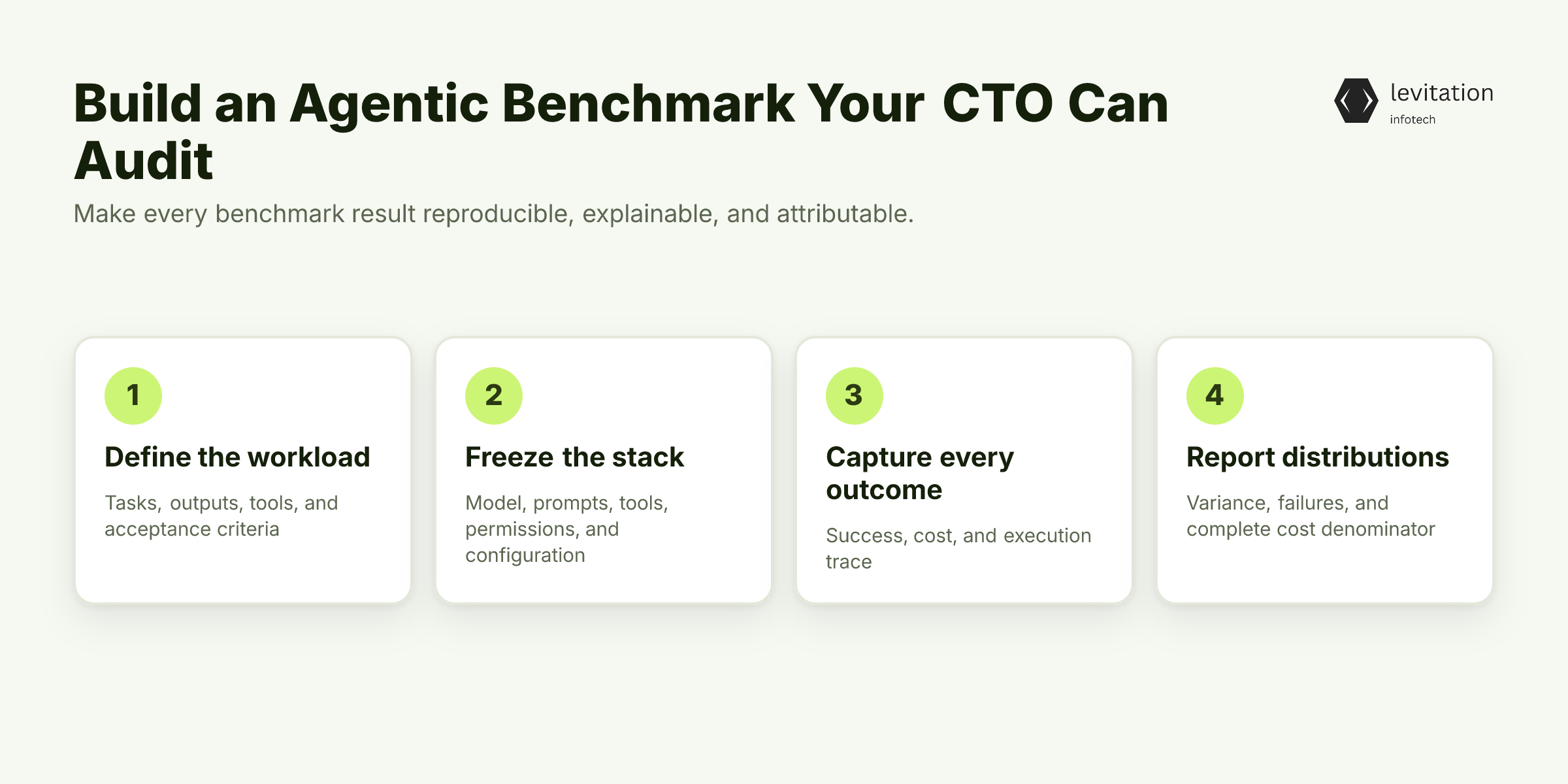
A score without an acceptance test is an opinion. The harness must make every result explainable.
Define the workload first
Select representative tasks with explicit inputs, expected outputs, permitted tools, failure conditions, and business acceptance criteria.
An invoice agent succeeds only if it records the approved adjustment. A polished explanation alone is not an accepted workflow outcome.
Keep task validity separate from agent capability. A domain owner should approve the oracle that decides success. The model team should not also define its own exam.
Every acceptance test needs a fixed stack before its results can be compared. What exactly must be frozen?
Freeze the stack
Record the model version, system prompts, tool schemas, permissions, context policy, serving configuration, cache state, and retry logic.
Otherwise, a result cannot be reproduced. It also cannot be attributed to a specific architectural change.
This protects against false attribution. If a run improves, the team must know its cause. Was it the model, routing, context, tools, retries, or serving?
A frozen stack still needs a complete record of each outcome. Which fields belong in that record?
Capture three outcomes for every run
Capture verified success, total cost, and the execution trace.
The trace should include latency, turns, tool calls, retries, cache reuse, concurrency, human escalation, and failure category.
A final answer without its execution path cannot explain why the run was cheap or reliable. It also cannot reveal which optimization produced the gain.
Those fields become useful only when compared across repeated runs. What does repetition reveal?
Report distributions, not a single score
Repeat each candidate on the same tasks. Expose variance, failure concentration, and the complete cost denominator.
A single average can hide a stack that succeeds mostly on easy work. It can also hide expensive tail failures on difficult tasks.
Disclose missing configurations. Do not extrapolate results for entries you could not reproduce.
The benchmark can then be expressed as an auditable algorithm.
- Run every candidate stack against every task.
- Apply the business oracle to each result.
- Add cost, latency, trace, and success to the ledgers.
- Rank qualifying stacks by verified successes divided by total cost.
Use the Agentic Benchmark Checklist as a pre-release audit for task validity, outcome validity, reproducibility, and implementation fidelity.
Also check for invalid shortcuts, overly easy task distributions, and graders that reward plausible text instead of completed work. This problem appears in LLM evaluations that approve failing models.
With an auditable baseline, the next gain comes from changing the stack, not merely swapping models. Which part of the stack should change first?
Optimize the Stack Before You Replace the Model
Model replacement gets attention. It is rarely the cheapest first move.
Route by workload, not brand
Send bounded, repeatable tasks to the cost-efficient stack. Escalate uncertain or high-impact tasks to the quality leader. Require an independent success check before accepting the cheaper route.
A routing policy must include its fallback conditions. "Use the cheap model" is not a policy. "Use it for validated requests under defined conditions" is.
Routing sets the path, but the path itself still needs tuning. Which levers reduce its cost?
Measure agent-specific cost levers
Measure several agent-specific cost levers. These include trimming context that does not affect the decision, constraining tool loops, and caching reusable prefixes. Also evaluate capping retries and tuning concurrency under dependent multi-turn traffic.
Verify every optimization against both cost per verified success and completion quality. A cheaper run that creates more downstream work is not cheaper.
Once the levers are measured, the team needs a budget that governs the whole run. How should that budget be set?
Establish FinOps for AI
Assign a maximum total cost per workflow. Alert when retries or tool calls push a run over budget. Attribute spend by model, tool, runtime, and escalation category.
This is where FinOps tools that count VMs instead of AI workloads miss the real cost object. The unit of management should be the accepted workflow.
The governing budget belongs to AI agent TCO and FinOps for AI, not to a cloud resource.
That budget becomes the baseline for a fair bake-off. Which configurations should compete?
Run a three-way bake-off
A three-way bake-off compares several distinct configurations. It evaluates the cheapest viable candidate, the highest-quality candidate, and a routed hybrid.
Run all three on the same tasks with the same oracle. Select using a quality floor first and verified cost per success second.
The fallback policy can make a low-cost model the default while escalation protects difficult cases. Record fallback frequency, because a cheap headline price can conceal a costly escalation bill.
The practical result is a governed portfolio: cheap by default and stronger where failure is expensive. How should that portfolio appear in the procurement contract?
Make Cost per Outcome the AI Procurement Contract
The benchmark should change the contract, not merely produce a presentation slide.
Turn the benchmark into a procurement sequence
The procurement sequence consists of four distinct steps.
- Shortlist stacks by verified quality.
- Run a workload-specific bake-off.
- Contract on cost per accepted outcome.
- Reassess routing as prices and agent capabilities change.
Define which costs the contract includes. Specify the acceptance test, escalation treatment, and repricing trigger.
This changes the operating conversation from cheaper tokens to lower total cost per reliable workflow. It also makes retry and tool spend visible. It reduces dependence on one model vendor without pretending every workload has one ideal model.
Treat the 71.93% result as a hypothesis. It does not guarantee that Inkling will win in your environment.
For production AI agents, public rankings should shape questions, not replace local evidence.
Vendor claims about deployments, retention, or implementation speed are not benchmark proof. They describe vendor experience, not measured performance on your workload. The ranking must still be reproduced on your workload.
The remaining procurement question is simple: how should the contract express cost and quality together?
Frequently Asked Questions
What does the 71.93% more tasks result actually mean?
In BenchLM.ai's October 2026 cost-adjusted result, Inkling completed 71.93% more tasks than MiniMax M3, the second-most-affordable entry. It is a benchmark-relative measure of completed task volume under the tested economics, not a promise of a 71.93% higher success rate in production.
Did the cheapest agentic AI stack also have the highest quality?
No, Inkling was cited at $0.79 per task, with 11.4% task resolution and a 19.0 score. Its score was below the top-performing model but above the third-place model. Use a cheap stack for suitable traffic, retain a stronger path for difficult work, and reproduce both against your own acceptance tests.
The harder procurement question is which costs the vendor must own when a disputed task reaches the contract.
About the author
Mayank Singh is a software developer at Levitation Infotech, where he builds web and AI-powered applications across the company’s fintech, healthcare, and enterprise projects.