


TL;DR: Traditional FinOps dashboards were built for deterministic VM and storage costs. AI workloads break that model. Costs vary per request. The people triggering spend are no longer just engineers. The meaningful unit of cost is the business outcome, not the token. The fix is use case economics: tag by feature, instrument at the application layer, and surface cost-per-outcome where decisions get made.
Key Takeaways: - AI spend is now mainstream. FinOps teams are increasingly expected to manage it. But tooling still optimizes for VMs at 5% CPU, not probabilistic inference. - The same prompt can produce different costs on different runs, so unit cost alone won't drive decisions. - Use case economics (cost per resolution, per summary, per review) is the only metric that connects AI spend to business value. - Instrumentation must happen at the application layer, not the resource layer, because AI spend does not respect traditional tags. - Non-technical builders are now triggering production AI spend, so cost visibility has to move into their tools, not your dashboard.
Your FinOps Dashboard Is Winning the Wrong War
Your FinOps dashboard celebrated cloud waste reductions last quarter. Meanwhile, your AI bill grew beyond anyone's forecasts, and nobody can explain which feature is responsible. You're not bad at FinOps. Your tools are measuring the wrong thing.
The FinOps Foundation's reporting makes the shift explicit. AI is now a primary spend category. FinOps teams are increasingly expected to manage it alongside their traditional cloud cost work. That is not a gradual drift. It is a phase change.
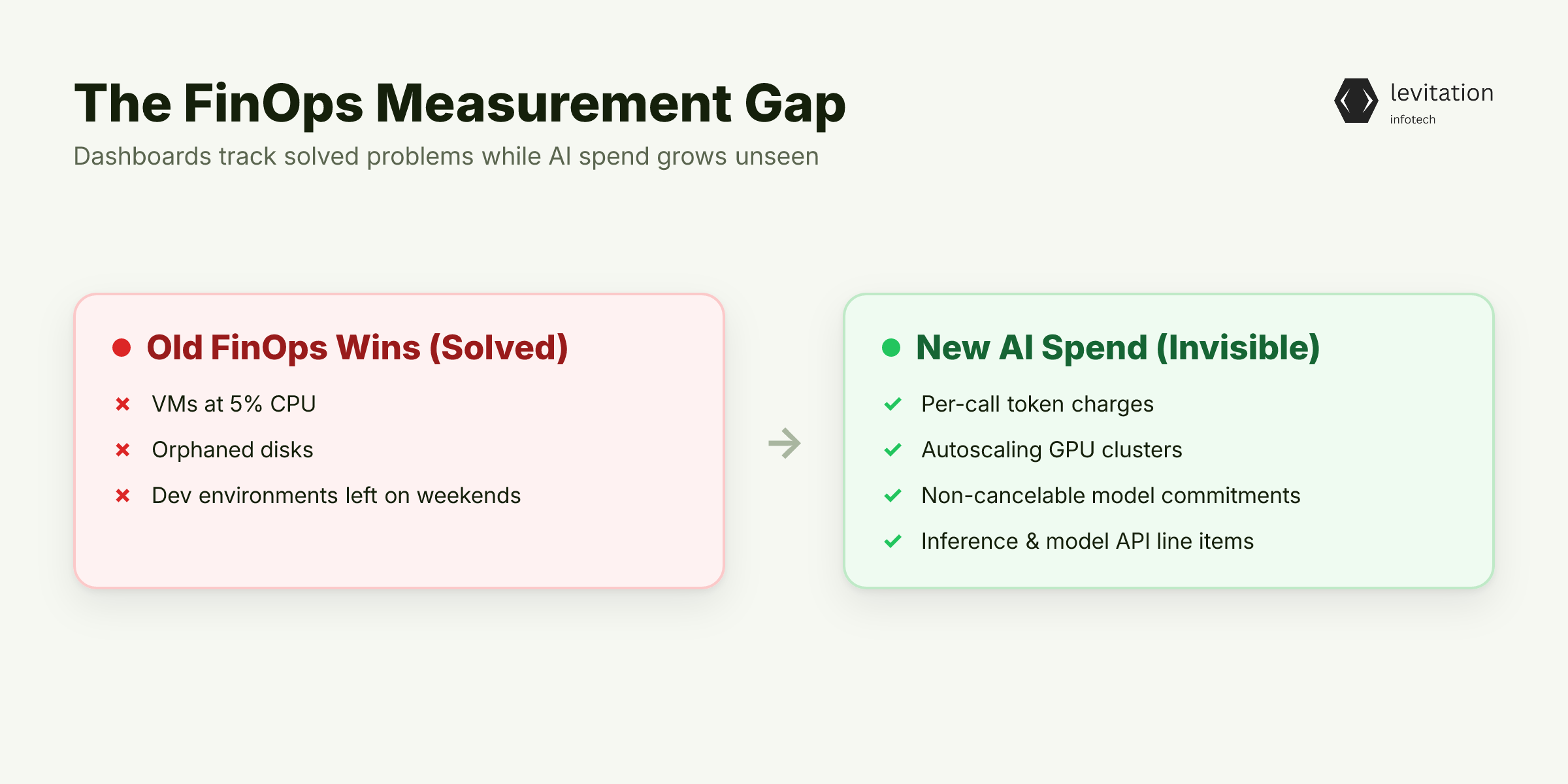
The traditional wins are exhausted: - VMs running at 5% CPU - Orphaned disks - Dev environments left on over weekends
Those are solved problems. The FinOps for AI framework exists because the new spend looks nothing like the old spend. AI inference, model APIs, and GPU commitments do not show up as neatly tagged line items. They show up as per-call token charges, autoscaling GPU clusters, and commitments you cannot easily cancel.
Most teams are still reporting on the old shape of the bill. Their dashboards are accurate about the part of cloud that no longer grows. The part that does grow is invisible to them.
But the problem isn't just visibility. The unit of cost itself behaves differently, and your tools haven't caught up.
AI Costs Are Probabilistic, Not Deterministic
VM cost is deterministic. A running instance costs X per hour, predictably, every hour, regardless of what you do with it. FinOps tooling was built around that contract. Tag the instance, allocate the hour, report the cost.
AI cost is probabilistic. The same prompt can produce different costs on different runs. Output length varies. Retry logic triggers when the model returns a malformed response. Model selection shifts between dev and prod. The temperature setting alone can swing token consumption.
Forecasting GPU commitments adds another layer. You can buy a one-year reservation for an H100 cluster, but the workload patterns that justify it are themselves uncertain. You are hedging a probabilistic cost with a deterministic contract. The mismatch surfaces as either overcommitment or capacity panic.
Then there is the FinOps personas for AI problem. The barrier to becoming an "AI Developer" is now low enough that product managers, analysts, and marketers are triggering production AI spend. They use no-code tools, embedded copilots, and SaaS AI features. They have never seen a resource tag, and they will not start now.
The math is unforgiving. Lean, centralized FinOps teams cannot scale one-on-one support to an expanding population of new spenders. The old model, a FinOps engineer onboarding each new spender, does not survive the new headcount.
If the unit of cost is unpredictable, and the people triggering it aren't technical, what's the right unit to measure AI spend against?
The Real Unit of Measure Is Use Case Economics
The FinOps Foundation's most important concept for AI is use case economics. It measures the total cost of achieving a specific business outcome, per unit of that outcome.
This is not an abstract idea. It is a concrete shift in what you measure: - Cost per customer query resolved - Cost per document summarized - Cost per code review completed - Cost per sales call analyzed
These numbers connect AI spend to business value in a way that raw token counts never can. An inference bill is meaningless on its own. A cost-per-resolution on a support use case that sits well below the value of each ticket resolved is a clear investment decision.
The same use case at a cost-per-resolution that approaches or exceeds that value becomes a redesign conversation.
The framework survives the probabilistic cost problem because it normalizes across run-to-run variance. You stop caring that one prompt cost more than another. You care that across many resolutions, the average cost stays within profitable bounds. The outcome rate must be high enough to justify the spend. Variance becomes a confidence interval around the mean, not a forecasting failure.
This is also where undifferentiated engineering tax surfaces. Every hour your AI team spends on infrastructure plumbing is an hour not spent on product capabilities that differentiate your business. That cost belongs in the denominator too, even if it is hard to quantify precisely. Teams that ignore it end up with use cases that look cheap on tokens but expensive in reality.
The framework is elegant. The instrumentation is where most teams stall.
How to Instrument Cost-Per-Outcome Tracking
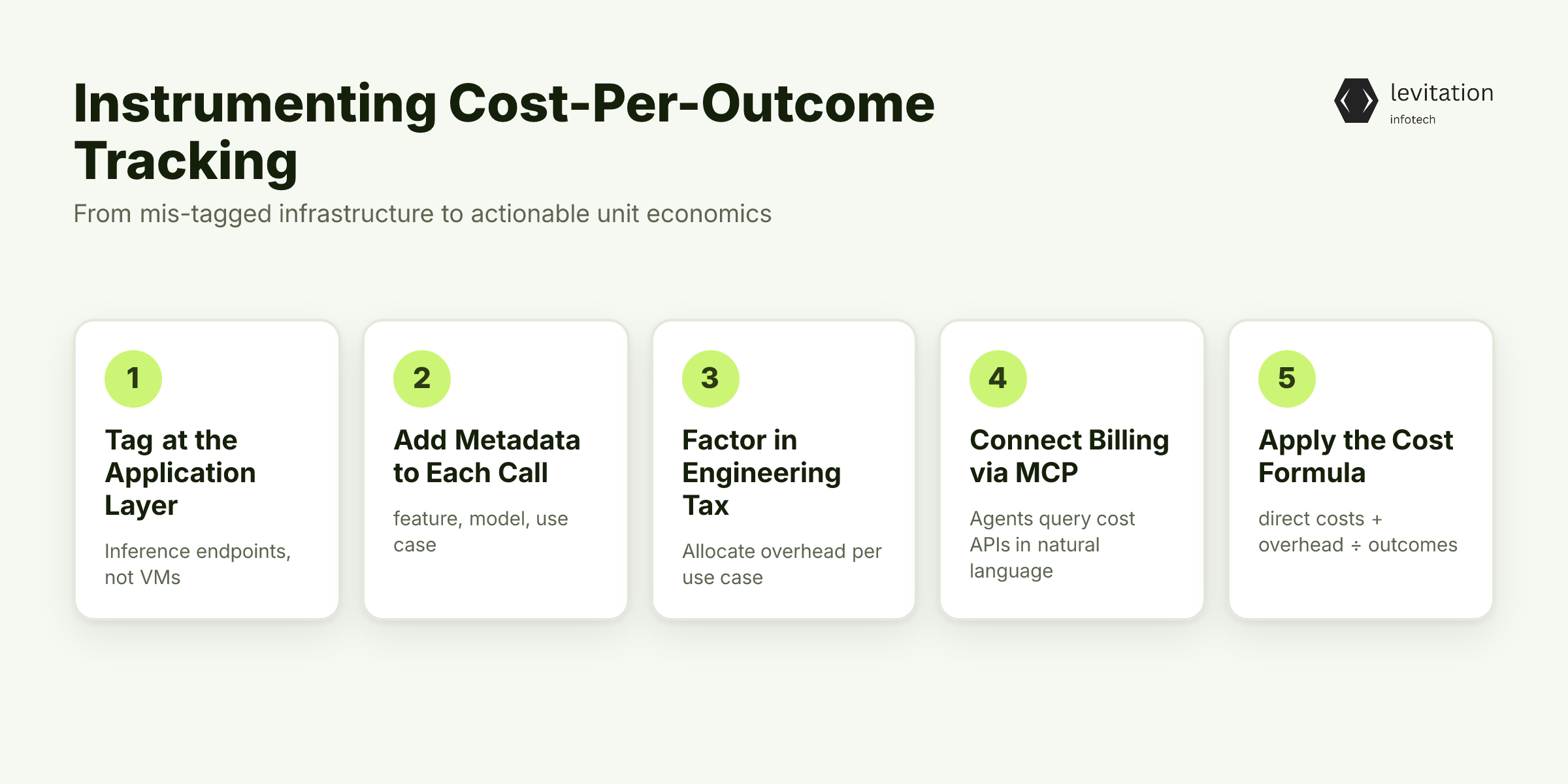
The first mistake teams make is trying to tag by infrastructure. Your AI spend does not map to VMs. A single inference endpoint serves multiple features with very different cost profiles. Traditional resource tags cannot see that boundary.
What works is tagging at the application layer. Every inference call needs metadata: which feature it served, which model it used, which use case it belongs to. The tag lives in the request envelope, not the infrastructure manifest. From there, aggregating cost is arithmetic. Sum the token charges for requests tagged "feature X." Divide by the number of successful outcomes.
The next move is factoring in the engineering tax. If engineering hours go into infrastructure plumbing for one use case, that overhead belongs in its cost-per-outcome figure.
The CFO's blind spot on GPU autoscaling is the same problem at a different altitude. The cost is real, but it does not show up on the line item your finance team reviews.
A practical step many teams miss: use the Model Context Protocol to let AI agents connect to your billing APIs, cost management tools, and FinOps data sources. This turns natural language questions ("what did our summarization feature cost last week?") into real-time cost analysis without custom integration. The plumbing that took weeks to build becomes a conversation.
The formula that ties it together is straightforward. Take direct costs (tokens, GPU-hours, API calls) plus allocated engineering overhead. Divide by the number of business outcomes delivered. That is your cost-per-outcome for the use case. Track it weekly. Compare across features. Act on it.
Even with the right metrics and the right plumbing, one group will silently break your forecasts.
The Non-Technical Spender Is Your Blind Spot
Non-technical builders do not think in tags, resources, or VMs. They think in outcomes and shipping features. A product manager wiring up an AI summarization button has no idea. They just added a line item to your GPU bill. They have never opened a cloud console. They will not start.
This group will trigger AI spend through: - No-code AI tools that bypass your infrastructure entirely - Embedded copilots in SaaS products - API keys provisioned through personal accounts
Centralized FinOps teams cannot onboard every new "AI Developer" individually. The answer is self-service cost visibility at the point of decision. Surface cost-per-outcome inside the tools these users already work in. That means the product analytics dashboard, the experimentation platform, the CRM. Not a FinOps report they will never open.
Teams that get this right stop chasing spend after the fact. Teams that get it wrong spend quarters writing policies nobody reads. A product manager who sees cost per outcome will decide differently than one who finds out at the next board meeting.
So what actually changes when you get this right?
From Cost Cutting to Value Optimization
The boardroom conversation shifts. Instead of "how do we cut the AI bill?" you get "which AI use cases earn their place in the portfolio?" That is a different meeting, with different attendees, and different outcomes.
You can defend or kill specific features with data, not vibes. A use case with a cost-per-outcome well below its business value stays. One that costs more than the value it delivers gets redesigned or retired.
The conversation stops being about cloud cost and starts being about product investment. FinOps for AI tools and services become a portfolio management discipline, not a procurement problem.
Forecasting becomes range-based, not point-based. You model cost-per-outcome variance instead of pretending GPU hours are predictable. Finance teams can plan against confidence intervals. Engineering teams can identify which use cases have variance worth investigating.
The undifferentiated engineering tax becomes visible. Use cases that look cheap on tokens but expensive in total ownership get flagged early. Teams stop building infrastructure for features that do not earn their keep.
The FinOps for AI approach is how AI spend earns its place next to every other line item on the P&L.
The end state is a FinOps practice that answers the only question that matters. Is this AI spend producing more value than it costs?
Frequently Asked Questions
What is FinOps for AI?
FinOps for AI is the practice of managing AI-specific cloud and API spend through use case economics. That means measuring cost per business outcome, not the deterministic resource accounting that traditional FinOps applies to VMs and storage. It accounts for the probabilistic nature of AI costs and the non-technical personas now triggering them.
How is AI cost monitoring different from cloud cost monitoring?
Cloud cost monitoring tracks deterministic resource usage: VM hours, storage GB, data transfer. AI cost monitoring must track variable token consumption, model selection, retry patterns, and engineering overhead. Then it must attribute those costs to specific business outcomes. The same prompt can produce different costs on different runs, which breaks traditional forecasting.
What is use case economics in FinOps?
Use case economics is the FinOps Foundation's framework. It measures the total cost of achieving a specific business outcome with AI, like cost per customer query resolved or cost per document summarized. It connects AI spend to business value in a way that raw token counts or GPU-hours cannot.
Why do traditional FinOps tools fail for AI workloads?
Traditional FinOps tools were built for VM-centric tagging and resource accounting. AI spend does not map cleanly to VMs. It is triggered by non-technical users through SaaS copilots and APIs, and it varies probabilistically per request. The dashboards optimize for the wrong unit of measure.
How do you track cost per inference?
Instrument at the application layer. Tag every inference call with metadata about the feature, model, and use case it served. Aggregate direct costs (tokens, GPU-hours, API charges) plus allocated engineering overhead. Divide by the number of business outcomes delivered. That gives you a cost-per-outcome figure that survives variance.
Teams wrestling with this often move faster with a partner who has shipped production AI systems.
About the author
Mayank Singh is a software developer at Levitation Infotech, where he builds web and AI-powered applications across the company’s fintech, healthcare, and enterprise projects.