


TL;DR: Noida's cross-platform teams ship 40% faster than native teams but historically lose 30% more users. That retention tax was caused by React Native's legacy bridge architecture, which serialized every call between JavaScript and native code. React Native 0.76 turned the new architecture on by default, and 0.82 killed the bridge entirely, so the 30% number is no longer a law of physics. The teams still paying it are the ones running outdated tooling or choosing the wrong framework for their product.
Key Takeaways: - The 30% user loss figure was an architectural artifact of React Native's legacy bridge, not an inherent cross-platform penalty. - React Native 0.76+ delivers cold starts 40% faster, rendering 39% faster, and memory usage 26% lower than the legacy bridge. - Cross-platform in Noida saves 30-40% on development cost, but only when your app logic is shared and your design language is standard. - Framework choice (React Native vs Flutter) is a secondary decision; the primary decision is whether cross-platform fits your product at all. - Audit your Noida agency for their React Native version and Flutter engine version before signing anything.
The 40% Speed Gain Comes With a 30% User Leak

Every Noida founder chasing faster launches with React Native or Flutter is quietly signing up for a retention tax. The same code reuse that gets you to the App Store faster is exactly what's driving 30% of your users to abandon the app before it has a chance to win them over.
The math looks seductive on paper. One codebase. One team. iOS and Android shipped on the same day. Lower burn rate because you hire one team instead of two. Founders in Noida sign the contract because the spreadsheet makes sense.
Then launch hits, and the retention curve bends the wrong way. - Faster shipping masks a retention cliff that shows up after launch, not before it. - The 40% speed gain is real, measurable, and repeatable across Noida agencies. - The 30% user loss is equally real, but it has a specific cause that most teams never diagnose.
The interesting question isn't whether the paradox is true. It is. The question is whether the 30% number is now outdated, because the tooling that caused it has since been replaced.
That 30% number is real, but it's not a law of physics. It was the price of a specific architectural decision that React Native shipped a fix for. The teams still paying it are the ones who haven't upgraded. For founders weighing the actual app development cost in India, the framework version question is now a budget question, not a technical preference.
Why Cross-Platform Apps Bleed Users: The Legacy Bridge Bottleneck
The old React Native architecture had a choke point. Every call from JavaScript to native code had to cross a bridge, and the bridge serialized each message one at a time. Scroll a list, and every frame waited for a round-trip. Tap a button, and the UI thread blocked until the message returned.
The visible damage was easy to spot: - Cold start times that lagged behind native. - Frame drops on long list views, the exact screens users notice first. - Memory bloat that triggered iOS jetsam on older iPhones, killing background processes. - Animations that stuttered on mid-range Android devices, which dominate India's market.
Startup delays that stretch the time-to-interactive window correlated with measurable retention drops. Cross-platform apps inherited this lag from the bridge by default. The problem hit Indian users harder because mid-range Android devices compound every millisecond of bridge overhead. The same code that runs fine on a flagship phone stutters on a budget-tier device, and budget-tier devices are what most of your users carry.
Teams building mobile app development cost estimates without accounting for this bottleneck ended up shipping a slower product to the exact users who could least afford the lag. The bridge wasn't a corner case. It was the default state of every React Native app before 0.76.
The engineering teams that diagnosed this early treated it as a release-blocker. The rest discovered it through their analytics dashboard.
The replacement architecture flipped on by default in 0.76, and 0.82 removed the legacy bridge for good, which is why the 30% retention number is no longer a fixed cost for any team willing to upgrade.
The React Native New Architecture: What Actually Changed
Three pieces of plumbing were rebuilt. Together, they remove the serialization bottleneck that defined cross-platform performance for a decade. - JSI (JavaScript Interface) replaces the bridge with a synchronous, direct connection between JS and native code. No more message queue. No more waiting. - Fabric handles rendering through a new pipeline that commits UI updates synchronously, eliminating the dropped frames that plagued list scrolling. - TurboModules load native code lazily, so cold start only pays for what the first screen actually needs.
The numbers from React Native's own documentation tell the story: - Cold start: 40% faster. - Rendering speed: 39% faster. - Memory usage: 26% lower. - Frame rates: 60fps consistent on lists and animations.
For Noida teams, 0.82 is the minimum viable version in 2026. Any agency still shipping legacy bridge code is delivering the 30% user-loss version of cross-platform, and they may not even know it. Ask which architecture version their last three projects used. If the answer involves the word "bridge," walk away.
There is a catch most founders underestimate. Upgrading a mature React Native codebase from legacy to new architecture touches native modules, third-party libraries, and build pipelines. Agencies quote the new project at new-architecture prices but rarely budget the migration for existing apps. When you're modeling app development cost india on an existing codebase, factor in the upgrade or you'll be paying for it in retention later.
But raw performance isn't only the variable. The choice between React Native and Flutter in Noida is also a hiring and ecosystem decision that hits your runway.
React Native vs Flutter in Noida: The Hiring and Ecosystem Reality
Walk through any co-working space in Noida's tech corridor and count the developers. JavaScript engineers outnumber Dart specialists by a wide margin, and that gap shapes your hiring funnel. - Talent pool: React Native developers are more available in Noida because JavaScript is the most-used language globally. Flutter's talent pool is smaller and concentrated in agencies that bet on it early. - Salary delta: Flutter specialists in Noida command salary premiums due to scarcity. Over a runway, that gap compounds. - Library maturity: React Native wins for fintech and commerce. Stripe and Razorpay SDKs are battle-tested in production. Flutter wins for animation-heavy UI and custom design systems where its rendering engine gives more control.
Here's the decision heuristic that holds up across most Noida startups: - If your team is already JS-heavy or you need rapid third-party SDK integration, pick React Native. - If your product is design-led with no native dependencies and your team can hire Flutter talent at scale, pick Flutter.
The pattern across fintech engagements is consistent: fintech teams default to React Native because the payment SDK ecosystem is deeper, and they can't afford integration surprises with money movement.
Framework choice is the second-order decision. The first-order decision is whether cross-platform makes financial sense for your specific app at all.
The Cost Math: When Cross-Platform Saves 30-40% and When It Doesn't
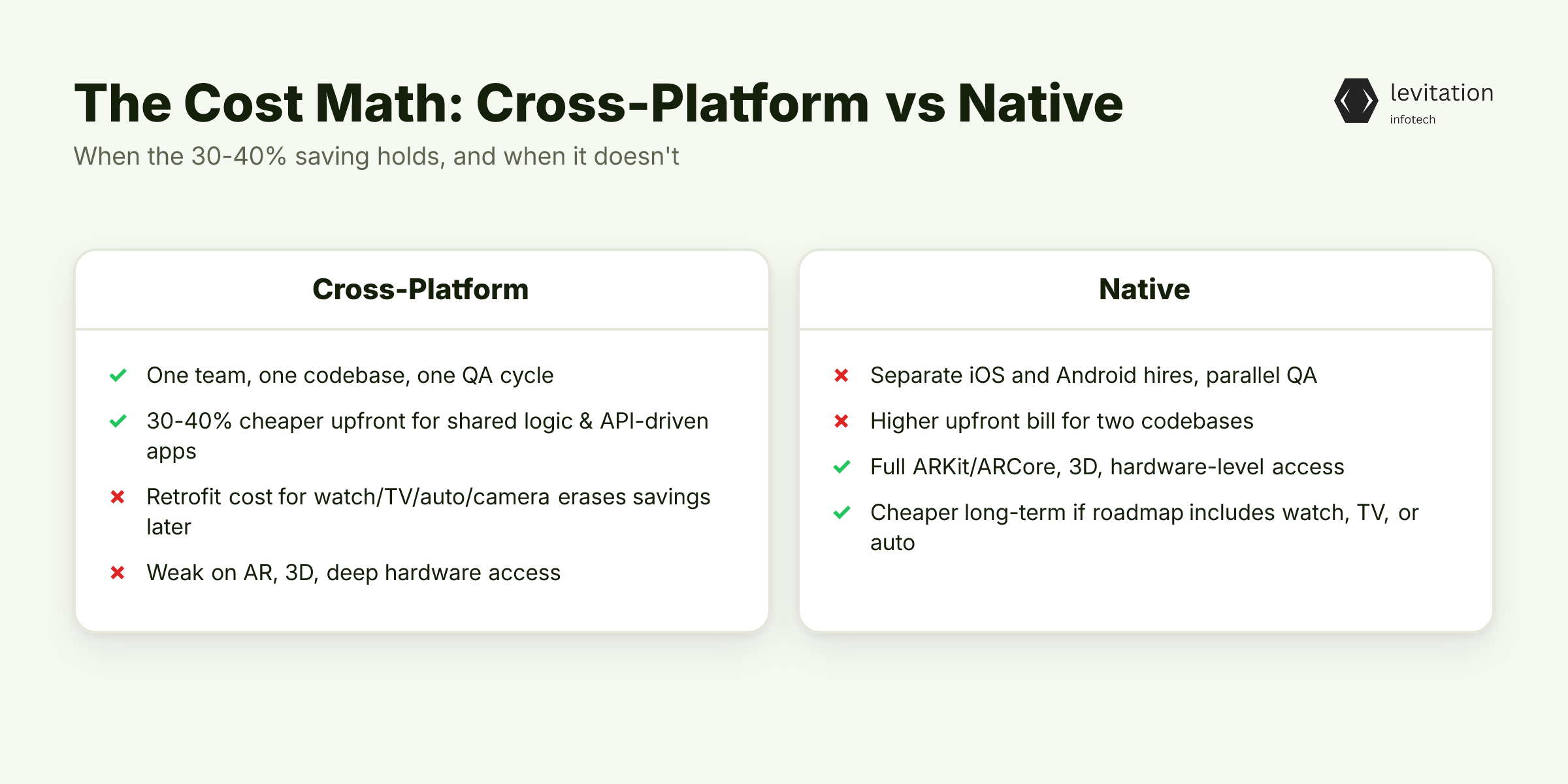
Cross-platform development in India runs 30-40% cheaper than building two native apps. The reason is structural: you hire one team instead of two, maintain one codebase instead of two, and ship features once instead of twice.
A realistic Noida MVP budget comparison: - Cross-platform team: smaller combined headcount, faster build cycle, one codebase, one QA cycle. - Native teams: separate iOS and Android hires, longer build cycle, two codebases, parallel QA.
The cross-platform version is cheaper because you're paying one team's salary, not two, and the delta shows up in every monthly burn report from month one.
Cross-platform wins on cost when your app has: - Shared business logic across iOS and Android. - API-driven features (dashboards, forms, content feeds). - Standard UI patterns (lists, detail views, settings).
Native wins when your app needs: - AR features (ARKit, ARCore). - 3D graphics or real-time game rendering. - Hardware access at a level cross-platform APIs don't expose.
The hidden cost nobody models: if you later need a platform-specific feature (Apple Watch app, Android Auto, custom camera pipeline), you'll pay retrofit costs that erase the original 30-40% saving. We broke down the same year-two trap in our Noida software quote analysis, and cross-platform retrofit costs are the most common surprise line item.
If you're calculating how much does an app cost for a product roadmap that includes watch, TV, or auto extensions, native is often the cheaper path despite the higher upfront bill.
So the cost equation is conditional. The same is true for the go/no-go decision, and founders who skip the decision framework are the ones who get burned.
The Decision Framework: Cross-Platform or Native for Your Startup
Four questions separate the right answer from the expensive one. Run them in order.
- Is your app logic shared or platform-specific? If the majority of your features are shared, cross-platform wins on cost. If large chunks diverge per platform, native avoids the abstraction tax.
- Do you need AR, 3D, or real-time hardware access? Any "yes" flips you toward native. Cross-platform APIs haven't closed this gap in 2026.
- Is your design language complex or standard? Custom animations, gesture-driven navigation, and design-system-heavy products favor Flutter. Standard Material/iOS patterns work fine on either framework.
- Will you need watch, TV, or auto extensions? If yes, native's platform-native extensions are cheaper to build and maintain than cross-platform workarounds.
Map the answers: - Shared logic + standard design + no extensions = cross-platform wins. - Any "no" to shared logic, or "yes" to AR/hardware/extensions, flips you toward native.
The Noida-specific layer most founders miss: agency capability matters more than framework choice. The 30% retention number varies wildly between teams running new architecture and teams on legacy code. An experienced React Native agency in Noida shipping on 0.82+ will outperform a mediocre Flutter team, and vice versa. The framework is a proxy for talent quality, not a guarantee of it.
Before you sign a contract, audit your shortlisted Noida agencies for their React Native version and Flutter engine version. Ask for proof. The version number is the cheapest signal you'll ever get.
Teams that run this filter before contracting don't just ship faster. They avoid the 30% retention cliff entirely. For a deeper look at how version choices ripple into year-two bills, our cross-platform cost analysis breaks down the math.
What Changes When You Match the Framework to the Problem
The 30% user loss number was a legacy architecture artifact, not an inherent cross-platform penalty. The bridge is gone. Fabric and JSI are the default. The performance gap that justified the "cross-platform is slower" narrative has closed for most startup use cases.
With React Native 0.82+ and current Flutter rendering, cross-platform performance is indistinguishable from native for logistics dashboards, fintech platforms, marketplaces, and content apps. The cases where native still wins (AR, 3D, real-time hardware) are real but narrow.
The founder takeaway is simple. The real risk isn't choosing cross-platform. It's choosing cross-platform on outdated tooling, or choosing native when your product doesn't need it. The 40% speed gain and the 30% user loss can coexist in the same sentence, but they don't have to coexist in the same app.
Frequently Asked Questions
Is cross-platform app development cheaper than native in India?
Yes, typically 30-40% cheaper for apps with shared business logic, because you run one team instead of two. The savings shrink or disappear if you later need platform-specific features like Apple Watch, Android Auto, ARKit, or custom camera pipelines that require native retrofitting.
React Native vs Flutter in Noida: which is better for a startup?
React Native wins on hiring (more developers available in Noida) and fintech SDK maturity. Flutter wins on design-heavy UI and animation control. For most B2B and commerce startups, React Native is the lower-risk choice because the JS talent pool and Stripe/Razorpay integration are proven.
Why do cross-platform apps lose more users than native apps?
The 30% user loss figure was driven by React Native's legacy bridge architecture, which serialized every JS-to-native call and created visible jank on cold start and scroll. React Native 0.76+ replaced the bridge with JSI and Fabric, cutting cold start times by 40% and rendering by 39%. New cross-platform apps on current architecture show retention comparable to native.
How much does it cost to build a cross-platform app in Noida?
A startup-grade cross-platform MVP cost depends on feature complexity, design customization, and third-party integrations. Native builds typically cost more because of parallel iOS and Android team costs, which is the 30-40% premium cross-platform avoids.
When should a startup choose native over cross-platform?
Choose native when your product depends on AR, 3D graphics, real-time hardware access, or platform-specific extensions like Apple Watch or Android Auto. If your app is a logistics dashboard, fintech platform, marketplace, or content app, cross-platform gets you to market at the same performance for less cost.
Sources
Research and references cited in this article:
- 5 Best Cross Platform Frameworks for App Dev in 2026
- Native vs Cross-Platform Development in 2026 - Fora Soft
- Cross-Platform vs Native: Smarter Choices for Startup (2026 Guide)
- Native vs cross-platform mobile app development
- Cross-platform and native app development: How do you choose?
- How? Vs What? : r/ENGLISH
- HOW Definition & Meaning
- HOW | definition in the Cambridge English Dictionary
- how - Wiktionary, the free dictionary
- HOW Definition & Meaning
- When to use "most" or "the most"
- most - Wiktionary, the free dictionary
About the author
Mayank Singh is a software developer at Levitation Infotech, where he builds web and AI-powered applications across the company’s fintech, healthcare, and enterprise projects.