


TL;DR: We reviewed 28 fixed-price and hybrid quotes from Noida-based software firms for a mid-complexity web product. Initial totals clustered across a wide band, but realistic 12-month cost-of-ownership projections landed 30-50% higher. The same hidden costs surfaced in nearly every quote, buried in appendices or "out-of-scope" clauses. Here is where the markup lives, and how to read a quote like a forensic accountant before you sign.
Key Takeaways: - Fixed-price contracts price in a buffer. Vendors recover it through change-request fees once you are locked in. - Cloud, licences, security audits, maintenance, change requests, and SLA tiers are the six costs almost never in the base quote. - The cheapest quote rarely survives a 7-point vendor vetting checklist. The survivors look nothing like your original shortlist.
You compared 28 quotes from Noida software firms, picked the lowest one, and signed. Months later, your CFO is asking why the same project quietly cost much more than the headline number. After reviewing 28 quotes line by line, here is where the 30-50% markup lives. That is also why almost every software company in Noida is betting you won't catch it before signing.
The Quote That Doubled: What 28 Noida Software Proposals Actually Showed
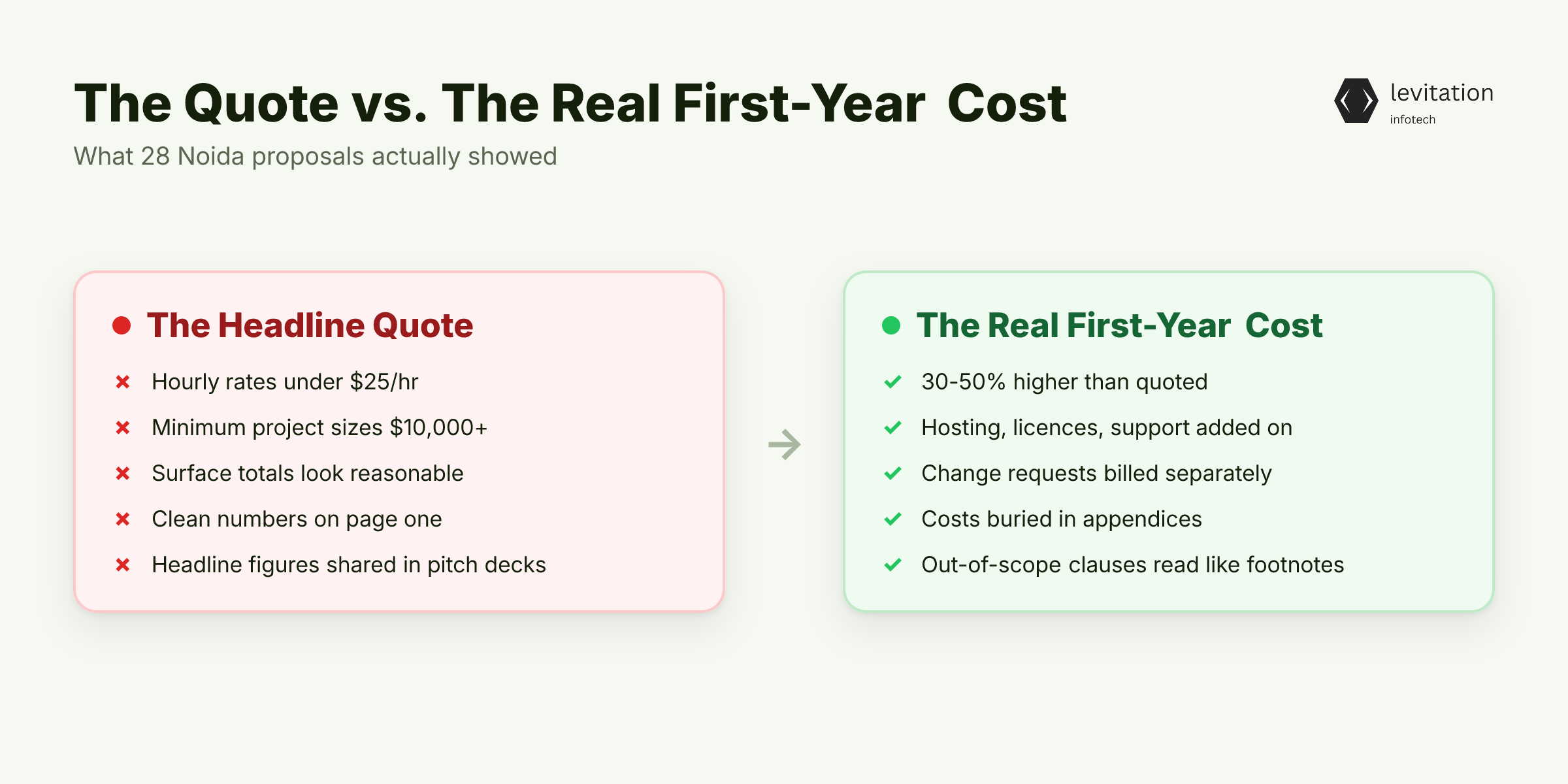
We pulled 28 fixed-price and hybrid quotes from Noida-based firms for a comparable mid-complexity web product. The surface numbers told one story. The line items told another.
Initial quoted totals clustered across a band that looks reasonable for a mid-scale build. But when we reconstructed a realistic first-year cost-of-ownership, including hosting, licences, support, and one round of change requests, the same projects landed 30-50% higher. The pattern was consistent across the entire sample.
The bait was uniform too. One firm in our sample, ScalaCode, listed hourly rates below $25/hr and minimum project sizes of $10,000+. These are the kinds of headline numbers founders share in pitch decks and Slack groups.
They are also the least important numbers in the entire proposal. The trap lives in the small print. The same hidden costs surfaced across the sample, sitting in appendices, in "client-provided" assumption lines, and in "out-of-scope" clauses that read like footnotes.
The numbers were not lying. They were just omitting. The contract model most founders default to is the one that makes the omission almost invisible. The cheapest quote in our sample looked clean on page one, but by month twelve that same client was paying for line items the proposal had buried in appendices. For context on baseline pricing, see our breakdown of custom software development cost in India.
The Fixed-Price Trap: Why Your "Locked-In" Quote Is a Moving Target
Fixed-price contracts feel safe. Founders see a number, see "fixed," and sign. The number is the lock. The fine print is the key.
Software is not a manufactured good. You are not buying 10,000 widgets. Requirements shift after the first demo. Edge cases surface once users touch the product.
A third-party API changes its terms. The fixed price trap in Noida software outsourcing works because vendors know this. They price the bid by adding a buffer to absorb unknowns they have seen a hundred times before. Then they recover that buffer through change requests once you are committed.
The "fixed" number is really a fixed entry price. Anything outside the literal line items triggers a fresh estimate. Want to add a feature you discussed in the sales call? Fresh ticket. Want to integrate a payment gateway you mentioned in week one? Fresh ticket.
Want to fix a bug that shipped with the original build? Often a fresh ticket too, unless your contract defines a warranty period in writing.
Here is the part most founders miss. When we compared the same 28 firms on an hourly basis, the total cost was often lower once the buffer and change-request overhead were stripped out. The fixed-price model does not save money. It hides the true cost until you are too invested to walk away.
For a closer look at how engagement models shape the final bill, our guide to custom software development explains the structural differences. If the contract structure is the lock, the line items inside it are the keys. Here is what we found buried in all 28.
The 6 Hidden Costs Embedded in Every Noida Software Quote
Across our sample, the same categories of hidden costs appeared repeatedly, split across appendices, assumptions pages, and out-of-scope clauses. The six below are the ones that showed up in nearly every proposal.
Hidden cost #1: Cloud infrastructure and hosting. AWS, Azure, or GCP consumption is almost never itemised. The build runs on a developer's laptop or a temporary sandbox, and the production environment is treated as your problem. Cloud costs scale with traffic and user volume, not with the size of the original quote. That is why vendors leave the line blank.
Hidden cost #2: Third-party API and SaaS licences. Payment gateways, SMS providers, email services, monitoring, and error-tracking tools (Twilio, SendGrid, Sentry, Stripe) are passed through at vendor markup. The vendor signs up on a partner plan, charges you the list price, and pockets the margin. Vendor partner billing arrangements are rarely disclosed inside the quote.
Hidden cost #3: Security audits and penetration testing. VAPT and baseline security audits are positioned as post-onboarding activities. That means they get quoted after you are already locked in. Security audit costs scale with regulatory scope and product complexity, which is why a transparent vendor names the auditor and the scope inside the base quote. For a deeper look at the security audit gap, our ISO 27001 cost analysis shows what compliance-stage auditing actually costs at scale.
Hidden cost #4: Ongoing maintenance and bug fixes. Post-launch support is priced as a recurring share of the build cost annually, but framed as "optional." Optional here means you can refuse it, and then your product rots within months. The vendor knows this. The "optional" framing is the upsell.
Hidden cost #5: Change request and scope-expansion fees. Every PRD amendment becomes a fresh ticket billed at the same hourly rate, often with a minimum charge per ticket. The vendor's incentive is to bill you twice. Once for the buffer in the original quote, and again for every change you make after signing. This is the core mechanism of the fixed-price trap.
Hidden cost #6: Post-launch SLA and on-call tiers. 24/7 support, uptime guarantees, and incident response windows are quoted as "available on request." That phrase means after you sign. Once production is live and your users are complaining, the SLA conversation happens at vendor-set prices, not at your negotiated rates. For a broader view of how software development cost in India scales beyond the build phase, this is where founders get hit hardest. The SLA tier is the line that does the most damage.
Spotting the line items is step one. Knowing which ones to push back on, and what the right number looks like, is where most founders lose leverage.
How to Read a Software Quote Like a Forensic Accountant
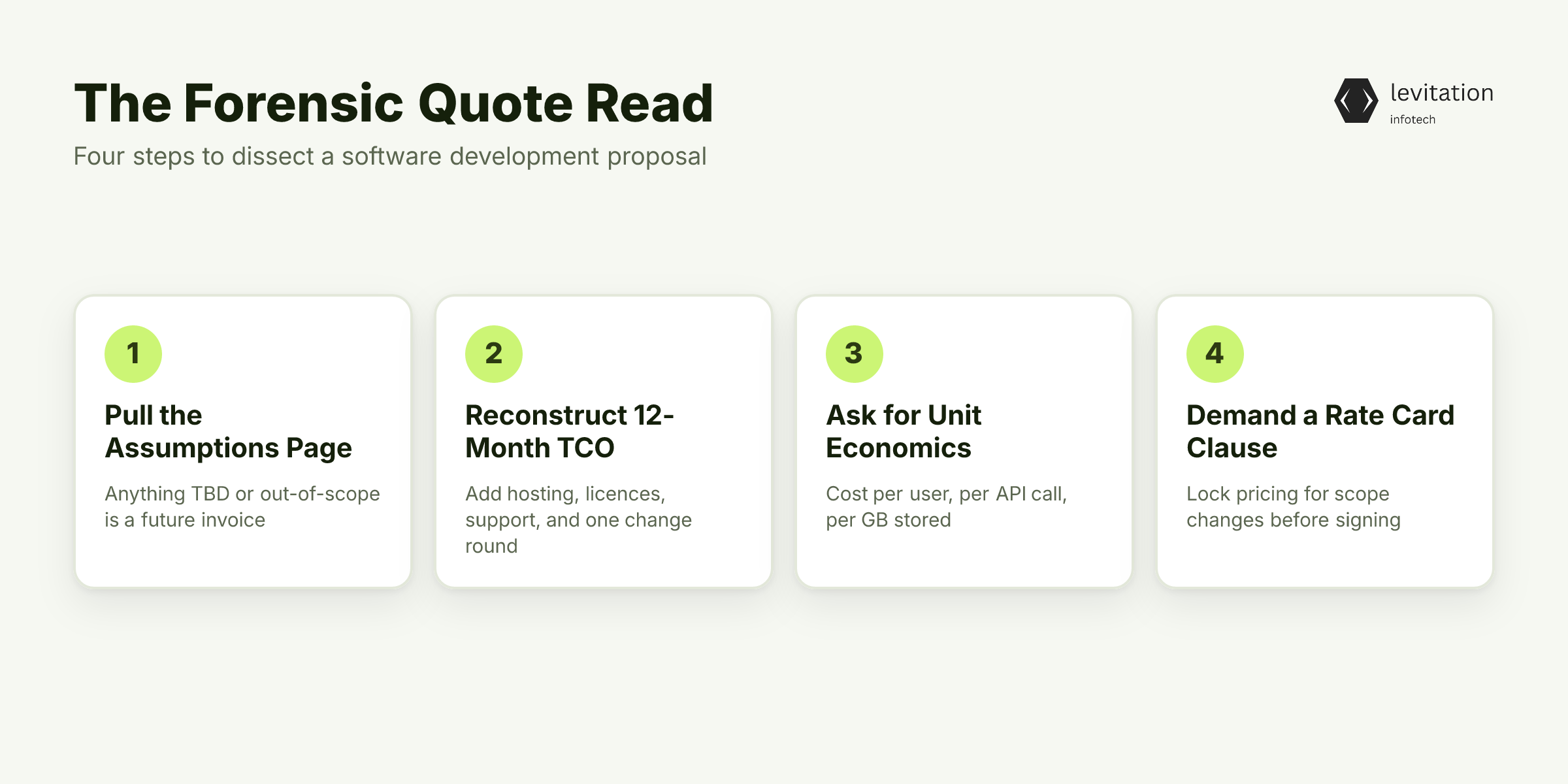
Quote literacy is a learned skill. Most founders skim for the bottom-line number and miss every signal that matters. Here is the four-step forensic read we use when evaluating a custom software development company proposal.
Step 1: Pull the assumptions page. Anything listed as "client-provided," "out-of-scope," or "TBD" is a future invoice. Treat it as one. If the assumptions page has more than ten items, the vendor is hedging, and you will pay for the hedge.
Step 2: Reconstruct a 12-month TCO, not just the build price. Add hosting, licences, support, and one round of change requests. If the vendor refuses to give you these numbers, they are hiding them. Walk away or get them in writing.
Step 3: Ask for unit economics. Cost per user, cost per API call, cost per GB stored. Vendors who cannot break this down are hiding margin in aggregates. A vendor who can break it down has nothing to hide.
Step 4: Demand a "what changes the price" clause with a rate card. If the vendor will not commit to the cost of a scope change, the buffer is already inside the base quote. The rate card is your protection. Without it, every change is a negotiation from scratch. For more on vendor selection for Indian software firms, this clause is the single highest-leverage item in the contract.
Quote literacy stops the bleeding, but the real protection comes before the proposal lands in your inbox, during vendor selection itself.
A 7-Point Vendor Vetting Checklist That Strips the Markup
Run this checklist before you sign anything. The cheapest quote on your shortlist will rarely survive all seven checks.
Check 1: Ask for two past clients in your domain, then call them. Ask specifically about post-launch invoices versus the original quote. The vendor's references will say everything went great.
The actual invoices will tell the truth.
Check 2: Request a sample SoW with redacted pricing. The format reveals whether the firm scopes transparently or hides behind ranges. A vendor who refuses to share even a redacted sample has something to hide.
Check 3: Verify the team that will work on your project, not the leadership that pitched it. Ask for LinkedIn profiles and retention data. The "A team" in the pitch deck often rotates to other projects mid-engagement.
Check 4: Look for in-house DevOps, QA, and security. If these are outsourced to a third party, that is another margin layer on your invoice. You will pay the third-party rate plus the vendor's markup.
Check 5: Test the change-request process during the pilot. Send a mid-engagement scope change and measure how they handle pricing. A vendor that responds with a clear rate card is rare. A vendor that responds with "let us discuss" is a red flag.
Check 6: Confirm who owns the source code, the cloud account, and the licences on day one. A vendor that retains these can hold the project hostage later. Code and account ownership must transfer before final payment, not after.
Check 7: Ask about their definition of "done." If it does not include deployment, monitoring, and one cycle of post-launch fixes, those are billable extras. The "done" definition is where most post-launch invoices are born.
Run the checklist and a different shortlist emerges. The cheapest quote rarely survives it. The surviving firms look very different from the ones you started with.
What a Transparent Quote Actually Looks Like (And Why Most Founders Never See One)
A transparent quote is not a marketing document. It is a working budget. Here is what separates it from the 28 we reviewed.
It lists infrastructure, licences, support, and change-request rates inline, not in appendices. You can read the entire year-one cost in one sitting, without flipping to page 14.
It separates build cost from run cost clearly. The 12-month TCO is visible before you sign, not after. You know what you are paying for and when.
It commits to code ownership, account ownership, and a defined handover. Retention of these is itself a cost, and a transparent quote makes that cost zero.
Founders who insist on this format save 30-50% in year-one TCO and avoid the post-signing surprise entirely. The projects that finished on budget all started with a quote formatted this way. For a closer look at bespoke software pricing in India, transparency is the single biggest lever you control.
Frequently Asked Questions
Q: How much does custom software development cost in India for a startup?
A: A basic MVP from a Noida software firm lands in a wide band depending on scope and complexity. A realistic 12-month cost-of-ownership including hosting, licences, and support runs 30-50% higher than the build quote alone. Always ask for a TCO breakdown before comparing vendors.
Q: What is the fixed price trap in software outsourcing?
A: A fixed-price contract prices in a buffer to absorb unknowns, then recovers that buffer through change-request fees once you are locked in. The "fixed" number is really a fixed entry price. Anything outside the literal line items triggers a fresh estimate.
Q: How do I evaluate software development quotes from Indian vendors?
A: Pull the assumptions page, reconstruct a 12-month TCO, ask for unit economics like cost per user, and demand a clause that defines the cost of future scope changes. Any vendor that will not commit to those numbers is hiding margin inside the base quote.
Q: Are software companies in Noida reliable for startup projects?
A: Many are. The city has a deep talent pool and rates that vary widely across firms. But reliability varies sharply. Vet using two past client references in your domain, verify the actual delivery team, and confirm code and account ownership on day one before you sign. Our list of software development companies in Noida is a starting point, not a shortlist.
Q: What hidden costs should I watch for in a Noida software quote?
A: The six most common are cloud infrastructure, third-party API and SaaS licences, security audits and penetration testing, ongoing maintenance, change-request fees, and post-launch SLA tiers. Across the 28 quotes we reviewed, these categories consistently appeared in appendices or "out-of-scope" clauses rather than the base line items.
Run the four-step forensic read on your own shortlist before you sign.
Sources
Research and references cited in this article:
- Custom Software Development Cost in 2026: Full Guide
- How Much Does Custom Software Development Cost in 2026? A Complete Guide | Cozcore Technology
- Custom Software Development Cost 2026: Pricing Guide & Trends | SDH global
- Software Development Costs in 2026
- Software Development Cost in 2026: Pricing, Rates & Factors - IWIS
- Avoid Common Deceptive Pricing Traps
- Why We Don't Do Fixed-Price Software Projects (And Neither Should You)
- Price-Fixing – Brave For Free
- The vendor trap is real. | Craig Scott
- Top IT Vendor Management Challenges in 2026 And How ...
- How to Choose a Software Development Company | 2026 Guide
- How to Choose a Software Development Company: 8-Step Framework 2026
About the author
Mayank Singh is a software developer at Levitation Infotech, where he builds web and AI-powered applications across the company’s fintech, healthcare, and enterprise projects.