


IBM's June 2026 study found two-thirds of CTOs are accountable for AI systems they don't fully control. The engineers shipping those systems knew it months before the board did. That's not a technology problem. It's a structural one. And it has a fix that doesn't require another committee.
TL;DR: Two-thirds of CTOs now own AI systems they cannot fully see or steer, while their engineers run shadow tools around official policy. Traditional governance models, built for slower, predictable software, collapse under AI's velocity. The fix is runtime control: instrument the pipeline itself, not the approval gate. Teams that adopt this model ship faster, not slower, because runtime checks catch issues earlier and reduce rollback cycles.
Key Takeaways: - Two-thirds of CTOs are accountable for AI they don't control, per IBM's June 2026 IBV study. The accountability gap is a board-level liability, not a tooling issue. - Organizations claiming full AI visibility are operating on an illusion; most are still uncovering shadow AI activity they didn't know about. - Shadow AI adoption is a signal that your sanctioned systems underserve real workflow demand. Engineers are your sensor array, not your problem. - Runtime control (prompt logging, output validation, recovery playbooks) embedded in the pipeline beats pre-deployment approval gates. It ships faster, catches issues earlier, and reduces firefights.
Two-Thirds of CTOs Are Accountable for AI They Don't Control
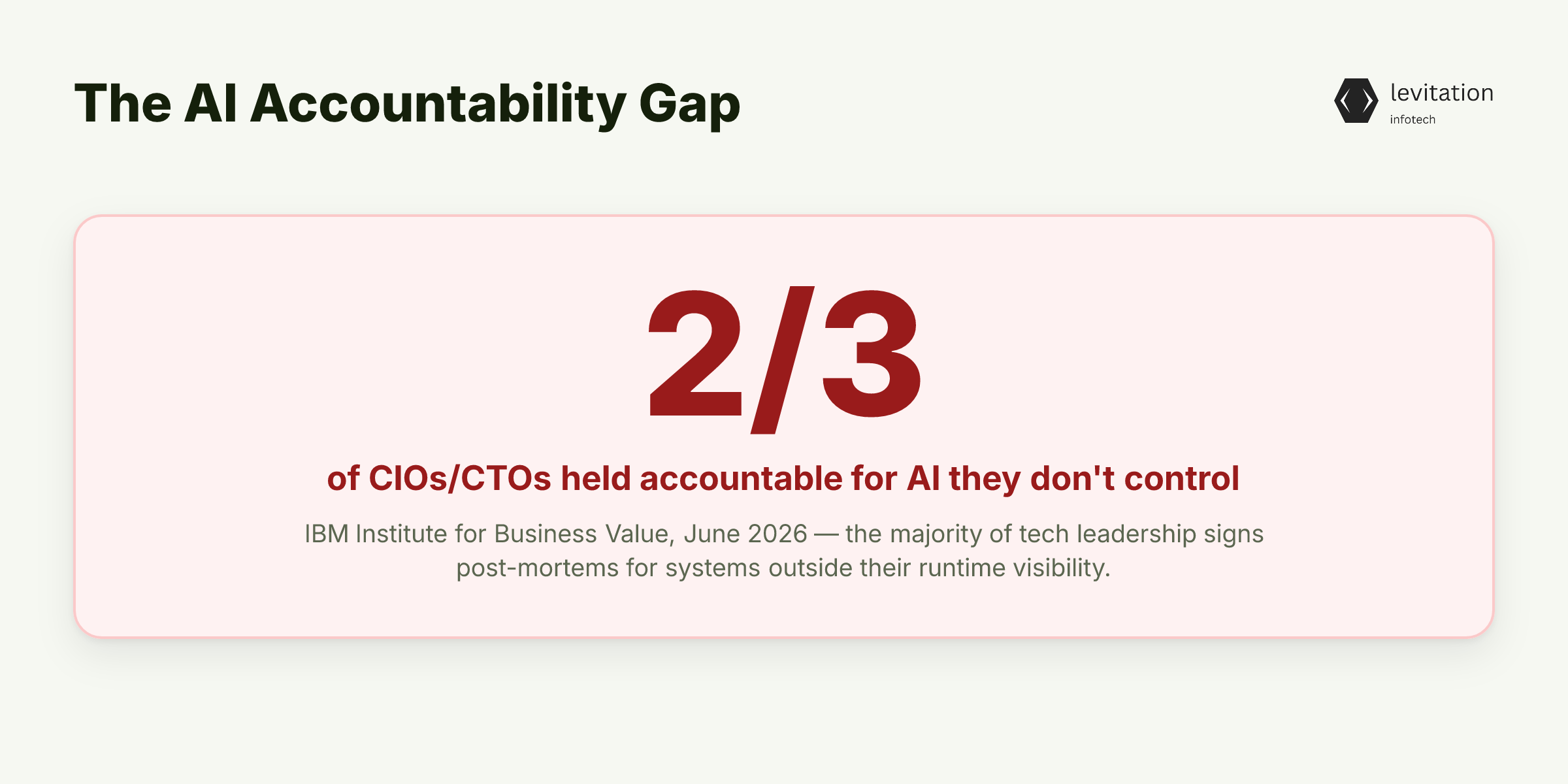
IBM's Institute for Business Value released a study in June 2026 that should have made every CTO uncomfortable. Two-thirds of surveyed CIOs and CTOs report being held accountable for AI systems they do not fully control. The number isn't a rounding error. It's the majority of the leadership class.
Matt Lyteson, IBM's CIO, put it bluntly: the challenge now is scaling AI systems that operate continuously and autonomously, often within governance models and architectures designed for a far slower, more predictable environment. It is no longer just about deploying AI faster. It is redesigning how organizations control, govern, and invest in AI, and embedding control and visibility from the start, so they can scale with confidence. The framing matters. Lyteson isn't talking about better dashboards. He's talking about redesigning the architecture that decides what gets seen, what gets stopped, and what gets logged.
This is where accountability becomes dangerous. When a model misfires in production, the CTO signs the post-mortem. Not the engineer who wired the API call. Not the vendor who sold the wrapper. The CTO. The person furthest from the actual runtime behavior carries the most personal risk.
Consider what that means during a board meeting. You don't know which AI systems are running. You don't know which ones your teams patched last week. You don't know which prompts are sending customer data to a third-party endpoint. But you will be asked, under oath, why it happened. The AI governance frameworks most enterprises adopted in recent years were not designed for this moment. They were designed for slower software.
But here's what makes this different from every previous governance failure: the gap isn't a policy problem. It's a velocity problem.
Your Governance Playbook Was Built for a Slower Machine
The direction of the data tells a clear story. AI adoption is now widespread in data and engineering workflows. AI-assisted development consistently ranks as a top investment priority. Adoption is no longer experimental. It's operational.
Yet data quality, privacy, and control consistently rank as top barriers to wider AI adoption. Not model capability. Not cost. Control. The thing slowing enterprises down isn't that AI doesn't work. It's that nobody can prove what's running, where the data flows, or who can see it.
Traditional governance assumes weeks-long review cycles. A model gets proposed, evaluated, approved, deployed, and audited. That worked when software moved in quarters. AI doesn't move in quarters. Model behavior shifts in hours. A prompt template change can reroute sensitive data through a new endpoint before lunch. A fine-tune can drift the model's outputs by Friday. The review committee is still reading last month's documentation.
This is the friction the IBM study is naming. Governance built for a slower machine cannot keep up with a system that learns, adapts, and ships daily. The result isn't just technical debt. It's a responsible AI governance deficit that compounds every week you wait.
If the gap is velocity, where exactly is the friction hiding? The uncomfortable answer is that most CTOs are looking in the wrong place.
The Visibility Illusion: What You See vs. What's Actually Running
Surveys consistently show that organizations overestimate their AI visibility. When asked, most claim full visibility into AI usage. Yet those same organizations are still uncovering shadow or unauthorized AI activity months later. Those two realities cannot both be true.
The gap between confidence and reality is the AI control gap, and it's not closing. It's widening.
Policy does not equal enforcement. A signed acceptable-use policy sitting in a shared drive is not a control. It's a document. Shadow AI doesn't start with a rogue team. It starts with a prompt. A file upload. An embedded assistant in a SaaS tool that the procurement team never flagged because nobody told them to look. A developer using a coding assistant that wasn't on the approved list because the approved list doesn't include one that solves their actual problem.
The enterprise AI risk management problem isn't that engineers are reckless. It's that the sanctioned tools don't match the workflows. When the official stack underperforms, engineers route around it. Not because they want to break rules, but because their job requires shipping.
The same is true for AI model selection, where you can read more about why your AI strategy says three models but engineers use eleven. Visibility of tools does not equal visibility of data. And visibility of data does not equal control of behavior.
So who actually knows what's running? Not the governance committee. Not the CISO dashboard. The engineers shipping code every day.
Your Engineers Aren't the Problem - They're the Sensor Array
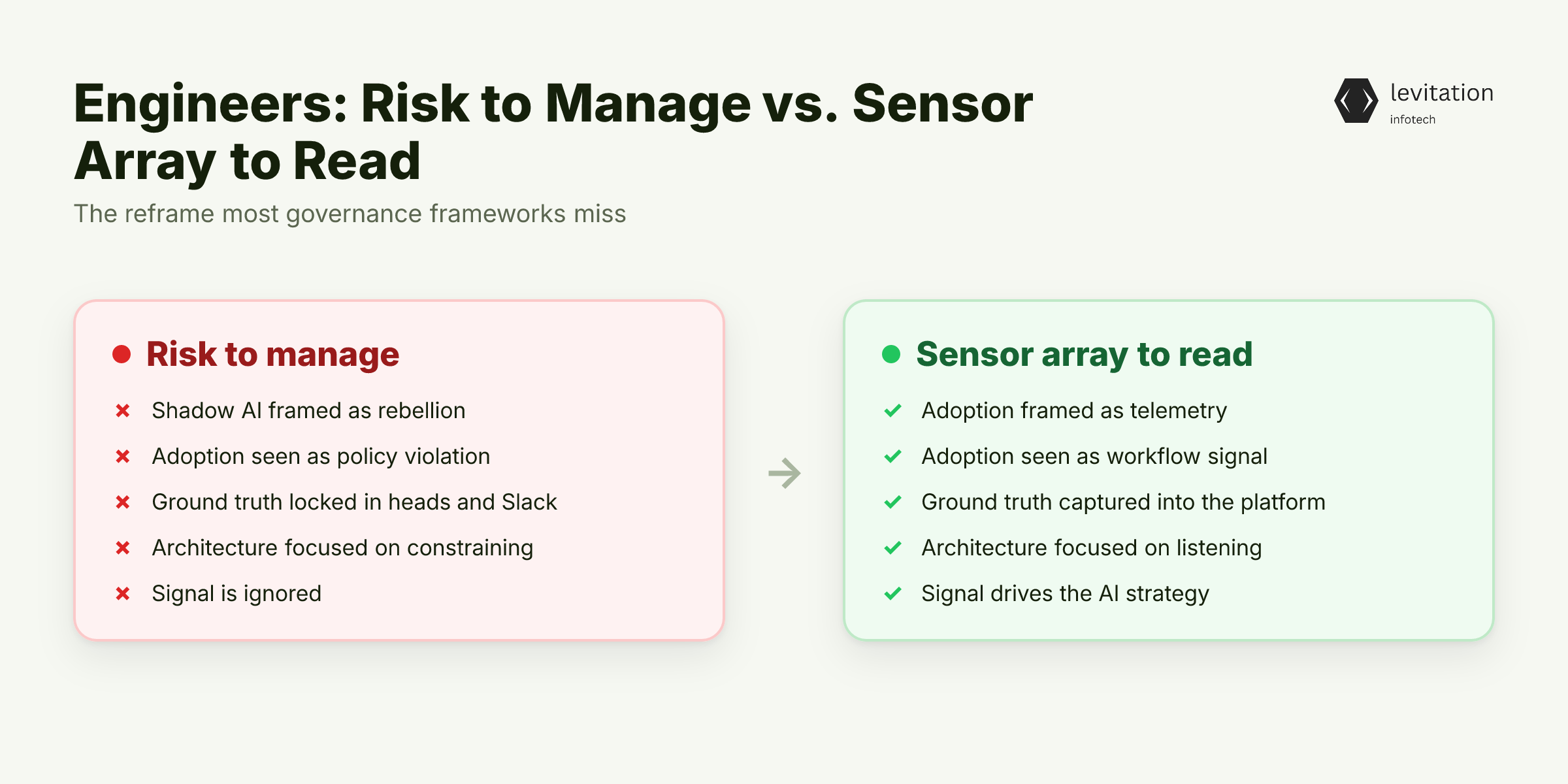
Here's the reframe most governance frameworks miss. Shadow AI adoption is not rebellion. It's telemetry.
Engineers adopt AI tools first because they're closest to the friction. They see the manual validation step that bogs down every pipeline. They feel the slow code review queue. They know which brittle data pipeline breaks every sprint. When they reach for an AI tool, they're not bypassing policy. They're signaling that the official stack doesn't meet the actual workflow demand.
The information asymmetry is the real AI control gap. Your engineers hold ground truth about what's working and what isn't. They know which tools actually help. They know which ones produce hallucinated outputs. They know which APIs leak data in ways the security team never audited. That knowledge is locked in their heads, in Slack threads, in commit messages.
The question is whether your architecture listens to them. Most don't. Most governance frameworks treat engineers as a compliance risk to be managed, not as a sensor array to be instrumented. That's the mistake.
If you want to close the control gap, you stop trying to constrain engineers and start trying to read them. What tools are they using. What data are they feeding in. What outputs are they trusting. That signal is worth more than any policy document. And it's exactly what your enterprise AI platform strategy should be capturing.
If the engineers are the sensor array, the question becomes: what control architecture listens to them without becoming a bottleneck?
Runtime Control Beats Control Theater
Lyteson's IBM guidance is specific: embed control and visibility at the start of AI system design, not after deployment. The mechanism is runtime instrumentation. Not approval gates.
Runtime control means the controls live inside the pipeline. Prompt logging happens at the inference call, not in a quarterly audit. Output validation runs as a continuous check, not a pre-deployment review. Access controls fire at the prompt level, not at the role level. Recovery playbooks activate automatically when drift exceeds threshold, not when a human notices three days later.
Replace pre-deployment approval gates with continuous runtime checks. Quality, governance, observability, recovery, auditability, and human approval all work together as one system. The strongest controls are layered, not sequential. Sensitive data workflows get one set of guardrails. Customer-facing flows get another. Critical pipelines get a third. Each set matches the actual exposure profile of that workflow.
Runtime control sounds heavier than a traditional governance committee. It's not. Pre-deployment gates block every change behind a human queue. Runtime checks let the change ship while the controls run alongside. The difference is the difference between stopping the car to check the tires and having sensors that warn you in real time.
The teams that have adopted this model for production AI systems report a counterintuitive result: they ship faster, not slower. The controls catch issues earlier, so rollback cycles shrink. Engineers stop filing tickets to request approval and start trusting the system to enforce policy automatically. AI governance implementation at the runtime layer changes the relationship between the governance team and the engineering team from adversary to ally.
This sounds heavier than a traditional governance committee. So why do teams running this model ship faster, not slower?
Why Runtime-First Governance Ships Faster
The reason in-house AI governance drags is the same reason it fails. The governance committee becomes a queue, not a function. Every model change, every new prompt template, every integration request gets routed through the same review process. The team building the controls is the same team trying to ship the systems. The people enforcing the rules are the people waiting on the rules.
A focused, templated governance architecture compresses the timeline by removing the reinvention cost. You don't need to design your own prompt logging framework. You don't need to invent your own output validation library. You don't need to write your own recovery playbook from scratch. The patterns exist. Applying them to your stack takes weeks, not quarters.
Longevity comes from engineering quality, not from audit theater. Systems built on runtime instrumentation outlast systems built to pass a single review cycle. The architecture that monitors, validates, and recovers automatically doesn't need to be rebuilt every time a new model version ships or a vendor changes.
You can read more about why runtime visibility beats periodic audits for systems that change weekly. The same logic applies to governance: if your AI ships daily, your controls must run continuously.
The deeper question for enterprise AI implementation is what you're really buying. Are you buying a policy document that satisfies a quarterly review? Or are you buying an architecture that survives the next several years of model changes, vendor shifts, and regulatory updates?
Which leaves the real question: what actually changes for a CTO who closes this gap versus one who doesn't?
The CTO Who Closes the Gap Owns the Next Decade
The payoff is not subtle. You shift from explaining AI incidents after the fact to preventing them by design. Board confidence changes immediately. The conversation stops being "what went wrong" and starts being "what can we ship next."
Your engineers stop working around governance and start working through it. The runtime controls actually help them ship because they catch bad outputs before customers see them, surface drift before it cascades, and provide audit trails that don't require manual compilation. The adversarial relationship between the security team and the engineering team dissolves.
AI becomes a compounding asset instead of a liability you're personally on the hook for. Every model you ship, every workflow you automate, every integration you approve adds to a control architecture that gets stronger with use. The enterprise AI solutions you build today become the platform for what you build next year. And the year after.
The CTO who closes this gap doesn't just reduce risk. They buy optionality. They become the leader who can say yes to AI initiatives because they can prove what runs, what doesn't, and why. In a market where most CTOs are still explaining incidents, that leader owns the next decade.
Frequently Asked Questions
Q: What is the AI control gap?
A: The AI control gap is the distance between how fast AI systems are adopted across an organization and how fast governance, visibility, and runtime controls can keep pace. IBM's June 2026 study found two-thirds of CTOs are accountable for AI systems they don't fully control, and separate research shows that organizations claiming full AI visibility are typically still discovering shadow AI activity they didn't know about.
Q: How do you regain control of enterprise AI systems?
A: You regain control by embedding it at the design stage rather than reviewing it after deployment. That means runtime instrumentation, including prompt logging, output validation, access controls, and recovery playbooks, wired into the pipeline itself, replacing pre-deployment approval gates with continuous checks. The goal is layered controls where sensitive data, customer-facing, and critical-pipeline workflows each get the specific guardrails their exposure demands.
Q: What causes shadow AI adoption in engineering teams?
A: Shadow AI adoption starts with normal workflow friction: a manual validation step, slow code review, a brittle data pipeline. Engineers reach for AI tools because the official stack doesn't meet the actual demand. It's not rebellion; it's a signal that your sanctioned AI systems underserve the workflows that need them most.
Q: How long does enterprise AI governance implementation take?
A: A templated, runtime-first governance architecture typically deploys in weeks, not quarters, by avoiding the reinvention cost of governance review processes, runtime instrumentation patterns, and recovery playbooks. In-house governance builds that try to design every component from scratch drag far longer.
Q: Can you govern AI without slowing engineering velocity?
A: Yes, when controls live at the runtime layer instead of the pre-deployment approval gate. Continuous checks for quality, observability, auditability, and human approval running alongside the pipeline actually help engineers ship because they catch issues earlier and reduce rollback cycles. The teams that adopt runtime control report fewer firefights, not more.
About the author
Mayank Singh is a software developer at Levitation Infotech, where he builds web and AI-powered applications across the company’s fintech, healthcare, and enterprise projects.