


TL;DR: AI deployment speed runs at API speed. That means daily model updates. Traditional risk control still operates on quarterly review cycles. This creates a built-in control void. Models serve users for an entire review cycle before any oversight touches them. The fix is not faster meetings. The fix is a continuous control plane. It is built from automated pre-deployment checks, runtime guardrails, post-deployment drift monitoring, and named individual risk owners. These owners respond in minutes, not weeks.
Key Takeaways: - The mismatch between AI ship speed and risk review speed is built-in. It is not a process failure. Quarterly control was designed for waterfall software, not continuous AI deployment. - Replace calendar-driven reviews with three always-on control layers. These are pre-deployment automated checks, runtime guardrails, and post-deployment drift detection. - Assign AI risk to named individuals with measurable thresholds. Do not assign it to departments. Spread of responsibility guarantees control gaps. - When risk operates at ship speed, teams ship faster. This happens because the safety net is automated, not because oversight is relaxed.
Your AI Ships at API Speed. Your Risk Review Runs on a Board Calendar.
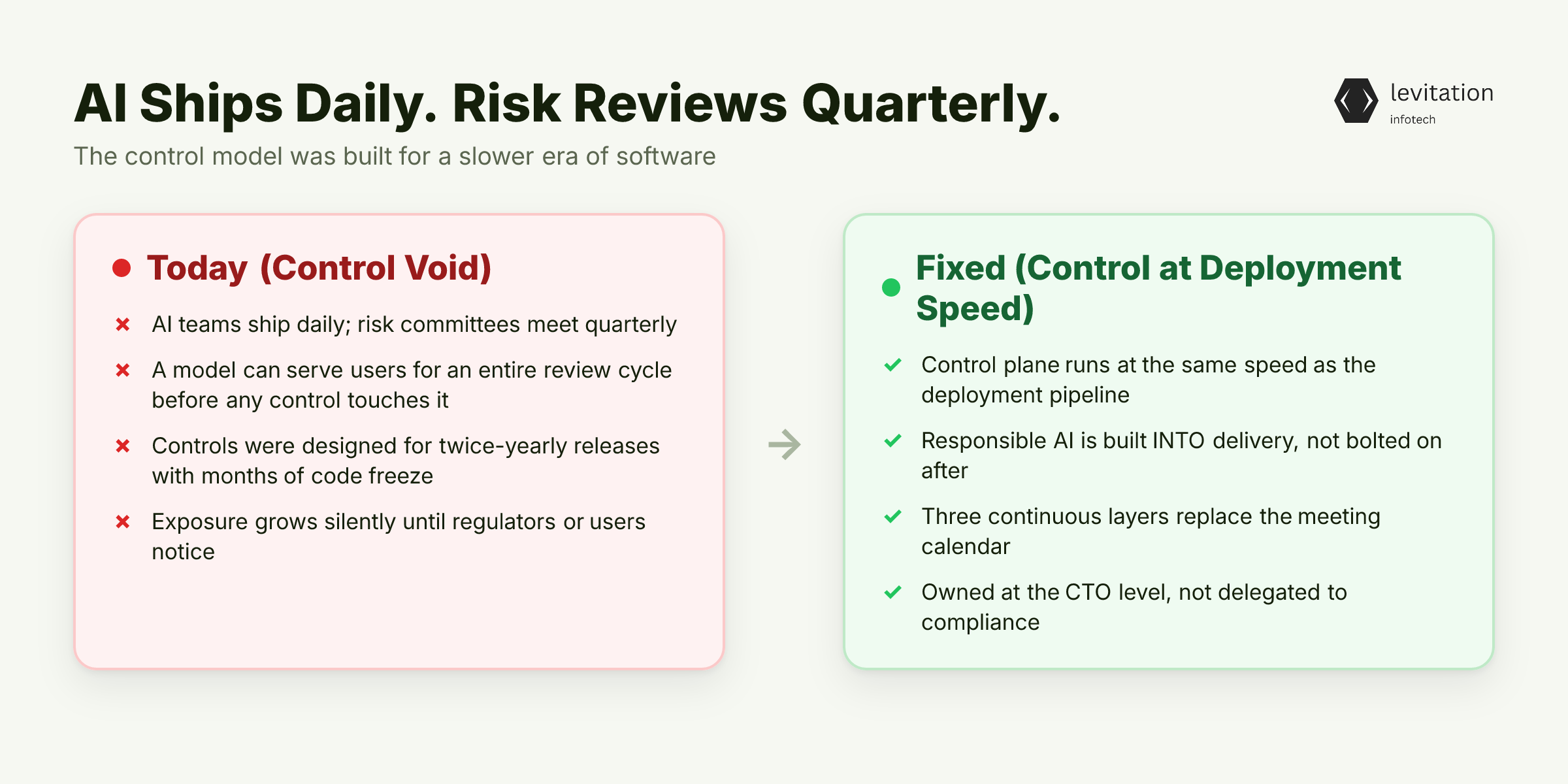
It's Monday morning. Your AI team pushed a model update on Friday. They served it to your user base over the weekend. It won't reach a risk review until the next scheduled cycle. That's not a control gap. That's a control void.
AI shipping has sped up beyond anything traditional AI governance frameworks were designed for. That speed edge creates a real business edge. It also means your risk committee meets quarterly. By then, it is reviewing models that may have already been replaced, retrained, or swapped out.
The instinct is to blame the risk team for moving too slowly. The real problem runs deeper. The control model itself was designed for a different era of software. In that era, releases happened twice a year. Code also froze for months between deploys.
Three built-in facts make this gap unbridgeable with process tweaks alone: - AI teams ship daily. Risk committees meet quarterly. - A model can serve users for an entire review cycle before any control review touches it. - The closer you are to the customer, the more exposure grows during that window.
This is not a compliance-team problem. It is a CTO-level concern. The exposure grows silently until something goes wrong in front of regulators, users, or both. The companies that spot this early build responsible AI into their delivery pipeline. They do not build it on top of it. The groups that pass AI governance audits share one trait. Their control plane runs at the same speed as their deployment pipeline. Building one needs three layers. None of these layers run on a meeting calendar.
Quarterly Reviews Were Designed for a World That No Longer Exists
Traditional control assumed low-frequency, high-stakes releases. Quarterly or annual checkpoints made sense when a software update meant six months of QA. They also made sense with a staged rollout and a documented change request. AI systems do not work that way.
Model behavior drifts all the time. Data distributions shift. User behavior changes. Prompt patterns change as your customers figure out new ways to use your product. A quarterly snapshot tells you what the model did last quarter. It does not tell you what the model is doing right now. Worse, by the time the review happens, the model may have been swapped or retrained. It may also have been quietly broken by a third-party API update you didn't control. If your team isn't already watching for it, your AI model is drifting and you don't know.
The control map that actually works has three layers. None of them need scheduling a meeting: - Pre-deployment gates run bias tests, eval suites, prompt-injection scans, and policy compliance checks automatically in the CI pipeline. - Real-time runtime monitoring runs output filtering, hallucination detection, rate limits, and toxicity scoring on every response. - Post-deployment drift detection runs statistical monitoring of input distributions, output quality, and performance metrics. These metrics alert when something shifts.
Each layer is a system property, not a calendar event. The groups getting this right have moved their AI governance function. It moved from a quarterly review board to an always-on monitoring stack. The committee still exists, but it reviews the control plane, not individual model decisions. Which raises the question: what do those three layers actually look like in production?
The Control Plane That Matches Ship Velocity
The alternative is a control plane built for the speed your AI team already operates at. In this model, compliance is a pipeline stage, not a hallway conversation.
Replace quarterly manual reviews with daily or hourly automated compliance scorecards. These scorecards feed a real-time risk dashboard. This is the core insight: control has to become infrastructure. The control plane has three layers. Each layer runs without anyone scheduling a meeting.
Layer 1: Pre-deployment automated checks. Every model update, prompt change, or API swap triggers a battery of automated tests before it reaches production. Bias tests run against held-out demographic slices. Eval suites score outputs against your quality bar. Prompt-injection scans probe for jailbreak vectors. If anything fails, the deploy is blocked. No human needs to attend anything for this to work. Teams that skip this step often find their MLOps pipeline is undermining model safety. The review board never sees these issues.
Layer 2: Runtime guardrails. Once the model is live, every request and response passes through a guardrail layer. Output filtering catches policy violations. Hallucination detection flags low-confidence answers in high-stakes contexts. Rate limits prevent abuse. This layer is the immune system. It doesn't prevent deployment. It contains damage in real time.
Layer 3: Post-deployment monitoring. Drift alerts fire when input distributions shift. Performance drop triggers review queues. Usage anomalies flag potential abuse or unexpected adoption patterns. The team that built this control plane for enterprise AI solutions at scale runs continuous signals per model. They do this not because the data is interesting. They do it because catching drift early is the difference between a quiet fix and a public incident.
The pattern across regulated industries is consistent. Groups that treat control as infrastructure ship faster, not slower. This happens because the safety net is always on. The AI platform approach makes compliance a property of the system. It is not a gate the system has to pass through. But technical controls only address half the problem.
Blue-Green Rollbacks and Predefined Isolation Playbooks
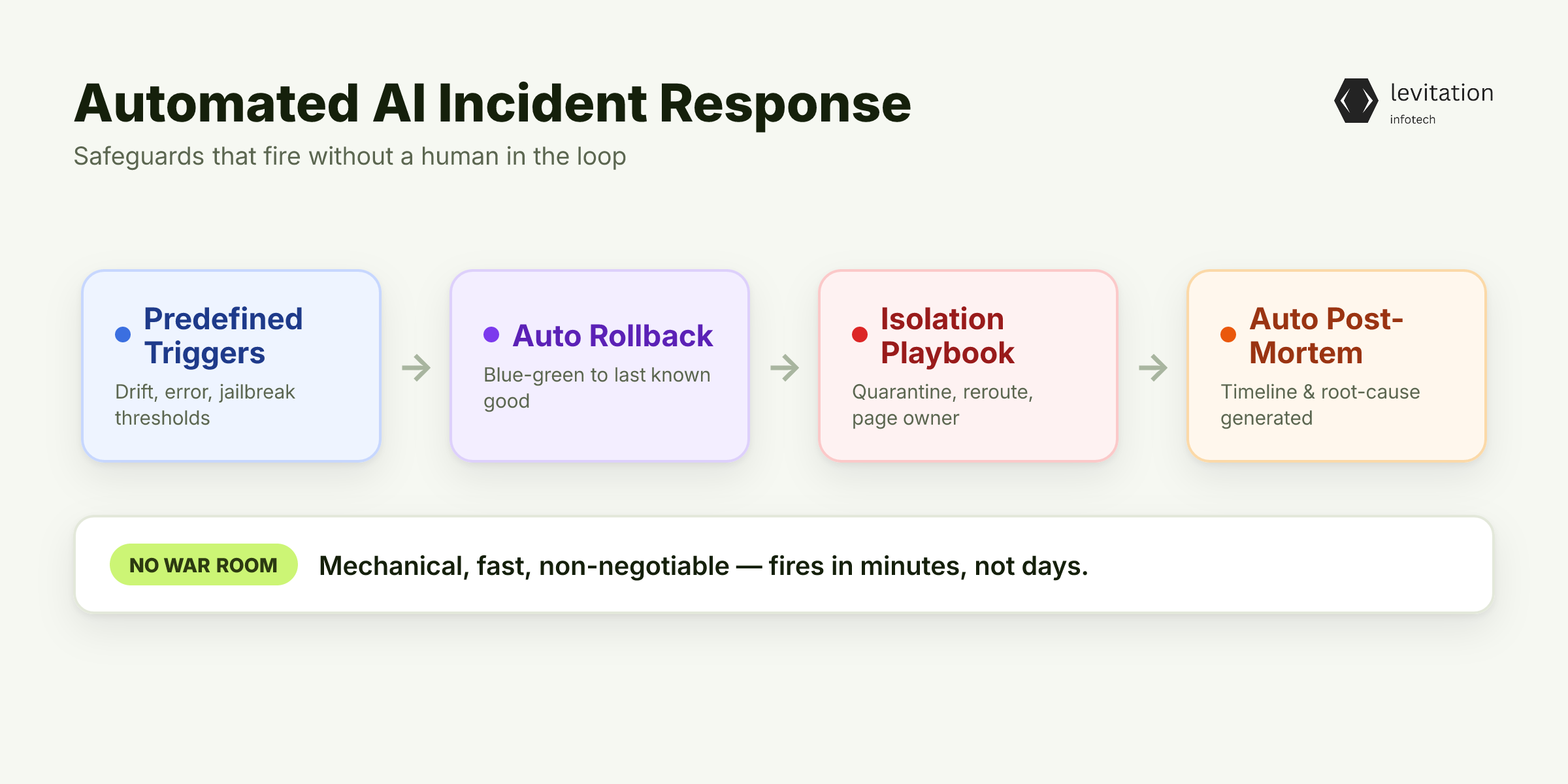
The first half of that control plane is technical. It includes deployment and runtime safeguards that don't need a human in the loop to trigger. The second half is operational. It is about knowing what to do when the safeguards detect something real.
Blue-green deployment strategies enable rapid rollback to the last known good configuration before customer impact grows. The key word is "predefined." Rollback triggers should be set before shipping, not negotiated during the incident. Define thresholds for drift percentage, error rate, jailbreak success rate, and hallucination confidence. When any threshold is crossed, the rollback fires automatically. If your team still treats canary deploys as a slow manual process, that is a problem. Canary deployments are slowing your fixes in exactly the way that grows governance debt.
The teams that ship reliable production AI under regulatory scrutiny treat rollback triggers like circuit breakers. These triggers are mechanical, fast, and non-negotiable. Set in advance isolation playbooks let you quarantine suspicious systems within minutes, not days. If a model starts producing outputs that match a known jailbreak pattern, the playbook runs. It also runs if drift goes above acceptable bounds for a specific cohort. The playbook runs without waiting for a war room. The system isolates the affected deployment, routes traffic to the fallback, and pages the named owner. Because AI systems fail differently than traditional microservices, the runbook has to assume partial failure modes. These modes don't exist in stateless web apps.
Auto-generated post-mortems close the loop. When an incident occurs, the system produces the timeline, affected cohorts, and root-cause guess. It does this without waiting for a committee. The post-mortem is a deliverable, not a meeting outcome.
Here's the operational checklist that separates teams that handle AI incidents well from teams that don't: - Define rollback triggers (drift threshold, error rate ceiling, jailbreak success rate) before shipping, not during the incident. - Pre-approve isolation playbooks so quarantine doesn't need three layers of approval. - Auto-generate incident timelines with affected cohorts, response actions, and time-to-resolution metrics. - Feed every incident back into the pre-deployment eval suite. This way, the same failure mode is caught earlier next time.
From Department Ownership to Named Individual Risk Owners
Technical controls alone won't close the gap. The second half is about who actually owns the risk when something goes wrong at 2 AM.
Department-level ownership guarantees spread of responsibility. "The security team handles prompt injection" means nobody handles it until something breaks. The fix is to assign risk ownership to specific individuals, not departments. "John owns prompt injection mitigation" creates accountability. John has a measurable threshold, a set response, and a pager. The same pattern applies to model drift, data privacy, bias monitoring, and third-party model supply-chain risk.
Set up a cross-functional risk governance committee that meets bi-weekly. This committee needs clear decision authority, not advisory status. The committee reviews control plane health, resolves cross-cutting risk questions, and approves changes to thresholds. It doesn't review individual model decisions. That work happens in the automated layer. The committee exists to govern the system that governs the models.
The org design insight is simple but often missed. AI risk spans security, legal, ML, and product. Siloed ownership guarantees gaps. The named-owner model works because each risk category gets a person. That person has a threshold, a playbook, and authority to act. This is how AI ethics moves from a slide deck to a working practice.
For groups trusted by Fortune 500 brands for enterprise AI systems in India, the named-owner model is table stakes. The risk surface of an AI product in production is too broad for committee ownership. Each risk category needs a name, a number, and a response. Anything less is theater. The AI governance function works only when every risk thread has a human attached to it. That human must be able to be paged.
What Changes When Risk Runs at Ship Cadence
When both halves work together, the pattern is clear. Both halves include technical controls and individual ownership.
Ship speed doesn't slow. In fact, teams ship faster because they know the safety net is automated. The blocker is not control. It is uncertainty about whether the deploy is safe. Remove that uncertainty with a working control plane, and the deploy pipeline speeds up.
Risk reviews become continuous and evidence-based. They are not periodic and political. Instead of a quarterly slide deck summarizing what happened three months ago, risk teams see real-time signals. These signals show what's happening right now. The conversation shifts from "did anything go wrong last quarter?" to "what's our current exposure, and what's the trend?"
Incidents are contained in minutes. They are not escalated through quarterly retrospectives. The named owner gets paged, the playbook runs, the rollback fires, and the post-mortem is auto-generated. The enterprise AI deployments that show this pattern share a common trait. These systems still run in production long after deployment. Their retention also grows over the engagement period. That longevity is not luck. It is what happens when risk operates at the same speed as shipping.
The CTO stops choosing between speed and safety. The trade-off everyone accepted in the waterfall era dissolves. The old choice was "we can move fast or we can be compliant, pick one." That choice dissolves when the control plane does both. Speed becomes a function of how good your automated safeguards are. It is not a function of how few reviews you skip.
This is the AI implementation pattern that works. It is not faster meetings. It is not more reviewers. It is infrastructure that makes control a runtime property of the system. Teams that get this right spend their quarterly review cycles improving the control plane. They do not spend it auditing individual model decisions. The board stops asking "what went wrong last quarter." It starts asking "how is our exposure trending." That's a better conversation. It only happens when risk runs at the same speed as shipping.
Frequently Asked Questions
How often should AI risk reviews happen in an enterprise?
For high-speed AI deployments, risk reviews should run continuously via automated compliance scorecards. They can run daily or hourly, not quarterly. Save quarterly reviews for policy and framework updates, not individual model assessments. Real-time monitoring handles the per-model risk. The quarterly cycle handles the meta-question of whether the control plane itself is still enough.
What is the difference between AI governance and AI risk management?
AI governance is the broader discipline. It covers the policies, roles, decision rights, and guardrails that ensure AI systems are safe and ethical. AI risk management is a subset of that discipline. It focuses on finding, assessing, and reducing risks. These risks include security, bias, compliance, and operational issues. The work happens within that control framework. Governance sets the rules. Risk management runs and monitors them.
How do you scale AI controls without slowing deployment speed?
Move controls from human-in-the-loop review to system-enforced guardrails. Pre-deployment checks (eval suites, bias tests, prompt-injection scans) run automatically in the CI pipeline. Runtime monitoring (drift detection, output filtering) runs continuously. Blue-green deployment with set rollback triggers means you ship with a safety net rather than ship-then-approve.
What are the top AI risks in production systems?
The highest-impact production AI risks are model drift, prompt injection, jailbreaks, hallucination, data leakage, bias amplification, and third-party model supply-chain risk. Model drift means behavior changes as data distributions shift. Prompt injection and jailbreaks attack the model. Hallucination shows up in customer-facing outputs. Data leakage happens through model inputs or outputs. Bias amplification grows at scale. Each needs a different control. None are well handled by a quarterly review.
Who should own AI risk in an organization?
Individual named owners per risk category, not departments. For example, one person owns prompt injection mitigation. Another owns model drift response. Another owns data privacy controls. These owners report into a cross-functional risk governance committee. That committee meets bi-weekly with clear decision authority. Department-level ownership creates spread of responsibility. Named ownership creates accountability.
About the author
Mayank Singh is a software developer at Levitation Infotech, where he builds web and AI-powered applications across the company’s fintech, healthcare, and enterprise projects.