


TL;DR: A ₹2 lakh monthly team can cost more than a ₹6 lakh fixed build. This can happen once both are priced against the same outcome. Fixed price wins when scope and acceptance criteria are stable. Dedicated capacity wins when the roadmap must change, while a staged contract handles genuine uncertainty.
Key Takeaways: - The fee-only crossover arrives in month three, but that ignores management and running costs. - Fixed price buys a defined outcome; a monthly team buys capacity to adapt. - Compare matched proposals, then write the change trigger before signature.
The Dedicated Development Team Price Tag Is Only the Starting Point
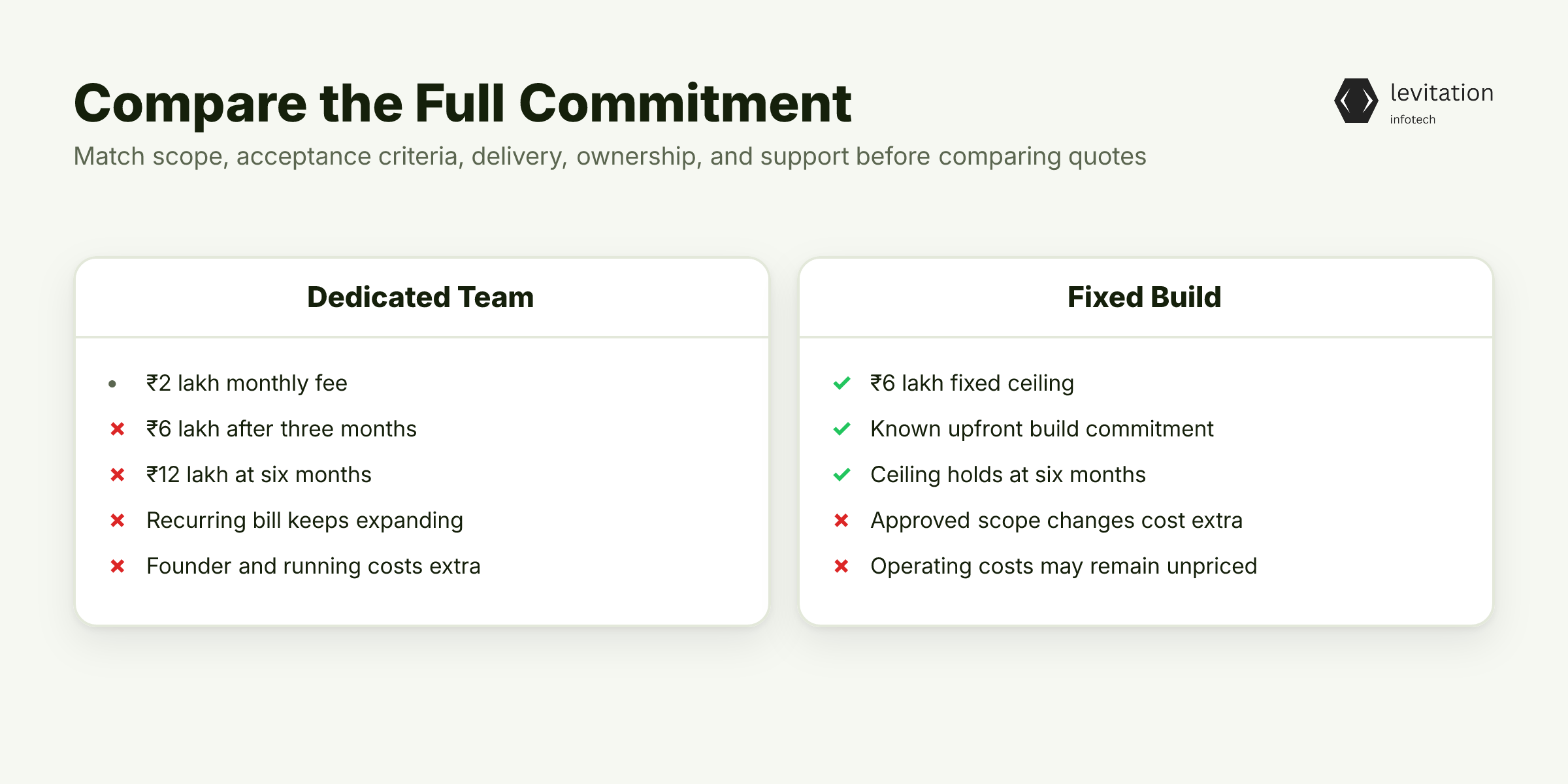
A ₹2 lakh monthly team looks cheaper than a ₹6 lakh fixed build. Then three months erase the price gap. After six months, fees reach ₹12 lakh before founder time, infrastructure, and maintenance enter the total.
Run the three-month test
Using the headline premise, three months of team fees equal the entire ₹6 lakh fixed build. At six months, the same example reaches ₹12 lakh.
This shows the cost pattern, not a universal rate card. The fixed build has a ceiling. The team has a clock.
That clock raises a harder question: what exact release will both quotes deliver?
Attach every price to an outcome
Before comparing labels, define one release that both vendors must deliver. Every proposal should use the same product scope. It should also use the same acceptance criteria, quality requirements, and delivery date.
It should also state source-code ownership and the support window after launch. Without the same scope, the cheaper proposal often describes less.
A clear custom software development proposal should expose those terms before negotiation.
In practice, once scope matches, ask which running costs still sit outside either quote.
Separate build cost from operating cost
Build cost pays for creating the release. Running cost pays for keeping it available, secure, and useful.
Ask whether hosting and databases are included. Then test whether security controls, maintenance, scaling, and support sit inside the quote or outside it.
A lower initial price can become the expensive option when these ongoing costs are hidden.
Which obligations will your current quote leave unpriced?
Compare the full commitment
Dedicated team: ₹2 lakh per month
Fixed build: ₹6 lakh ceiling
Add these same hidden loads to either quote: - Founder management time - Hosting and database charges - Maintenance and support - Approved scope changes
Neither price is complete until both sides carry the same outcome and obligations. With that match in place, the next question is why the recurring bill keeps expanding.
Why a Recurring Team Expands the Bill
The recurring bill expands because a monthly fee buys time and judgment, not a finished product.
Capacity is not a finished product
A monthly fee purchases team availability and the right to change priorities. It does not guarantee that a defined product will finish within a fixed ceiling. That product must also meet defined acceptance criteria.
Imagine moving payments ahead of analytics after the first design review. The dedicated team absorbs that shift. A fixed build must treat it as a change.
That difference becomes expensive only when nobody decides which change matters.
Before the invoice grows, which change will you decide is worth the cost?
Count founder management as a line item
Plan for 3 to 8 hours per week of client management. That time belongs in the total project cost, even when no invoice names it.
Those hours cover: - Roadmap and priority decisions - Requirement and design reviews - Acceptance and approval decisions
The idle-capacity warning in why a 'dedicated' team sits idle makes the same point. Reserved hours still create a commitment, even when the month needs fewer hands.
Launch creates the next bill, and that bill needs its own line.
Budget the software after launch
Hosting and database charges happen every month under either business model.
Routine maintenance covers fixes, model migrations, prompt tuning, quality monitoring, security patches, and support. Add those services before selecting the cheaper quote.
Use the same software development cost in India baseline for both proposals.
Security work can still hide inside that allowance.
Price security work explicitly
Baseline work includes encryption and secrets detection to strip API keys before code reaches a model. Also include role-based access, audit logs, dependency scanning, and deletion controls.
If the contract omits them, the dedicated bill grows or the fixed scope was incomplete. Security cannot remain an implied favor.
What else does ownership cost after launch?
Add the annual ownership load
Plan maintenance at 15% to 25% of build cost per year. For a ₹10 lakh MVP, that is ₹1.5 lakh to ₹2.5 lakh annually.
Use this as a planning allowance, then confirm what support includes. This load appears under either model. It is the price of leaving room for uncertainty.
If that room is valuable, the fixed-price bargain can become a false economy.
Which promise should control the comparison: a fixed outcome or changing capacity?
Software Development Cost in India: Compare Like With Like
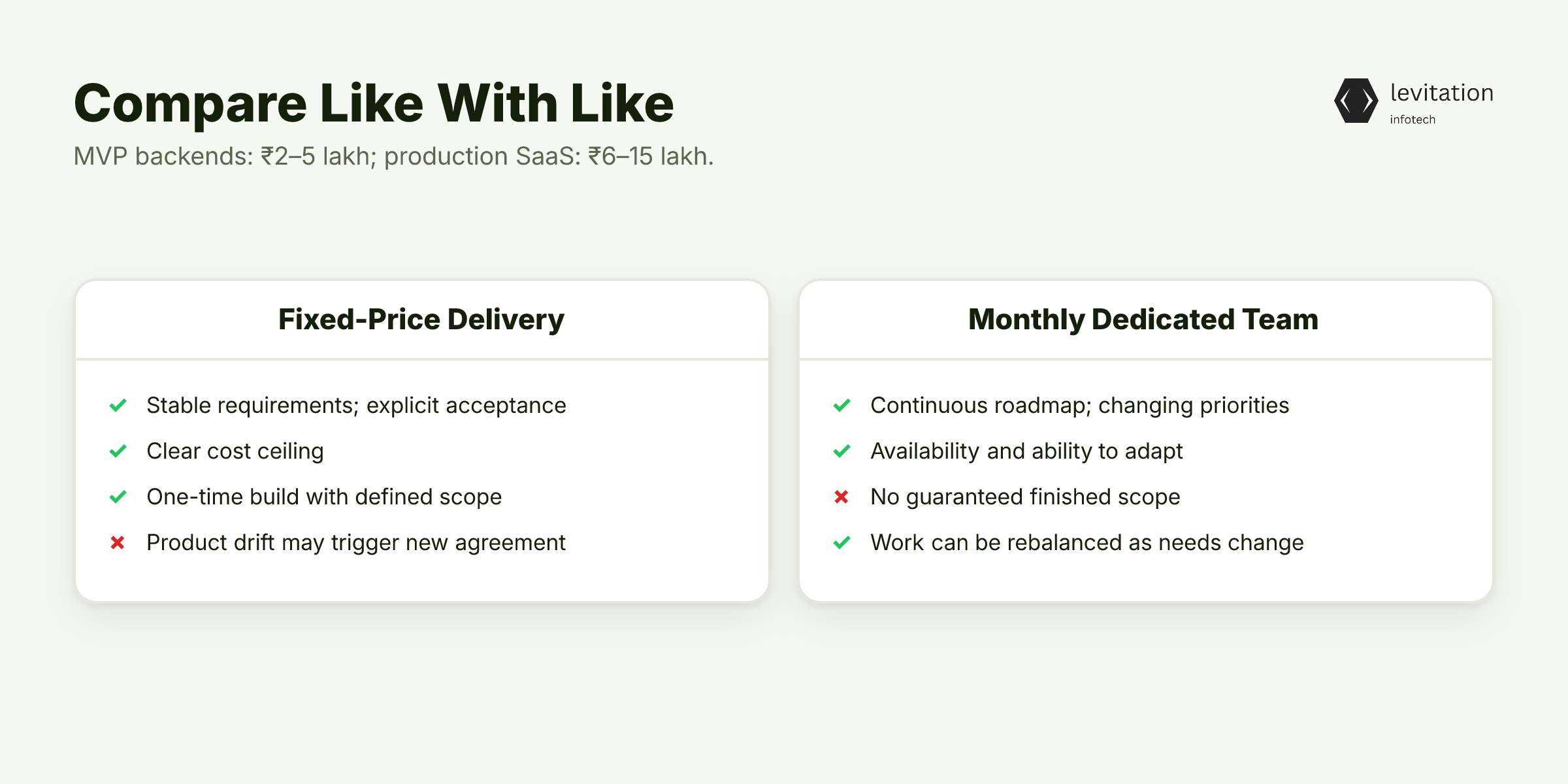
The difference isn't team quality. It is what each contract promises.
Anchor the comparison to verified ranges
The 2026 India AI-coding-tool cost guide places one-time MVP backend builds at ₹2 lakh to ₹5 lakh. Production SaaS builds range from ₹6 lakh to ₹15 lakh.
Use the full software development cost in India guide to compare those scope reference points. Treat each range as a starting point, not a quote for every project.
They help expose missing work, but they cannot replace detailed discovery.
Which scope details would your own brief miss?
Identify what fixed pricing is buying
Fixed-price delivery is strongest for a one-time build with stable requirements and explicit acceptance criteria. It works best when the delivery window is defined and the product has stopped changing shape.
Imagine a settled checkout flow with a fixed list of screens and tests. Fixed price gives the buyer a clear ceiling.
However, it becomes a bad choice when the product itself is still evolving. The drift warning in fixed-price SaaS quotes becoming hourly shows why.
When does that drift justify buying capacity instead?
Identify what monthly capacity is buying
Monthly capacity is justified by a continuous roadmap, changing priorities, or specialist skills needed immediately. The buyer receives team availability and the ability to adapt, not a guaranteed finished scope.
Imagine a marketplace that must add fraud checks, partner tools, and new markets in sequence. A dedicated team can rebalance its work. A fixed-build vendor cannot do this without a new price agreement.
So how do you compare two different promises on one page?
Compare every vendor proposal the same way
Founders outsourcing software development to India should give every vendor the same brief. Ask each to price: - The same deliverables - The same nonfunctional requirements - The same ownership terms - The same support window - The same recurring costs - The same change process
Role labels and team size cannot show whether two proposals deliver the same outcome. The cost gap predicts the right work model only after you classify how truly stable the requirements are.
Until then, the cheapest quote often prices the least uncertainty. How stable are your requirements when the first quote arrives?
Fixed Price Software Development Wins on Scope Certainty
Requirement stability turns a price list into a decision.
Build a requirement-volatility matrix
Place known requirements in one column, probable changes in a second, and unknown discovery in a third. Then apply a simple rule: - Known requirements: Use a fixed build for the stable core. - Probable changes: Combine a fixed core with dedicated capacity or a defined change budget. - Unknown discovery: Run a short paid discovery stage, then reprice the main build.
Do not force unknown discovery into a fixed deliverable.
Before choosing a column, price the full commitment. See which model the uncertainty actually favors.
Compare total cost, not monthly fees
For dedicated capacity, multiply the monthly fee by active months. Then add founder management, hosting, maintenance, and approved changes.
For a fixed build, add the build fee to running costs and any separately approved changes. For a ₹10 lakh MVP, annual maintenance at 15% to 25% adds ₹1.5 lakh to ₹2.5 lakh.
Hosting and database charges recur monthly and must appear in both models. A sound custom software development proposal makes those items visible.
The software development cost in India guide provides the reference point, not the worksheet.
Which number changes when support and management enter the sheet?
Find the fee-only crossover
At ₹2 lakh per month, dedicated fees reach a ₹6 lakh fixed-build budget after three months. Treat that crossover as an early warning, not a final verdict.
It becomes meaningful only when both options cover the same outcome. Otherwise, one proposal is often cheaper because it promises less.
Which outcome will make the comparison fair?
Use a one-page total cost worksheet
Put these fields on one page: - Delivery window and expected scope changes - Weekly management commitment - Infrastructure and recurring services - Annual maintenance and support assumptions
Then identify the month when dedicated spending would exceed the fixed-build ceiling. A worksheet without a decision date is only notes.
What decision will that date force?
Define the repricing trigger before launch
Define what qualifies as a changed requirement before launch. Name who approves it and whether it pauses the fixed scope or uses dedicated capacity.
This prevents uncertainty from entering the project without a commercial decision. The framework tells you which shape to buy. However, only a precise contract prevents that shape from expanding after signature.
Which clause could let it expand anyway?
Contract for the Work You Actually Buy
A good delivery model can still fail because of vague clauses.
Lock the fixed-build deliverables
Require a fixed-build agreement to lock its deliverables before signature: - PRD and prioritized user stories - Architecture and API specifications - Acceptance tests and nonfunctional requirements - Delivery schedule - Source-code ownership - Acceptance procedure - Change-order process
Each item turns intent into proof that a buyer can check.
Does your contract cover the team's operating model too?
Specify the dedicated-team operating model
For a dedicated team, document the work model instead: - Monthly capacity and team composition - How work is assigned and sprint outcomes - Communication schedule and reporting - Code ownership and access rights - Rollover, termination, and service levels
Separate committed work from advisory capacity. Otherwise, the buyer can pay for a team without knowing what it will do.
Which deliverables carry the same weight in both models?
Make security a priced deliverable
Make security a priced deliverable, not a launch-week assumption. Include encryption, secrets detection, role-based access, audit logs, dependency scanning, and deletion controls.
Place model migration and prompt tuning in the acceptance criteria or support schedule. Ask how each item will be tested and accepted.
What happens when discovery reveals a new dependency?
Handle uncertain discovery first
If requirements are unstable, begin with a short, paid discovery or MVP stage. Give that stage explicit acceptance criteria, then price the larger build.
Do not disguise open-ended discovery as a fixed deliverable.
Who has delivered that scope under real operating pressure?
Vet delivery capability with proof
Demand proof from real operations, not polished promises. Look for evidence of relevant delivery experience, production reliability, and client retention.
These signs matter because software quality shows over time. A custom software development proposal should carry this evidence, while the India cost guide keeps price comparisons honest.
About the author
Mayank Singh is a software developer at Levitation Infotech, where he builds web and AI-powered applications across the company’s fintech, healthcare, and enterprise projects.