


TL;DR: Fixed-price SaaS quotes in Noida don't fail because vendors are dishonest. They fail because the engagement model is wrong. The vendor is forced to price work it hasn't done yet, and the founder is forced to sign a number that can't survive real architecture. The fix is a tiered engagement: Discovery, scoped MVP, pre-agreed hourly. It protects budget where scope is knowable and admits cost where it isn't.
Key Takeaways: - Sprint 3 is the breaking point because real services (payments, auth, tenant isolation) get wired into the scaffold. The scope the fixed-price quote never priced surfaces here. - A longer spec document won't fix this. The unknowns that blow up SaaS budgets (auth edge cases, API failure modes, multi-tenant data isolation) are not specifiable before you build. - A tiered engagement model with fixed-price Discovery, fixed-price narrow MVP, and pre-agreed hourly T&M prevents the sprint-3 collapse. You keep the budget predictability founders want.
The Sprint 3 Breaking Point Nobody Warns You About
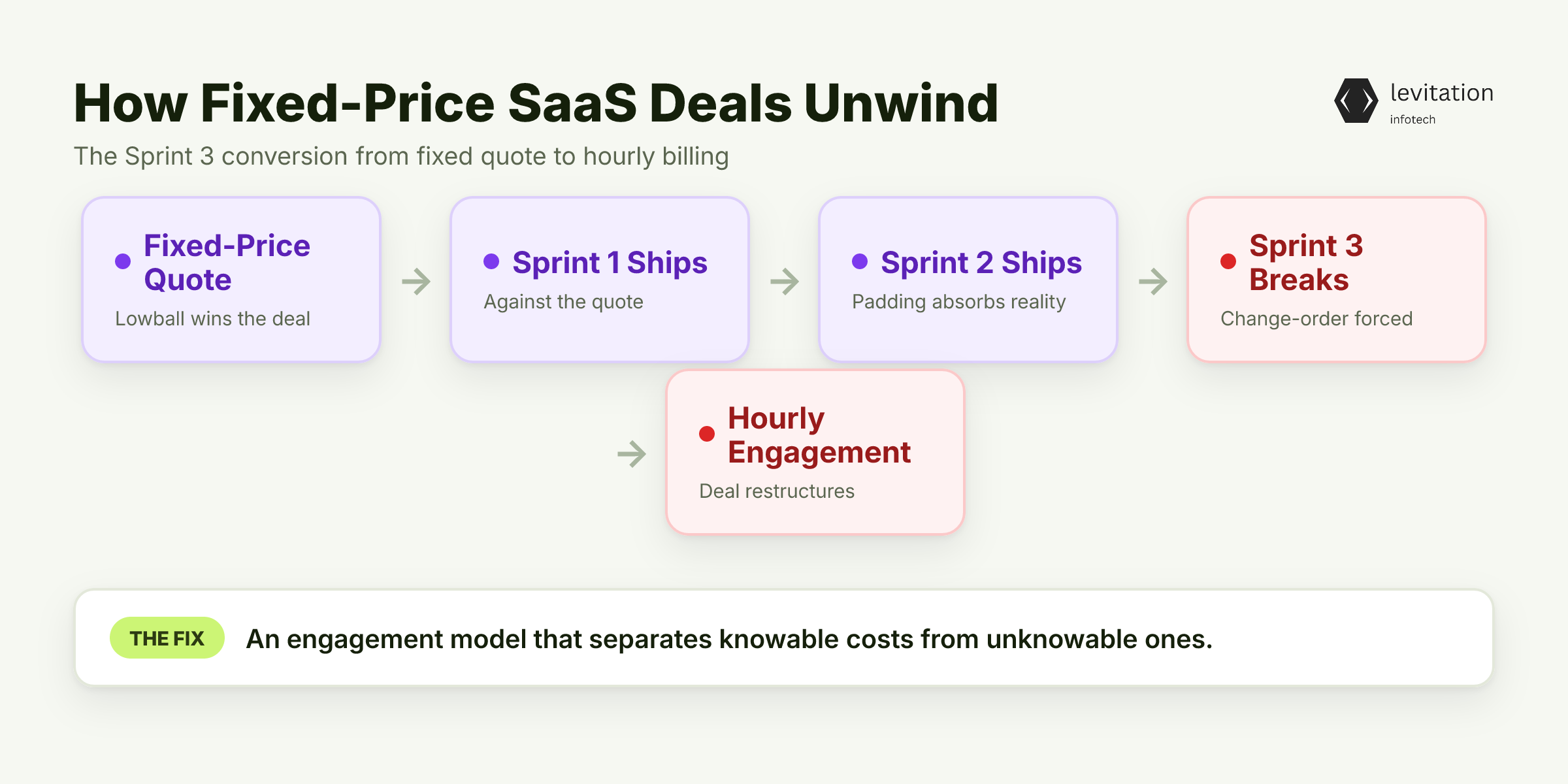
Sprint three is where the deal dies. Not the project. The deal. The pattern is almost clockwork. Sprint 1 and 2 ship against the fixed-price quote. Sprint 3 forces a change-order conversation. By the time the dust settles, the engagement is hourly.
Most Noida SaaS development companies quote fixed-price because that's what closes deals. They don't price real risk. Quotes for an Indian SaaS MVP are set low enough to win the deal. They assume the spec survives contact with reality. It never does for a first-time product. The founder loses twice: budget predictability dies, and the vendor relationship sours when product-market-fit pressure is highest.
The natural response is to blame the vendor. The structural answer is worse. The vendor is behaving rationally. The quote is structurally dishonest by design, and both sides pretend it isn't.
This is exactly why fixed-bid pricing stalls Noida SaaS builds by 6 months. The conversion event isn't a mistake. It's the business model unwinding. The vendor pads the quote to absorb known unknowns. The founder signs a number that looks like certainty. By sprint 3, the padding is gone and the real scope is finally visible.
Neither side was lying. The model was lying. If you understand why this happens, you can see why the fix isn't a better spec or a more honest vendor. It's a different engagement model, one that admits which costs are knowable and which aren't. That's the only way to keep custom software development cost in India from doubling between week one and week nine.
Why 'Just Add More Detail to the Spec' Never Works
The instinct is to blame the spec. The instinct is wrong. Founders assume a longer requirements document fixes the problem. But a SaaS MVP's unknowns are not the kind that fit in a Google Doc. The unknowns that matter, including integration behavior, third-party API rate limits, multi-tenant data isolation patterns, and auth edge cases, are not specifiable before you build. You can't write down what you don't yet know.
They pad the quote to absorb the risk of those unknowns. The "fixed-price" you signed is already inflated to cover expected change orders. Once sprint 1 reveals the real scope, the vendor faces a choice: eat the padding, or convert to hourly. Almost every shop picks hourly. That's rational, not malicious. - The padding gets consumed by sprint 2. - The real scope surfaces in sprint 3 when payments and tenant logic get wired in. - The conversion conversation happens before the scope conversation.
The deeper trap: when the engagement flips to T&M mid-build, you've lost the negotiation advantage you had at signing. You're now buying hours from someone who already knows more about your codebase than you do. The hourly rate you didn't pin down at signing is the rate they quote you at conversion. It's almost always higher than the custom software development rate card you would have seen if you'd asked earlier.
This is also why systems that survive sprint three tend to stay in production. The teams that run them didn't skip the unknowns. They surfaced them up front through a real Discovery phase, then built only the narrow slice that could be priced honestly. Skip the discovery and you're rebuilding the same product three years later. Three triggers, fired in sequence, account for most of those failures, and recognizing them before signing is the real edge.
So the failure isn't a missing line item in the spec. It's a specific sequence of triggers that fires inside the first three weeks of coding. Those triggers are predictable, and so is the fix. But only if you know which multi-tenant SaaS architecture decisions need to be made before sprint one starts.
The Three Hidden Triggers That Flip Fixed-Price to Hourly
Three triggers, not one. Miss any of them and sprint three burns.
Trigger 1: The auth and onboarding reality. Sign-up flows, email verification, password reset, SSO, and role-based access look simple on a Figma board. They expand into a long list of edge-case requirements that no fixed-price quote accounts for: token refresh, session expiry, multi-factor flows, password hashing standards, account lockout policy, audit logging. None of it shows up in the original quote because the founder was thinking about login, not everything that happens around login.
Trigger 2: Third-party API surface area. Payment gateways like Razorpay or Stripe, SMS providers, and email delivery each add integration testing, webhook handling, and failure-mode logic that no fixed-price quote ever covers. Webhook signature verification, idempotency keys, retry policy, partial-failure reconciliation, refund flows, dispute webhooks. Every one of these is real engineering work that the MVP spec quietly assumed "the API just handles."
Trigger 3: Tenant data isolation. The moment a SaaS product is multi-tenant, row-level security, backup segregation, and compliance considerations force architectural decisions that weren't in the original scope. For healthcare and fintech-adjacent products, this trigger alone can consume an entire sprint. The SaaS MVP development cost conversations never price it in.
Sprint 3 is almost always where Trigger 2 or 3 surfaces because that's when the team wires real services into the scaffolded UI. It's the first time the vendor sees the real complexity. By then, the fixed-price quote is already underwater.
This is the mechanism every founder in the Noida SaaS market eventually learns the hard way. Fixed-price is a sales tool, not a delivery tool, for any non-trivial SaaS build. The bespoke SaaS application development shops that deliver well are the ones that price this sequence in, not the ones that hide it. If the failure is structural, the fix has to be structural too, which means giving up the single-number quote.
What a Tiered Engagement Model Actually Looks Like in Practice
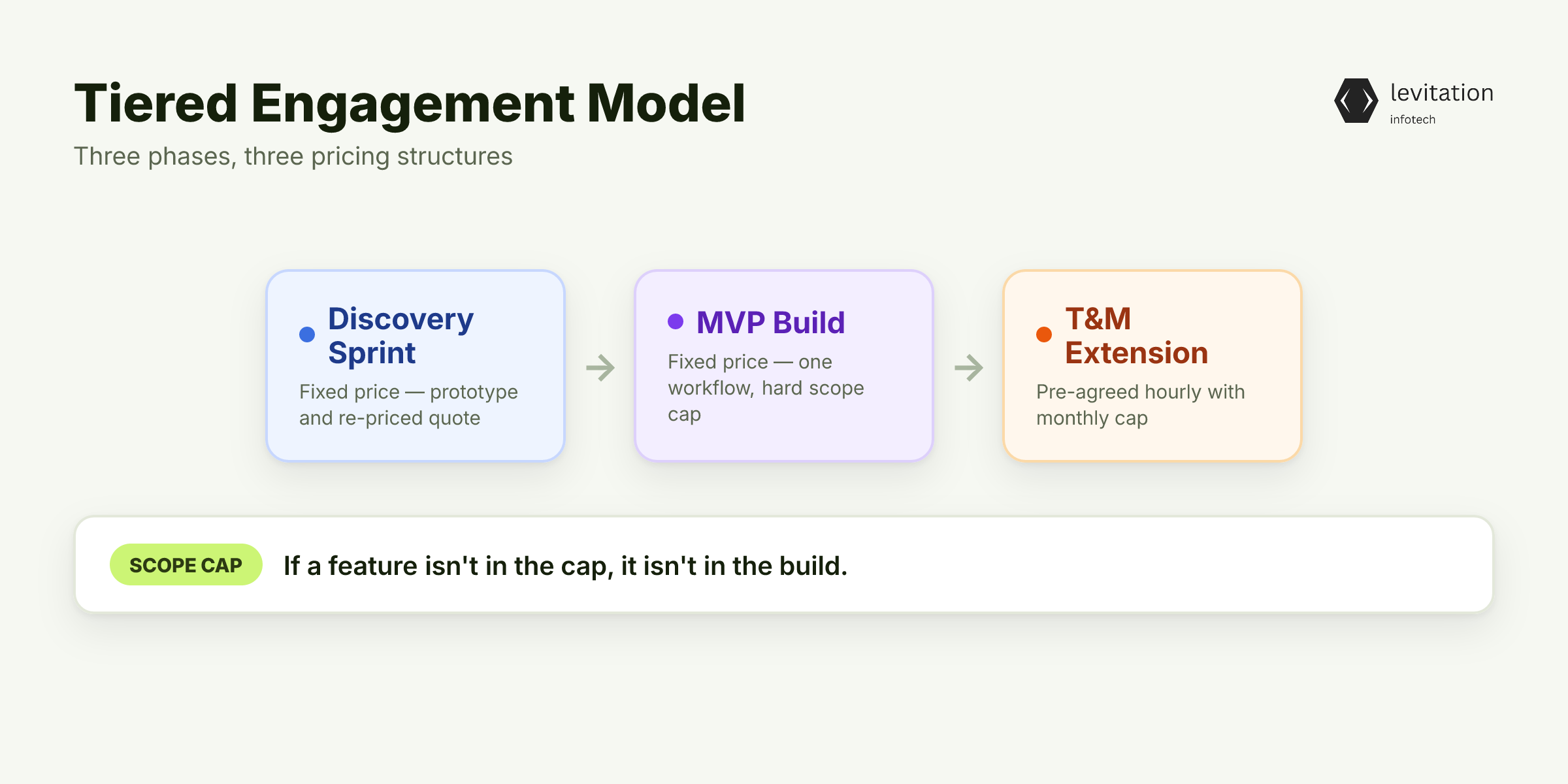
Stop quoting a single number. Start quoting three. Replace the fixed-price quote with three linked milestones: a fixed-price Discovery Sprint, a fixed-price MVP build with a hard scope cap, and a T&M extension phase with a pre-negotiated hourly rate. Each phase has a different job. Pricing them all the same is what kills you.
Discovery Sprint (fixed price). The deliverable: a clickable prototype, a confirmed architecture document, and a re-priced MVP quote that reflects what you actually learned. This is the missing piece that prevents the sprint-3 collapse. Without it, every other commitment is guesswork.
MVP build (fixed price, narrow scope). One core workflow, one payment path, one user role. Budget the rest as Phase 2, not as "we'll squeeze it in."
The hard scope cap forces tradeoffs to be explicit. If a feature isn't in the cap, it isn't in the build.
T&M extension (pre-agreed hourly, pre-agreed cap). Indian developer rates vary by seniority and compliance complexity. The rate should be on page one of the proposal, not buried in an annexure. Add a monthly cap and a weekly burn report. This isn't giving up predictability. It's buying predictability for the parts that can be priced, and explicit hourly for the parts that can't.
The dedicated development team engagement model fits naturally here. Same team across all three phases, no re-onboarding, no knowledge transfer loss. Mature engineering organizations use this structure to avoid the sprint-3 conversion event because the alternative is the conversion nobody wants.
Re-pricing the build after Discovery sounds expensive. It isn't. It's the cost of finding out, in week two, what the quote was hiding in week zero. The MVP cost in India is the same number either way. The question is whether you discover the real number before or after you've signed. Knowing the model exists and reading an actual quote are two different skills. Most Noida proposals will not lay this out unless you ask for it.
How to Read a Noida SaaS Quote Before You Sign
A good quote reads like a contract. A bad one reads like a sales call summary. The difference shows up in the line items. Here is what to look for, and what to walk away from.
Red flag #1: A single line item for "MVP development" with no phase breakdown. This is the quote that's about to become hourly. If the proposal can't decompose the work into Discovery, Build, and Extend, the vendor hasn't thought about the work, only the price.
Red flag #2: Hourly rate hidden in fine print or only quoted verbally. Indian rates for mid-level and senior or compliance-heavy work vary widely, and the spread between them is large. They should be on page one. If they aren't, the rate is going to be a surprise.
Red flag #3: No mention of third-party integration costs (Stripe, Razorpay, SendGrid, Twilio). These are the exact triggers that cause the sprint-3 flip. A quote that ignores them is a quote that will renegotiate them later, on the vendor's terms.
Green flag: A separate Discovery line item at fixed price, with a deliverable you can evaluate before committing to the build phase. This means the vendor understands the engagement, not just the sale.
Green flag: A scope-change clause that names a price per requirement, not "TBD." This lets you make tradeoffs without renegotiating the whole engagement. Custom software development services that don't offer this are pricing in their own margin for the change-order conversation they know is coming.
Green flag: A list of explicitly out-of-scope items. The honest quote tells you what it isn't doing. The dishonest quote leaves omissions for sprint 3 to discover.
Ask directly: "What is your hourly rate if we need to add a feature after sprint 2?" If they won't answer in writing, the sprint-3 conversion will be on their terms, not yours. This single question, asked before signing, separates the vendors who will survive the build from the ones who won't. For a deeper look at how vendors disguise the conversion, the patterns in 6 hidden costs in Noida software quotes show the same tactics across the market.
What Changes When You Stop Fighting the Conversion
The sprint-three moment is not a failure. It's a signal. It tells you the engagement model was wrong from the start, not that the vendor or the founder was wrong. Founders who accept that SaaS development cost in India is a discovery-driven number, not a fixed one, make better capital decisions and ship faster. They stop treating the change-order as an adversarial event and start treating it as the first honest conversation about scope.
The tiered model compresses the typical 6-month delay caused by fixed-bid stalls. Change orders stop being a reason to renegotiate the whole engagement. The contract was already structured for them. The price was already agreed.
The conversation becomes "do we want to spend more hours on this feature," not "do we need to rewrite the SOW." Three things change when you stop fighting the conversion: - You keep the psychological safety of a fixed price for the parts that matter most (the MVP scope), and the operational honesty of hourly for the parts that can't be predicted. - The vendor relationship survives the sprint-3 moment because there's no contract to renegotiate, just a pre-agreed hourly rate and a cap. - You stop being the founder who has to explain to the board why a "fixed-price" project is well over budget.
The teams that build bespoke SaaS products the right way and stay in production didn't avoid the unknowns. They surfaced them up front, priced them honestly, and built only the slice that could be priced. The rest went into a known-rate extension phase, not a surprise mid-build conversion.
This is also how compliance-heavy deployments for healthcare and fintech-adjacent products get delivered without the engagement collapsing. The compliance work is priced as a separate phase, not absorbed into a fixed bid that was never going to hold.
If you want to know whether your vendor can run this kind of engagement, ask them how they handle fixed bid vs hourly billing in India. The answer will tell you more about the next six months than the proposal will. For teams that operate this way as a default, like the engineering groups at Levitation, the model isn't a workaround. It is the product.
Frequently Asked Questions
Q: Is fixed-price or hourly billing better for a SaaS MVP in India?
A: Neither on its own. A tiered model with fixed-price Discovery, fixed-price narrow MVP scope, and a pre-agreed hourly rate for everything after outperforms both. It gives you budget predictability where scope is knowable and honest hourly billing where it isn't.
Q: How much does a SaaS MVP cost in India in 2026?
A: Costs vary widely by scope, architecture, and feature set, so a single number is misleading. The key indicator isn't the dollar figure on the quote. It's whether the engagement model accounts for Discovery and a pre-agreed hourly rate for post-sprint-3 work. Quotes that don't include these structures are almost certainly teasers designed to convert to hourly billing by sprint three.
Q: What is a fair hourly rate for Indian SaaS developers?
A: Hourly rates depend on developer seniority, tech stack complexity, and compliance requirements. The spread is large. The specific number matters less than getting it in writing before sprint three, when the fixed-price quote usually dissolves.
Q: Why do Noida SaaS vendors push fixed-price quotes if they convert to hourly?
A: Fixed-price quotes close deals faster. Ask instead for the tiered model and you'll see which vendors can actually deliver.
About the author
Mayank Singh is a software developer at Levitation Infotech, where he builds web and AI-powered applications across the company’s fintech, healthcare, and enterprise projects.