


TL;DR: Boards approve multi-model AI plans. Engineers ship on a single vendor. The gap is a governance failure. Fix it by governing the decision (data class, criticality, vendor), not the model. Then encode that governance as code. This makes the compliant path the fastest path. Procurement memos won't close this gap. An internal API gateway with policy enforcement will.
Key Takeaways: - Engineers route around procurement because APIs ship in hours while contracts take far longer. - Governing the workload decision, not the model choice, is what makes hybrid AI actually work. - Model registries, evaluation-as-CI, and gateway-level policy enforcement make governance as fast as code.
Your Boardroom Says Hybrid. Your Git Log Says Otherwise.
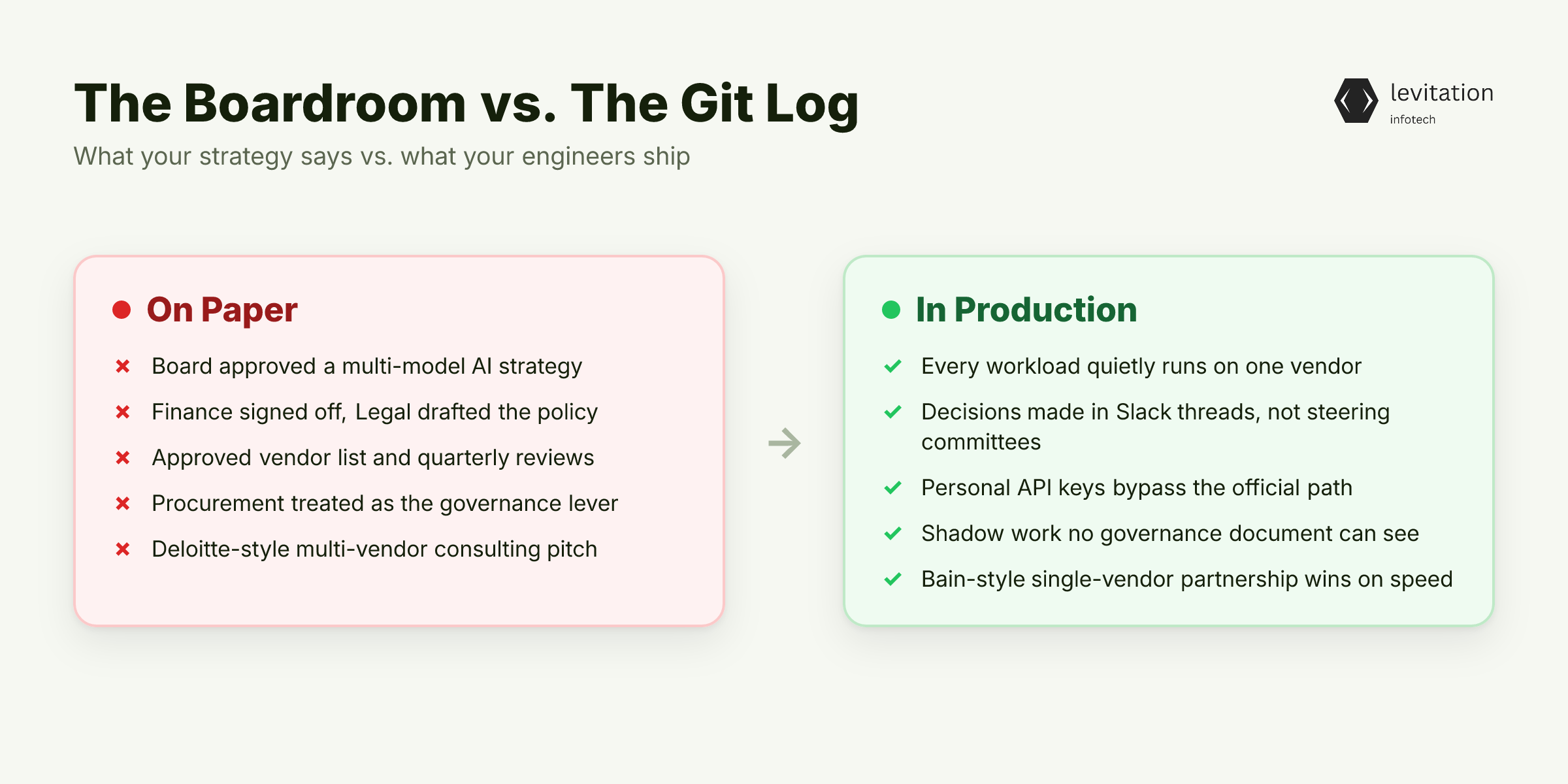
Here's a pattern every CTO recognizes: the board approved a multi-model AI strategy. Finance signed off. Legal drafted the policy.
Engineering quietly built everything on one vendor anyway.
Deloitte launched a generative AI practice. It helps enterprises blend open and proprietary models. This spans developer productivity, fraud detection, and supply chain. The consulting world's biggest names are telling clients to diversify. Yet those same firms keep losing the internal fight.
Bain & Co. partnered directly with OpenAI, not "OpenAI plus alternatives." The signal is clear: even consulting firms cannot resist single-vendor gravity when speed matters.
The real hybrid AI strategy is the one your team is already running, whether you approved it or not. Pull requests tell the truth that slide decks do not.
If your engineers are using one provider for nearly every workload, you do not have a hybrid strategy. You have a strategy on paper and a single-vendor reality in production.
This is a common failure. Most enterprises treat AI governance as a procurement document. It includes a list of approved vendors, a data classification matrix, and a quarterly review meeting. Meanwhile, engineers who actually ship make the decision in a Slack thread. They often use a personal API key to bypass the official path entirely. The result is shadow work no governance document can see.
But the obvious fix makes the problem worse: tightening procurement, locking down the vendor list, sending a memo. Here's why.
Why Procurement Will Never Beat Developer Velocity
Procurement operates on enterprise timelines measured in months. OpenAI's path from signup to production call runs in hours. The velocity mismatch is structural, not cultural.
No governance document survives that gap.
One hybrid approach offers a useful mirror: execution is picked per task, not per application. A model on local hardware handles a low-latency interaction. A cloud model handles a complex reasoning step. Both can sit inside a single product.
Developers get compatible runtimes, model formats, and a unified API. The decision moves from architecture review to runtime routing.
When governance feels like a bottleneck, engineers route around it. They use personal API keys, spawn shadow projects, and quietly test models in notebooks.
These side channels are not malicious. They are a rational response to a process that cannot keep up. The result: your most innovative work happens outside your AI governance perimeter. It happens exactly where auditors cannot see it.
So if tightening controls backfires, and loosening them creates chaos, what's the actual answer?
The Uncomfortable Truth: Hybrid AI Is a Governance Problem First, Architecture Second
Most enterprises reverse the order. They pick a vendor stack first, then write governance to defend it. One workload-first model inverts this: decide the workload, run it anywhere, govern centrally, and abstract infrastructure.
The order matters. It is the difference between a strategy that survives contact with engineers. It is also the difference from one that gets bypassed in a sprint.
Vendor dependency offers a cautionary lesson. Organizations build impressive AI features on top of cloud models they do not control. They then inherit every change the model provider makes. When a vendor shifts pricing, retires an endpoint, or changes behavior, the dependent organization inherits the change.
This is feature-driven integration, not a vertically integrated AI strategy. It looks like hybrid AI from the outside. Underneath, it has a single point of dependency.
The decision worth governing is not which model to use. It is which class of data, which latency tolerance, and which failure cost each workload carries.
A customer support summarizer touches PII. It should not share a model with a marketing copy generator. That one touches nothing sensitive. They should not share a governance path either. Treating them as the same workload is how AI governance fails. It ends up either too loose to matter or too tight to ship.
Governing the decision instead of the model is the mechanism. So how do you turn this into a framework your engineers will actually use?
The Three-Layer Model Selection Framework
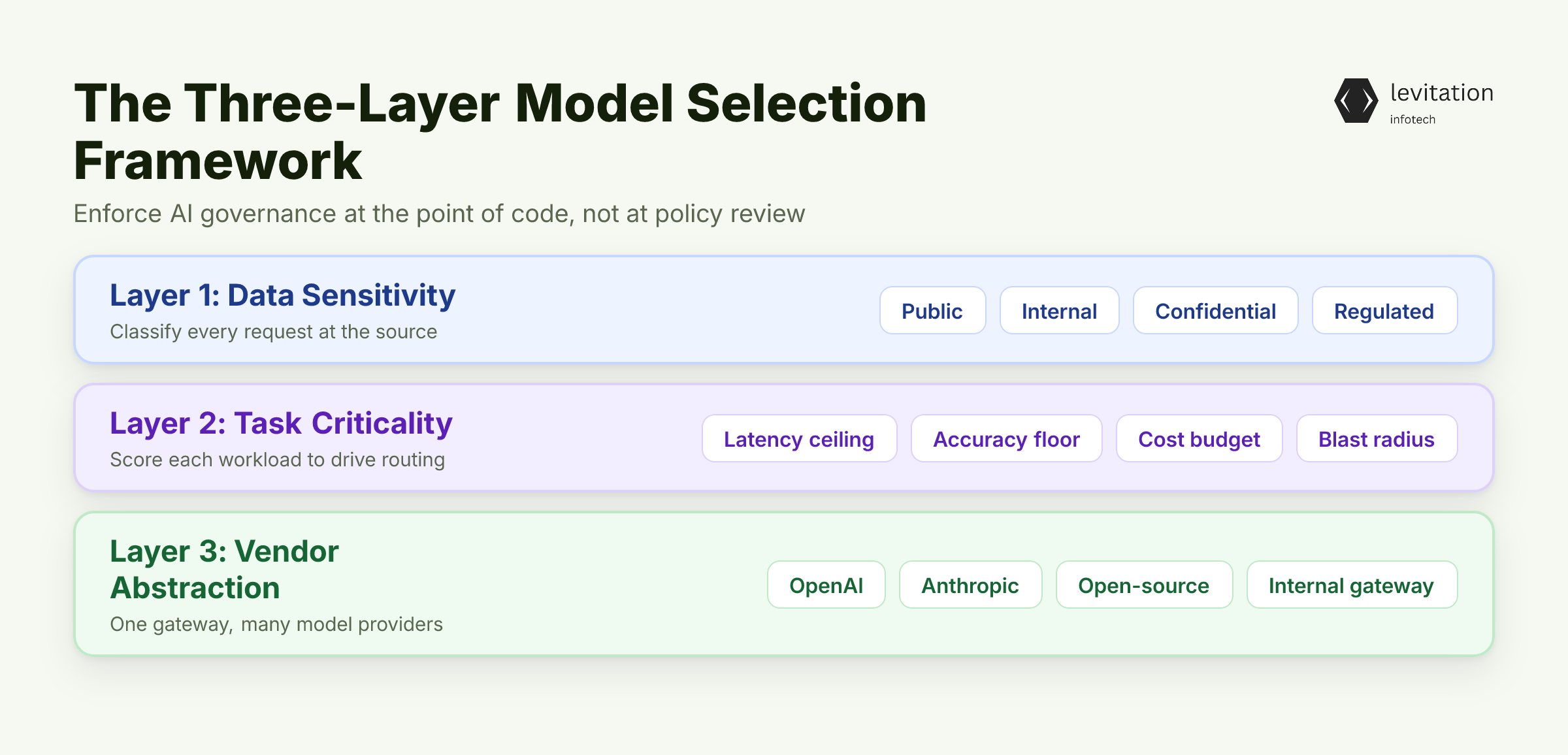
A framework that survives contact with engineers has to be enforceable. It must work at the point of code, not at the point of policy review. The three-layer model below does exactly that.
Layer 1 - Data sensitivity classification. Every request is tagged at the source: public, internal, confidential, or regulated. The tag maps to eligible model categories. Public data can hit any API. Confidential data stays on private cloud or on-prem.
Regulated data (PII, PHI, anything covered by sector rules) must run on infrastructure you control. Full stop. This is the layer that matters most, and the one most teams skip.
Layer 2 - Task criticality scoring. Each workload gets a profile. It includes latency ceiling, accuracy floor, cost-per-call budget, and blast radius if the model hallucinates. A chatbot misclassifies an intent. A medical triage tool misses a critical symptom. They carry very different blast radii.
The score determines fallback logic, retry policy, and which models are eligible at all. Criticality is the input that makes routing intelligent rather than arbitrary.
Layer 3 - Vendor abstraction. A thin internal gateway normalizes OpenAI, Anthropic, and open-source endpoints behind one interface. Engineers write code against the gateway. The gateway handles the rest.
This is where AI governance becomes a runtime concern instead of a documentation problem. Without this layer, every new model is a new integration. With it, model swaps are config changes.
The framework is the spec. The harder engineering problem is making the governance layer fast enough that nobody bypasses it.
Deployments built on proven patterns reach production far sooner. In-house teams that rebuild every layer from scratch are much slower. Those in-house rebuilds often produce weaker abstractions. The speed advantage compounds. The sooner the framework is live, the sooner shadow projects start migrating. They move into the compliant path.
Governance That Ships at the Speed of Code
The compliant path has to be the fastest path. Otherwise engineers will not use it. Here is what makes that work in practice.
Pre-approved vendor registry maintained as code. New models are added via pull request, evaluated in a sandbox, then promoted to production tiers automatically. No more waiting for the next quarterly review.
The registry is version-controlled, reviewable, and auditable. When a new model drops and your team wants to try it, the path is simple. It is a PR, not a procurement ticket.
Model evaluation as CI. Every new model version runs a regression suite against your golden prompts before it touches production traffic. Accuracy, latency, cost, and safety metrics are tracked per release.
This is the same pattern your engineering team already uses for application code. It just runs against prompts instead of functions. The teams that skip this step end up with silent regressions and eventual outages. We have written about this in 7% Pass AI Governance Audits. The 93% Can't See Why..
Policy enforcement at the gateway, not in the wiki. Data classification tags attached to requests determine routing in real time, with zero engineer intervention.
Confidential data cannot reach a public API even if the engineer tries. The gateway blocks it before the call leaves your infrastructure. This is the same pattern we have applied across enterprise deployments in regulated industries.
This is what it looks like in week one. Here's what it looks like 18 months later, when the system is actually mature.
What Mature Multi-Model Governance Actually Looks Like
Mature AI governance changes the texture of daily work. Engineers stop asking permission. They start asking questions. The gateway answers them automatically with cost, latency, and compliance data. A senior engineer choosing between models sees the trade-offs in their IDE. They see them rather than in a wiki last updated in Q2.
Vendor switching becomes a configuration change, not a six-month migration. True multi-model governance means no single point of lock-in. When a vendor changes pricing, retires an endpoint, or falls behind on benchmarks, you move workloads. You do it in a sprint. Not a fiscal year.
This is the resilience hybrid AI is supposed to deliver. It is the only way it actually does.
The AI vendor strategy shifts from quarterly procurement reviews to continuous, data-driven decisions surfaced in dashboards. Cost-per-task, model drift, fallback rates, and compliance violations become live signals. Strategy becomes a runtime property, not a planning artifact.
We have explored this in Your AI Strategy Says Three Models. Your Engineers Use Eleven. The gap between stated strategy and ground truth is where most governance dies. Closing that gap is what maturity looks like.
The long-term payoff is operational, not just architectural. Teams that run mature multi-model systems see compounding gains. They see lower unit costs, faster model swaps, fewer compliance gaps, and engineers who actually want to use the approved path.
Validation in mature deployments comes from the system continuing to improve after launch. It is not from the original architecture being perfect. Several systems that started with this kind of framework are still running in production today. That longevity is the only real measure of an AI platform.
This is the kind of layered governance we build at Levitation. We build production-grade AI systems. In these, governance and abstraction are as engineered as the models. The lesson is that hybrid AI does not fail at the architecture layer.
It fails at the governance layer, where boards plan in quarters and engineers ship in hours. Close that gap with code, not memos, and the strategy on paper becomes the strategy in production.
Frequently Asked Questions
What is a hybrid AI strategy in practice?
A hybrid AI strategy routes workloads to different models based on data sensitivity, latency, and cost. On-prem open-source handles sensitive data. Private cloud handles regulated tasks. Public APIs handle general-purpose work. It is not a single architecture. It is a decision framework that runs all the time.
How do you govern multi-model AI deployments without slowing engineering teams?
Govern the decision, not the model. Pre-approve vendors through a code-based registry. Enforce data classification at the API gateway. Run model evaluations as part of CI. Engineers get one interface. Governance happens automatically based on request metadata.
Why do engineers bypass official AI vendor policies?
Procurement cycles run on timelines measured in months while APIs ship in hours. When the official path is slower than the unofficial one, engineers route around it. They often use personal API keys and undocumented projects. The fix is to make the compliant path the fastest path.
How long does it take to build a hybrid AI strategy?
A focused framework that adapts proven patterns lets the three-layer system deploy quickly. It deploys in a fraction of the time of an in-house rebuild. In-house teams that rebuild governance, evaluation, and the abstraction layer from scratch spend months. They re-solve problems that are already solved. They typically end up with weaker abstractions.
What's the difference between hybrid AI and multi-model AI?
Hybrid AI refers to where models run (on-device, private cloud, public cloud). Multi-model AI refers to using multiple models across those environments. A mature hybrid AI strategy uses multi-model governance. It makes those decisions automatically rather than case by case.
About the author
Mayank Singh is a software developer at Levitation Infotech, where he builds web and AI-powered applications across the company’s fintech, healthcare, and enterprise projects.