


TL;DR: Only 7% of enterprises pass independent AI governance audits. Yet 74% of leaders believe they could. The gap isn't a knowledge problem. It's an evidence problem.
Organizations that generate audit-grade technical artifacts pass at about 10x the rate. They beat those relying on policy documents. Building evidence generation into the AI architecture from day one compresses the path to audit readiness. The system produces evidence as a byproduct of normal operation. No manual reconstruction is needed.
Key Takeaways: - Policy statements are not audit evidence. Technical artifacts generated by the system itself are. - A maturity score of 120 is self-reported. Higher scores correlate with better compliance and governance maturity. - Organizations with fully integrated AI governance pass independent audits at 10x the rate of those still piloting. - Building evidence generation into the architecture from day one compresses the audit-readiness timeline. It does this by producing evidence as a byproduct of normal operation. - Audit-ready systems add value over time. The same evidence infrastructure speeds up M&A diligence, vendor risk reviews, and regulatory inquiries.
The 74% Who Think They're Ready
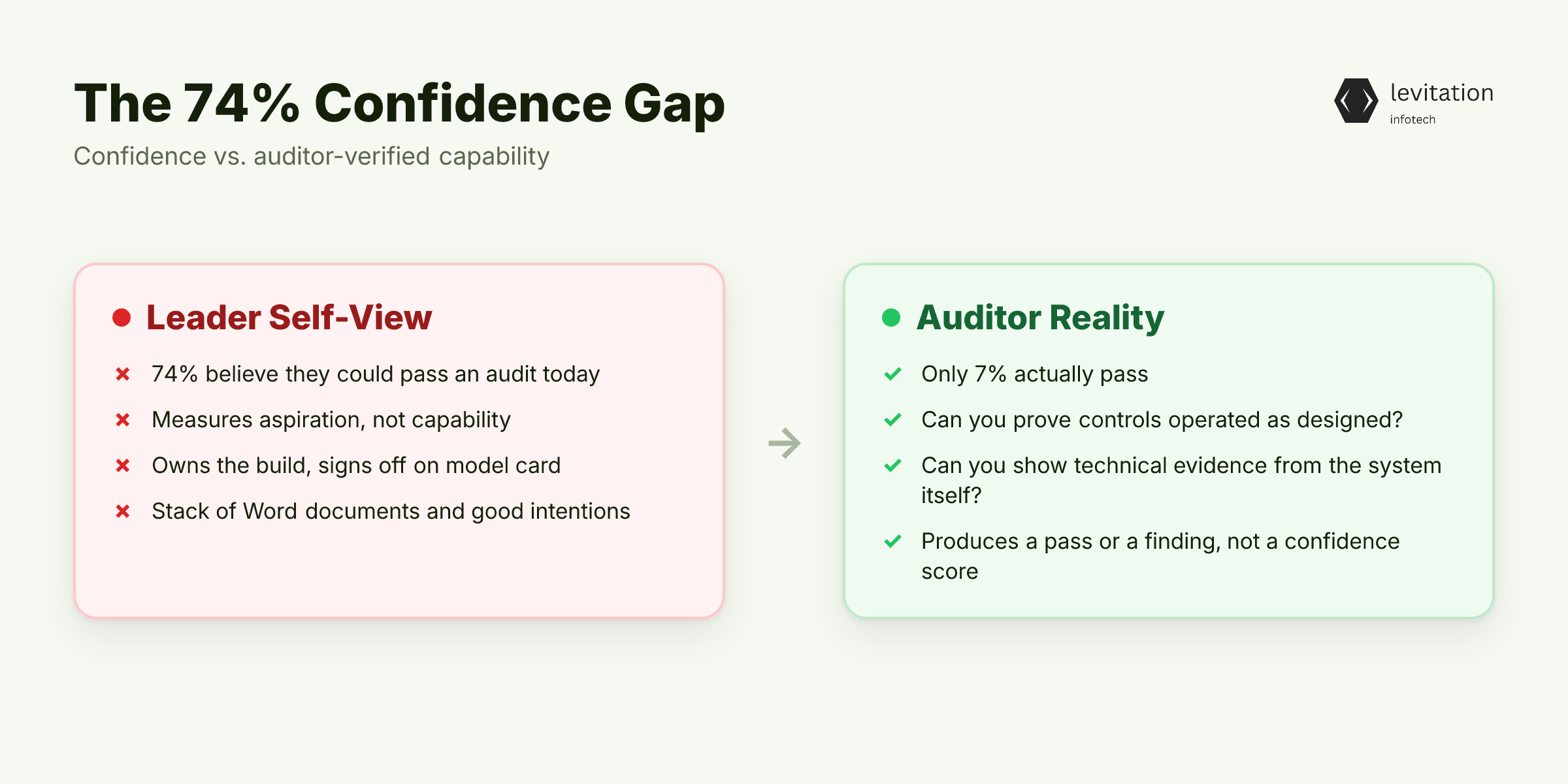
Seventy-four percent of enterprise leaders believe their organization could pass an AI governance audit today. Only 7% actually do. That 67-point gap between confidence and competence is the most expensive blind spot in enterprise AI right now. It is also the gap leaders tend to overlook.
The disconnect starts at the top. Those closest to the build are most likely to overestimate audit readiness. The reason is structural. They own the build. They sign off on the model card. They sign off on the access policy. They sign off on the data lineage diagram.
From inside the build, everything looks controlled. From inside the audit, it looks like a stack of Word documents and good intentions.
The problem isn't dishonesty. Most technical leaders genuinely believe their AI governance is solid. They've invested in frameworks. They've written policies. They've appointed responsible officers.
But the question they answered was "Did we build this responsibly?" Auditors ask something else. They ask: "Can you prove that the controls operated as designed?" They also ask: "Can you show technical evidence generated by the system itself?"
Those are different questions. The first produces a confidence score. The second produces a pass or a finding.
The self-reported maturity score of 120 that many organizations cite? It measures aspiration, not auditor-verified capability. It's the answer to the wrong question. It's inflated by the pride of the team that built the system.
So why do policy-rich, framework-heavy organizations still fail when auditors walk in?
Why Policy-Rich Organizations Still Fail Audits
An auditor reviewing AI data governance will accept a policy as context. They will not accept it as evidence.
This distinction is where the 93% collapse. A written access control policy tells the auditor what should happen. The audit log entry tells the auditor what did happen. One is a claim. The other is proof.
Auditors don't grade claims. They grade artifacts. The same blind spot kills explainable AI programs that look great in design reviews and die in audit rooms (why-explainable-ai-fails-external-audit).
Consider what AI compliance actually requires. Look at the frameworks multinational enterprises now face. The EU AI Act enforces Article 12 logging requirements for high-risk systems. NIST AI RMF 1.0 defines Govern, Map, Measure, Manage functions. ISO/IEC 42001:2023 sets control objectives for AI management systems.
Each framework specifies what evidence looks like. It does not say what your policy claims you intended. Extending an LLM stack to cover a new framework without rebuilding the evidence layer produces audit findings. Not audit passes (extending-llm-stack-auditors-disagree).
Here's the failure pattern. A technical leader presents a beautifully formatted governance policy during the audit. The auditor asks for the last 90 days of ABAC decision logs for the production LLM. The leader reaches for the access logs. There are none. The system never recorded authorization decisions. The policy said access was controlled. The system never proved it was. The audit result is a finding, not a pass.
The 93% fail because they can describe what should happen. But they cannot prove what did happen. That's the entire gap. It has nothing to do with the quality of the policies. The policies are fine. The evidence generation was never built into the architecture.
If policies don't count as evidence, what does an auditor actually accept? And how do you measure whether you have it before the audit begins?
What a Maturity Score of 120 Actually Measures
A maturity score of 120 is a self-reported metric. It correlates with better compliance and governance maturity. It reflects integration across capabilities that auditors independently verify. Organizations reporting high scores typically show strength in several key areas: - Evidence generation. Can the system produce audit logs automatically, without manual assembly? - Access traceability. Can you show who accessed what data? Can you show the authorization and timestamp? - Model lineage. Can you trace a model output back to its training data version? Can you trace it back to the model checkpoint? - Decision auditability. Can you rebuild why the system made its decision? Can an auditor check this on their own? - Remediation speed. When an issue is found, how fast can you contain it? How fast can you document the response and prove corrective action?
High scores correlate with full integration across these areas. Lower scores typically reflect organizations with frameworks on paper but no automated evidence capture.
The policies exist. The architecture doesn't log. The blind spot is the one audits always find first (blind-spot-ai-stack-audits-find). That gap is exactly where the 93% live.
These capabilities map directly to the regulations auditors test against. EU AI Act Article 12 logging requirements align with evidence generation and decision auditability. NIST AI RMF Govern functions cover model lineage and access traceability. ISO 42001 control objectives anchor remediation speed and the corrective action loop.
The correlation isn't random. Self-reported high scores predict pass rates. They do this because they track the capabilities auditors actually test.
For enterprise AI solutions built with these dimensions in mind, the audit becomes a documentation exercise. Not a forensic investigation. For systems bolted together after the fact, the audit becomes a scramble. Same score range. Completely different readiness.
So what separates the two? It comes down to architecture, not policy.
The 10x Gap Between Pilots and Integrated Governance
There's a structural reason why the gap exists. It also explains why one group passes at 10x the rate of the other.
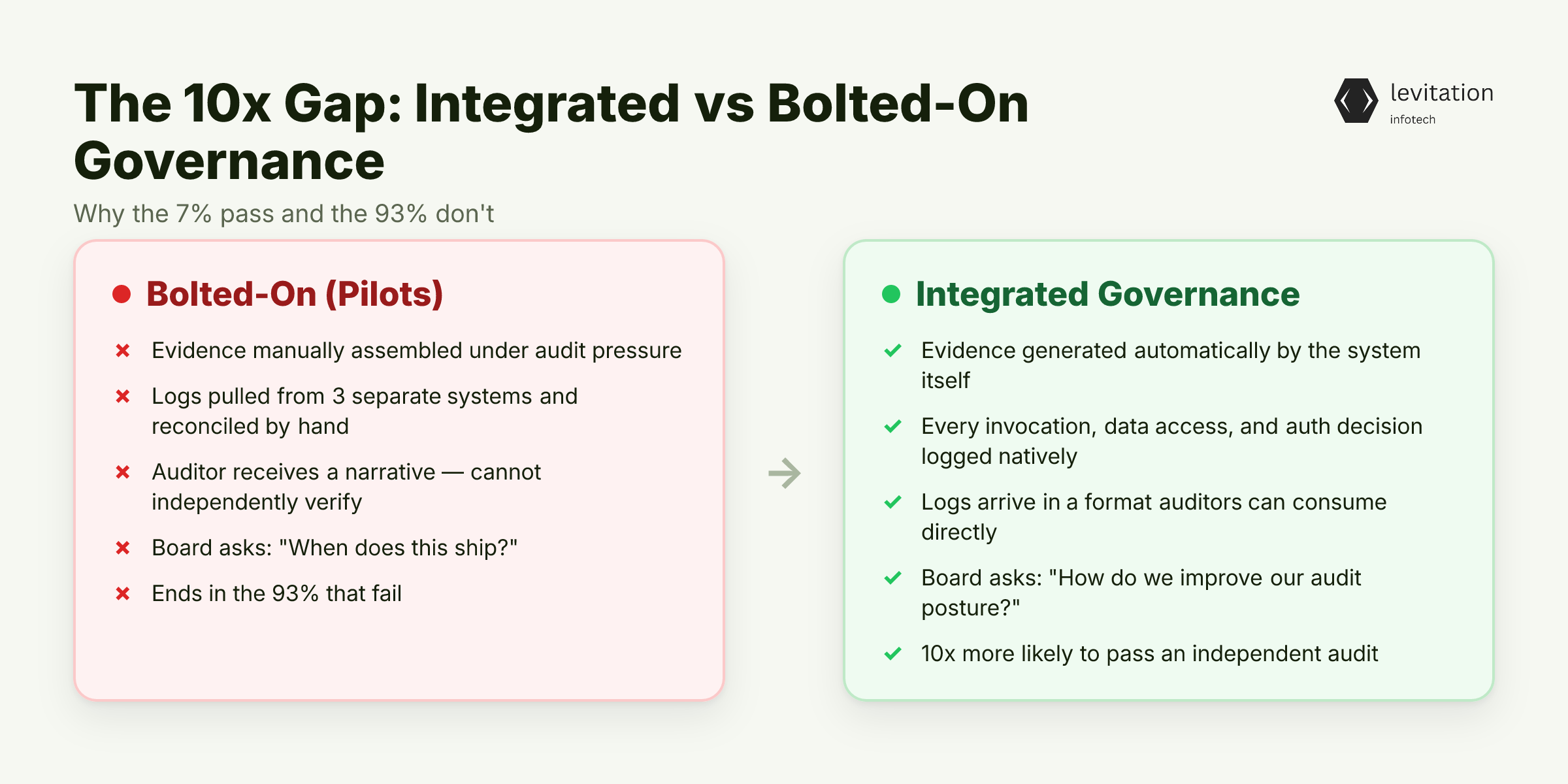
Grant Thornton's survey found a stark number. Organizations with fully integrated AI governance are ten times more likely to pass an independent audit. They pass at higher rates than those still piloting. That ratio isn't about effort. It's about architecture.
Integrated governance means evidence generation is automatic. Every model invocation, every data access, every authorization decision is logged by the system itself. The logs arrive in a format auditors can consume.
Bolted-on governance means evidence is manually assembled under audit pressure. Someone pulls logs from three different systems. They reconcile timestamps. Then they build a narrative. That narrative might be accurate. The auditor has no way to verify it without re-running the work.
The same MLOps pipeline that passes engineering tests will fail a 2026 audit. That failure happens if the system wasn't designed for evidence generation from day one (compliant-mlops-pipeline-will-fail-2026).
The difference shapes what boards see, too. Boards receiving AI governance KPIs make different investment decisions. These KPIs include remediation cycle time, evidence coverage rate, and control attestation scores. Boards receiving AI project status updates invest differently. As a result, the first group asks "How do we improve our audit posture?" The second asks "When does this ship?" The first group reaches the 7%. The second stays in the 93%.
The financial pressure makes this gap existential. The EU AI Act's penalty structure is up to €35 million or 7% of global turnover. It turns a failed audit from an inconvenience into a balance-sheet event.
For a mid-sized enterprise, that's not a fine. That's a year of operating margin, gone. And enforcement has begun. Not as a future threat, but as a current cost.
For AI compliance leaders, the question is no longer whether to invest in integrated governance. It's how to do it fast enough.
So what does the build path actually look like? Picture a technical leader sitting at a modest maturity score trying to reach audit-ready.
Building Audit-Ready AI Systems
The path from the 93% to the 7% is shorter than most teams expect. It's short, but only if evidence generation is treated as an architectural decision. Not a documentation project.
Here's how the build typically progresses: - Instrument AI pipelines to generate evidence automatically. Include ABAC decision logs, training data lineage, model version trails, and inference audit records. This is the foundation. If the system doesn't log, nothing else matters. - Map generated evidence to specific control requirements across EU AI Act, NIST AI RMF, and ISO 42001. Build a control-evidence traceability matrix. Auditors should be able to review it in minutes. Not weeks. - Build the KPI dashboard organized by stakeholder level. Boards see governance metrics. These include control coverage, audit readiness score, and remediation cycle time. Engineering sees operational metrics. Compliance sees evidence completeness. - Run a pre-audit using the same evidence criteria external auditors will apply. Fix gaps. Then re-run. By the end, the system should produce every artifact an auditor will request, on demand.
This approach is faster than retrofitting compliance onto existing systems. That retrofit requires rebuilding evidence trails after the fact. The process is technically possible but operationally brutal. Enterprise AI solutions designed with audit as a constraint from day one skip that reconstruction entirely.
The same principle shows up across adjacent problems. Model registries that pass engineering tests still fail audit. They fail when the evidence layer was bolted on after the model shipped.
The cost of building evidence generation into the AI governance architecture from day one is a fraction of rebuilding it under audit pressure. The AI compliance posture that results is the difference between passing and remediating for months.
Speed matters. But what does the organization actually gain when it crosses from the 93% into the 7%?
What Passing an AI Governance Audit Actually Changes
Passing an AI governance audit is not a certificate to hang on a wall. It's an operational capability that reshapes how fast the organization can move.
Audit-passing organizations can deploy AI into regulated production environments. They do this without extended review cycles. The evidence infrastructure that satisfied the auditor also satisfies internal risk, legal, and compliance stakeholders. Approval cycles compress because the evidence each stakeholder requires is already generated.
New use cases reach production faster. This happens because the enterprise AI system already produces what each gatekeeper asks for.
The benefits compound. Evidence-generating systems speed up M&A diligence, vendor risk reviews, and regulatory inquiries.
When an acquiring company's auditors ask "Show us your AI control coverage," the answer is available on demand. No months of reconstruction required. When a regulator sends a request, the same evidence pipeline produces the response.
The audit infrastructure is not a cost center. It's a force multiplier for every regulated interaction the organization has.
The long-term effect is structural. Systems built for audit readiness from the foundation remain viable far longer than systems retrofitted for compliance. Retrofits age badly. Each new framework adds another manual reconciliation layer.
Architectures designed with evidence generation as a first-class concern absorb new requirements with configuration changes. Not rebuilds. That difference is what compounds across every new framework. It compounds across every new jurisdiction. And it compounds across every new use case the organization adopts.
Frequently Asked Questions
Q: What is an AI governance audit?
An AI governance audit is an independent assessment. It checks whether an organization's AI systems work as their policies say. It also checks them against outside frameworks. Those frameworks include the EU AI Act, NIST AI RMF 1.0, and ISO/IEC 42001:2023. The audit tests for technical evidence of compliance, not just the existence of written policies.
Q: How is AI governance maturity scored?
Maturity scoring reflects self-reported integration across key capabilities. These include evidence generation, access traceability, model lineage, decision auditability, and remediation speed. Higher scores correlate with systems that generate audit-grade evidence automatically. The score itself is self-reported and not a substitute for auditor verification. A score of 120 correlates with strong integration across these dimensions.
Q: What frameworks do AI governance audits follow?
Audits typically test against multiple frameworks at the same time. The EU AI Act is enforceable, with fines up to €35M or 7% of global turnover. NIST AI RMF 1.0 is a voluntary US framework. ISO/IEC 42001:2023 is an international management system standard. Audits also draw on extra guidance from OECD, UNESCO, and G7 instruments.
Q: How long does AI governance audit preparation take?
Organizations building evidence generation into their AI architecture from the start reach audit readiness faster. They beat teams retrofitting compliance onto existing systems. Retrofitting requires manually building evidence trails that built-in systems produce automatically. Systems designed for evidence generation from day one skip the reconstruction work entirely.
Q: What's the difference between AI governance and AI compliance?
AI governance is the inside system of policies, roles, and controls. It directs how AI is built and used. AI compliance is the proof that those controls meet outside rules. Governance is what you do. Compliance is the evidence you can prove it.
Want to see how audit-grade evidence generation works in practice? The evidence layer turns every model decision into an artifact auditors accept on first review.
About the author
Mayank Singh is a software developer at Levitation Infotech, where he builds web and AI-powered applications across the company’s fintech, healthcare, and enterprise projects.