


TL;DR: Off-the-shelf ERP works until your Indian manufacturing firm crosses roughly 60 active users. Past that point, every workflow change, every connector, and every report becomes a paid change request. The build-vs-buy decision needs to happen before the sales cycle pressures you, not after the contract is signed.
Key Takeaways: - The 60-user mark is where vendor templates stop absorbing your edge cases and every deviation becomes billable - Hidden ERP costs (integration fees, customization tax, ramp clauses) add up well beyond the year-one quote - Three failure patterns hit every mid-market manufacturer past 60 users: integration breaking points, manual reporting, and employee resistance - Custom ERP wins on supply chain visibility, multi-plant workflows, GST automation, and role design - Four questions before signing any contract determine whether build or buy serves your business
The 60-User Wall: Where Off-the-Shelf ERP Stops Fitting Indian Manufacturing
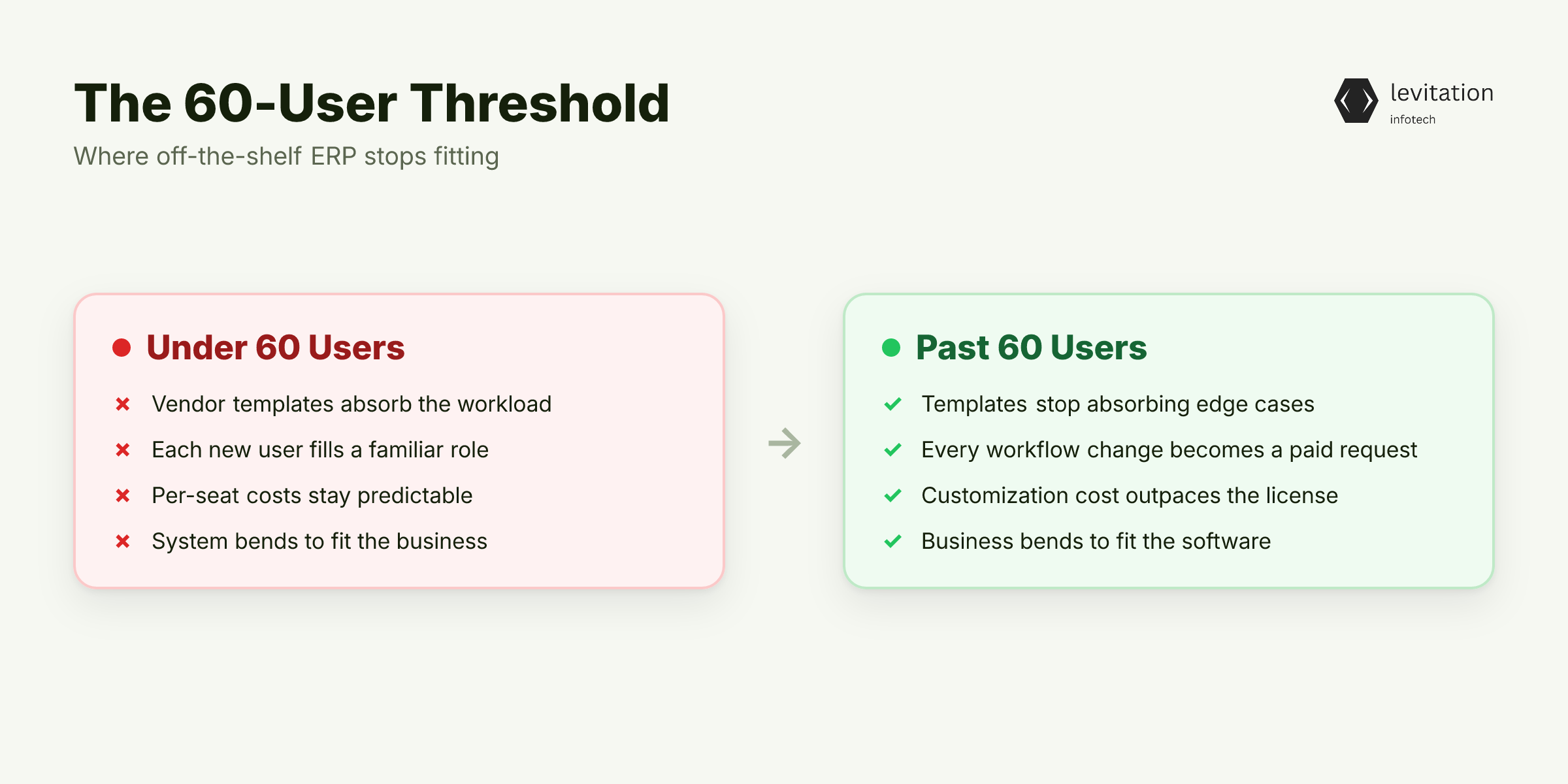
The day your Indian manufacturing firm crosses 60 active ERP users, the software your vendor sold you stops being yours. Every workflow you bend to fit it costs money. Every report you need costs more.
The per-seat license your sales rep quoted you? It rarely stays flat as the contract matures.
Why 60? Below that number, vendor templates do the heavy lifting. A 30-person shop fits inside Odoo's defaults, SAP Business One's reference configurations, or Zoho's inventory templates. Each new user adds a familiar role: a buyer, a storekeeper, a dispatcher.
Past 60, the math changes. Every additional user brings a new plant, a new shift, a new contract manufacturer, or a new compliance workflow. The template stops absorbing your edge cases. Each one becomes a paid change request to the partner.
The three products most Indian mid-market manufacturers evaluate promise exactly the wrong thing at this scale. Odoo promises open-source flexibility. SAP Business One promises enterprise discipline. Zoho promises low cost and fast deployment.
None of them warn you that past 60 users, the cost of making the system match your business starts exceeding the cost of the system itself.
The pitch sounds fine in the demo room. The math falls apart once you see what the vendor doesn't put on the quote. Most custom ERP decisions look clean in the proposal. They look very different at month 18. This is why serious buyers invest in ERP software development thinking before the sales cycle locks them in.
What ERP Vendors Won't Put on the Quote: The Build vs Buy Math
The per-seat license is the smallest number on a multi-year ERP bill. What hides behind the quote your sales rep handed you.
First, the ramp clause. Most MSAs let the vendor raise per-user fees at renewal. The "discounted" year-one price assumes your user count stays flat.
As you add users over the contract lifecycle, the per-seat rate climbs. This pattern mirrors what we see in off-the-shelf year-two cost reality.
Founders rarely model this. Vendors rarely flag it.
Second, integration fees. Every external system costs money to connect. Tally. The GST portal. Shop-floor IoT. Your e-commerce storefront. Your logistics partner. Each connector is billed separately.
As integration scope grows, connector costs add up to a meaningful share of total ownership.
Third, the customization tax. Off-the-shelf systems treat workflow changes after go-live as change orders, not configurations. A new dispatch approval flow that took one meeting to scope becomes a billable engagement. It is sized to the partner's day rate.
ERP implementation cost in India benchmarks shift sharply when you model the steady drip of such changes across the contract.
Odoo's apparent affordability is the most common trap. The open-source base is free. The implementation partner, the support contract, the Manufacturing and Quality modules, and the GST add-ons are not.
Once you total them for a 60+ user manufacturer, the partner-driven cost stack erodes the open-source advantage.
Odoo implementation costs are driven as much by ecosystem fees and module licensing as by the base platform.
These costs are not the only thing that gives way past 60 users. How your team actually uses the system reveals three predictable failure patterns at this scale.
The Three Failure Patterns That Hit Every Indian Manufacturer at 60 Users
Past 60 users, three failure patterns show up in nearly every mid-market manufacturer. They are predictable. They are also rarely mentioned in the sales cycle.
Pattern one: the integration breaking point. Shop-floor data, Tally entries, and bank feeds need to reconcile in real time once production volume scales. Off-the-shelf systems require middleware to bridge them. That middleware was never in the original quote.
It also breaks whenever the tax portal changes its API. The fix is another billable engagement. The ERP integration layer becomes its own cost center.
Pattern two: the manual reporting bottleneck. Founders and plant heads end up exporting CSVs because the canned reports don't match how the business measures itself. Gross margin per SKU. Rejection rates by shift. Dispatch TAT by plant.
The standard reports cover none of these. The custom report builder is a separate module with its own license tier.
Pattern three: employee resistance. The people closest to the work revert to spreadsheets. They don't trust the data. They don't like the generic screens. They don't want to log into a system that doesn't reflect how their day actually flows.
This is one of the top four implementation risks for mid-market manufacturers. It's a pattern we explored in Why Plant Managers Log Line Stops in WhatsApp, Not ERP. The ERP system you bought is the one your team quietly works around.
If these three patterns are predictable, why don't vendors warn you before the contract? Because solving them is the entire revenue model. This is where a custom build actually wins.
Where Custom ERP Actually Wins for Indian Manufacturing
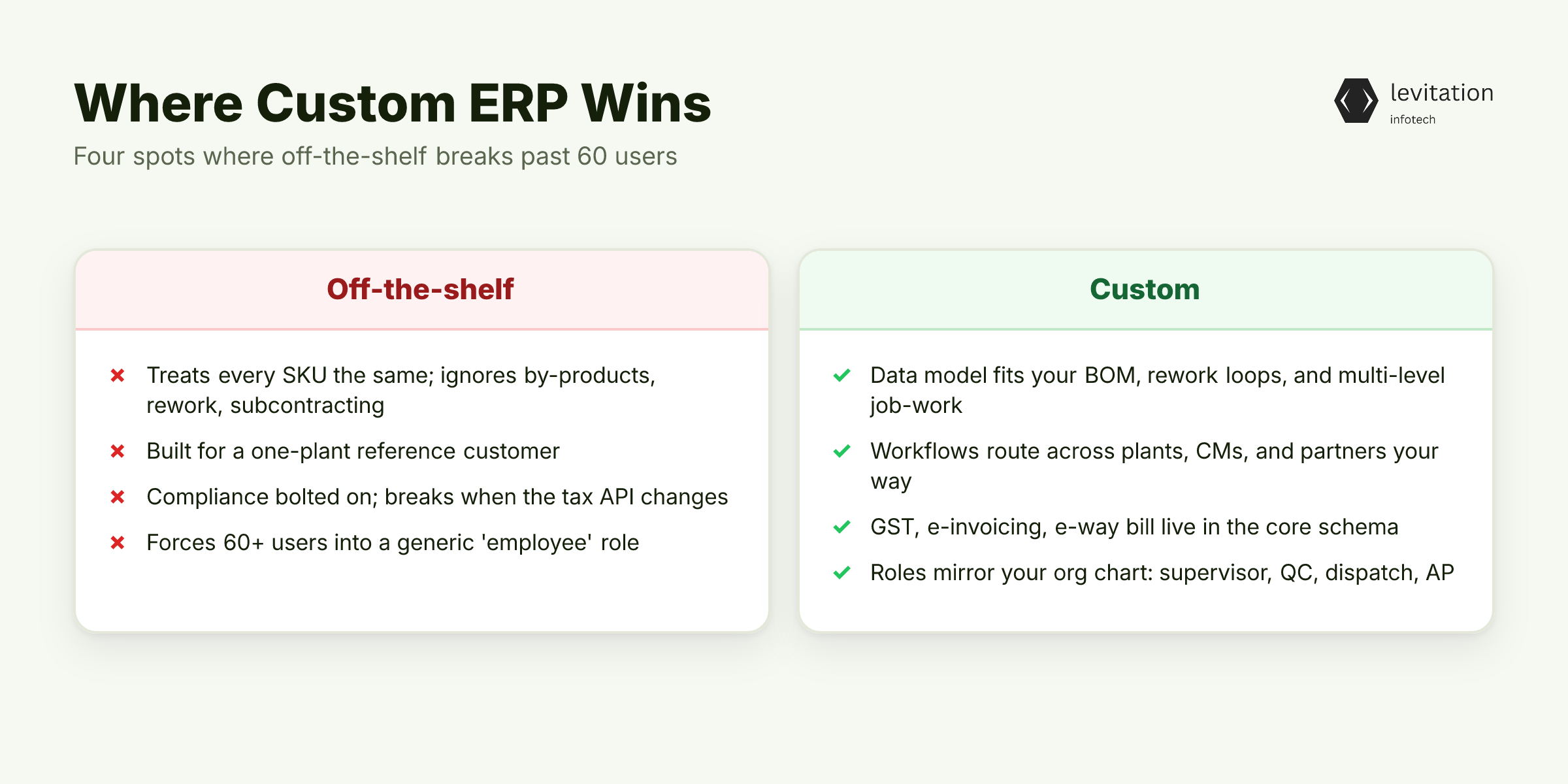
Custom does not mean "better in every way." It means better in four specific places where off-the-shelf fails past 60 users.
Supply chain visibility built for your bill of materials. A generic template treats every SKU the same. Your business does not. A custom data model handles your by-products, your rework loops, and your multi-level subcontracting.
That prevents the overstocking and profit-loss scenarios that plague off-the-shelf deployments in Indian manufacturing.
Multi-plant and contract-manufacturer workflows. Your work routes between multiple plants, contract manufacturers, and job-work partners. The vendor's reference customer had one plant. A custom ERP is built around how your work actually moves, not how someone else's does.
GST, e-invoicing, and e-way bill automation built in. Most packaged systems treat compliance as a connector. Connectors break whenever the tax portal changes its API.
A custom data model puts compliance in the core, not at the edge. The schema changes when GST changes, not the integration layer.
Role and permission design that mirrors your org chart. Supervisor, floor manager, QC inspector, dispatch coordinator, accounts payable. A custom build lets each role see only what they need.
Packaged systems force 60+ users into a generic "employee" role and rely on clumsy workarounds. The right Odoo development partner can also extend the open-source base to deliver this without the full license cost.
None of this means custom is always the right call. The decision depends on four questions most founders never ask before signing.
The Build Decision Framework: Four Questions Before You Sign Anything
Run these four questions before your next vendor call. The right answer usually surfaces without much debate.
Question one: does your workflow diverge from your industry standard in ways templates can't absorb? If yes, you will pay more in customization than you save on licensing. A shop-floor that does subcontract assembly, rework, and multi-level job-work is already past that line.
Question two: what is the 5-year TCO including integration, support, and change requests? Compare against ERP implementation cost in India benchmarks for Odoo, SAP B1, and from-scratch builds at your user count.
Don't compare licenses. Compare the full bill over five years. Custom solutions are not always the cheapest option on paper. TCO analysis matters more than the upfront quote.
Question three: can you articulate the five reports that actually run your business? If the vendor's standard reports don't cover them, you are buying a system you will export from daily. And exporting defeats the purpose.
Question four: do you have internal technical ownership, or will you be dependent on the implementer for every change? This determines whether ERP development is a one-time project or an ongoing capability. Without internal ownership, custom is a liability, not an asset.
Most manufacturers past 60 users go custom from day one. Or they buy packaged and plan a staged migration to custom once the first renewal cycle exposes the cost ramp.
Run those four questions honestly. The right path usually surfaces on its own. This is what changes when you choose correctly.
What Changes When You Get ERP Right at 60+ Users
The real win is not a faster month-close. It is your plant heads trusting the data in the system enough to stop maintaining parallel trackers. Many Indian manufacturers run a shadow ERP in spreadsheets for years after go-live.
The system is the official record. The spreadsheet is the working record. That ends when the official record finally matches reality.
Reconciliation between Tally, bank, and production becomes a background process. Workflow tweaks that cost a change order on a packaged system become configuration changes on a system your team owns. The cost of change drops toward zero.
Change happens more often. The business adapts faster.
At 60+ users, the question is no longer build vs buy. It is who owns the change. Vendors own the change in packaged systems.
Your team owns the change in a system built for your ERP integration and your data model. That single fact reshapes how the business operates against its enterprise resource planning backbone.
The pattern is consistent. The vendors who sold you the packaged system are the same vendors who profit from every change request. The team that builds it with you profits from the opposite. That incentive alignment is the actual decision.
Frequently Asked Questions
How much does custom ERP cost for a 60+ user Indian manufacturing company?
For a mid-market Indian manufacturer with 60 to 100 users, custom ERP development pricing varies widely based on module count, integration depth, and whether you build from scratch or extend Odoo. Use the ERP implementation cost in India benchmarks to compare against 5-year TCO of SAP B1 or Odoo Enterprise at the same user count. License cost is the smallest line item. Integration, change requests, and support over the contract lifetime typically dwarf the original quote.
Is Odoo enough for an Indian manufacturer with 60+ users?
Odoo can work for 60+ users, but the open-source version requires a paid implementation partner for setup, integrations, and support. Once you add Manufacturing, Quality, GST, and shop-floor modules plus connectors to Tally and logistics, the total cost stack grows. The real question is whether Odoo's standard modules match your workflows, or whether you will be paying for heavy customization that defeats the cost advantage.
Why does ERP fail at the 60-user mark specifically?
Below 60 users, vendor templates and best-practice configurations absorb most edge cases. Above 60 users, every additional user brings a new role, plant, or workflow that does not fit the template. Each deviation becomes a paid change request. That is where the per-user economics flip and customization costs start exceeding licensing savings.
How long does a custom ERP build take for Indian manufacturing?
A phased custom ERP build for a 60+ user Indian manufacturer depends on module count, integration scope, and internal team capacity. Core modules (procurement, production, inventory, sales, finance) plus parallel integration to GST, Tally, and shop-floor systems define the first phase. Multi-plant or contract-manufacturing complexity extends the timeline further. Use phased delivery to keep value flowing while the system matures.
Should we build custom ERP or buy Odoo/SAP for our Indian factory?
Build custom when your workflows diverge from industry templates, when you need deep integration with proprietary shop-floor or supply chain systems, and when you have internal technical ownership. Buy Odoo or SAP when your processes are close to industry standard, you have no internal tech team, and you want a faster go-live. The four-question framework here is designed to force that decision before the vendor's sales cycle pressures you into the wrong one.
Want to pressure-test your ERP decision before your next vendor call? Start with a 5-year TCO model and run the four questions with your operations lead.
Sources
Research and references cited in this article:
- ERP Implementation Challenges in Indian Manufacturing and How to ...
- ERP & Reporting Pain Points Manufacturers Cannot Ignore
- How Manufacturing Pain-Points are Solved by ERP Integration
- Common ERP Challenges in 2026 and How to Overcome Them
- ERP Implementation Challenges in Manufacturing and How to Avoid Them - Insights - xfive
- Odoo vs Custom ERP: Which is Right for You? 2026
- Odoo Implementation Costs in 2026: A Complete Guide for Businesses
- 10 Best ERP Systems of 2026: Honest Reviews & Comparison
- Odoo Community vs Enterprise 2026: Cost, Pricing & Hidden Fees
- Navigating the ERP Landscape: Odoo vs. Zoho for Indian ...
- 3 Successful ERP Implementation Case Studies
- 3 successful ERP implementation case studies to learn from
About the author
Mayank Singh is a software developer at Levitation Infotech, where he builds web and AI-powered applications across the company’s fintech, healthcare, and enterprise projects.