

TL;DR: Indian plant managers log line stops in WhatsApp because most manufacturing ERPs were never designed for the shop floor. The fix is not discipline or better training. It is a tablet-first, offline-capable shop floor ERP that beats WhatsApp on speed while feeding real data into OEE, maintenance, and root-cause systems.
Key Takeaways: - WhatsApp is a shadow ERP running in parallel to the licensed one, and the data gap it creates is invisible to leadership. - Traditional ERPs fail operators because they were configured by finance teams for finance teams, not for gloved hands on the line. - A custom Odoo-based shop floor ERP can land far faster than a typical in-house build, making line stop logging quicker than WhatsApp and restoring real-time production visibility.
The WhatsApp Confession Nobody Wants to Audit
Your plant manager isn't lazy. Your ERP is unusable on the shop floor. The WhatsApp group chat is the most damning evidence you have never investigated.
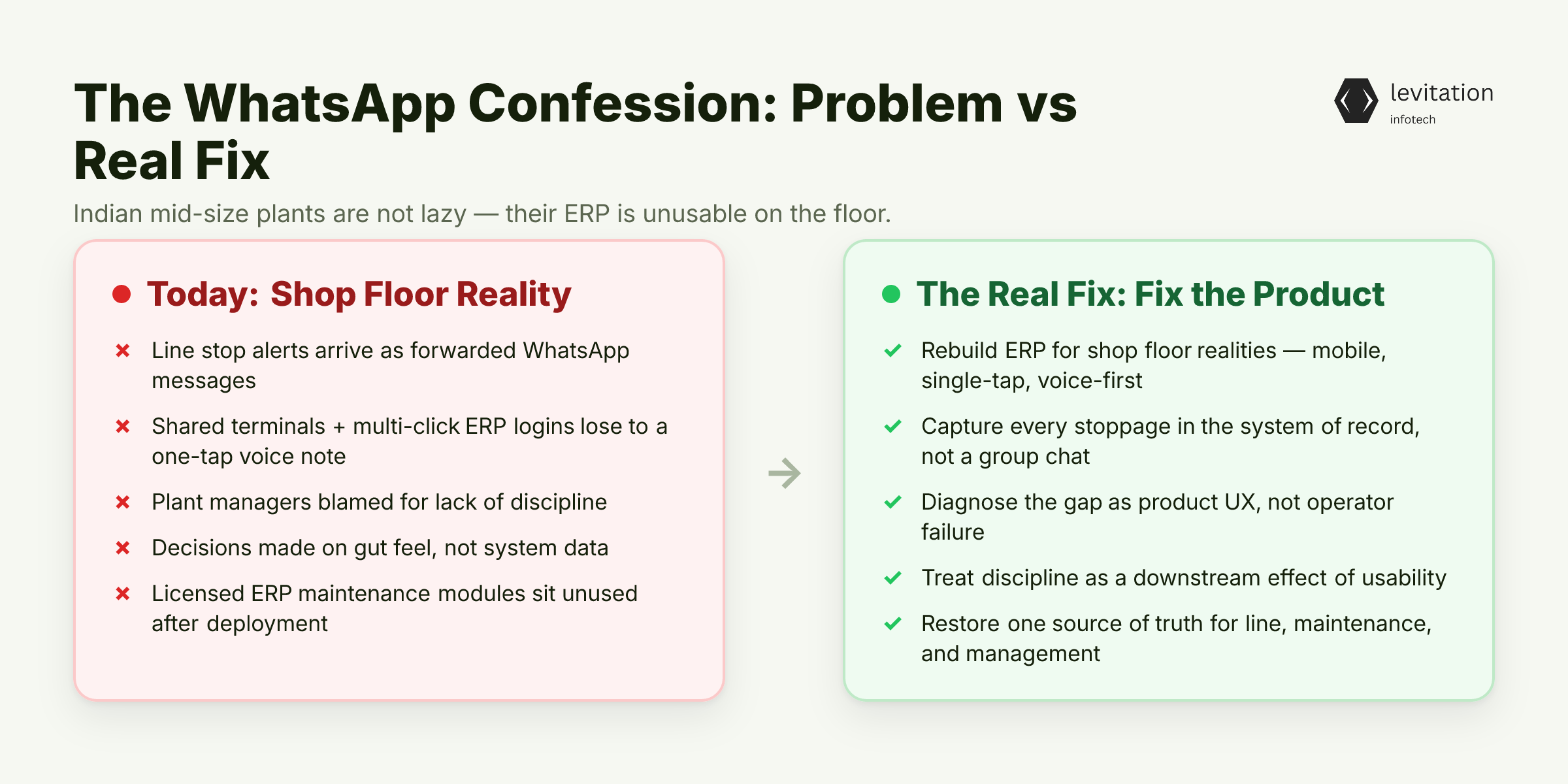
Walk any mid-size Indian plant between 9 PM and the end of second shift. You will see line stop alerts arriving as forwarded messages. They land in a sprawling group chat. Everyone from floor supervisors to the managing director gets included.
"Line 4 choked. Resetting." "Feeder jam again. Maintenance bhaiya please come."
This is shadow IT at industrial scale. The licensed ERP cost lakhs to deploy. Maintenance modules were configured. Shop floor data entry was "trained."
And yet, when a line actually stops, the message goes to WhatsApp first. Always.
The obvious conclusion is that plant managers lack discipline. That is wrong.
They default to WhatsApp because no one gave them a faster alternative. A tap, a voice note, a one-line text beats a multi-click ERP login on a shared terminal. Every single time.
Plant managers in Indian mid-size plants (Rs 5 to 100 crore revenue) are not resisting technology. They are running the only race they were given. The ERP lost at the starting line.
Treating this as a people problem guarantees another year of decision-making on gut feel.
But blaming the plant manager misses what is actually broken in the ERP stack itself. The gap is in the product, not the operator. And once you see the gap, you cannot unsee it. custom ERP solutions built for shop floor realities
Why Traditional ERPs Fail the Shop Floor
Most ERP for manufacturing India deployments are configured by finance teams. They are configured for finance teams.
The buyers are CFOs. The success metrics are inventory valuation, purchase order closure rates, and GST reconciliation speed. None of those KPIs care whether an operator with gloves and a barcode scanner can log a line stop in seconds.
Login friction is the first killer. Shared terminal logins, password resets every shift, role-based access flows that assume a desk and a keyboard. That is the daily reality.
Then come the nested menus: Production, Shop Floor, Work Orders, Downtime Entry, Reason Code, Sub-reason, Submit. That is a four to five click journey. A single WhatsApp message is the alternative. The math is over before it starts.
Indian shop floors have weak WiFi in production zones. Concrete pillars, metal cages, access points stretched across long production lines create coverage gaps.
ERPs assume constant connectivity. They serve a blank error screen when the signal drops. The operator closes the browser and picks up the phone. End of story.
The result: operators log into ERP at end-of-shift, if at all. The data is already stale. Stale data is worse than no data because the dashboard shows numbers and the plant manager trusts them.
Competing content from Absolute ERP, Timeline, and Lighthouse sells modules. None of them address the operator experience gap.
Their case studies are full of CFO quotes and inventory accuracy charts. You will find exactly zero studies on how long it takes an operator to log a line stop during a real stop.
This is the same pattern we covered in Why Enterprise Software and ERP Systems Fail Frontline Staff and How to Fix It: the user with the gloves never sits in the design review. The buyer sits in the design review.
That is the visible problem. The invisible one is far more expensive. ERP implementations that ignore shop floor UX
The Hidden Cost of 'Free' Workarounds
WhatsApp messages disappear into chat history. They never reach the OEE dashboard, the maintenance backlog, or the root cause analysis.
Months later, no one can reconstruct why a particular line lost hours of production. The data exists somewhere between a phone backup and a forwarded screenshot. It is not queryable.
Line stop data becomes folklore. "That line keeps jamming on second shift" is a sentence the plant manager has repeated year after year.
Compare that to what an ERP could surface. Stop patterns that cluster by line, shift, and SKU. Root causes invisible to spreadsheet analysis but obvious once the data is structured. That insight does not exist in the WhatsApp group. It cannot.
Engineering, quality, and supply chain teams operate blind to real production signals. They plan maintenance on calendar dates. They size buffers on last quarter's averages.
They redesign processes based on assumptions that were already wrong when the meeting started.
The cost is not the WhatsApp app. It is the six-figure decisions being made on gut feel every month.
A wrong buffer size here. An unnecessary machine replacement there. A missed root cause that triggers a half-shift outage next quarter. None of these show up as a WhatsApp line item. All of them show up in the margin.
So what does an ERP that actually wins against WhatsApp look like? The answer is less about features and more about friction removal. enterprise resource planning systems that capture real production data
What a Shop Floor ERP Must Do to Beat WhatsApp
A shop floor ERP wins on the same axis WhatsApp wins: speed, minimal typing, and zero cognitive load. The technology stack matters less than the interaction design.
Here is the minimum bar: - Tablet-first UI with barcode or RFID scan-to-stop. One tap, not five clicks. The operator scans the line, taps a reason tile, and moves on. The whole interaction takes a fraction of what a multi-step ERP form demands. - Offline-first architecture. The app must work without WiFi and sync when connectivity returns. A blank error screen on a factory floor is a deal-breaker. - Auto-dispatch. Line stop logged triggers a maintenance ticket, pages the supervisor, and updates the OEE dashboard in near-real time. No human routing. - Pre-built shop floor modules. Odoo manufacturing India comes with the bones: production orders, work centers, routings. The shop floor UI is the layer that needs custom work. - Localization. Marathi, Hindi, Tamil, Kannada. Reason codes and screens in the operator's language. English-only ERPs fail in Tier-2 plants.
The tradeoff is real. Specialized MES vendors charge Rs 2 to 10 crore for mid-size implementations with rigid templates. They sell heavy customization packages and long change-request queues.
General-purpose ERPs need deep custom ERP development for manufacturing operations to compete on UX. Neither path is automatic.
The right choice depends on your shop floor complexity, integration depth with PLCs and SCADA, and how much operator experience actually matters to your leadership.
Most plants underestimate that last variable. Operators are the data source. If they do not log, nothing else works.
For a deeper look at the build-versus-buy trade in this exact space, the Noida founders replacing Odoo with custom ERP story shows what mid-size plants actually decide when off-the-shelf fails them.
Which raises the next question your CFO will ask: can we just keep WhatsApp and pipe it into the ERP? Odoo implementation tailored for shop floor speed
Integrating WhatsApp With ERP - And When to Stop
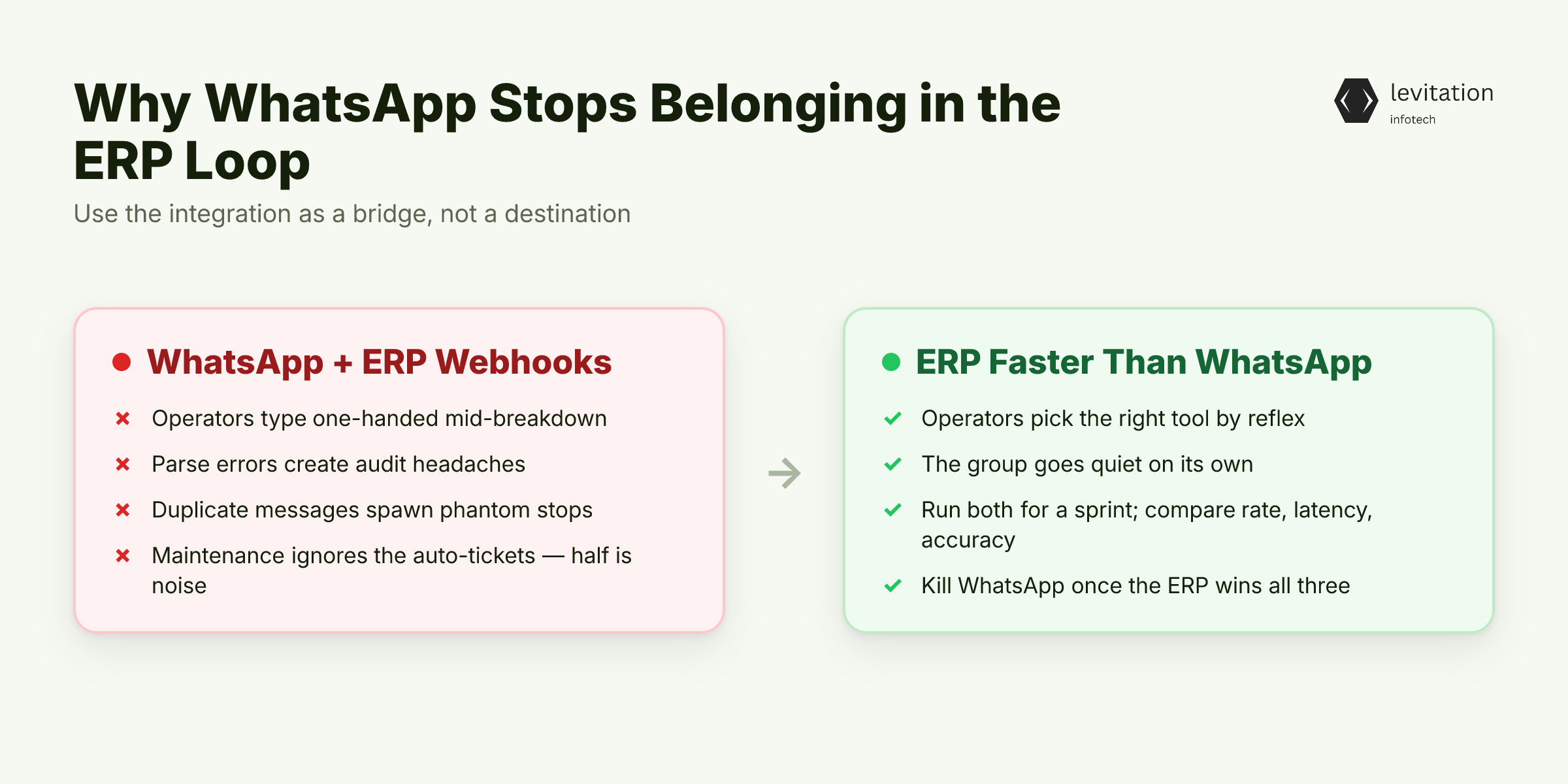
Technically, yes. WhatsApp Business API plus ERP webhooks can capture messages, parse them against a reason code dictionary, and create line stop events. A "Line 4 choked" message can become a structured event with reasonable parsing accuracy after training a model on the specific group's dialect of complaints.
The integration is a transitional tactic, not the destination. It still depends on humans typing structured messages under shift pressure. They type in between fixing the actual stop, with one hand on the machine.
Parsing errors become audit headaches. Duplicate messages become phantom stops. The maintenance team learns to ignore the auto-dispatched tickets because half are noise.
The real fix is to make the ERP faster than WhatsApp so operators prefer the right tool. When the ERP feels faster than the WhatsApp group, the group goes quiet on its own. Cultural adoption beats integration engineering.
Use the integration window to retire the WhatsApp dependency after the new UI proves itself. Run both for a sprint.
Compare logging rate, latency, and reason-code accuracy. When the ERP wins on all three, kill the group.
That transition depends on one thing most ERP projects underestimate: deployment speed. A focused custom ERP build can land far faster than a typical in-house team.
In-house teams routinely underestimate PLC data integration, machine telemetry, and operator workflow complexity. The math is brutal: every month of WhatsApp-only data is a month of blind operational decisions. So why do most in-house teams still miss the timeline? ERP integration workflows that bridge legacy and new systems
Why Custom ERP Deployment Speed Matters
In-house teams underestimate shop floor integration. PLC data, machine telemetry, and operator workflows balloon a scoped project far beyond the original estimate.
The IT team specs a clean cloud ERP. The shop floor team reveals legacy machines with proprietary protocols, WiFi dead zones on the production floor, and a reason code list that varies by shift.
A focused Odoo-based custom ERP manufacturing build can land faster when scoped tightly. The sequencing matters: - Discovery and reason-code standardization early. - Module configuration and shop floor UI build through the middle phase. - Pilot on one line, train operators, measure adoption before rollout. - Roll out to remaining lines once the pilot proves adoption.
Speed matters because every month of WhatsApp-only data is a month of operational decisions made blind. The cost of delay is not project overhead. It is the running loss from unidentified stop causes that compound quarter over quarter.
Longevity is the second test. Systems still running in production years after deployment prove the architecture was not a prototype. They prove the team understood maintenance, training, and change management, not just the initial go-live.
This same engineering standard is why the same teams are trusted by Fortune 500 brands for enterprise AI systems in India, production-grade work, not slideware.
The same discipline that keeps an AI inference pipeline running reliably keeps a shop floor ERP accurate through multiple ERP upgrade cycles. The engineering bench at Levitation brings that standard to mid-size plants that usually get prototype-grade attention.
So what actually changes on the floor once line stops are finally captured in real time? ERP software development with proven deployment speed
What Changes When Line Stops Finally Get Logged Properly
OEE moves from a quarterly estimate to a live, shift-level signal. The plant manager walks the floor and sees availability, performance, and quality on a tablet, updated continuously. No more "let me ask accounts to run the report."
Maintenance shifts from reactive to scheduled. The WhatsApp ping and scramble pattern ends. That pattern, where a technician hears about a stop from a forwarded message and walks over without context, dies.
Real stop reason trends feed the maintenance calendar. Parts are pre-staged.
Root cause analysis becomes possible. "Feeder calibration" stops cluster by line, shift, and SKU.
The fix moves upstream to design, supplier quality, or operator training. The same line that jammed weekly stops jamming monthly. The savings compound.
The cultural shift is the deepest one. The shop floor becomes a data source instead of a data black hole.
Operators see their inputs flow into dashboards their supervisors use. The WhatsApp group quietly goes quiet. The plant manager's phone stops buzzing at 2 AM.
Deployments that survive year two make this shift durable. The ones that die in year two were never built for the shop floor in the first place. The questions below cover what plant managers ask first. ERP system implementations that turn shop floors into data sources
Frequently Asked Questions
Q: Why do plant managers prefer WhatsApp over ERP for line stop tracking?
A: WhatsApp is faster, requires no login, and works on any phone. Most ERP for manufacturing India systems are desktop-first, require multiple clicks, and assume reliable WiFi. Plant managers choose speed over completeness, and the data gap becomes the ERP team's problem to solve, not the operator's.
Q: Can WhatsApp be integrated with manufacturing ERP software?
A: Yes, using WhatsApp Business API and ERP webhooks, messages can be parsed and converted into line stop events. But integration is a transitional fix. It still relies on operators typing structured messages under pressure. The durable fix is a shop floor ERP that is faster than WhatsApp to use.
Q: What is the best ERP for manufacturing in India for mid-size plants?
A: For plants between Rs 5 crore and Rs 100 crore revenue, Odoo-based custom ERP manufacturing deployments win on cost and flexibility versus specialized MES systems that run Rs 2 to 10 crore. The right answer depends on your shop floor complexity, not the vendor's marketing list.
Q: How long does ERP implementation take for a mid-size Indian manufacturer?
A: A focused shop floor ERP build covering line stop tracking, maintenance dispatch, and OEE can land faster than typical in-house builds when scoped tightly. In-house teams frequently overrun their estimates because they underestimate PLC integration, operator training, and WiFi coverage gaps.
Q: What does a custom ERP for manufacturing cost in India?
A: Specialized MES-style shop floor systems range from Rs 2 to 10 crore for mid-size implementations. A custom Odoo manufacturing India build with shop floor modules typically costs a fraction of that, with the main variable being integration depth with existing machines and legacy systems.
The starting line is a build that lands in weeks, not quarters.
Sources
Research and references cited in this article:
- Solving Manufacturing Pain Points With ERP
- It seems like everyone hates their ERP. What is the biggest pain?
- Top Pain Points Using an ERP System - Enterprise Software Solution Provider
- 4 Pain Points In ERP Transformation And How To Overcome Them
- Common ERP Implementation Problems and Solutions
- Odoo ERP for Manufacturing in India: What You Need to Know in 2026 | Kalk Solutions
- Best Odoo Manufacturing in India: A Complete Guide 2026
- Odoo Manufacturing ERP Implementation in India
- Odoo Manufacturing: Build a Real-Time Shop Floor
- How to Implement Odoo ERP for a Manufacturing Company
- Manufacturing ERP Software Comparison: India 2026
- ERPNext vs Traditional ERP: 7 Reasons Indian SMEs Save 80% in 2026
About the author
Mayank Singh is a software developer at Levitation Infotech, where he builds web and AI-powered applications across the company’s fintech, healthcare, and enterprise projects.