


Your event-sourced ledger has 100% test coverage. It has perfect immutability. It also has audit-grade event logs. Then the reconciliation engine returns a mismatch on day one. No one on your team can explain the mismatch. The system is mathematically correct, yet it is regulatorily wrong.
TL;DR: Event-sourced ledgers store state changes as immutable events. This makes them look ideal for audit trails. However, RBI reconciliation expects settled-state snapshots in a double-entry format, not replayable event streams. The fix is not to abandon event sourcing. It is to add a reconciliation-native projection layer. This layer translates your event store into the language reconciliation engines already speak. It does so without sacrificing auditability.
Key Takeaways: - Event-sourced ledgers fail reconciliation not because they are wrong. They fail because reconciliation tools cannot consume event streams natively. - Unit tests and integration tests both miss this. They verify internal consistency, not bilateral agreement with a counterparty's view. - A reconciliation-native projection layer that materializes settled events into a flat, queryable schema resolves the mismatch. It does so without polluting the event store.
The Paradox: A Correct Ledger That Auditors Can't Read
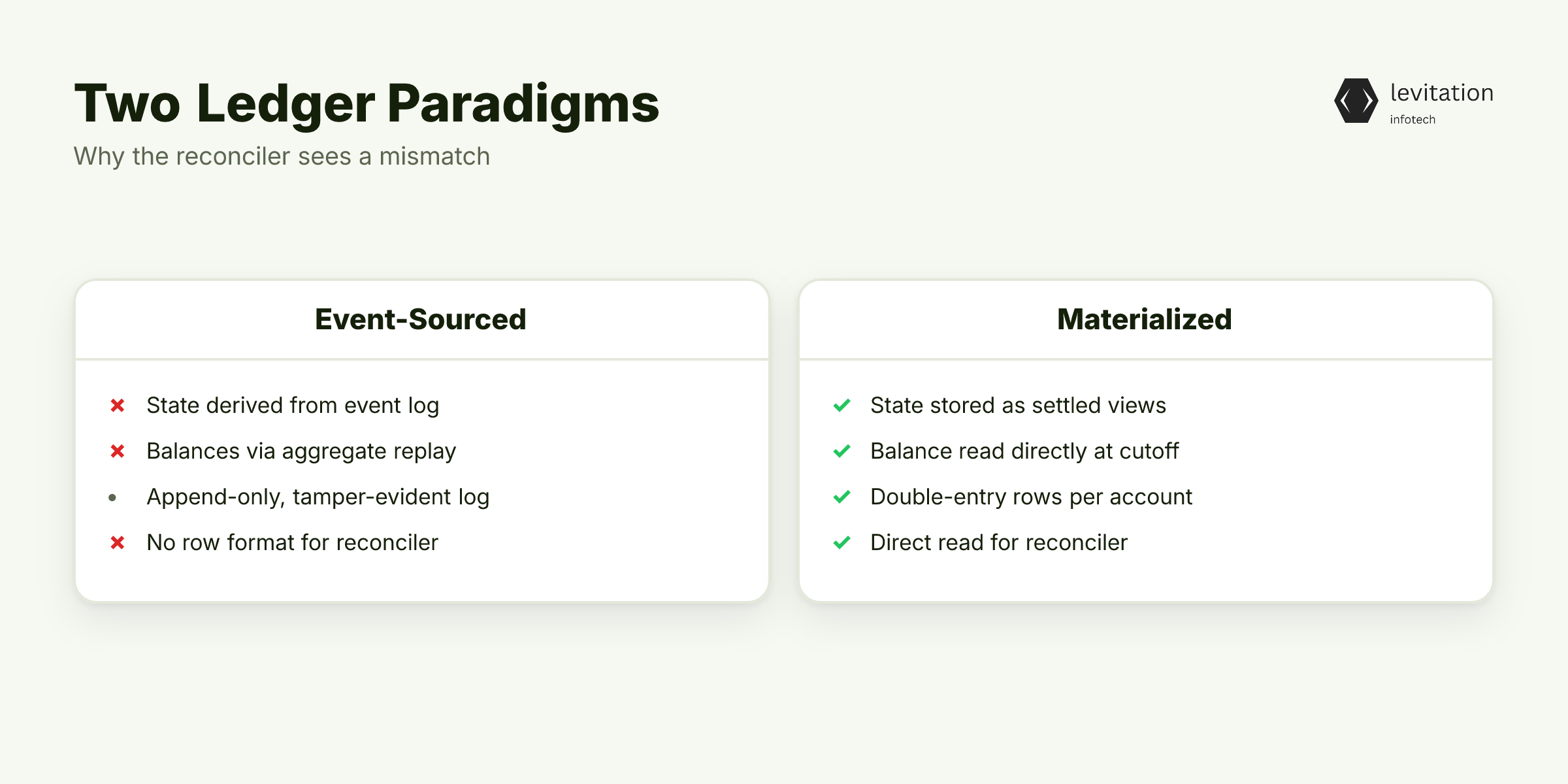
Your engineering team ships an event-sourced ledger. By every internal measure, it is correct. Events are append-only. Balances derive deterministically from the event log. The audit trail is complete and tamper-evident.
Then the regulator's reconciliation engine returns a mismatch on the first submission. Your compliance lead is on a call at 11 PM. He is trying to explain the gap. Your ledger says one thing. Their system says another.
This is not a bug. It is a paradigm collision.
Event-sourced ledgers store every state change as an immutable event. This is theoretically perfect for audit trails. You can replay history. You can reconstruct any point-in-time state. You can also prove that no unauthorized mutation occurred. However, fintech solutions built on event streams assume that state is derived, not stored. Reconciliation engines assume state is materialized, not replayed.
RBI reconciliation expects settled-state views. These are a snapshot of debits, credits, and balances per account at a cutoff timestamp. Your event store holds causally linked events. These events must be replayed through aggregates to produce that snapshot. The reconciliation tool does not know how to replay your events. It expects rows. It expects a ledger. It expects double-entry.
So why does a ledger that passes every functional test fail the moment reconciliation runs?
Why Unit Tests and Integration Tests Both Miss This
Most test suites assert three things. They check that events are written. They check that balances are derived correctly. They also check that projections match expected state. These tests pass. The team celebrates.
The CI pipeline glows green. None of these tests simulate the reconciliation contract.
RBI reconciliation is not asserting that your system is internally consistent. It is asserting that your system agrees with the counterparty's system at a point in time. That is a different verification model.
Your tests prove your ledger is correct to itself. Reconciliation proves your ledger is correct relative to another ledger. These are not the same proposition.
Event sourcing optimizes for temporal reconstruction. This is the ability to answer "what was the state at time T?" by replaying events. Reconciliation optimizes for bilateral agreement. This is the ability to answer "do both ledgers agree on the state at time T?" by comparing snapshots. These two goals use incompatible verification models. No amount of unit testing bridges that gap.
This is the same paradigm collision that has tripped up event-driven banking architectures in production. Teams optimized for demo-readiness instead of regulator-readability. The architecture that wins the engineering review can still lose the audit. The resolution has to happen at the architecture layer, not in the test suite.
This is not a coding problem. It is a semantic gap between what your ledger expresses and what reconciliation expects to read.
The Semantic Gap Between Event Streams and Reconciliation
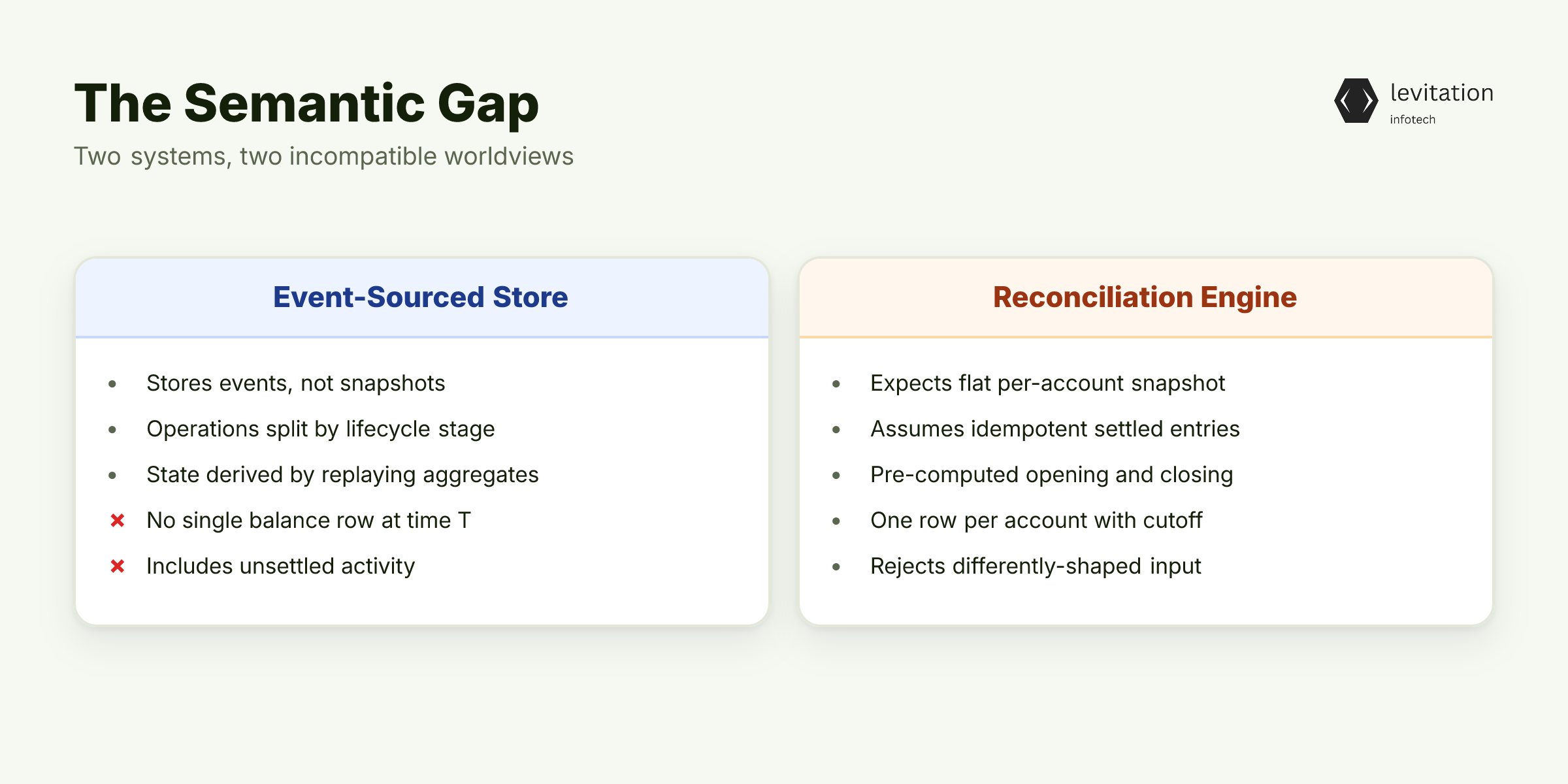
Reconciliation engines expect a snapshot. Specifically, they expect per-account debit and credit lines. They also expect opening balance, closing balance, and a cutoff timestamp. These arrive in a flat schema. Reconciliation tools parse and diff this schema against the counterparty's submission.
Your event-sourced system does not store snapshots. It stores events. These include authorized, captured, settled, reversed, and possibly partially failed events. Current state is derived by replaying these events through aggregates. There is no single queryable row that says "account X had balance Y at time T." Reconciliation tools do not natively understand such a row.
The deeper issue runs deeper. Reconciliation assumes idempotent, commutative operations that have been settled into a ledger. Event sourcing captures intent, authorization, capture, and settlement as distinct event types.
An authorized transaction is not yet settled. A captured transaction might still be reversed. At reconciliation time, your event store may hold events that have been authorized but not yet settled. Including them in the reconciliation view would inflate balances. Excluding them entirely would understate activity.
The reconciliation engine sees an incomplete or differently-shaped view of the world. As a result, it rejects the submission.
This is why the same event-sourced ledger that is provably correct internally can be rejected alone by an external reconciliation system. The rejection is not a technical judgment about your ledger's accuracy.
It is a structural rejection of the input format. Distributed ledger fintech compliance systems that survive this gap do so by treating reconciliation as a first-class output contract, not an afterthought.
The solution is a reconciliation-native projection layer. This layer translates events into the language auditors and RBI systems already speak.
Building a Reconciliation-Native Projection Layer
A projection layer is a read model. It materializes events into a shape optimized for a specific consumer. In this case, the consumer is RBI reconciliation. The shape is a settled-state, double-entry view.
Here is the concrete sequence that works: - Step 1: Define your reconciliation contract first. Before designing any event types, specify the exact schema reconciliation expects. It should include per-account debit and credit lines. It should also include opening balance, closing balance, cutoff timestamp, and account identifiers. Write this contract down. Treat it as a non-negotiable interface. Your event schema must be capable of producing it. - Step 2: Build a settlement-applied projection. Materialize only events tagged with `Settled` status into a read-optimized table. Deliberately exclude `Authorized`, `Pending`, and `ReversalRequested` events. These states confuse reconciliation because they represent money in motion, not money at rest. Your projection should only reflect money that has actually settled. - Step 3: Generate the reconciliation view on demand. When the regulator's cutoff arrives, replay only settled events up to timestamp T. Produce a stable snapshot. This snapshot matches the double-entry model. It is also stable enough to hash, sign, and submit. Your event store stays clean. The projection does the translation. - Step 4: Version your projection schema alongside your event schema. When RBI changes reconciliation requirements, you can rebuild the view. This works without rewriting event logic. Schema evolution in the projection is decoupled from schema evolution in the event store. This separation is what makes the system maintainable over years. - Step 5: Emit a reconciliation-completion event. When the projection is generated, write a `ReconciliationSnapshotGenerated` event back into the event store. This creates a self-auditing trail. It is an immutable record showing which events were used, at which time, and by which process. Auditors can verify the chain end-to-end.
These steps work in theory. Three specific patterns consistently appear in systems that still pass audits five years later.
Three Patterns That Actually Pass RBI Audit
Pattern 1 is dual-write settlement confirmation. Every monetary event is followed by an explicit `SettlementConfirmed` event. The projection layer treats only `SettlementConfirmed` events as the source of truth. This prevents authorized-but-not-settled amounts from appearing in reconciliation views. It also eliminates a whole class of timing-related mismatches.
Pattern 2 is temporal cutoffs with materialization locks. Before reconciliation runs, the projection layer takes a point-in-time lock on settled events up to cutoff T. It writes the snapshot to an immutable reconciliation table. It also signs the snapshot with a cryptographic hash.
Auditors can verify the hash against the underlying event log. This proves the snapshot was not retroactively edited. This is the real-time ledger regulatory pattern that turns a snapshot into evidence.
Pattern 3 is idempotent reconciliation events. When reconciliation is re-run, the system emits a `ReconciliationCompleted` event. Re-runs happen for corrections and resubmissions. Its ID is deterministic, derived from the cutoff timestamp and the account set.
Retries produce the same output. The regulator can see which view was submitted on which date. The system never double-counts.
The projection layer is a well-understood architectural pattern, not a research project. Fintech AI that passes QA faces a similar structural challenge. Internal correctness does not guarantee regulatory acceptance.
The lesson generalizes. When these three patterns are in place, something interesting happens. It affects the relationship between your engineering team and your compliance team.
What Changes When Your Ledger Speaks Both Languages
Engineering keeps event sourcing's immutability, temporal reconstruction, and full auditability. None of that is sacrificed. The event store remains the canonical source of truth. The debugging, replay, and forensic benefits that drew the team to event sourcing in the first place remain fully intact.
Compliance gets a flat, settled-state, double-entry view that RBI reconciliation expects. This view is generated deterministically from the same event store. They stop asking the engineering team to "just export a CSV of the ledger." The projection already produces exactly what they need. The RBI reconciliation audit cycle becomes a routine submission, not a fire drill.
Audit cycles shrink because the projection is reproducible, version-controlled, and self-documenting. The `ReconciliationSnapshotGenerated` event in the event store proves what was submitted and when. Over multi-year horizons, dual-language ledger architectures reduce regulatory rework. This is because teams that solve the semantic gap once do not re-encounter it.
The deeper shift is cultural. Engineering stops treating compliance as a downstream consumer of awkward data exports. Compliance stops treating engineering as a black box that produces "the ledger."
Both teams work from the same event store. They look at the same system through different lenses. Each lens is native to their domain.
That is the goal. Not to choose between event sourcing and reconciliation. To build a system that speaks both languages fluently.
Frequently Asked Questions
Q: Why does RBI reconciliation reject event-sourced ledgers?
A: RBI reconciliation expects settled-state snapshots with per-account debits, credits, and balances at a cutoff timestamp. Event-sourced ledgers store events that must be replayed to derive state. Most reconciliation engines cannot consume these event streams natively. The rejection is a format mismatch, not a correctness failure.
Q: Can event sourcing and regulatory reconciliation coexist in the same system?
A: Yes. They can coexist through a reconciliation-native projection layer. This layer materializes settled events into a flat, queryable schema matching the reconciliation contract. The event store remains the source of truth. The projection serves as a regulatory-facing view. Both stay consistent because the projection is deterministic.
Q: What is the difference between an event-sourced ledger and a double-entry ledger?
A: An event-sourced ledger stores all state changes as immutable events. Current balances are derived by replay. A double-entry ledger stores settled debits and credits as rows. It has an invariant that total debits equal total credits. Reconciliation engines are built for the double-entry model. That is why a projection layer is needed.
Q: How long does it take to add a reconciliation projection layer to an existing event-sourced system?
A: The timeline depends on event types, settlement complexity, and counterparty count. Teams that have shipped this pattern before can typically deploy it faster. This is because the projection layer is a well-understood pattern rather than a novel design.
Q: Does using event sourcing for a banking ledger violate any RBI guidelines?
A: No RBI guideline prohibits event sourcing. The challenge is that RBI's reconciliation and reporting formats assume relational, settled-state representations. Event-sourced systems that fail to expose a reconciliation-compatible projection risk non-compliance. This risk exists not because of the architecture itself, but because of the output format reconciliation tools receive.
About the author
Mayank Singh is a software developer at Levitation Infotech, where he builds web and AI-powered applications across the company’s fintech, healthcare, and enterprise projects.