


TL;DR: A payment timeout can leave a fintech team unsure whether money moved. A delayed sync can make the app, backend, and ledger tell different stories. Quotes focused on screens and APIs often defer both problems to costly retries, reconciliation, support, and compliance.
Founders should buy a staged, testable plan. It must name one source of truth, define recovery, and keep build, resilience, compliance, and maintenance visible.
Key Takeaways: - A payment timeout means unknown status, not failed payment, until the server checks the authoritative record. - Idempotent retries, versioned server events, and manual-review paths must be priced as core deliverables. - Comparable vendor bids require the same scope, explicit failure tests, and acceptance criteria for every stage.
The Quote Is Only the Build Cost
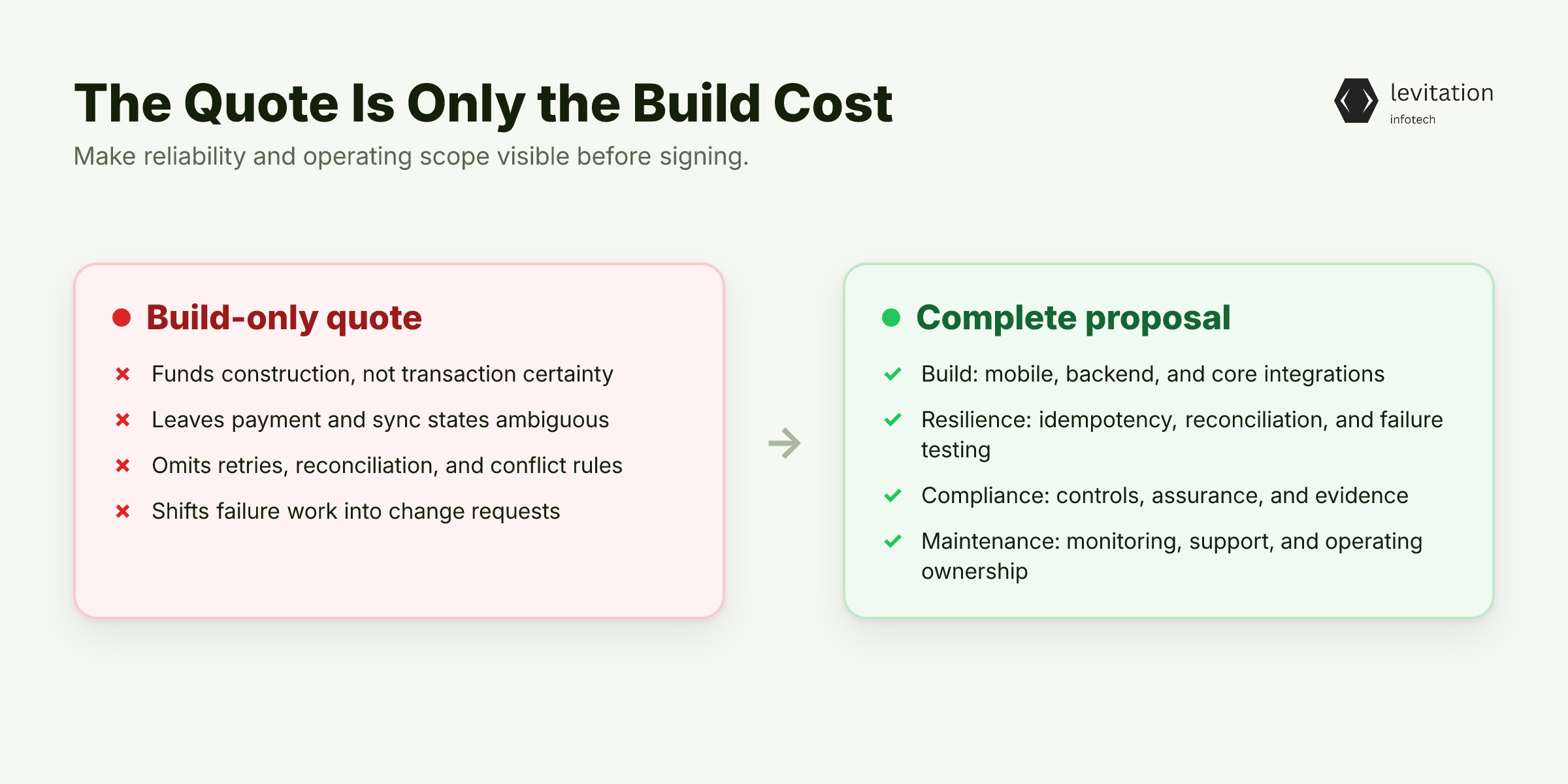
A fintech quote of $50,000 to $300,000+ can look reassuring until a payment request times out after the processor has accepted it. A delayed sync can also leave the app and ledger in disagreement.
The costly work is not another screen. It is the retry, reconciliation, and support work that mobile app development quotes often omit from scope.
Published estimates for mobile app development cost in India put a fintech app at $50,000 to $300,000+. That price buys construction, not certainty about ambiguous transaction states.
Proposals for fintech solutions can treat payment and sync behavior as a feature detail. The operating cost often appears later as a change request.
Two paths reveal the hidden scope: - Payment timeout: The client receives no final response, while the processor may already hold the charge. - Sync overwrite: An offline device sends an old transaction record after the server has accepted a newer one.
Either path can expand the work into idempotent retries, ledger reconciliation, conflict rules, observability, support tooling, and more integration testing. When proposals omit this work, regulatory complexity and development costs can also be underestimated.
Founders should split every proposal into four visible lines: - Build: Mobile experience, backend services, and core integrations. - Resilience: Idempotency, reconciliation, conflict handling, and failure testing. - Compliance: Security controls, assurance work, and evidence generation. - Maintenance: Monitoring, incident support, and operating-model ownership.
Padding the quote may absorb the first incident. It will not tell the team which state is authoritative, so the same failure can return after launch. Which design choices can reduce that risk before more people join the team?
Why Bigger Teams Do Not Fix Ambiguous State
Adding more QA staff or a larger contingency only postpones discovery. Neither can fix a team that has not decided which outcomes are final, retryable, or reversible. Extra people will test undefined behavior, then document the ambiguity more carefully.
A compact payment taxonomy forces those decisions: - Confirmed success: The authoritative record says the payment completed. - Confirmed failure: The authoritative record says the payment was rejected. - Pending processing: The processor says work remains in progress. - Unknown status after a timeout: No final answer is available yet.
A timeout is a missing answer, not a negative answer. Treating it as failure can trigger a second payment or a false refund request.
Sync conflicts need a separate taxonomy: - Duplicate: The same update arrives more than once. - Stale: An older version attempts to replace a newer one. - Out-of-order: A later event arrives before the event it follows. - Concurrent: Two clients edit the same record from the same starting version.
The mobile client may show a cached balance, while the backend holds another balance and the payment gateway holds the outcome. Each system answers from a different snapshot.
Full fintech delivery is more than screens and APIs. Research identifies a secure ledger, payment logic, compliance capabilities, integrations, and constant maintenance as core scope. This is the production gap described in why event-driven banking demos fail in production.
Ask every vendor what happens when the client retries after an ambiguous response and which system records the authoritative outcome. Expect a state diagram, not reassurance.
The real control point isn't headcount. It is the architecture's definition of truth. Without it, every added engineer becomes a faster source of conflicting truth.
Which system should define that truth?
Price State Transitions Instead of Screens
Teams often estimate fintech software by artifacts: screens, APIs, and named features. That model misses the moments when money changes state. The better unit of estimation is the transition itself.
Build the estimate around five cost buckets
Require every vendor to place deliverables and assumptions into the same buckets: - Mobile experience: Design, client flows, offline behavior, and notifications. - Transaction core: Payments, ledger records, balances, and integrations. - Resilience engineering: Idempotency, reconciliation, conflict rules, observability, and recovery. - Compliance: Security controls, data handling, assurance, and audit evidence. - Ongoing maintenance: Monitoring, incident response, support tooling, and ownership.
This makes a mobile MVP visibly different from a production-ready fintech product. The screen count may remain unchanged while the delivery burden changes sharply. Which hidden work does each bucket contain?
Create a failure-scenario worksheet
Give the team one worksheet with these fields: - Trigger - Source of truth - Client behavior - Server behavior - Audit event - Recovery owner - Required test
Each completed row becomes a priced engineering and QA task. For a duplicate tap, the worksheet must define who creates the intent. It must also define how the retry is recognized, which record survives, and how the event is audited.
The build plan should then require: - One server-authoritative payment status. - An explicit unknown outcome. - Idempotency keys for every payment intent. - Versioned server events for synchronization. - A manual-review path for unresolved conflicts.
These choices expose work that can sit outside a feature estimate. Secure-ledger work, reconciliation, monitoring, and support tooling often appear only after launch. See how fintech solutions compare when delivery scope is normalized this way.
Use one acceptance test for every high-risk scenario. The proposal must name the authoritative system, allowed transitions, expected client behavior, and recovery procedure. It should describe deliverables and tests, not adjectives such as robust, scalable, or secure.
Which contract should govern the build?
Engineer Payment and Sync State Machines First
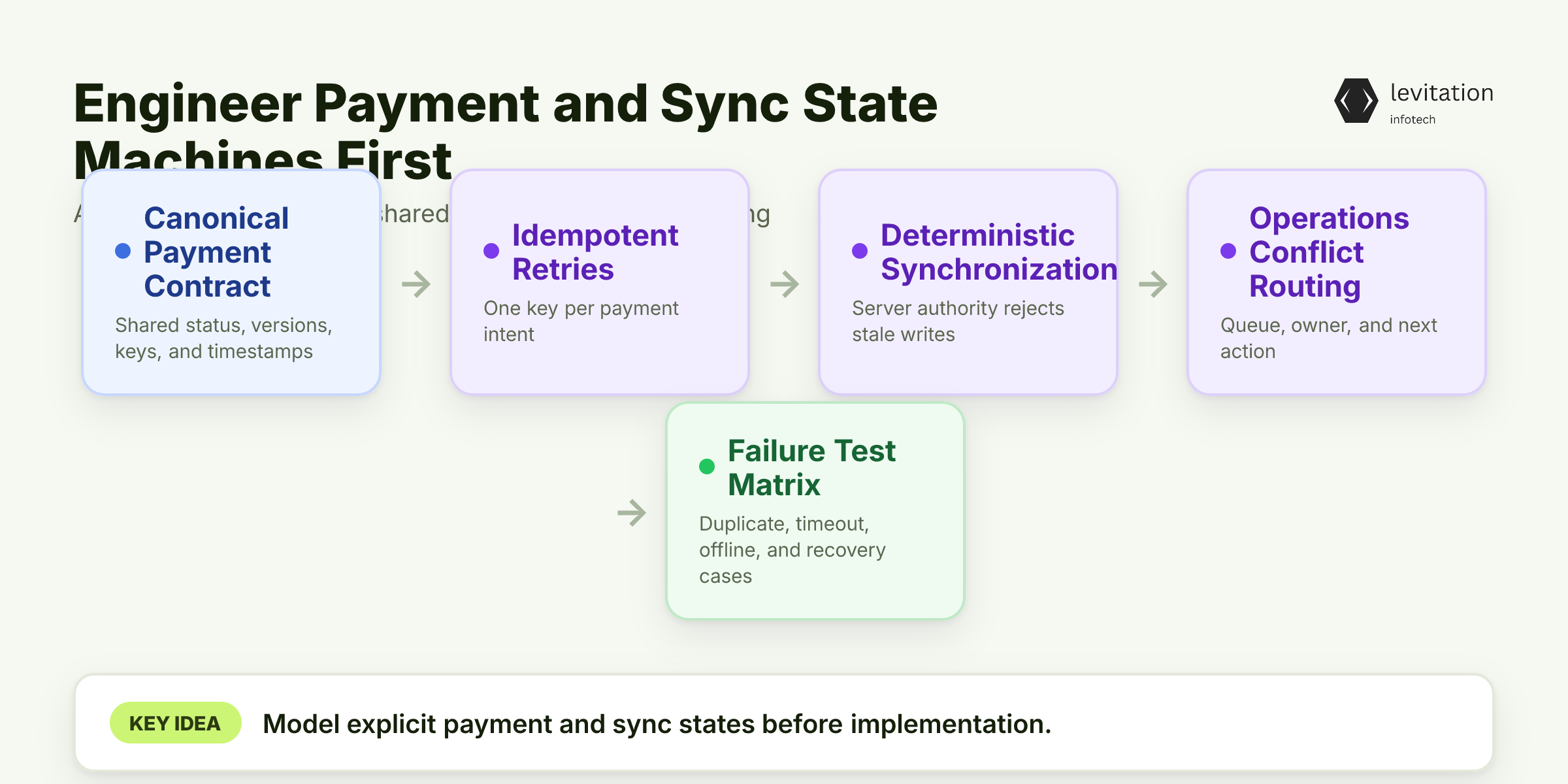
Start with a contract every component can interpret the same way. Ambiguity disappears when payment and synchronization behavior become explicit records and rules.
Define the canonical payment contract
The contract should include: - Current status - Record version - Idempotency key - Correlation ID - Server timestamp - Allowed next states
A sample record could show status unknown and version 7, along with a traceable idempotency key, correlation ID, server timestamp, and permitted next states. It states what happened, which version it represents, and what may happen next.
The contract gives retries a shared reference. How should the server use it safely?
Make retries idempotent
Generate one idempotency key per payment intent. Reuse it for every retry.
Before creating a charge, the server checks whether that intent already exists. A timeout triggers a status lookup, not a guess that payment failed.
Retries without a shared key turn recovery into a second payment attempt. How should the client stay in sync with server records?
Make synchronization deterministic
Give every server record a version or sequence number. Treat transaction and balance data as server-authoritative. Reject stale writes instead of letting an old device overwrite newer truth.
Editable profile data can use field-specific merge rules. Last-write-wins remains unsafe for money movement because it ignores business order.
Deterministic sync keeps balances from drifting. Where should unresolved conflicts go?
Route unresolved conflicts to operations
Send each unresolved conflict to an operations queue. Attach the customer, device, payment intent, event history, and recovery action.
Give every item an owner and a next action. That converts silent disagreement into visible work.
The queue creates accountable work. How should the team prove the design works before release?
Build a failure test matrix
Cover these scenarios before release: - Duplicate taps - Timeout before processor acceptance - Timeout after acceptance - Offline replay - Delayed events - Out-of-order updates - Concurrent edits - Backend recovery - Reconciliation against the authoritative record
These are acceptance tests, not optional QA extras. Passing tests create evidence for the bid. Which costs belong in each gated stage?
Operate the design
Measure unknown payment outcomes, duplicate attempts, reconciliation age, sync conflicts, and manual-review volume. Pair every alert with a runbook that assigns an owner and next action.
With the technical work defined, the commercial proposal can price it. The next question is whether vendors priced the same scope.
Build a Comparable Fintech App Development Cost Proposal
A low bid can still be expensive if it buys a different product. Normalize every quote before comparing prices. Confirm whether each estimate includes: - Mobile UX - Backend services - Ledger or payment processing - External integrations - Compliance and security hardening - Post-launch ownership
Published estimates place fintech apps in India at $50,000 to $300,000+. Payment apps often fall around $50,000 to $350,000+. Full-service digital banking apps are estimated at $120,000 to $300,000. A complete from-scratch solution can reach $300,000 to $1 million or more and take up to two years.
These ranges aren't contradictions. Mobile-only, payment-focused, digital-banking, and complete custom stacks describe different scopes. The proposal must define inclusions and exclusions before its number has meaning. Our mobile app development cost in India guide explains why scope normalization matters.
Separate assurance costs
Security assurance needs its own line. Penetration testing can add $15,000 to $50,000, while PCI DSS certification can add $5,000 to $50,000.
The quote must identify which activities each figure covers. Remediation, retesting, and ongoing compliance work often remain outside the quoted total.
Assurance has a price, but its boundary must be clear. How should delivery proceed after signing?
Buy the work in gated stages
Each stage should have deliverables and acceptance criteria: - Discovery and transaction mapping - Platform foundation - Payment and sync hardening - Compliance validation - Staged release - Post-launch monitoring
A stage should close only when its failure tests and operating handoff pass.
Before signing, ask five questions: - Who owns payment truth? - How are retries made idempotent? - How are sync conflicts resolved? - Which failure scenarios are tested? - Which compliance and maintenance costs sit outside the total?
A properly scoped bid doesn't merely look less expensive. It makes the cost of the next release predictable. Will vendors price that future, or only the screens?
The Payoff: Predictable Releases, Not Zero Failures
Resilience isn't a promise that failures disappear. It's a promise that every failure has a known state, a bounded recovery path, and an accountable owner. Payments and networks will still fail.
That design produces practical gains: - Fewer unplanned integration tasks because failure behavior enters the original scope. - Clearer release scope because each gate has defined acceptance criteria. - Shorter incident diagnosis because logs and events share the same identifiers. - Less manual reconciliation because server records remain authoritative. - Better compliance evidence because operating workflows create the audit trail.
Before signing the commercial proposal, require seven artifacts: - Payment-state diagram - Retry contract - Conflict policy - Failure test results - Monitoring plan - Ownership map - Itemized post-launch support
Vendor delivery evidence belongs in the diligence column, but it cannot replace transaction-specific tests or a clear operating contract.
Reliable fintech delivery emerges when the team defines state transitions, proves them under failure, and buys them as explicit scope. Otherwise, the original screen count will predict the invoice by accident.
The artifacts turn risk into visible ownership. What should buyers ask once these artifacts are on the table?
Frequently Asked Questions
Q: How much does fintech app development cost in India?
A: Published estimates place fintech app development in India at $50,000 to $300,000+ depending on complexity and features. Payment apps often fall around $50,000 to $350,000+, while full-service digital banking apps are estimated at $120,000 to $300,000. A complete from-scratch solution can reach $300,000 to $1 million or more and take up to two years.
Q: How much does payment failure handling add to app development cost?
A: There is no defensible universal add-on because the cost depends on transaction volume, integration design, reconciliation needs, and the selected platform. Require vendors to itemize idempotency, status management, reconciliation, monitoring, testing, and support as separate deliverables. Do not hide them in a contingency.
Q: How should a fintech app prevent duplicate charges and resolve sync conflicts?
A: Use one idempotency key per payment intent. Treat timeouts as unknown until status is checked. Keep payment and balance state authoritative on the server. Apply versioned events, reject stale writes, define field-specific merge rules, and route unresolved cases to a manual-review queue.
Q: What do penetration testing and PCI DSS certification add to the budget?
A: Published estimates put penetration testing at $15,000 to $50,000. PCI DSS certification can add $5,000 to $50,000. Confirm whether each activity is included in the development estimate. State what deliverables are covered. Check whether remediation, retesting, or ongoing compliance work remains outside the quoted scope. Before signing, ask vendors to map each figure to named deliverables.
About the author
Mayank Singh is a software developer at Levitation Infotech, where he builds web and AI-powered applications across the company’s fintech, healthcare, and enterprise projects.