


TL;DR: AI agents don't automatically beat rules on cost. They win when variable inputs, frequent exceptions, or policy churn make rule upkeep and manual escalation costly. A governed hybrid works best in many fintech workloads, with agents interpreting and coordinating while rules enforce hard limits.
Key Takeaways: - Measure cost per correctly completed, policy-aligned case, not per token or API call. - Put agents around exceptions. Keep rules for stable, deterministic decisions. - Choose through a three-ledger TCO analysis and a shadow pilot with explicit stop conditions.
Cheaper Inference Can Hide a Costlier Decision System
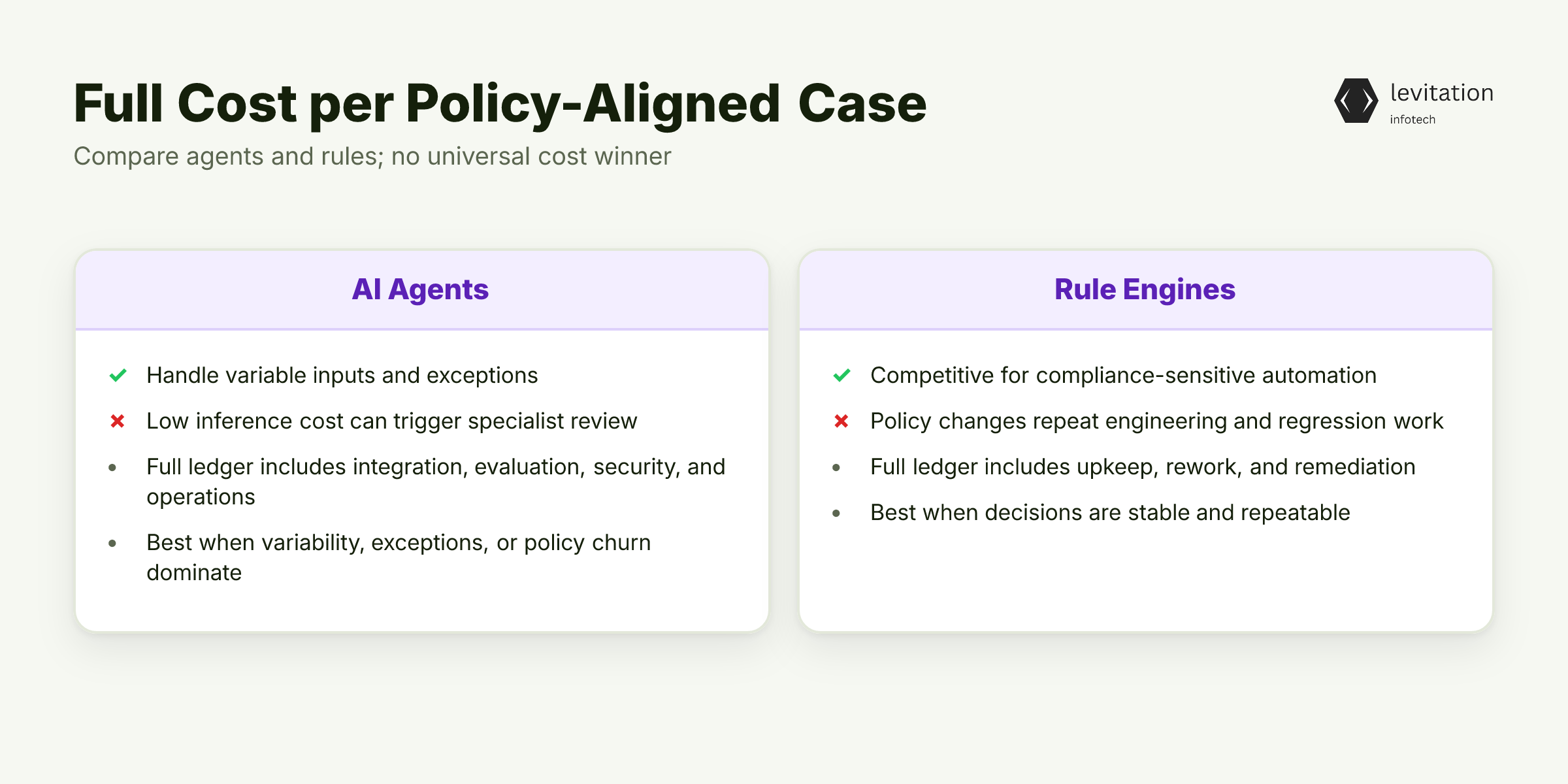
Indian fintech CTOs are comparing the wrong numbers. Agent inference looks cheap until evaluation, integration, and exception management are added. Rule transactions look cheap until repeated policy-change work is counted.
Neither calculation shows the full cost of running a fintech decision system. Consider a fintech application with one missing document, one contradictory transaction record, and one policy check. The workflow is complete only when the case reaches a policy-aligned outcome.
One correctly completed, policy-aligned case is the right economic unit. A token, API call, automated decision, or rule is not. The full cost stack includes: - Discovery and workflow design - Integration and data plumbing - Model inference, retrieval, and tool calls - Evaluation-set creation and regression testing - Monitoring, security controls, and incident handling - Human review and exception management - Rework and customer remediation - Policy-change engineering and rule upkeep
These costs can reverse the apparent bargain. A cheap model creates an expensive system when every case needs specialist review. A cheap rule becomes costly when policy changes force repeated engineering and regression work.
Traditional rules and RPA falter when inputs deviate. Agents can reason across variable inputs and multiple systems as requirements change. That does not make agents universally cheaper. Rule engines remain competitive for compliance-sensitive decision automation, while hybrid systems that combine AI and rules are also common.
There is no universal cost winner. An agent beats rules only when variability, exceptions, or policy churn dominate the workload. Otherwise, it adds a control layer without removing enough manual work.
For teams comparing fintech solutions, the unit of economics must include the full operating ledger. The answer depends on the workload. The decisive comparison is where rules already win and what extra burden an agent must absorb.
Why Replacing Rules with Agents Usually Loses
Rules win on stable, explicit policy
Rules win when policy is stable and explicit. They produce predictable outputs, fast decisions, and straightforward regression tests. If inputs rarely drift and policy changes rarely, this benchmark is hard to beat.
An agent must beat that benchmark on completed cases, not demo quality. Clever summaries don't offset a wrong outcome, slow decision, or unreviewed tool call. That is the bar an agent must clear before it earns control over decisions.
Agents add a control plane
Remove the rule engine, and policy work doesn't vanish. It changes shape.
An agent-led system also needs: - Orchestration and tool permissions - Context assembly and retrieval - Latency, retries, and failure recovery - Evaluation and observability - Prompt-injection and data-access defenses - Human oversight and escalation paths
Every layer adds operating cost, risk, and ownership. The organization still needs clear constraints, named exception owners, audit trails, and a safe fallback.
A governed hybrid separates judgment from authority. An agent interprets unstructured inputs and coordinates work. Deterministic rules enforce hard constraints, while people approve high-consequence actions.
Each component then handles the work it does best. Evaluate agent development against the workflow, not a leaderboard. Use an independent evaluation set to compare functional success, error rate, latency, fairness, and prompt-injection vulnerability.
Include cases that expose missing context, broken tools, and conflicting evidence. A shortlist of top AI companies for fintech in India can identify providers with security-critical delivery experience. That experience matters, but it isn't proof of lower operating cost.
As why fintech AI costs vary explains, workload evidence matters more than vendor labels.
That control model reveals a narrower opportunity. Agents reduce costs around exceptions, rather than replacing deterministic work everywhere. The decisive question is where that boundary sits.
The Exception Boundary Is Where Agents Earn Their Keep
The strongest case for agents is a narrow exception path, not the entire workflow.
Start with high-variability exceptions
Imagine a fraud review with contradictory narratives, missing context, and several systems to reconcile. An agent extracts, classifies, summarizes, ranks, routes, or proposes the next action.
Rules should still enforce hard constraints. People should still own high-consequence actions.
The best candidates include: - Compliance-reporting preparation - Fraud detection and investigation support - Cases affected by changing requirements - Workflows requiring evidence from several source systems
These candidates fit because judgment, not mere data movement, drives the exception. The top generative AI companies in India landscape reveals delivery capability, but it can't define your boundary. Before choosing candidates, map the exception's risk profile.
Map the exception, not the entire workflow
Create an exception map with three axes: - Input variability: How much does each case differ from the last? - Consequence of error: What harm follows a wrong recommendation? - Reversibility: Can the action be undone before reaching the customer?
High variability and reversible outcomes make the safest early targets. High-consequence or irreversible actions need stricter controls, even when the agent understands them well. Those controls only work if the pilot measures the full journey.
Measure the complete journey
Measure labor and error economics directly: - Manual escalations per case - Time to resolution - Misrouting and rework - Policy-change engineering hours - Share of cases handled without escalation - Customer remediation and repeat contacts
Compare the complete exception journey. Autonomous reasoning alone doesn't create savings. The vendor and framework landscape remains only the delivery layer.
Treat pilot results for compliance reporting and fraud detection as directional evidence. They aren't guaranteed percentages. A controlled fintech pilot must test them against your own cases and error definitions.
The exception mechanism only produces savings if it's cheaper across its full lifecycle. A token-price estimate can't answer that. The break-even model must show where agent work displaces enough costly handling to repay its full operating cost.
Three Ledgers Reveal the Real 2026 Break-Even
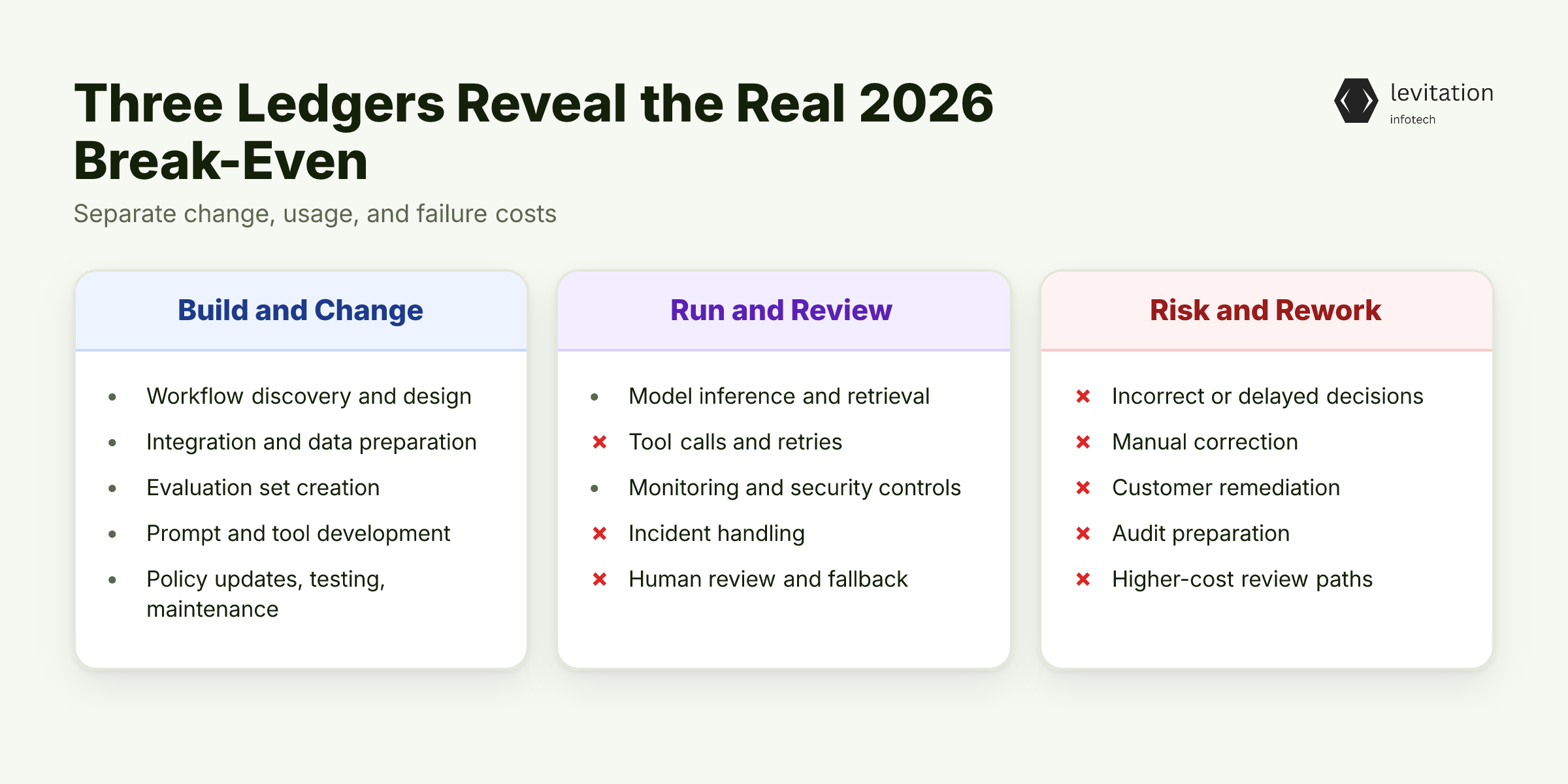
Compare the same workload under all three architectures. Generic market claims won't survive contact with your case mix.
Build-and-change ledger
Record: - Workflow discovery and design - Integration and data preparation - Evaluation-set creation - Prompt and tool development - Policy updates and regression testing - Ongoing maintenance
This ledger catches costs that appear before production but return with every policy change. It prevents a narrow pilot from looking profitable while the system loses money at scale.
That failure mode is detailed in When Per-Use-Case AI ROI Becomes a System-Level Loss. Production introduces the second cost profile.
Run-and-review ledger
Add: - Model inference and retrieval - Tool calls and retries - Monitoring and security controls - Incident handling - Human review - Rule or agent fallback operations
The run ledger exposes costs that scale with usage. The build ledger exposes costs that scale with change. A hybrid reduces one cost source while risking unchecked growth in the other.
Failure and rework form a third cost source.
Risk-and-rework ledger
Estimate: - Incorrect or delayed decisions - Manual correction - Customer remediation - Audit preparation - Cases moved into higher-cost review paths
Don't assign a guaranteed loss reduction before a pilot proves it. Keep unvalidated loss avoidance outside the base-case ROI.
Annual net benefit is avoided exception handling, avoided policy-change work, and avoided rework, minus agent runtime, evaluation, oversight, integration, and change costs.
Run recent cases through three designs: rules only, agent only, and the governed hybrid. Use internal data and written vendor assumptions. Keep every assumption visible and testable.
Track cost per correctly completed case beside task success, error rate, and p95 latency. Also track bias and fairness checks, prompt-injection vulnerability, and human escalations.
Don't reduce AI development cost to engineering salaries or model rates. When AI development services teams quote a build, ask which ledger owns each item. Calculate the fully loaded architecture cost instead.
A sound TCO model is not enough if the system cannot survive production. Commercial claims must be tested in a pilot with explicit stop conditions.
Run a Shadow-to-Production Pilot With Stop Conditions
One workflow. Not a platform program.
Select one bounded workflow
Select a workflow with frequent exceptions and measurable outcomes. Limit tool access, and keep a deterministic fallback active throughout the test.
A good first pilot has a clear start and end. It also has limited permissions and a meaningful incumbent baseline. Before the agent runs, establish the baseline it must beat.
Baseline the incumbent
Trace every rule, integration, manual escalation, policy change, and failure path. Capture current cost, latency, accuracy, and review workload.
Don't use a vendor's generic benchmark as your baseline. The incumbent's real behavior defines the standard the agent must clear. That baseline becomes the comparison point for shadow recommendations.
Shadow before acting
Let the agent recommend decisions without moving money or changing customer access. Also block irreversible actions during this stage.
Log its reasoning, tool calls, inputs, and outcomes. Compare every recommendation with the incumbent decision and eventual result. Shadow agreement alone won't reveal how the agent handles hostile inputs.
Test beyond happy paths
Build a diverse evaluation set separate from training data. Cover normal, edge, adversarial, and prompt-injection cases.
Also test tool failure, missing context, conflicting data, and unsafe instructions. A happy-path pass isn't a production pass. Those failures need hard controls before any canary begins.
Govern the canary
Govern the canary with narrow permissions: - Allowlist tools and validate every schema - Enforce policy through deterministic rules - Require human approval for high-consequence actions - Retain complete audit trails - Preserve immediate rollback to the rule path
Define stop conditions from the incumbent SLA before launch. Include task-success degradation, severe errors, latency or cost ceilings, and security-test failures.
Buy commodity connectors and standard platform capabilities. Retain control of proprietary workflows, evaluation data, policy integration, and audit ownership.
Vendor diligence should test control maturity, not just delivery speed, because claims of fintech savings are not evidence. When evaluating top generative AI companies in India, ask for control evidence, not a savings promise. Teams offering AI development services should expose the same evidence.
Once the pilot produces measured evidence, the CTO can make a narrow build, buy, or hybrid decision. That beats betting on an entire product category. The measured result will show where the economic boundary belongs.
Choose Build, Buy, or Hybrid From the Evidence
The evidence now supports a portfolio, not a religion. - Keep rules when inputs and policy are stable, decisions are high-volume, and predictable explainability matters most. - Choose an agent-led workflow when ambiguous inputs, cross-system orchestration, or frequent exceptions dominate. - Default to a hybrid when interpretation adds value but hard financial or compliance constraints must remain deterministic. - Build proprietary decision logic, evaluation assets, and workflow integrations that create differentiation. - Buy standard platform capabilities, commodity connectors, and commodity model access. - Retain rules as the authoritative fallback wherever hard constraints remain more economical.
The top AI companies for fintech in India shortlist helps assess delivery controls. Then apply your pilot's evidence to workload selection.
Present fintech AI-agent cost comparisons in India as case-specific TCOs, not one market rate. Report ROI using verified exception-cost reduction and incremental operating costs.
Operational gains to track in a governed design include: - Fewer manual escalations - Faster policy updates - Shorter resolution cycles - Better audit trails - More predictable operating capacity
Cost matters, but control matters too. The real answer hides in four details: break-even timing, hybrid design, ROI boundaries, and build-versus-buy criteria.
Frequently Asked Questions
Q: Are AI agents cheaper than rule engines for Indian fintechs in 2026?
A: They are cheaper only when variable inputs, frequent exceptions, or policy churn make rule upkeep and manual escalation costly.
Use these decision cues: - Rules: Stable inputs, explicit policy, high-volume decisions - Agents: Variable inputs, ambiguity, and frequent exceptions - Hybrid: Valuable interpretation with hard deterministic constraints - Outsourcing: Suitable for commodity platform work, not proprietary policy ownership
AI agent development is justified only where the agent changes exception economics. For broader fintech solutions, architecture choice must follow workload evidence.
Q: When does a hybrid architecture combining AI agents and rules win?
A: Use a hybrid when unstructured interpretation or cross-system coordination adds value but hard policy constraints must remain deterministic.
This design reduces review and rework while preserving explainable final controls and a reliable fallback. The agent handles variability, while the rules preserve authority.
Q: What should a fintech CTO include in an AI-agent ROI model for fintech?
A: Include the incumbent's fully loaded exception and policy-change costs. Then subtract agent runtime, evaluation, monitoring, human review, integration, and risk costs.
Report cost per correctly completed case beside payback period. Show unverified loss avoidance separately from the base case.
Q: What drives AI development and AI-agent costs in India?
A: The main drivers include workflow integration, evaluation, observability, and security controls. Model and tool usage, human oversight, and change management also add cost.
Salary or vendor-rate comparisons alone don't provide a meaningful cost benchmark. Outsource commodity platform work when its controls and economics are clear. Retain internal ownership of policy and evaluation assets.
Q: Should a fintech CTO build or buy its AI-agent capability?
A: Buy standard platform and integration capabilities. Build the proprietary workflow, policy logic, evaluation harness, and audit controls that create competitive advantage.
Keep deterministic rules wherever hard constraints and reliable fallback remain more economical. Start with the cases your team already handles. The evidence from that first case will determine whether broader ownership or a hybrid approach pays off.
About the author
Mayank Singh is a software developer at Levitation Infotech, where he builds web and AI-powered applications across the company’s fintech, healthcare, and enterprise projects.