


TL;DR: Hospital AI ROI looks great when measured per use case and looks broken when measured per system. The fix is total-cost accounting driven by an AI governance council that tracks downstream clinical events, not just vendor-reported savings. Without it, even a winning AI portfolio can quietly lose money on the balance sheet.
Key Takeaways: - Per-use-case ROI hides the cost of disconnected tools, alert fatigue, and downstream clinical events no vendor tracks. - Hospitals with structured AI governance programs reach positive ROI faster than those without. - Total-cost accounting, not better vendor reports, is the mechanism that turns pilots into compounding returns.
The Narrow ROI Trap: When a Win on Paper Is a Loss on the Balance Sheet
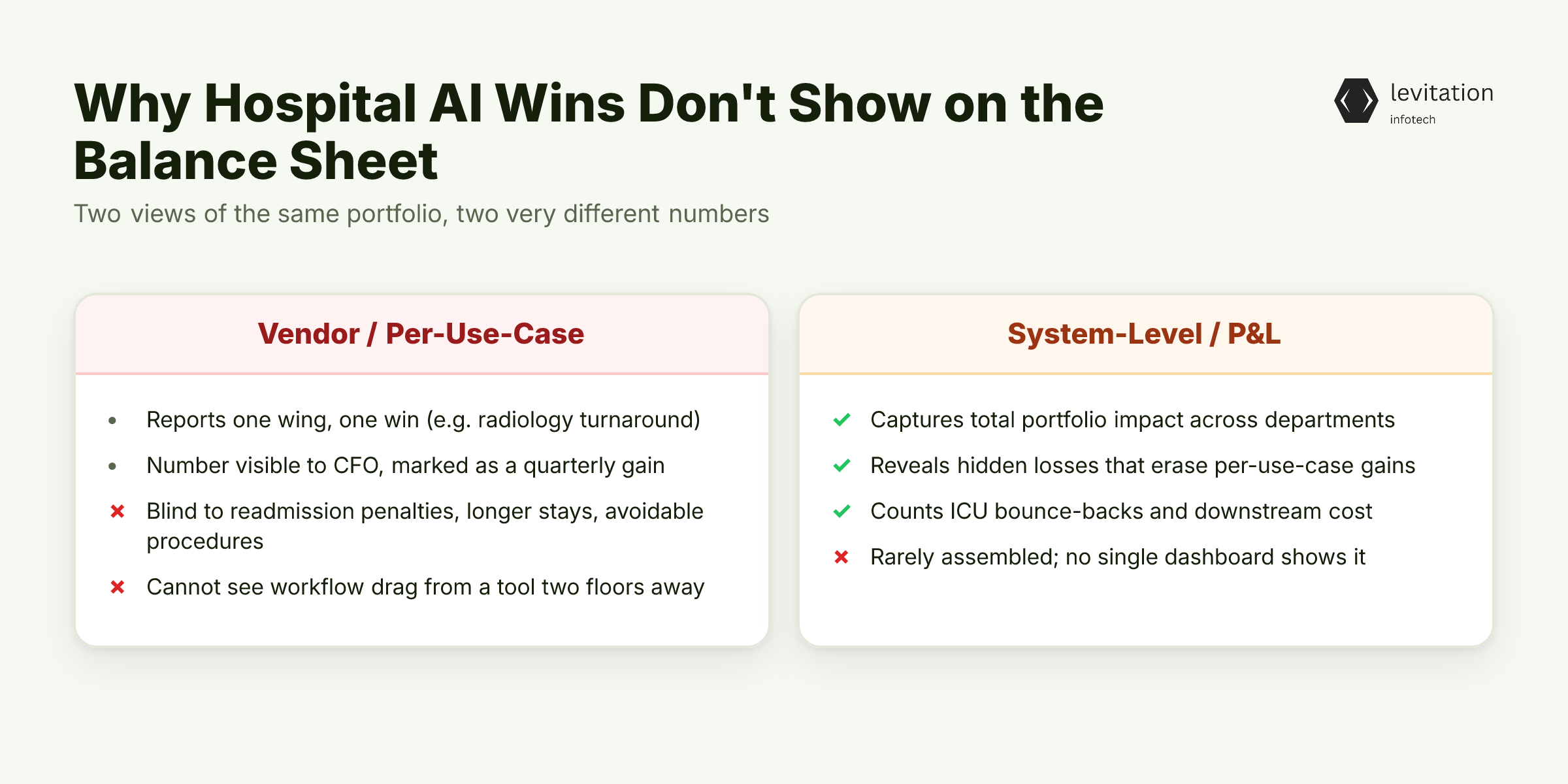
The pattern plays out the same way in most hospitals. A radiology AI cuts report turnaround time in one wing. The CFO marks the quarter a win.
Meanwhile, an unrelated sepsis-prediction model sits licensed but underused, because the EHR integration was never finished. Patients who would have been flagged earlier end up back in the ICU within 30 days. The cost of those readmissions, in penalties, longer stays, and avoidable procedures, erases the radiology gain. The AI portfolio reports a win on paper, while the ledger runs at a loss on those same patients.
This is the pattern behind why most hospital AI pilots die in year one. The disconnect between per-use-case wins and system-level losses is not a one-off. It scales with portfolio size.
The headlines announcing aggressive AI expansion at major US health systems are real. The gap between those announcements and the underlying P&L is also real.
The problem is that most hospital AI ROI is reported per use case, not per system. The CFO sees one number. The CMO sees another. Neither sees the total. A single vendor dashboard cannot tell you whether its gains are being erased by readmissions or complications in another department. It cannot show workflow drag from a tool that sits two floors away.
Vendors sell time saved. Clinicians track decisions reversed. Both are true. Neither is the answer.
The pattern is not an AI failure. It is a measurement failure. The accounting problem is structural, and it starts with how each vendor reports its own number. The reason it stays that fragmented is the next piece of the puzzle.
Why Hospital AI ROI Numbers Don't Add Up: The Per-Use-Case Accounting Problem
Each AI vendor reports ROI in isolation. Different denominator, different timeline, different definition of savings. Cross-vendor comparison is impossible because the data was never designed to be compared. It was designed to defend a renewal.
Industry analysts have published ROI scorecards showing average returns that arrive faster than executives expected. Read past the headline and those same reports warn that gains are not spread evenly across use cases. Administrative work leads. Clinical applications lag. The number is real, but it is an average, not a guarantee.
Most boards miss the distinction between a projection on a slide and a measured outcome on a balance sheet. The celebrated wins keep coming in pieces. Revenue cycle AI has been reported to deliver large coder productivity gains and cut claims review time. The CFO sends a memo.
What the memo does not mention is clinician burnout from juggling disconnected AI tools. That burnout quietly drives turnover costs that never appear on any vendor ROI sheet. Clinical AI does not fail in a single dashboard. It fails in the gaps between them.
Hidden cost categories multiply in those gaps: - Integration maintenance and middleware hours - Alert fatigue and clinician time lost to false positives - Duplicate data entry across tools that don't share context - Training and change-management burden per department - Downstream clinical events the AI never touched, but the deployment was supposed to prevent
There is a structural reason these numbers stay fragmented. Fixing it requires more than better spreadsheets. It requires a new layer of governance.
The Governance Multiplier: Why Structured Programs Hit ROI Faster
Health systems with an AI Governance Council reach positive ROI within a year of a pilot, according to industry research. Programs that build dashboards, set clear ownership, and use structured reporting reach early ROI faster than less organized ones.
The mechanism is straightforward. Governance forces total-cost accounting before deployment. Every use case has to clear a review that asks three questions: what does this displace, what does this add, what does this break. Use cases that pass are deployed with clear ownership and a sunset clause. Use cases that don't pass are either redesigned or killed.
Large health systems have publicly described rejecting multiple proposed AI use cases through governance review. They still generated large portfolio-level value from the applications they approved. The rejected proposals are not a cost of bureaucracy. They are the cost of discipline that protected the rest of the portfolio from fragmenting.
In a system that runs hundreds of live applications, the alternative to governance is silent fragmentation. Silent fragmentation is exactly how a large portfolio quietly shrinks without anyone noticing.
Governance works only when the underlying health information system can surface cross-departmental cost data, not just departmental KPIs. If the HIS treats radiology, the ICU, and the ED as three accounting islands, the governance council will make decisions on a partial map. The technical prerequisite is a single source of cost truth that crosses clinical and operational boundaries. Most hospital data architectures do not have that today.
A governance framework sounds like bureaucracy. In practice, it is the opposite. It is what lets hospitals say no to AI that would dilute the ROI of AI that works. The next question is what the portfolio looks like once that filter is applied at the system level.
What Hospital AI ROI Actually Looks Like When Measured as a System
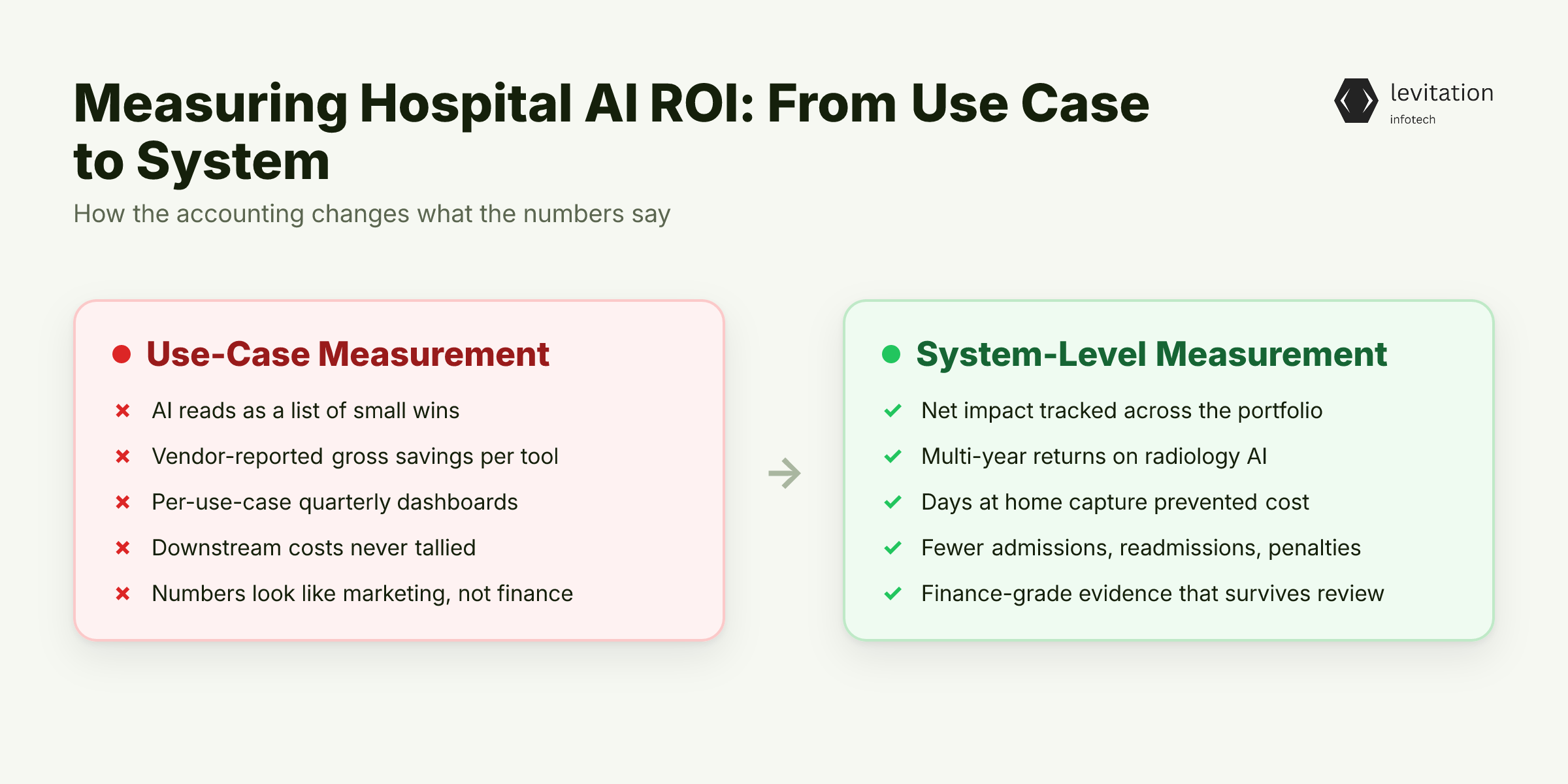
When measurement stops at the use case, AI looks like a long list of small wins. When measurement moves to the system, the picture changes. Programs that track net impact across the portfolio report meaningful returns over multi-month horizons. AI-powered radiology platforms have produced multi-year returns when cost, time, and downstream imaging are measured together.
Some programs have reported reductions in admissions and ED visits alongside major savings. They have also reported more days patients spent at home rather than in a hospital bed.
What these outcomes share is not the AI. It is the accounting. Each came from a program that measured net impact at the system level, not vendor-reported gross savings at the use-case level. The days at home matter more than any single dollar figure. They capture the cost AI prevented, which is the cost no per-use-case dashboard ever tallies.
Days at home mean fewer admissions, fewer complications, fewer penalties, and fewer readmissions. None of those savings show up on a radiology AI's quarterly report. All of them show up on a hospital's P&L.
The shift in framing is small but powerful. Hospitals that stop measuring AI and start measuring care delivery with AI in it see the numbers stop being vendor marketing. They become finance-grade evidence. That evidence is what survives a board meeting, a budget review, and a procurement cycle. That is the ai in healthcare decision that compounds. It is the one that separates a real program from another pilot postmortem.
The outcomes are real. The deployment method is what determines whether your hospital sees them or writes another entry in the long list of failed pilots.
The CTO's 4-Step Framework for Total AI Cost Accounting
Step 1: Map every AI use case to a cost or revenue line in the general ledger, not to a department budget. Departmental accounting is the source of the blind spot. If the sepsis model sits in an ICU cost center and the radiology model sits in a radiology cost center, neither can show the other's drag. The general ledger is the only view that captures what the hospital actually spent and saved.
Step 2: Track downstream costs in parallel. 30-day readmissions, ICU days, complications, alert-driven clinician time, and integration maintenance hours belong on the same dashboard as the AI's reported savings. A separate "AI ROI" page is a vendor artifact. A page that puts AI savings and AI-driven costs on the same canvas is a finance tool.
Step 3: Stand up a governance council with explicit veto power. Disciplined rejection of weak use cases is what keeps the surviving portfolio net positive. Without veto power, governance is a committee that writes reports no one reads.
Step 4: Consolidate to a quarterly net ROI report reviewed jointly by the CFO and the CMO. If a use case cannot show net positive over two consecutive quarters, sunset it and redeploy the budget. This step is where pilots stop being permanent expenses and start becoming a managed portfolio that survives leadership changes and budget cycles.
The framework can be put in place faster than most hospital procurement timelines. Hospitals that deploy this way run the systems in production for years after go-live. The measurement discipline compounds each cycle. That long horizon is where healthcare technology moves from project to platform, and where the year-two cost cliff stops appearing on your ledger.
When this works, the numbers stop being surprising. They start being predictable. That predictability is what makes the next cycle of deployment less risky than the last.
What Changes When You Measure AI the Way You Measure Everything Else
Year one, the governance council audits the existing portfolio and finds that many AI use cases are net negative once downstream costs are tallied. Year two, those use cases are either redesigned or sunset. The surviving portfolio runs cleaner.
Year three, the HIS data underneath those deployments is governed well enough that the measurement denominator itself improves. Each cycle makes the next cycle easier.
The compounding effect is the real return. It is the return that vendor ROI decks never show.
The shift is simple. The question is no longer "which AI has the best ROI pitch." It is "which AI survives our governance council's net-cost test."
That question protects the hospital's margin and makes healthcare AI procurement a finance decision rather than a marketing one. Procurement teams that run this filter at scale are the ones who turn AI from a line item into infrastructure.
Frequently Asked Questions
How do you measure ROI for hospital AI across multiple use cases?
You measure at the system level, not the use-case level. Map every AI deployment to a cost or revenue line in the general ledger. Track downstream costs like readmissions and clinician time in parallel. Consolidate to a quarterly net ROI report reviewed jointly by finance and clinical leadership. Use-case ROI reported by vendors is a marketing input, not a finance figure.
What is a realistic ROI timeline for clinical AI?
Structured programs with governance and dashboards reach early ROI faster than unstructured programs, according to industry research. Industry-wide, executives report meaningful ROI in less time than they expected, but only for programs that survived governance review.
Why do some hospital AI deployments fail to show positive ROI?
Three reasons recur. The use case was never integrated into clinical workflow, so adoption stays low. Downstream costs like alert fatigue and readmissions were never tracked, so they erase the gross savings. There was no governance mechanism to sunset underperforming deployments, so budget stayed locked in low-ROI tools while high-ROI ones waited for funding.
How does an AI governance council improve hospital AI ROI?
Governance forces total-cost accounting before deployment, sets clear ownership post-deployment, and gives the organization permission to reject use cases that would dilute the portfolio. Disciplined rejection of weak proposals keeps the surviving portfolio net positive.
What hidden costs should hospitals track when deploying AI?
Beyond the license and implementation fee, track integration and maintenance hours, clinician time spent on alerts and rework, training and change-management cost, 30-day readmission rates for affected cohorts, and the opportunity cost of budget locked in low-ROI tools. Per-use-case vendor reports almost never include these. Net hospital-level measurement is non-negotiable.
About the author
Mayank Singh is a software developer at Levitation Infotech, where he builds web and AI-powered applications across the company’s fintech, healthcare, and enterprise projects.