


TL;DR: Fixed-bid contracts look safe, but they lock scope before you know what to build. For SaaS, where requirements shift after the first round of user feedback, this creates a 6-month stall, a change-order backlog, and effective costs that routinely exceed T&M because change orders compound the original scope. The fix is matching the engagement model to your build stage: discovery sprint, then T&M agile, then targeted fixed-bid only on well-scoped modules.
Key Takeaways: - Fixed-bid contracts stall SaaS builds because SaaS requirements change after user feedback, and the contract treats discovery as already done. - The discovery work skipped at contract signing becomes billed as overrun once the build hits its first unknown. - T&M with 2-week sprints and capped monthly burn delivers a working SaaS MVP in 4-6 weeks instead of a multi-month black box. - The right model changes with stage: fixed-scope discovery, T&M MVP, then hybrid with fixed-bid only for compliance modules where scope is genuinely known.
The Fixed-Bid Illusion Founders Fall For
Every founder loves a fixed-bid contract until the vendor goes silent for three months while "reviewing requirements." The pricing model you pick predicts your launch date more accurately than your tech stack. Most Noida engagements pick wrong.
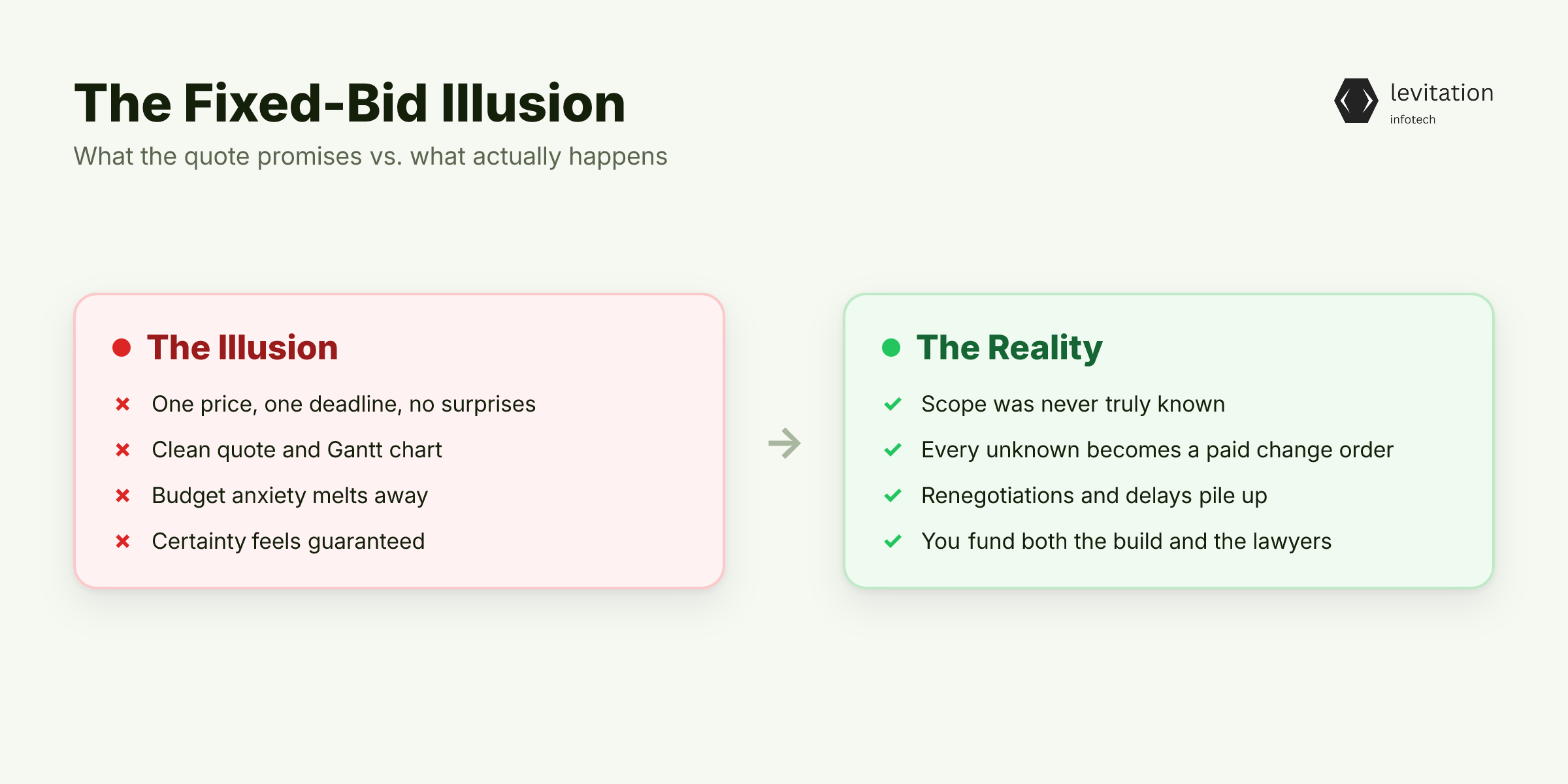
Fixed-bid feels safe because it promises what every first-time founder craves: a number. One price. One deadline. No surprises.
When the vendor sends a clean quote and a Gantt chart, the budget anxiety melts away. Here is the problem. That certainty is fictional.
A fixed price assumes scope is known. For a greenfield SaaS product, scope is never known. Not at the first meeting. Not at the PRD handoff.
The vendor quotes against a requirements doc that describes a product nobody has tested against real users. To win the contract, Noida vendors often quote at the bottom of the realistic range.
The margin does not disappear. It migrates to change orders.
The illusion breaks the moment the build hits its first unknown. Maybe a multi-tenant data model is more complex than the PRD assumed. Maybe a payment integration needs webhook handling the original spec skipped. Maybe compliance requirements show up in week three.
Each one becomes a paid change order, a renegotiation, and a delay. You walked in wanting budget certainty. You walked out funding both the build and the contract lawyers.
If you want to understand the real software development cost in India before signing anything, the fixed-bid quote is the least reliable number on the table. The contract itself is not the problem. The contractual mechanics are. And those mechanics are predictable.
How Fixed-Bid Contracts Mechanically Stall a Build
The stall is not a personality issue. It is structural. The fixed-bid contract is a machine that produces delays, and it does so in four predictable steps.
Step one: the scope-locking clause. The contract defines what gets built. Anything outside that definition is paid extra. So every feature the founder forgot to specify becomes a change order with a price tag.
Every user role the founder did not think about. Every integration that turns out to matter. Same story, same fee.
Step two: the discovery gap. SaaS development requires real discovery work before code starts. Fixed-bid quotes bake this in as "already done." If the founder skipped the actual discovery work, the vendor absorbs the cost until they cannot. Then the overrun arrives.
Step three: the architectural reality. Multi-tenant SaaS, role-based access, billing logic, and API integrations almost never fit inside a PRD written in week one. HIPAA audit logging, SOC 2 evidence collection, and data residency rules add layers the original spec ignored. The vendor did not plan for them. Neither did you.
Step four: the change-order backlog. Once change orders start, vendors deprioritize them. New revenue is on the table. Old revenue is locked. Renegotiating scope is unprofitable, so the queue grows.
This pattern shows up across enterprise deployments in regulated industries. Seasoned vendors refuse fixed-bid for greenfield SaaS for a reason.
The result is not just a delayed project. It is a fundamentally different cost than what the contract promised. And the cost math gets ugly fast. The breakdown reveals why the lowest bid often becomes the largest invoice.
The Real Cost Math Behind a Stalled Fixed-Bid Build
SaaS development in India runs from $20,000 for a basic micro-SaaS MVP to $500,000+ for a complex multi-tenant platform. The midpoint varies based on features, integrations, and team location. These numbers assume the discovery work is already done.
Fixed-bid quotes almost always quote the lower bound. Then reality shows up.
A 6-month stall is not just a line item. It is runway burn while the founder pays engineers who cannot ship. It is a missed market window while a competitor moves first.
It is the founder's opportunity cost: the deals they could have closed, the investors they could have talked to.
The contract price is a fiction once change orders begin. The effective cost to build software under fixed-bid often exceeds T&M. Change orders and renegotiations add to the original scope. The vendor charges for the work either way.
The difference is whether you see the cost coming or whether it ambushes you three months in.
There is also the compounding cost of delayed feedback loops. When the vendor controls release timing, founders cannot test against real users.
Each delay means a stale hypothesis. Each stale hypothesis means a wrong feature. Each wrong feature means a future rewrite.
The cost of custom software development under fixed-bid is not just money. It is misaligned learning. The contract promised certainty. It delivered entropy.
So the question becomes: which engagement model actually delivers the cost control founders wanted in the first place?
Why T&M and Agile Engagement Models Reduce SaaS Risk
T&M bills against actual hours worked. Agile delivers in short sprints with visible outcomes. Neither promises a fixed number.
But both deliver something founders need more: control over what gets built and when.
For SaaS, the product definition changes after the first round of user feedback. That is not a theory. It is how the model works.
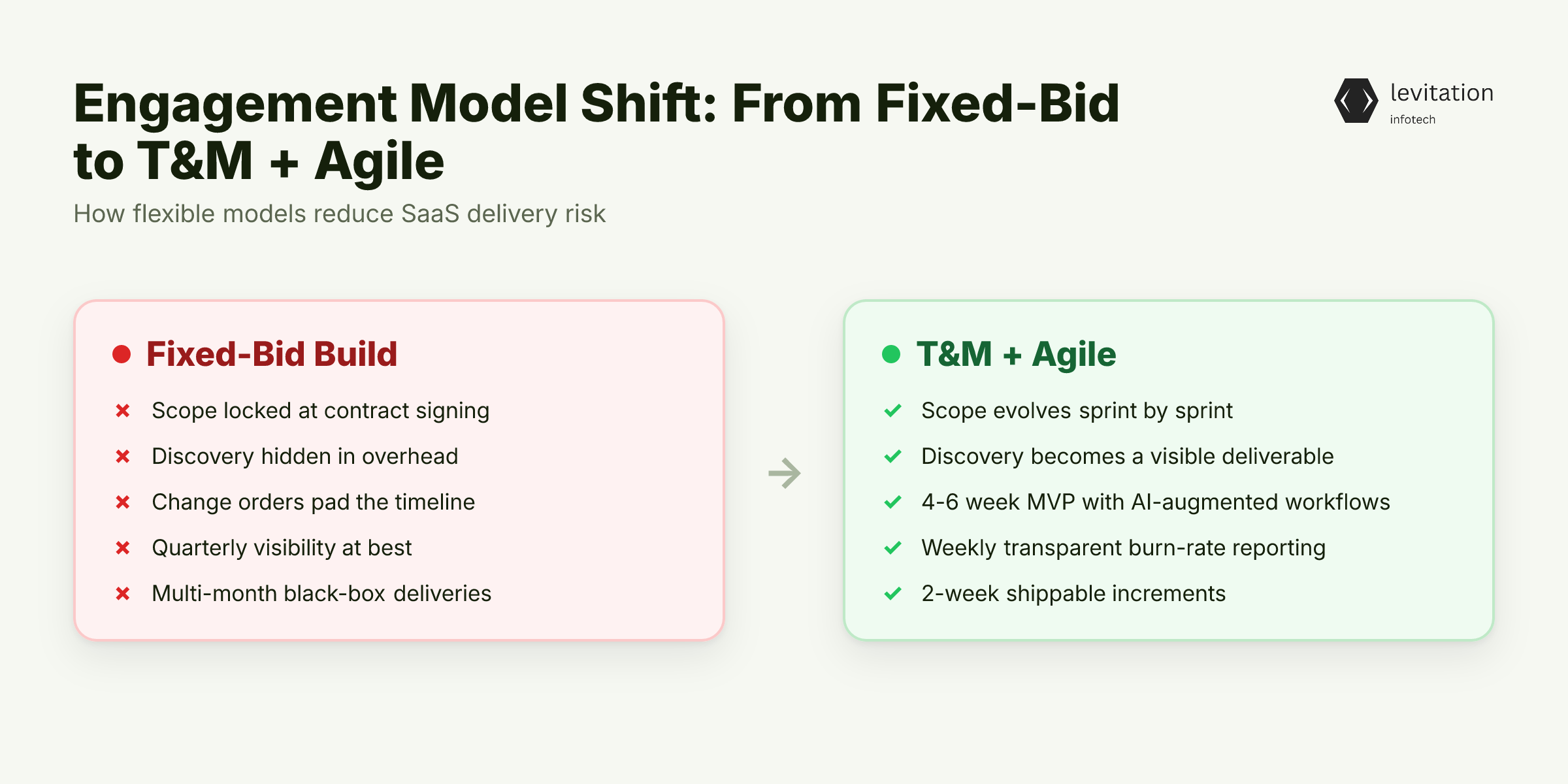
T&M lets the scope evolve as user feedback arrives, sprint by sprint, without renegotiating the entire contract.
Verified industry data now puts a well-scoped SaaS MVP at 4-6 weeks with AI-augmented workflows. That timeline is only achievable inside an agile model with tight feedback loops.
A long-horizon fixed-bid build of the same scope would absorb the same 4-6 weeks of work, padded with change orders.
The discovery phase becomes a paid, visible deliverable. The founder sees the PRD being written. They see the wireframes being tested. They see the architecture being chosen.
Discovery stops being hidden overhead baked into a fixed quote. It becomes a sprint with a clear exit criterion.
T&M shifts risk to the vendor through transparent burn-rate reporting. The vendor still wants efficiency. The founder still controls scope priorities. Both parties can see the numbers weekly, not quarterly.
Sprint-based forecasting with capped monthly burn beats a fixed number that was wrong from day one. You know the cost each month.
You can cut scope, add scope, or pivot based on what users tell you. A Noida SaaS product development partner running agile sprints can ship 2-week increments instead of multi-month black-box deliveries.
You see the build. You shape the build. Long-running production systems come from this kind of partnership, not from fixed-bid battles. Knowing the model is not enough, though. The harder part is matching the model to your specific build stage.
Matching the Engagement Model to Your SaaS Build Stage
Founders who get this right stop arguing about contracts and start shipping product. The model changes with the stage. Here is the framework.
Stage 1: Discovery sprint. Use a fixed-scope discovery sprint. The deliverable is a PRD, wireframes, and an architecture document. Pay hourly, not fixed-bid.
The cost is small. The output is a contract you can actually trust. This is where most founders skip ahead and sign a fixed-bid build contract instead. That is where the 6-month stall starts.
In regulated industries, the discovery sprint consistently proves to be the single highest-ROI investment in any SaaS build.
Stage 2: MVP (4-6 weeks). Use T&M agile with a 2-week sprint cadence and capped monthly burn. Tie the "definition of done" to user actions, not feature counts. A user can sign up, complete a core workflow, and pay. That is done. Everything else waits.
Stage 3: Scale. Blend. Use T&M for backend microservices and feature work where requirements still evolve. Use fixed-bid only for well-defined compliance modules, such as HIPAA audit logging, where the spec is genuinely stable.
This is the one place bespoke software work benefits from a fixed price.
Three red flags in any Noida SaaS vendor proposal: - A fixed price for a multi-tenant SaaS without a discovery phase. - A single PRD handed over before any user research. - Change-order fees that materially inflate the base contract.
The clause that protects you: a "scope re-prioritization" right. You can drop a feature mid-sprint without renegotiating the entire contract. The vendor bills the hours. You keep control of the roadmap.
This is the difference between a partner and a prison.
Custom software development costs behave differently under each model. The $20,000-$500,000+ range most articles quote assumes you have already done discovery.
If you have not, every model will cost more than the headline number. The question is whether you see the cost or it surprises you. Teams that run this framework ship differently. Here is what changes in the numbers.
What Founders Get When They Pick the Right Model
Sprint reviews every 2 weeks. Not multi-month silences followed by scope arguments. The founder sees working software, gives feedback, and watches the build adapt in real time.
A working SaaS MVP in 4-6 weeks, validated against real user behavior instead of a contract document.
The first paying customer shapes the next sprint. The second paying customer shapes the one after that. Feedback loops close in days, not quarters.
The ability to pivot the roadmap after the first paying customer without burning the remaining budget on change orders.
When the user says "I need this instead of that," the team adjusts. The contract does not get in the way. This is the actual software development cost you wanted: predictable, transparent, and aligned with outcomes.
Long-term engineering quality matters too. Long-running production systems reflect the T&M model's incentive to build right. The vendor's reputation depends on it.
Fixed-bid rewards building to contract. Those are not the same thing. In regulated industries, the projects that aged well had one trait in common. The engagement model let the team say "we found a better way" without a legal fight.
The real outcome: founders stop negotiating scope and start shipping product. That is the only metric that matters for SaaS cost recovery. Speed to market, validated learning, and compounding feedback loops beat a fixed number every time.
Teams that internalize this difference treat engagement models as a strategic tool, not a procurement checkbox.
If you are evaluating a partner for a SaaS build, ask them how they handle scope changes in week six. Their answer tells you more than any sales deck.
Frequently Asked Questions
How much does SaaS development cost in India in 2026?
Verified range is $20,000 for a basic micro-SaaS MVP to $500,000+ for complex multi-tenant enterprise platforms. The midpoint varies based on user roles, integrations, and compliance requirements. These figures assume discovery work is already complete.
Why do fixed-bid contracts stall Noida SaaS builds by 6 months?
Fixed-bid contracts lock scope at signing, but SaaS requirements typically change after the first round of user feedback. Every change becomes a paid change order. Vendors deprioritize renegotiation work.
The discovery work that should have happened before the contract gets billed as overrun. The result is a 6-month stall on top of an already-inflated budget.
What is the difference between fixed-bid and T&M engagement for SaaS?
Fixed-bid locks price and scope upfront. The vendor absorbs the risk if scope holds, but you absorb it when requirements change.
T&M bills against actual hours worked. It lets scope evolve sprint-by-sprint and keeps both parties aligned with transparent burn-rate reporting. For SaaS where the product definition shifts after launch, T&M typically delivers lower total cost and faster time-to-market.
How long does a SaaS MVP actually take to build in 2026?
A well-scoped SaaS MVP validating one core feature takes 4-6 weeks in 2026 with AI-augmented development workflows. More complex MVPs and full-featured products take longer, with timelines scaling based on user roles, integrations, and compliance requirements. Anything much longer usually signals a scope or engagement-model problem, not an engineering problem.
When is fixed-bid actually the right choice for a SaaS project?
Fixed-bid works when scope is genuinely known and stable. Examples: a well-defined compliance module, a third-party API integration with fixed endpoints, or a feature addition to an existing product.
It is the wrong choice for greenfield SaaS builds, multi-tenant architectures, or any work where user feedback will reshape requirements after week two.
Want a math view of your build before you sign? A discovery sprint gives you that without locking scope.
Sources
Research and references cited in this article:
- SaaS development costs 2026: full breakdown | BDS
- SaaS Development Costs: What You Will Actually Pay in ...
- How Much Does SaaS Development Cost in 2026?
- SaaS Development Cost: How Much Costs to Build a SaaS Product
- 2026 SaaS Pricing Trends Driving Up Enterprise Costs - Zylo
- Fixed Price Software Development vs Time & Material: When to Use
- How to Prevent Software Project Cost Overruns in 2026
- SaaS Development Cost in 2026: Complete Pricing Guide
- Project Delays and Cost Overruns
- Time And Material Vs Fixed Price (2026): Which Costs Less? - GainHQ
- Top 4 Engagement Models For Software Development
- Fixed Price vs Time-and-Materials vs Dedicated Teams — A Detailed Comparison
About the author
Mayank Singh is a software developer at Levitation Infotech, where he builds web and AI-powered applications across the company’s fintech, healthcare, and enterprise projects.