


TL;DR: Indian developers genuinely cost 60% less than US peers on hourly rate, but most engagements never realize that headline. Quarter one exposes hidden cost layers, sprint overruns, and contract traps. Structure the deal right, and the realized savings land in the 35-45% band instead of disappearing into rework and buffers.
Key Takeaways: - The 60% gap is a labor-rate comparison, not a total-engagement cost comparison, and that distinction is where savings die. - Sprint overruns compound. Missed velocity baselines shift downward sprint after sprint, and your burn rate climbs with each recalibration. - Quarter one is a paid diagnostic. Treat sprint one as a measurement tool, not a deliverable. - Contract structure decides whether you capture the 35-45% net savings or watch them evaporate into fixed-price buffers.
The 60% Number Is Real. Your Contract Probably Isn't Built to Capture It.
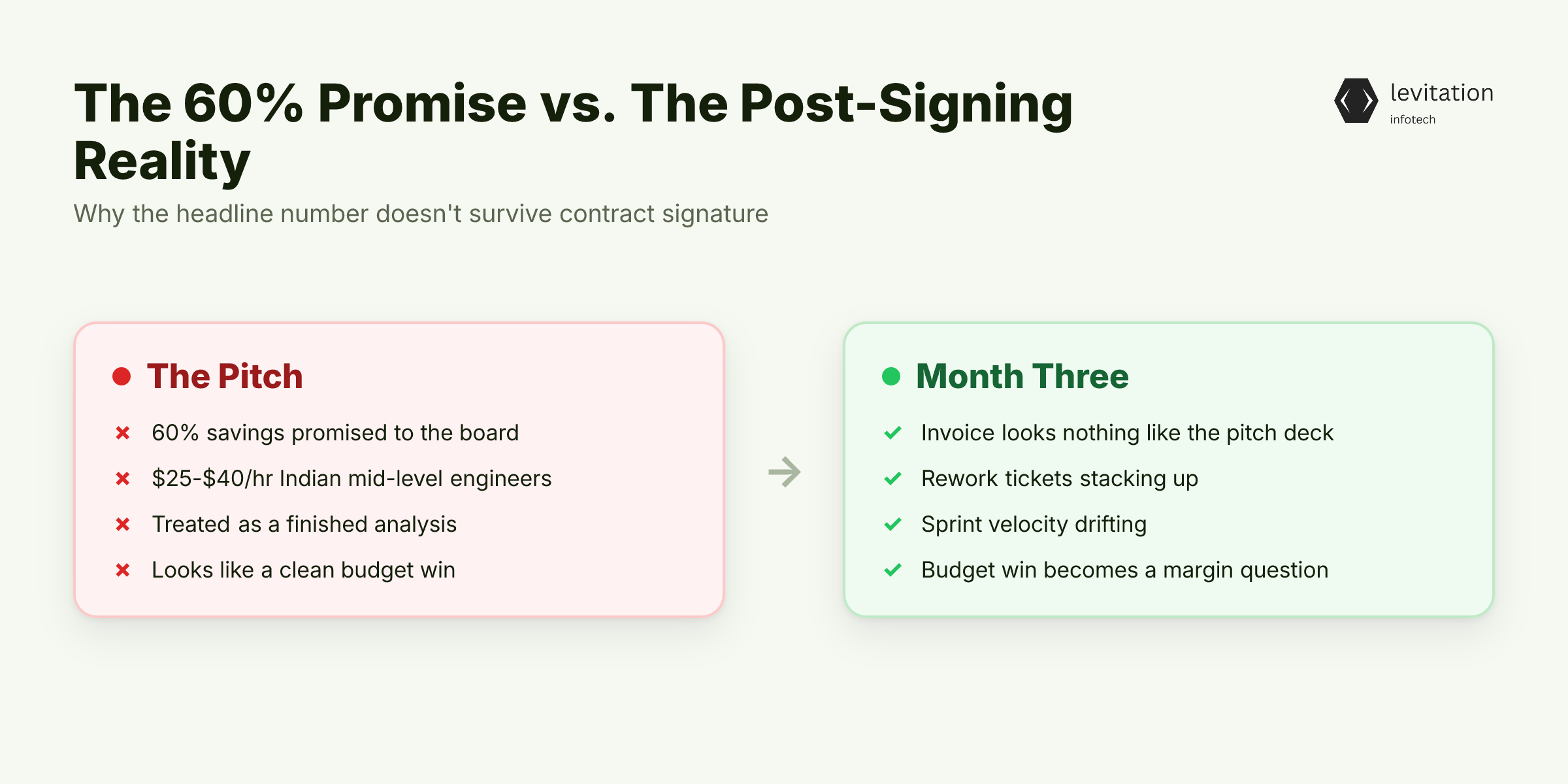
You pitched 60% savings to your board. By week nine, your CFO is reviewing an invoice that looks nothing like the pitch deck. The rework tickets are stacking up.
Sprint velocity is drifting. The custom software development engagement that looked like a budget win is now a margin question.
The headline number is real. Indian mid-level developers run $25-$40 per hour. The US national average for the same role sits at $94. That arithmetic produces a genuine 60% gap on paper. The catch is that almost no one treats it as a starting point.
Some firms quote 60% lower pricing while paying engineers top-percentile local wages. Cost-of-living and exchange-rate dynamics make this work. An Indian engineer earning $30/hour is well-paid by Indian standards.
On your cap table, the same engineer is a routine line item, not a budget crisis. But here's where founders go wrong. They treat the 60% number as a finished analysis. It isn't.
It's the visible surface of a layered cost structure that inflates the moment the contract is signed. Stack those layers, and you'll see why so many engagements miss the 60% mark by month three.
The Layered Cost Onion: What's Actually Inside Your Indian Dev Quote
Direct labor is layer one. That's the number on the pitch deck. Layer two is ramp-up: onboarding, environment setup, access provisioning, and the ramp-up period before any real velocity shows up.
Most firms bury this in month one. You pay for it as if it were productive output.
Layer three is the churn buffer. Indian firms replace mid-engagement developers over the course of multi-year engagements, and the cost of that replacement gets priced into your statement of work whether anyone tells you or not.
Layer four is currency exposure. Fixed-price contracts hedge INR/USD drift with a 4-6% buffer baked directly into the rate. Layer five is scope drift, stacked on top of currency, adding further premiums before any code is written.
Then 2026 added a new layer. Data-privacy audit costs for bespoke software projects touching regulated workloads now show up as line items. Healthcare and fintech projects carry the heaviest audit load.
Senior AI and cloud engineers in Tier-1 cities command premium fees that pass through to your invoice.
If fixed-price contracts inflate through buffers, the obvious move is time-and-material. But T&M exposes a different failure mode that hits harder and faster: velocity risk.
Why Sprint Overruns Eat the Savings Faster Than the Rate Gap Creates Them
Time-and-material engagements show the clean hourly number. You see exactly what the developer costs per hour.
What you don't see is the velocity risk you just absorbed. When a team takes longer than expected, you pay for every extra hour.
Sprint overruns compound in a way most founders don't model. Missed velocity baselines shift downward sprint after sprint. Hidden dependencies surface late.
The team's "real" velocity keeps getting recalibrated. Your burn rate climbs with each sprint.
India's mature agile delivery infrastructure and sprint-based development models help. They help only when you define "done" with surgical precision. Vague acceptance criteria turn every story into a renegotiation.
The math is brutal. A 60% rate advantage evaporates fast when a team consistently burns more than the estimated hours on a mid-sized application development engagement. You end up with effective rates that look nothing like the quote.
This is where the title's "quarter one" earns its weight. The first sprint is not a deliverable. It's a diagnostic that tells you whether the engagement will actually return 35-45% savings or none at all.
What 'Quarter One' Actually Tells You About the Engagement
Sprint one of an outsourcing engagement functions as a paid pilot disguised as production work. It exposes ramp-up time, communication latency, and code-review depth.
None of these show up in the pitch deck. All of them show up in the velocity number at week three.
Indian firms that execute well typically deliver net savings in the 35-45% range. This aligns with the verified savings band from the research. The rate advantage survives because the team proved it could execute.
Firms that miss sprint one almost never recover the headline rate advantage, because every subsequent sprint carries the weight of the missed baseline.
The Tier-1 city wage inflation pressure in 2026 means mature firms invest in retention. That investment shows up as stable sprint velocity, a leading indicator you can measure by week six.
If velocity is climbing or flat, the engagement has a chance. If it's drifting, the math already broke.
By the end of quarter one, you should have an empirically measured cost-per-story-point number. That number replaces the 60% marketing claim as your real planning baseline. It's also the only number your CFO will trust once the software development engagements hits turbulence.
Knowing what to measure in quarter one is necessary but not sufficient. You also need a contract structure that preserves the savings when the engagement hits turbulence.
Contract Structures That Preserve the 35-45% Real Savings Range
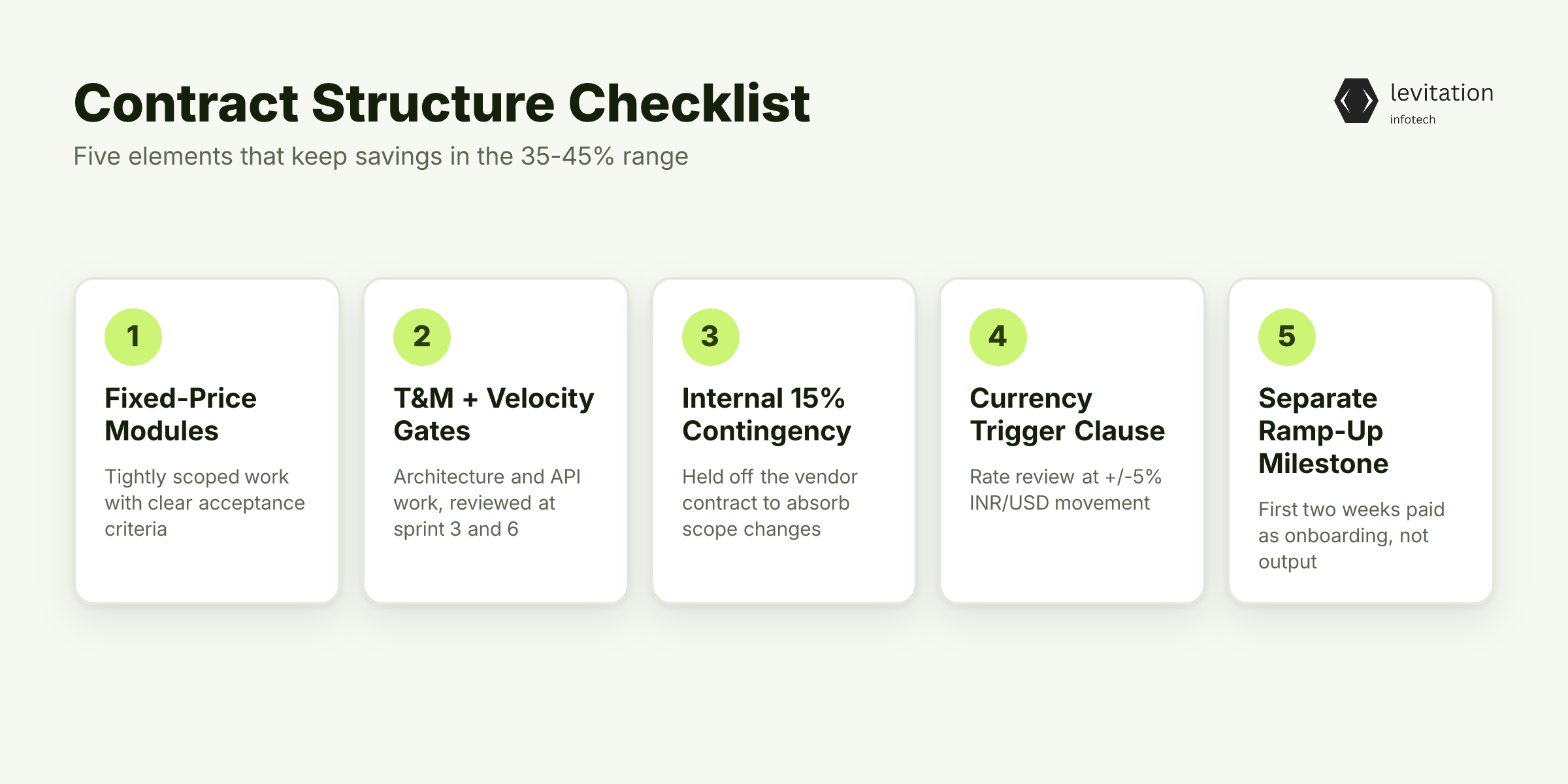
The first decision is fixed-price versus time-and-material. Use fixed-price only for tightly scoped modules with clear acceptance criteria. Feature work, not architecture work. Anything fuzzy gets priced with buffers that eat your margin.
Run core microservices architecture and API integrations as time-and-material with hard velocity gates at sprint three and sprint six. If the team hasn't hit baseline velocity by sprint three, you have data to renegotiate before more hours burn.
Build a 15% contingency reserve into your internal budget, not the vendor's contract. This lets you absorb scope changes without renegotiating, which is where most engagements lose months to paperwork. - Fixed-price for tightly scoped modules with clear acceptance - Time-and-material for architecture and API work with velocity gates - 15% internal contingency kept off the vendor's contract - Currency trigger clauses at +/-5% INR/USD movement - Separate ramp-up milestone for the first two weeks
Negotiate currency exposure clauses that trigger review at +/-5% INR/USD movement. Embedding the hedge into the rate is the vendor's preference, not yours. A trigger clause keeps the buffer transparent.
Require a ramp-up milestone separate from delivery milestones. Pay for the first two weeks as onboarding, not output. This prevents the most common sprint-one collapse. Treating ramp-up as productive hours burns the team's goodwill before velocity stabilizes.
Contract structure only works if the firm on the other side can actually execute. Most vetting advice you'll find online is generic, so here's what to ask instead.
Vetting Indian Dev Firms Beyond the Pitch Deck
Ask for the client retention rate, not the client list. A consistently high client retention rate is the number that predicts whether your engagement survives year two.
Logos are marketing. Retention is a leading indicator of delivery quality.
Probe for regulated-industry experience. Firms that have deployed compliant systems for healthcare and fintech understand audit trails, data residency, and change-control discipline in ways that generic dev shops don't. That experience transfers directly into backend systems rigor.
Look for teams with regulated AI deployment experience. The engineering rigor required for regulated AI work tends to carry over into standard feature development, reducing sprint overrun risk. That discipline shows up across the engagement.
Request two references from clients whose engagements ran longer than 12 months. Short-term client logos tell you nothing about retention. Long-term references tell you whether the firm survives the post-sale period when reality diverges from the pitch.
Test the technical depth of the sales contact. Ask about their team's experience with your specific stack. Surface-level answers predict surface-level delivery. If the person selling you the engagement can't speak fluently about your architecture, the engineers won't either.
Watch for the 60% day-one trap that catches most first-time outsourcers. Also stay alert to hidden costs in Noida software quotes that don't surface until the second invoice. The cheapest quote is rarely the cheapest engagement.
When vetting, contracting, and sprint diagnostics all align, the engagement economics shift in ways that go beyond the rate comparison.
What Changes When You Structure the Deal Correctly
Net savings land in the 35-45% band consistently across the engagement, not just on the rate card. The difference between a 60% headline and a 35-45% real number matters. It marks the gap between a board pitch and a P&L line item.
Sprint velocity stabilizes by sprint two instead of drifting through sprint four. That compresses time-to-market on every product cycle that follows. The advantage compounds across subsequent releases. You're not just saving money. You're shipping faster.
Currency and scope risk become managed variables instead of silent margin killers. The 15% internal contingency absorbs the drift. The velocity gates catch the underperformance. The currency trigger keeps the hedge honest.
The engagement compounds in other ways too. A well-run first engagement becomes the foundation for a long-term delivery partnership. That partnership compounds savings, reduces coordination overhead, and lets your frontend and backend delivery teams operate as a single unit across subsequent product cycles.
Firms that understand this treat outsourcing as a long-term engineering investment, not a short-term cost play. The same principle applies whether you're building a custom CRM, a HIPAA-compliant platform, or a regulated AI system. At Levitation, this is the model we see working consistently for clients who plan past the first invoice.
Frequently Asked Questions
How much does it actually cost to outsource software development to India in 2026?
Hourly rates for mid-level Indian developers run $25-$40. The US national average for the same role is $94. That produces a headline gap of roughly 60%. After accounting for ramp-up fees, churn buffers, currency hedges, and scope-drift buffers, net realized savings on a well-structured engagement typically land in the 35-45% range.
What is the real hourly rate for Indian developers compared to US developers?
Junior Indian developers start at $15-$20/hour and mid-level developers run $25-$40/hour. The US national average for the same role is $94/hour, which is why the headline rate gap looks dramatic. The realized cost depends entirely on how the engagement contract handles velocity risk and currency exposure.
How do you avoid sprint overruns when outsourcing to India?
Structure the first sprint as a paid diagnostic with a separate ramp-up milestone. Then lock velocity gates at sprint three and sprint six. Define done with surgical precision, run architecture work as time-and-material, and keep a 15% internal contingency reserve so scope changes don't force contract renegotiation.
Is fixed-price or time-and-material better for Indian dev firms?
Fixed-price works for tightly scoped modules with clear acceptance criteria, but it embeds 4-6% currency buffers plus scope-drift premiums that inflate the effective rate. Time-and-material is better for architecture and API work but transfers velocity risk to the buyer. It requires hard velocity gates to prevent sprint overruns from erasing the rate advantage.
What should I look for when vetting an Indian software outsourcing partner?
Ask for the client retention rate rather than a client list. Probe for regulated-industry experience such as healthcare and fintech deployments. Request references from engagements that ran longer than 12 months. High retention rates, regulated-industry work, and long-tenured client relationships are strong signals of engineering rigor and delivery discipline.
Sources
Research and references cited in this article:
- Real cost of outsourcing software development to India in ...
- Software Development Outsourcing Statistics 2026: Key Trends
- Software Development Outsourcing Rates by Country (2026)
- Cost of outsourced software development by country 2026
- In-house vs Outsourcing Software Development 2026
- Top Software Development Companies in India 2026 | Chirpn
- Offshore Software Development Rates in India 2026 | Full Guide | TechVinta Blog
- Software Development Rates in India 2026: Real Rate Card by Role, Seniority, and Stack
- Comparison of software developers in India with US, UK, Germany and the entire world
- Outsourcing to India: What Really Works in 2026
- IT Outsourcing to India – 8 Key Challenges and Solutions | TTMS
- Why Outsourcing to India is a Smart Business Move
About the author
Mayank Singh is a software developer at Levitation Infotech, where he builds web and AI-powered applications across the company’s fintech, healthcare, and enterprise projects.