


TL;DR: A healthcare app can cost more with fewer screens. Its premium comes from patient-data safeguards, clinical behavior, platform choices, integrations, AI evaluation, and release assurance. Price each risk separately instead of hiding it in a screen estimate.
Key Takeaways: - A feature's risk profile, not its screen count, drives much of a healthcare app's cost. - Split estimates into product engineering, platform delta, trust and assurance, and specialized intelligence. - Compare quotes through matched scope, acceptance criteria, delivery models, and clear recurring costs.
The Cost Premium Is Not in the Screen Count
Fewer screens do not guarantee a lower healthcare app budget. The price rises because failure can affect patient care, while the wireframe hides the work. Patient-data safeguards, clinical behavior, platform choices, and AI evaluation sit outside the interface.
The screen-count illusion
Screen counting assumes visible flow drives effort. A clinician sign-in can look like one form. Behind it sit authentication, access rules, consent records, and medical-data protection. None of that appears in the wireframe.
Consumer estimates often bundle screens, flows, and backend tasks into one price. Healthcare adds obligations that don't fit that unit: - Data integrity and reliable clinical behavior - Applicable legal and security requirements - Specialist testing and audit evidence - Dependence on hospital, clinician, or patient systems
The hidden control surface behind that simple form is where the estimate begins to diverge.
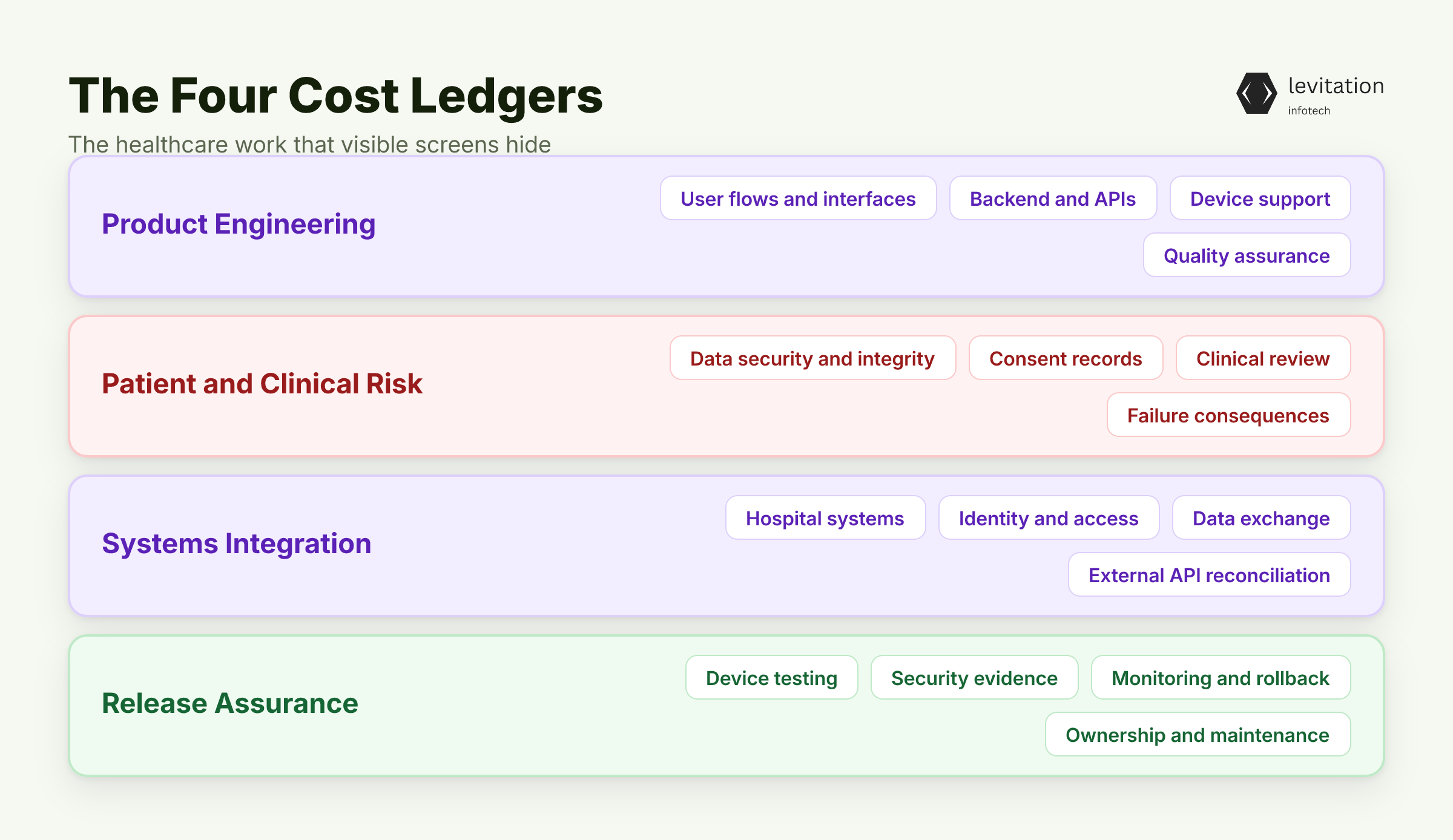
Four cost ledgers
A better estimate separates four cost categories: - Product engineering: User flows, frontend, backend, APIs, devices, quality assurance, and maintenance - Patient-data and clinical risk: Security, integrity, consent, clinical review, and failure consequences - Systems integration: Hospital systems, identity, data exchange, reconciliation, and external APIs - Release assurance: Device testing, security evidence, monitoring, rollback, and ownership
These ledgers overlap, but each has a different owner and failure mode. Omit one, and the quote looks complete while the product remains exposed.
These ledgers answer who owns the work. The four pricing pools later in the article organize the premium by cost driver.
Taken together, these categories define the product scope. That scope must include the broader healthcare technology layer: hospital systems, patient information, and care workflows. These aren't optional connectors around the app. They shape the app's operating behavior.
Healthcare products cost more because failure has a different meaning, not because they carry more features. The first dangerous mistake is to treat healthcare as a consumer app with stricter wording. But what else breaks when a generic estimate meets patient data?
Why Consumer-App Estimates Break on Healthcare Work
Cost depends on what a screen does and what can fail behind it. A screen displaying marketing content can tolerate delayed updates. A medical record, triage instruction, voice input, or imaging result cannot.
The same screen can carry different risk
Each clinical screen needs correct data, timely delivery, and a safe response when reality differs from the design. A wrong result can affect care, while an outage can interrupt a clinician's workflow.
The interface can remain unchanged. The obligations behind it still expand. That mismatch is where generic estimates break. What kind of hidden work does that mismatch create?
Security changes the labor model
Patient-data security shifts work from building features to proving that controls work. It touches architecture, testing, documentation, and release approval.
The invisible work includes: - Data classification and secure storage - Role-based access, session controls, and audit trails - Security testing, integrity checks, and compliance evidence
A screen inventory cannot show the effort required to produce that evidence. It also cannot show who owns each control after launch. The first estimating question is therefore not how many screens the app has, but what proof the release requires.
Platform choice is a budget decision
Cross-platform delivery reduces platform-specific work by sharing much of the codebase. Native iOS and Android delivery costs more because platform behavior, tools, and release paths need separate handling.
Native delivery earns its cost when complex medical imaging needs the best possible performance. It shouldn't be assumed for every healthcare app.
A simple appointment flow may suit cross-platform delivery. A diagnostic image viewer does not. The product requirement must decide the platform, not the delivery company's preference.
AI expands the specialist requirement
Automated triage and voice tools aren't conventional forms with a model attached. They require domain input, evaluation cases, failure handling, and clinical review.
Before estimating any feature, ask: - Does it handle patient data? - Could it affect a clinical decision? - Does it require a specific platform capability? - Does it need specialist engineering or domain review?
Use the app development cost in India framework to compare proposals on these assumptions. A cheaper total reflects less risk, fewer integrations, or shallower testing.
An India-based quote doesn't remove these obligations. Location changes the labor mix, not the consequence of failure. So where exactly does the healthcare premium belong?
Split the Premium into Four Cost Pools
The premium belongs in work that screen-count estimates bundle together. The model doesn't merely miss some work; it misses work with a different cost structure. Four pools make that structure visible.
Pool 1: Product engineering
Price the working product, not the drawing. Include user flows, frontend, backend, APIs, device support, quality assurance, and post-launch maintenance. Screen count then becomes context, not the estimator.
Once that product is defined, the next question is how much the platform choice adds.
Pool 2: Platform delta
Compare one cross-platform codebase with separate native iOS and Android delivery. Use native delivery when complex medical imaging or device-specific performance needs it. Don't assume every healthcare product should be native.
Pool 3: Trust and assurance
Price trust and assurance as its own workstream. It covers patient-data security, integrity checks, regulatory alignment, auditability, specialist testing, and release documentation.
Hiding these inside an hourly rate makes them impossible to challenge. A visible workstream lets founders decide which controls protect the launch and which can wait.
Pool 4: Specialized intelligence
Isolate extra engineering, evaluation, and domain input for automated triage or voice features. Adding AI then changes the estimate visibly instead of appearing as a mysterious feature allowance.
Mark every feature by risk
Create a feature-level decision matrix. Mark each feature across four dimensions: - Patient-data sensitivity - Clinical consequence - Platform requirement - Specialist need
This reveals which features need native delivery, can use cross-platform delivery, need specialist review, or fit a later release phase.
A reusable planning formula is:
Indicative effort = core product engineering + integration work + assurance work + platform delta + AI evaluation effort.
Itemize each term. Never blend assurance into a generic development rate.
Hospital context and patient-data scope set the budget before screen design. The healthcare technology for patient data and hospital systems layer must therefore appear in the estimate itself.
For AI-heavy scope, ask for delivery evidence before accepting the estimate. A cost model becomes useful only when it changes a decision. Which architecture should these cost decisions support?
Choose the Minimum Architecture That Survives Clinical Use
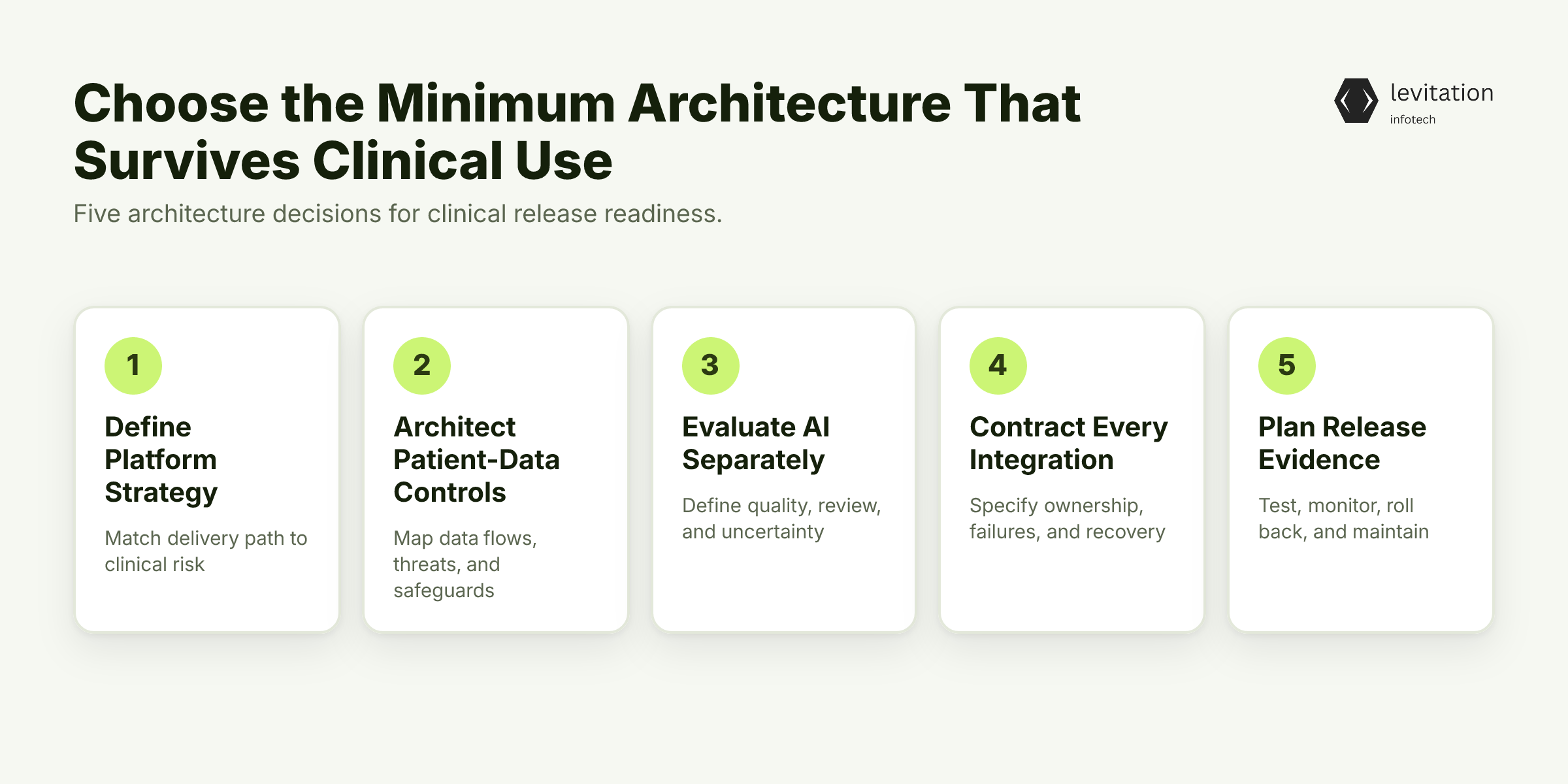
The lowest quote isn't always the leanest architecture. Sometimes a low-cost choice creates the release blocker that forces an expensive rebuild.
Set the platform strategy before estimating
Choose native iOS and Android, cross-platform delivery, or a justified hybrid only after documenting device, performance, imaging, accessibility, and workflow needs.
Document which features justify native work before estimates arrive, or platform cost becomes an arbitrary line. Which delivery path should the risk profile actually support?
Make patient-data controls architectural
Require a data-flow diagram and threat model before development. The first shows where patient data travels. The second shows how it could be exposed or altered.
The control set should cover: - Data in transit and at rest - Role-based access and audit trails - Consent records and secure storage - Session behavior and sensitive-data handling
These are architectural controls, not release paperwork. They determine how data moves, who can reach it, and what evidence remains after an incident.
Give AI a separate evaluation path
Define what automated triage or voice processing must produce. Specify how quality will be checked, where human review enters, and what happens when confidence is insufficient.
Evaluation isn't an optional model test. It defines the feature's real behavior, which is why narrow model evaluations can approve unsafe behavior. Clinical review and uncertainty handling belong in the launch estimate.
Design integrations as contracts
Treat every hospital, clinician, or patient-system connection as a contract. Specify API behavior, data ownership, error states, reconciliation, and failure recovery.
Ask a simple question: what happens when the other system is late, returns partial data, or changes its schema? An integration without defined failure behavior isn't finished.
Build release evidence into the plan
Include device testing, failure scenarios, data-integrity checks, security testing, monitoring, rollback, and maintenance ownership. Launch isn't the end of the project. It's the point where operational responsibility changes hands.
Require an architecture decision record for every major scope increase. It explains why a security control, native build, or specialist AI capability changes the mobile app development cost in India.
Architecture explains where the premium belongs, but what exactly belongs inside a comparable quote?
Turn Scope into a Quote You Can Compare
A low total is useless when each vendor priced a different product. Comparable quotes must begin with matching assumptions.
Create a one-page scope sheet
Record the following before asking for a price: - Target users and care journey - Patient-data fields - Supported platforms - Hospital and third-party integrations - AI functions - Security controls - Release obligations - Explicit exclusions
This sheet prevents a vague feature list from becoming an unlimited estimate. Once the scope is fixed, proposals can be compared on the same basis.
Demand a cost-pool breakdown
Require the proposal to separate: - Discovery, UX, and UI - Frontend and backend engineering - Integrations and API work - AI engineering and evaluation - Security, assurance, and specialist review - QA and device coverage - App-store release - Maintenance and managed infrastructure
A single total hides the assumptions that created it. Itemization makes proposals comparable. The breakdown also shows where a cheaper quote omitted scope.
Attach evidence to acceptance criteria
Define what each feature must demonstrate. Include data handling, access behavior, AI output, error states, and supported devices.
For example, “AI triage works” isn't an acceptance criterion. The proposal should state which cases it must handle, which failures require human review, and how those failures are recorded. That turns a feature promise into a testable release condition.
Compare delivery models, not just totals
Compare delivery models on both speed and fit, using the scope each team can carry. Expose the coordination overhead each model adds, then check whether the proposed healthcare scope fits that model.
Speed without matching scope isn't efficiency. It signals omitted integrations, specialist review, or release evidence. Which costs recur after launch?
Separate one-time and recurring costs
Distinguish launch delivery from managed infrastructure, post-launch support, security updates, and feature expansion. This also exposes why an apparently cheap software bill can grow after launch.
For 2026 pricing comparisons, write these assumptions into the proposal: - Platform strategy - Integration count and complexity - AI maturity and evaluation depth - Patient-data scope - Testing obligations - Ownership boundaries
Ask for an architecture workshop, itemized proposal, milestone plan, acceptance matrix, and change-control process. That package gives a founder more useful information than an unexplained total.
Use the detailed app development cost in India guide to check whether major cost drivers have been quoted or quietly omitted. Once the quote is decomposed, does each premium buy protection you actually need?
What the Premium Buys, and What It Should Not
A bigger healthcare budget isn't automatically better. It can also hide vague pricing and extra padding. The useful question is what each premium buys.
A properly funded healthcare mobile app provides: - Traceability around patient-data access - Controlled and testable clinical behavior - Dependable hospital and clinician integrations - Monitoring, rollback, and clear operational ownership - Release evidence beyond a successful demo
Don't add a healthcare premium automatically
Use a consumer-app estimate when the product has no patient data, clinical decisions, AI, or regulated workflow.
But the inverse rule matters more. If the app handles patient data, influences clinical work, or uses automated triage, keep assurance, specialist review, and integration work intact. Don't cut them to match a cheaper app budget.
That isn't padding. It's the cost of making failure visible and manageable.
A founder should be able to explain every material proposal line, identify the risk it addresses, and see which decisions can wait. The budget should match the real operating environment of the healthcare technology product, not a generic mobile app template.
The final test is simple. Can you explain the healthcare app development cost line by line and defend every premium as a deliberate product decision? If some lines still resist that test, the answers depend on product scope. What must your app handle and prove?
Frequently Asked Questions
A single 2026 price would create false confidence. The cost depends on what the product must handle and prove.
How much does healthcare app development cost in India in 2026?
There is no reliable single price. The estimate changes with patient-data scope, platform strategy, integrations, AI requirements, security assurance, and testing depth.
Ask for an itemized proposal based on a written v1 scope. Compare it using the app development cost in India framework.
Why do healthcare mobile apps cost more than consumer apps?
Healthcare apps must support strict patient-data security, data integrity, applicable legal requirements, and workflows where errors carry greater consequences. Native delivery for complex device work adds cost. So do automated triage and voice tools, which require specialist engineering and evaluation.
Will a cross-platform healthcare app cost less than a native app?
A cross-platform codebase reduces platform-specific mobile development work. Native delivery fits cases where complex medical imaging or device performance justifies it. Compare architecture and workload rather than assume one route is always cheaper.
How can a startup reduce healthcare app development cost without weakening security?
Narrow the first release, stage nonessential features, and settle the platform strategy early. Use this guidance to review your next proposal: which cost pool still lacks clear scope?
About the author
Mayank Singh is a software developer at Levitation Infotech, where he builds web and AI-powered applications across the company’s fintech, healthcare, and enterprise projects.