


TL;DR: India's headline cost advantage in custom software is intact on paper, but hidden costs (rework, integration cleanup, compliance retrofit, knowledge transfer, and neglected maintenance) routinely double or triple the three-year total. Founders who hire on hourly rate alone lose the saving to those second-order costs. The fix is to structure the engagement around the senior tier, not the cheapest quote, and to budget for the cost lines the vendor won't mention.
Key Takeaways: - A senior Indian team still delivers a meaningful cost advantage versus the US in 2026, but the savings only hold when the build is scoped and staffed correctly. - Five hidden cost lines (rework, integration debt, compliance retrofit, knowledge transfer, and maintenance neglect) routinely turn a cheap project into an expensive one. - The cheapest hourly rate produces the most expensive project because senior teams ship in fewer hours than juniors who spend those hours on debugging and rework. - A 2-week paid pilot, a fixed-scope MVP, and a 15-25% contingency reserve are the three structural moves that protect the budget. - India wins decisively on greenfield builds and cost-sensitive scaling. It loses when you need same-timezone iteration or hard data residency.
India's Rate Advantage Is Real. Your Savings Aren't.
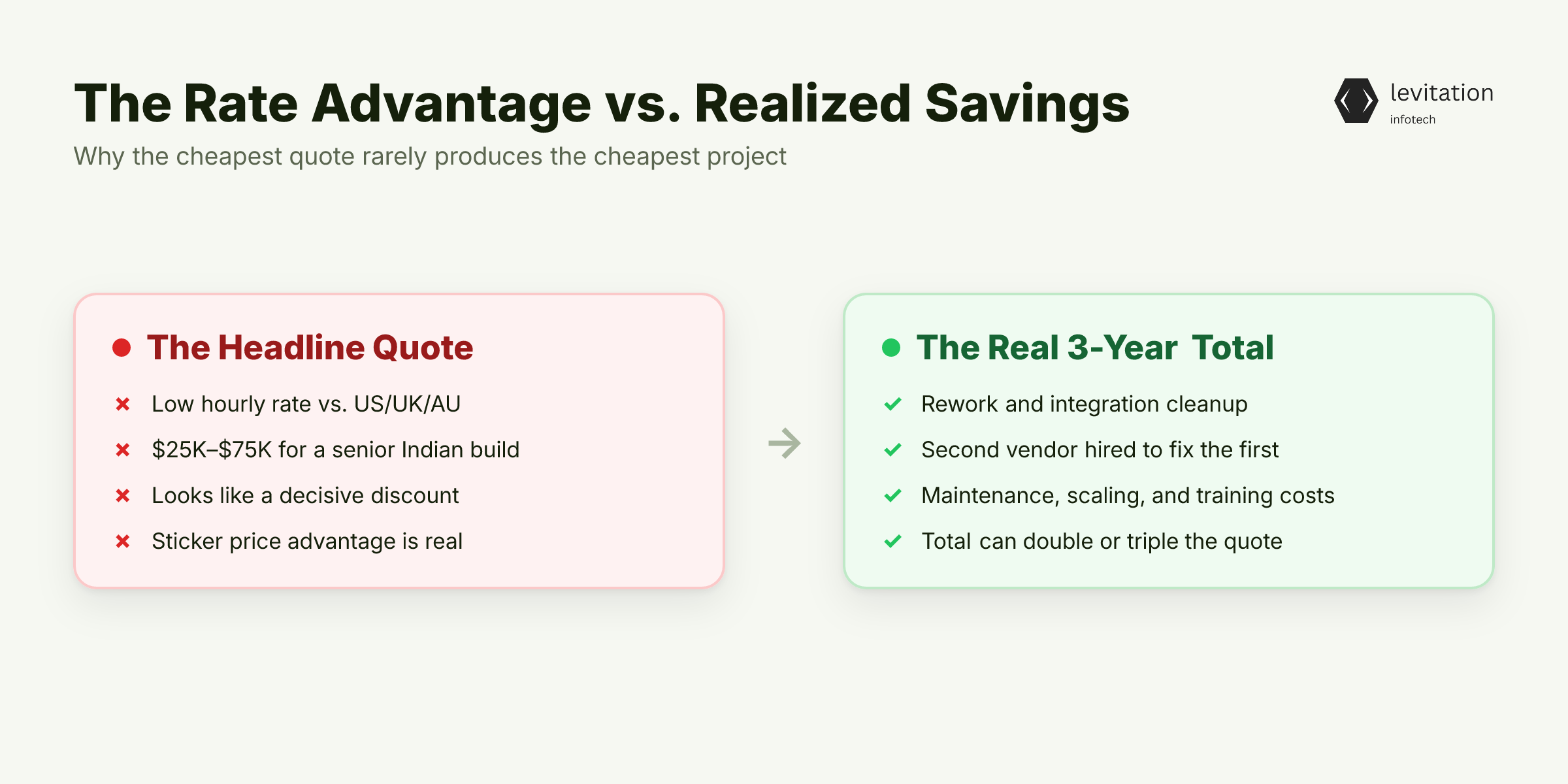
A low headline rate that looked like a decisive discount just turned into a thin margin. The cause: rework, integration cleanup, and the second vendor you hired to fix the first one.
Indian developer rates in 2026 still sit well below comparable US, UK, and Australian billing for senior engineering. The math on the quote page is real.
A production web platform built by a senior Indian team runs $25,000 to $75,000. An equivalent US build for the same scope lands in a much higher bracket. On the surface, the cost advantage is alive and well.
The problem isn't the hourly rate. It's that founders compare the hourly rate to their US budget and stop doing math.
Once you add the cost lines the vendor doesn't mention (maintenance, scaling, integration cleanup, training, compliance) the three-year total can double or triple. The sticker price advantage survives. The realized savings don't. The cheapest quote almost never produces the cheapest project, and that's where the cost advantage actually leaks out. The breakdown of what custom software development cost in India really includes makes this gap visible.
So if the rate is still low, where exactly does the money go?
The Five Hidden Costs That Double Your Indian Build
The headline rate is what you negotiate. The hidden costs are what you pay.
First, rework from miscommunication. Timezone gaps, ambiguous specs, and cultural shorthand routinely expand the original scope.
The founder thought the extra hours were part of the deal. They weren't. A two-line Slack message about "the dashboard" can mean four different things across two teams. The resulting rework is billed at the same rate the original quote used.
Second, integration debt. Cheap vendors skip clean API contracts and modular architecture. Every new feature becomes a rewrite because the original code wasn't built to be extended.
The team that built the custom software for the lowest bid often delivers a monolith that only they can maintain.
Third, compliance retrofit. Healthcare, fintech, and enterprise SaaS projects that skip compliance planning pay a steep premium later. They must retrofit HIPAA, PCI-DSS, or sector-specific controls.
Every component must be re-examined against the new controls. Vendors with regulated-industry experience price these controls in upfront. That's why their quotes look higher and their year-three costs look lower.
Fourth, the knowledge transfer tax. When the original team disbands, and offshore teams turn over fast, the replacement vendor charges a premium just to learn the codebase. They're paying for the cost of deciphering undocumented decisions.
The founder ends up paying elevated rates to onboard a team that should have been handed a working system.
Fifth, maintenance neglect. Ongoing maintenance scales with codebase complexity. Skipping it turns small fixes into emergency rate-card engagements.
Most startup founders skip this line, then absorb premium rates when something breaks in production at 2 a.m. on a Saturday.
These hidden costs don't hit every project equally. The vendors that produce them charge very different hourly rates. That gap is the real story. What separates the two tiers, and why does the spread look so wide?
What Actually Sets Indian Developer Rates in 2026
The hourly rate isn't a single number. It's a signal about what you're buying.
The low end of the band buys juniors, fresh hires, and body shops. They quote low because billable hours are their business model. Shipped outcomes don't pay the rent.
The upper band buys senior engineers with domain depth. That's where US/UK-grade engineering at lower cost actually lives.
Geography matters less than people think. A senior team in Noida, Bengaluru, or Hyderabad charges similar rates. What differs is the vendor's overhead and specialization.
The top software development companies in Noida tend to cluster in the senior band. The cluster also includes well-marketed body shops with senior websites.
Security-critical work commands a premium. Fintech, healthtech, and any project that touches regulated data carry real liability for the vendor. The premium tier for this work is verifiable through audit trails, deployed compliance systems, and named regulated clients.
The engagement model also shifts the number. Fixed-scope, dedicated team, and time-and-materials all price differently. Picking the wrong model for your stage can swing the budget hard in either direction.
That swing often matters more than the hourly rate itself.
If the rate band predicts the outcome, then the founder's real decision isn't India vs. the US. It's which tier of Indian vendor to hire.
Why the Cheapest Quote Always Loses the Cost Battle
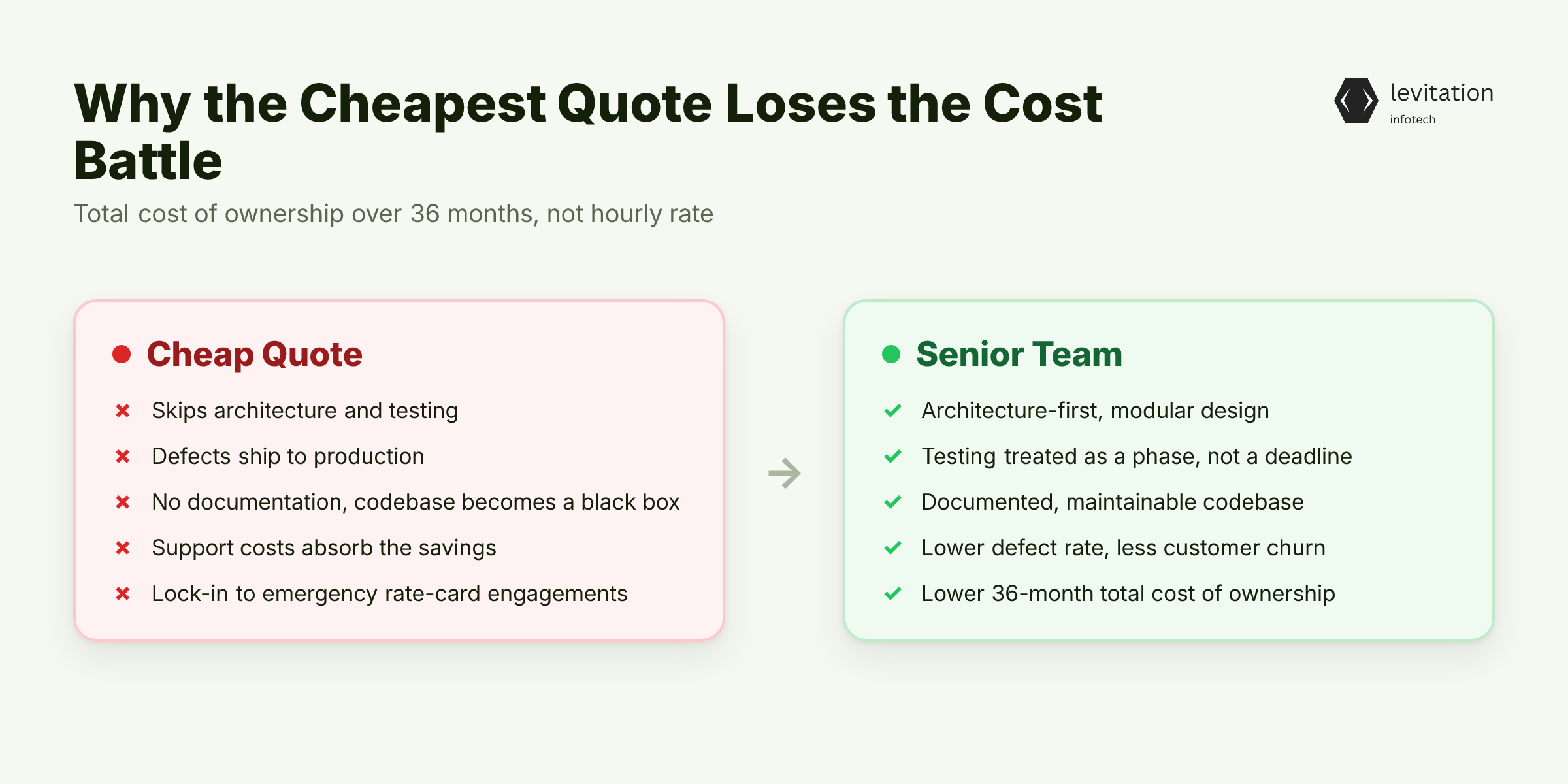
A junior team that takes far more hours to ship what a senior team finishes in fewer costs more, not less. And the code quality forces a rewrite before the system hits full useful life.
Cheap vendors skip architecture. Monolithic frontends, hardcoded business rules, and tightly coupled services make every future change expensive.
The team that quoted low to build the system quotes high to add the next feature. The codebase can't absorb it.
They skip testing. QA gets compressed into the final week. Defects ship to production.
Customer support costs absorb the savings. The founder discovers the defect rate in customer churn data, not in the vendor's status reports.
The senior tier treats testing as a phase. The cheap tier treats it as a deadline.
They skip documentation. The codebase becomes a black box that only the original (now-departed) team understood. The founder is locked into emergency rate-card engagements every time something needs changing.
The real cost comparison isn't hourly rate times estimated hours. It's total cost of ownership over 36 months. That math almost always favors the senior team, even at a higher sticker price.
So how do you actually hire the senior tier without getting catfished by a body shop wearing a senior website?
How to Structure a Build That Holds Its Budget
The structure of the engagement matters more than the rate card. Here are the seven moves that protect the budget.
Start with a tightly scoped MVP. A senior-team MVP in India typically costs $8,000 to $20,000. It takes 6 to 10 weeks, depending on features, user roles, and integrations.
The narrower the scope, the more predictable the cost.
Use a fixed-scope engagement for the MVP phase. That keeps the budget predictable. Then move to a dedicated team model once you're scaling features.
The two models solve different problems. Mixing them mid-build is where budgets leak.
Demand three artifacts before signing. A written architecture diagram. A sample of their code from a comparable project. A named team, not a bench of resumes.
Vendors with deployed regulated-industry systems have the audit trails already built. Their references survive scrutiny.
Insist on API-first design and modular microservices. Future vendors should be able to pick up the codebase without a six-week knowledge transfer. The custom software you build today should still be maintainable by a team you haven't hired yet.
Bake compliance into the contract from day one. Retrofitting it later costs more than designing it in. Every component needs to be re-examined against the new controls.
Vendors with regulated-industry experience price it in upfront, which is why their quotes look higher and their three-year totals look lower in practice.
Reserve 15-25% contingency on top of the estimate. The standard formula: Estimated Cost = (Hours × Hourly Rate) + Integrations + 15-25% Contingency. Skipping the contingency is how founders end up on the wrong side of the real total cost of a custom build.
Run a 2-week paid pilot before committing to a 6-month build. The cost is trivial. The filter is brutal.
It separates the top software development companies in Noida from the well-marketed alternatives before the bulk of the budget is committed.
If you follow that structure, what does the actual 2026 math look like for a real project?
When India Still Beats Every Alternative
A senior-team MVP at $8,000 to $20,000 with 6 to 10 weeks of delivery is still unmatched. No US or Western European alternative at any tier comes close.
The same scope from a Boston or London shop starts much higher. The gap widens as scope grows.
A production web platform at $25,000 to $75,000 from a senior Indian team remains much cheaper than the equivalent US build. This holds even after the contingency reserve.
Enterprise systems from $75,000 to $150,000+, delivered by teams with regulated-industry experience, compete on quality. Not just price. The work passes the same audits.
The break-even point is clear. India wins decisively on greenfield builds, MVPs, and cost-sensitive scaling.
India loses when you need same-timezone synchronous iteration or have hard data-residency rules that exclude offshore work. In those cases, the rate advantage doesn't matter. The work can't move.
The real competitor isn't the Indian vendor. It's the founder who hired on hourly rate alone and is now funding their second rewrite.
That founder paid twice and shipped once. The senior-team founder paid once and has a system that holds its budget.
If the rate advantage is a signal, not a saving, then the right question isn't "how cheap is India?" It's "how do I structure the engagement so the cheapness actually shows up in my three-year total?" The custom software development cost in India math only works when the engagement is built to capture it.
If you're scoping a build now, the next move is a 2-week paid pilot with a named team.
Frequently Asked Questions
Q: What is the average hourly rate of a software developer in India in 2026?
Indian developer rates in 2026 span a wide band depending on seniority. Junior developers and body shops sit at the low end. Senior engineers with domain expertise, the tier that actually delivers US/UK-grade quality, charge meaningfully more.
The cheapest rate rarely produces the cheapest project.
Q: Is it still cheaper to outsource custom software development to India in 2026?
Yes, on a like-for-like basis. A senior-team build priced in the $25,000 to $75,000 web-platform band costs $75,000 to $150,000+ in the equivalent US enterprise range. That's a real saving even after contingency reserves.
The cost advantage erodes only when founders hire on hourly rate alone. They then absorb the rework, integration, and maintenance costs the cheap vendor avoided.
Q: How much does a custom MVP cost in India?
A tightly scoped SaaS MVP in India typically costs $8,000 to $20,000 with a senior team. It takes 6 to 10 weeks, depending on features, user roles, and integrations. The range widens dramatically with integrations, compliance requirements, and team seniority.
Q: What hidden costs should I budget for when hiring an Indian software vendor?
Plan for five line items beyond the build quote. Rework from miscommunication, a major share of the original scope once timezone gaps and ambiguous specs surface. Integration cleanup if clean API contracts weren't enforced.
Compliance retrofit for regulated workloads. Knowledge transfer costs if you switch vendors. Ongoing maintenance that scales with codebase complexity.
A 15-25% contingency on top of the estimate is the standard buffer.
Q: How do I pick between a cheap Indian vendor and a senior Indian team?
Run a 2-week paid pilot before signing a long contract. Demand a written architecture diagram and code samples from a comparable project. Require a named team rather than a bench of resumes.
Vendors with regulated-industry deployments or security-critical clients have the audit trails and processes to survive that scrutiny.
About the author
Mayank Singh is a software developer at Levitation Infotech, where he builds web and AI-powered applications across the company’s fintech, healthcare, and enterprise projects.