


TL;DR: The 60% cost advantage of Indian developers is real, but the 2x timeline penalty baked into most outsourcing engagements erodes most of the headline savings. The fix is not where you source from. It is the engagement model. Dedicated cross-functional teams with mandated overlap, shared product ownership, and milestone-based payment deliver US-speed delivery at India prices.
Key Takeaways: - The 2x timeline penalty is structural to how outsourcing is scoped, not a reflection of Indian developer skill - True TCO math shows the 60% headline savings collapse once you account for extended delivery windows - The engagement model, not the location, is the variable that determines whether you capture real savings or watch budgets burn
Your CFO sees the 60% cost savings. Your CTO sees the 18-month delivery date. Both are looking at the same contract, and one of them is about to be blindsided by the true cost.
The 60% Savings Number That Lied to Your Board
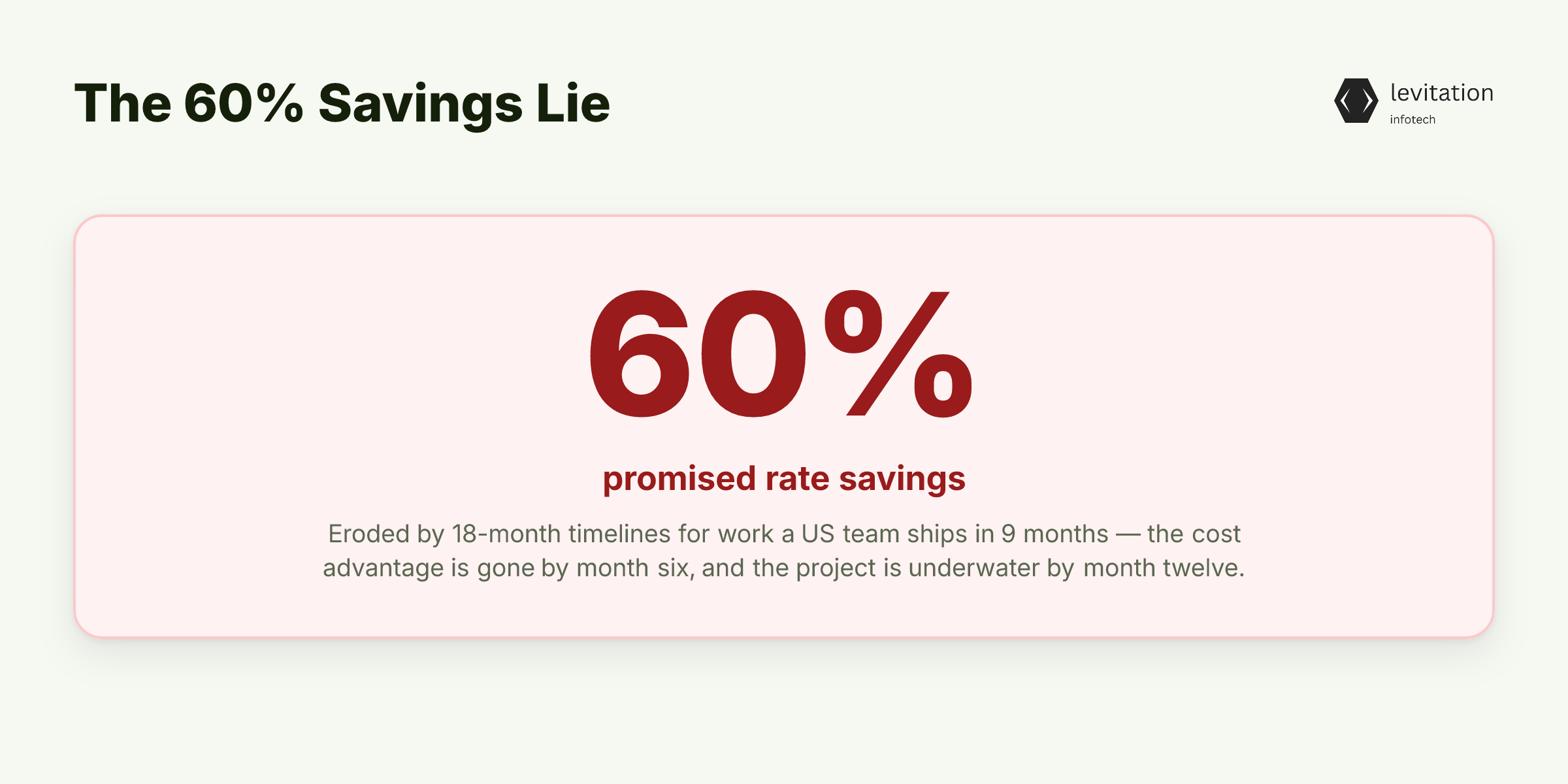
The headline is real. Indian developers bill at rates 40-60% below US developer rates, a gap procurement teams build entire business cases around.
The board signs off. The RFP goes out. The vendor wins on price.
Then delivery starts.
The same engagement that promises 60% savings routinely produces an 18-month timeline for what a US team ships in nine. CFOs compare the hourly rate. Nobody compares the burn rate per shipped feature.
By month six, the India team has consumed the cost advantage. By month twelve, the project is underwater. The CFO explains to the board why the "cheap" option cost more than the US quote they rejected.
This paradox is structural. It comes from how most custom software development relationships are scoped, not from the developers themselves. India's 5-million-strong talent pool includes world-class engineers. The friction lives in the engagement model. Handoffs, overlap hours, payment structure, and ownership of architecture decisions all add time.
Vendors will quote the rate. They will not quote the timeline risk. And that asymmetry is where the savings go to die.
So what actually accounts for the missing nine months? It's not what most outsourcing vendors want to talk about.
Why Your Project Takes 2x Longer (It's Not the Developers)
Five forces compound to double the timeline. None of them involve lazy or unskilled developers.
Time-zone friction compresses real-time collaboration into a 4-6 hour daily window. Your standup lands at their 7pm. Their architecture review lands at your 6am. Decisions stall because nobody is online together to unstick them.
Requirements get re-explained three times. From CEO to your PM. From your PM to the India lead. From the India lead to the developers. Each handoff loses fidelity. The feature that meant "flag high-risk transactions for manual review" arrives as "add a checkbox on the transaction form."
Hidden rework cycles eat weeks. Code that meets the literal spec but misses the business intent gets built, reviewed, and rebuilt. This is the silent killer across enterprise deployments in regulated industries. Teams ship what was asked, not what was meant.
Talent variance is enormous. India produces 1.5 million new engineering graduates every year. The senior architect who can match a US staff engineer's output costs about the same. Finding them without a vetting partner is a multi-month project on its own.
Infrastructure and tooling gaps add friction that compounds across the engagement. The India team works on one CI/CD pipeline. Your team works on another. Deployments fail in staging because the environments don't match. The software development team ships code that can't run where you need it to run.
If the timeline penalty is structural, then the savings number on your proposal is fiction. Run the real math.
The Real TCO: Why 60% Savings Collapse
Hidden costs hit both regions in percentage terms. Benefits, recruitment, infrastructure, and PM overhead add 20-60% on top of the base rate. They compound harder in India engagements because the longer timeline multiplies every line item.
The cost-of-living arbitrage is real. India is 73.7% to 83% cheaper to live in than the US, which explains the headline rate. It does not explain the delivery speed gap.
Walk through the math. An India engagement that takes 18 months for work a US team ships in 9 burns through the cost advantage. The US project costs more in absolute terms. Per month, the slower India project often costs more because the timeline multiplies every cost line.
This is the same trap we see in bespoke software engagements that look cheap on paper and bleed budget by month eight. The real question is cost-per-delivered-feature-per-month, not cost-per-developer-hour.
This is where most outsourcing advice stops: "calculate TCO carefully." That is not a strategy.
The Engagement Model That Breaks the Paradox
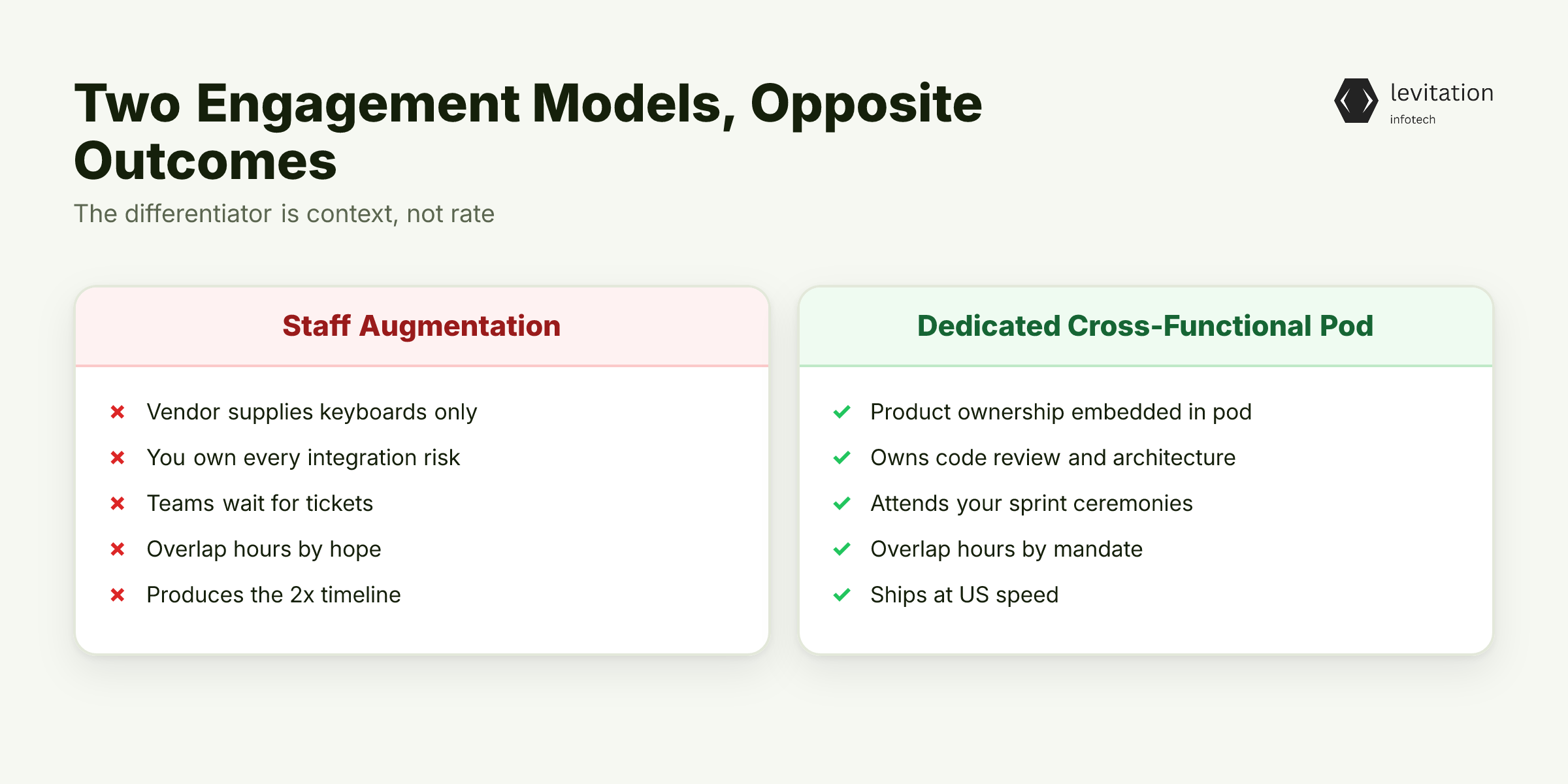
Two engagement models dominate India outsourcing. One produces the 2x timeline. The other dissolves it.
Staff augmentation rents bodies. You get the low rate, but you own every piece of integration risk: architecture, code review, deployment, QA, compliance. The vendor supplies keyboards. You supply everything else. This is the model that produces the 2x timeline.
Dedicated cross-functional teams embed product ownership inside the India pod. They attend your sprint ceremonies. They participate in architecture decisions. They own code review. They share overlap hours by mandate, not by hope.
The senior leads on both sides make decisions together instead of across a 12-hour gap. The differentiator is not the rate. It is whether the India team has enough context to make decisions or whether they wait for tickets. Teams that wait for tickets ship at half speed. Teams that have context ship at US speed.
Security-critical work in regulated industries requires a third structure entirely. When your product touches cardholder data or patient records, "we'll add security later" is not a viable plan. Compliance must be built into the pod structure from day one, not bolted on after audit findings.
The paradox dissolves when you measure outcomes instead of inputs. Features shipped, defects escaped, time-to-production. The hours are cheap either way. The shipped features are what you actually bought.
Knowing the model is one thing. Structuring the actual engagement so it delivers is where CEOs lose the plot.
Five Structural Decisions That Lock In US-Speed Delivery
The model sets the ceiling. These five decisions determine whether you hit it.
Mandate 4-hour daily overlap with named senior leads on both sides. This single decision eliminates most of the timeline penalty. When your staff engineer and the India tech lead share a room for four hours, ambiguity dies in the conversation, not in the next sprint.
Require the India team to use your CI/CD, your observability stack, and your deployment tooling from day one. No parallel infrastructure. The same artifact that passes tests in their environment must pass in yours. This one decision prevents weeks of "works on my machine" debugging and microservices integration failures.
Structure payments around milestone delivery, not monthly hours. Tie 30% of cost to acceptance criteria, not invoices. When the vendor's revenue depends on shipped features, their incentives align with yours. When it depends on hours billed, their incentives align with the timeline sliding.
Embed one of your own engineers as a rotating tech lead in the India pod for the first 90 days. This transfers architectural context faster than any document. By month four, the India team makes decisions your team would make, because your team taught them how.
Scope the first deliverable as a 6-week proof of capability. A single API or frontend module with full test coverage. If the vendor can't ship that in six weeks, they won't ship the full project in eighteen. The engagement model that holds clients long-term survives this filter. The others don't.
The companies that get this right don't see 60% cost savings. They see something better.
What 60% Real Savings Actually Looks Like
When the engagement model is right, the 60% savings are real. Not because the rate is lower. Because the 2x timeline penalty disappears and the burn rate per shipped feature collapses.
Companies that hit this model do three things differently. They reinvest the savings into product experimentation, running parallel bets instead of sequential ones. They shorten go-to-market cycles in ways that compound against competitors stuck in long delivery cycles. They staff product teams faster than US recruiting timelines allow.
The real competitive advantage is not the hourly rate. It is the ability to ship a working MVP on a predictable timeline at India prices. Use the time you save to enter the market, learn from customers, and raise the next round on traction instead of slides.
Predictability matters more than cost. Knowing your MVP ships on a fixed date at a fixed budget lets you plan fundraising, hiring, and market entry with confidence.
The CEO with a predictable delivery date at India prices wins a different board meeting. The one explaining why the "cheap" project is now month 14 has a much harder conversation.
Run the questions below against your current vendor before the next renewal.
Frequently Asked Questions
How much does it actually cost to outsource software development to India in 2026?
Indian developers bill at rates 40-60% below US developer rates, depending on seniority and tech stack. These rates assume a well-structured engagement. Poorly scoped projects can erase the savings through extended timelines and rework.
Why do outsourced projects to India take twice as long?
The 2x timeline penalty comes from time-zone friction (4-6 hour overlap), requirements handoff degradation, rework from spec-vs-intent gaps, and tooling mismatches. These forces compound regardless of individual developer capability or work ethic, which is why the location alone never solves the problem.
Is it cheaper to hire developers in India or the US for a long-term project?
For a 12-month project, India delivers 40-60% lower base cost. The real comparison is cost-per-delivered-feature-per-month. A slower India project costs more per month than a faster US project even when the absolute spend is lower. India wins on cost only when timeline discipline is enforced through the engagement structure.
What is the minimum budget to outsource software development to India?
Project-based engagements can start with a small, clearly scoped deliverable. Staff augmentation can begin with a single developer, but this model carries the highest risk of timeline overruns because integration and management overhead stay with you.
Which engagement model avoids the 2x timeline penalty when outsourcing to India?
Dedicated cross-functional teams with shared sprint ceremonies, mandated overlap hours, and embedded product ownership deliver US-speed timelines. Staff augmentation and pure body-rental models produce the 2x penalty because they leave integration, architecture, and quality ownership with you. For related reading on how dedicated teams perform under load, see our analysis of why a "dedicated" India team that serves three clients fails the test, and how India web app quotes break at sprint three when scoping is loose.
Compare these five decisions against your current vendor's contract to see where the savings actually leak.
About the author
Mayank Singh is a software developer at Levitation Infotech, where he builds web and AI-powered applications across the company’s fintech, healthcare, and enterprise projects.