


TL;DR: India web app quotes routinely miss the final bill by 40% by sprint three. The cause is not vendor quality or pricing model. It is a thin scope document that lets every undefined behavior surface as a change order mid-build. Scope discipline before the quote conversation is the only fix that actually holds.
Key Takeaways: - The 40% under-budget pattern is a scope documentation problem, not a vendor selection problem. - Fixed-price, hourly, and dedicated-team models all produce the same gap when scope is thin. - Founders who write a four-part scope document (roles, flows, integrations, out-of-scope) get quotes that stay close to the original number. - The assumption list inside a quote is the highest-leverage pressure test, more important than the headline number.
The 40% Gap That Hides in a Great-Looking Quote
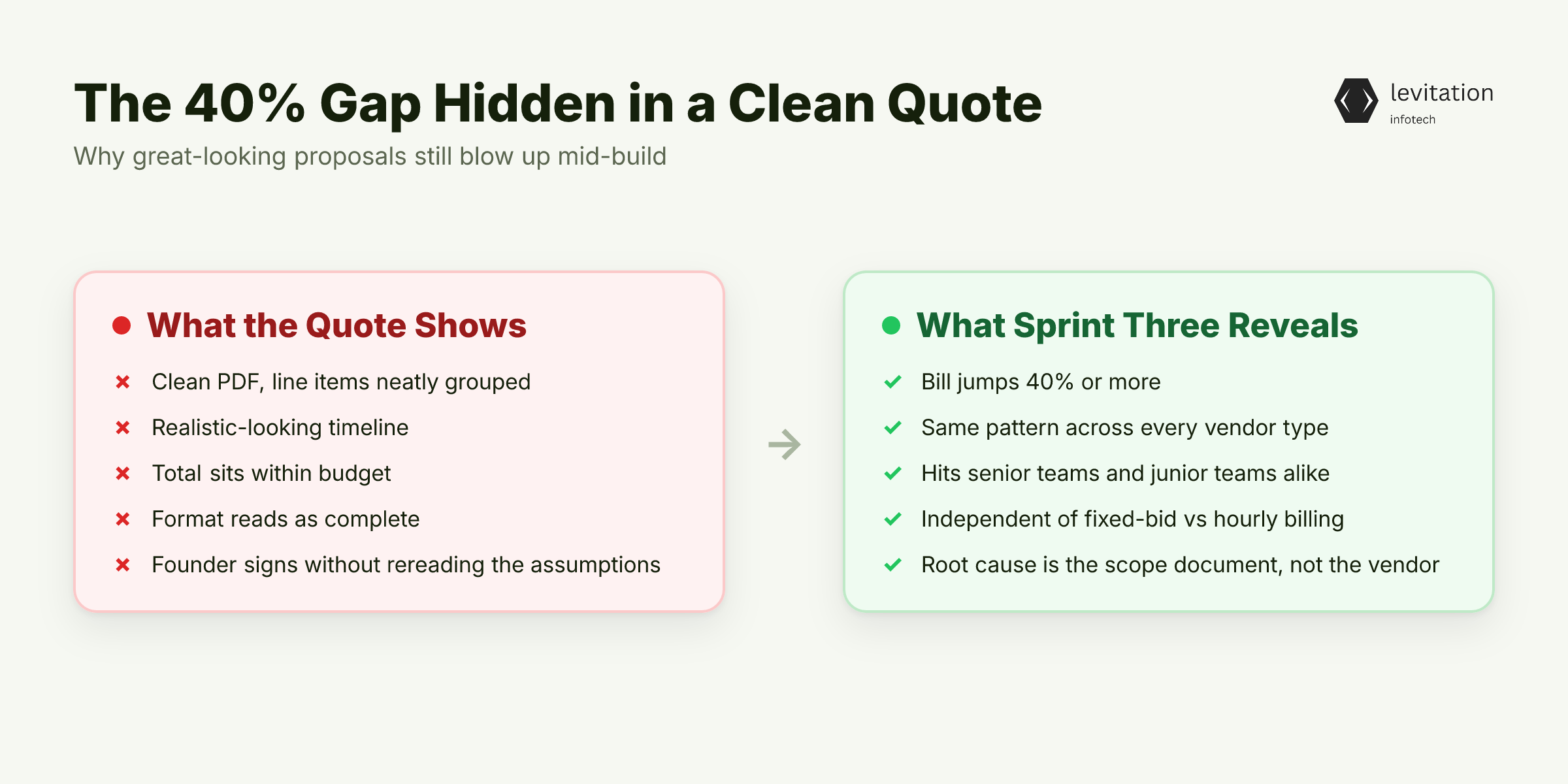
The quote arrives. Clean PDF, line items neatly grouped, timeline that looks realistic, total within budget. Most founders sign it without reading the assumptions twice. Then sprint three lands and the bill jumps 40%, sometimes more.
The pattern shows up across every build type we have seen, from two-sided marketplaces to internal ops dashboards. This is not a one-off mistake by a sloppy vendor. The 40% under-budget pattern is one of the most consistent signals we track. It happens with senior teams, with junior teams, with shops that pitch fixed bids, and with shops that bill hourly. The vendor's reputation has almost nothing to do with it. We have documented the same scope-driven cost jump in MVP builds before, and the pattern keeps repeating.
The reason the gap stays invisible at quote stage is simple. Vendors price against whatever scope document you hand them. If the document is one paragraph and a mockup, the line items look complete because the vendor has nothing to break out. A quote that says "auth, payments, admin, dashboard" against a thin scope reads identical to a quote that says the same against a tight one. The format hides the missing detail.
This is also why a generic app development cost India range is a poor substitute for a real quote. Cost ranges describe what the market charges in aggregate. Quote accuracy is a separate problem. It depends on what you specified, not what the average founder specified. So the natural reaction is to blame the vendor and find a better one. That is the obvious fix, and it is also the one that does not work. Why does swapping vendors fail when the math seems so clear?
Why "Get a Better Quote" Doesn't Fix the 40% Gap
After their first sprint-three surprise, most founders do the rational thing. They look for a better vendor. They ask for fixed bids instead of hourly. They check references. They compare three or four proposals.
The problem is that all of these moves treat the quote as the variable, when the real variable is the input. Fixed-price bids, hourly engagements, and dedicated developer models, all three pricing formats produce the same 40% gap when fed the same thin scope. Pricing format is not the lever.
A Noida web development company estimating your SaaS MVP reads your spec. They look at the tech stack and the complexity you described, then build a number. If your spec is two pages, the number is two pages wide. If your spec is one paragraph, the number is one paragraph wide.
The wide range you see in any SaaS development company quote, anywhere from $8,000 to $150,000 for an MVP, looks reassuring on a comparison sheet. It feels like you are getting options. In practice, the same 40% gap appears at every tier. The $8K quote misses by 40% at sprint three. The $150K quote misses by 40% at sprint three. The variance is upstream of the vendor.
This is the part founders find hard to accept. The team at the other end of the call is not lazy or dishonest. They are doing their best with what you gave them. Most founders are not technical, and the spec they hand over is missing the details that decide whether the build lands on budget.
Auth edge cases, payment reconciliation logic, role hierarchies, third-party integration failure paths, these do not show up in a one-pager. The vendor has no way to price them, and no incentive to flag them. So they get priced later, as change orders. Vendor selection is downstream of scope quality. So the question becomes: what is the scope document actually missing?
The Real Reason India Web App Quotes Miss by 40%
The mechanism is unglamorous. Two things happen, and they compound. First, the scope document does not describe the product in enough detail for a vendor to price the real behavior. Second, both sides underestimate the complexity of the behaviors that are not described. When the team reaches sprint three, the missing detail turns into work.
Auth edge cases alone can blow up a budget. What happens when a user signs up with Google but already has an account with email? What happens when a session expires mid-checkout? What happens when an admin changes a role while the user is logged in? Each is a small decision, but each is billable work. None appear in a "user authentication" line item.
Payment reconciliation is the same trap. Razorpay, UPI, and Stripe each have their own webhook flows, retry semantics, and reconciliation windows. A 2026 India quote that bundles "payments integration" without specifying the provider mix leaves the entire reconciliation layer for sprint three to discover.
Look at what 2026 India feature benchmarks actually cost when broken out: - User authentication (email + social login): ₹15,000 to ₹35,000 - Role-based access control (admin, user, manager): ₹20,000 to ₹50,000 - Razorpay, Stripe, or UPI payment integration: ₹25,000 to ₹60,000
These are market rates for clearly specified features. Stack three of them, and the gap between "auth + RBAC + payments" priced as a single bundle versus priced as three discrete features is exactly where the 40% hides. Same for admin role hierarchies and third-party integration testing. Both routinely surface as change orders because the original line item was a category, not a specification.
The compounding effect is what kills the budget. Every undefined behavior becomes a change request. Each change request is priced individually, with no volume discount, and almost always at the vendor's standard rate rather than the original blended quote rate. By sprint three, the cumulative creep is visible on the burn chart, and the original 40% under-budget gap is no longer a forecast. It is the new baseline.
This is also why any cost to build an app calculator that does not ask you about role hierarchies, payment provider mix, and integration testing scope is giving you a number that will miss by 40% or more.
Knowing the cause is one thing. Pre-quote scope discipline is what actually closes the gap, and it is a founder-side activity, not a vendor deliverable. So what does that document actually look like?
The MVP Scope Document That Prevents the 40% Gap
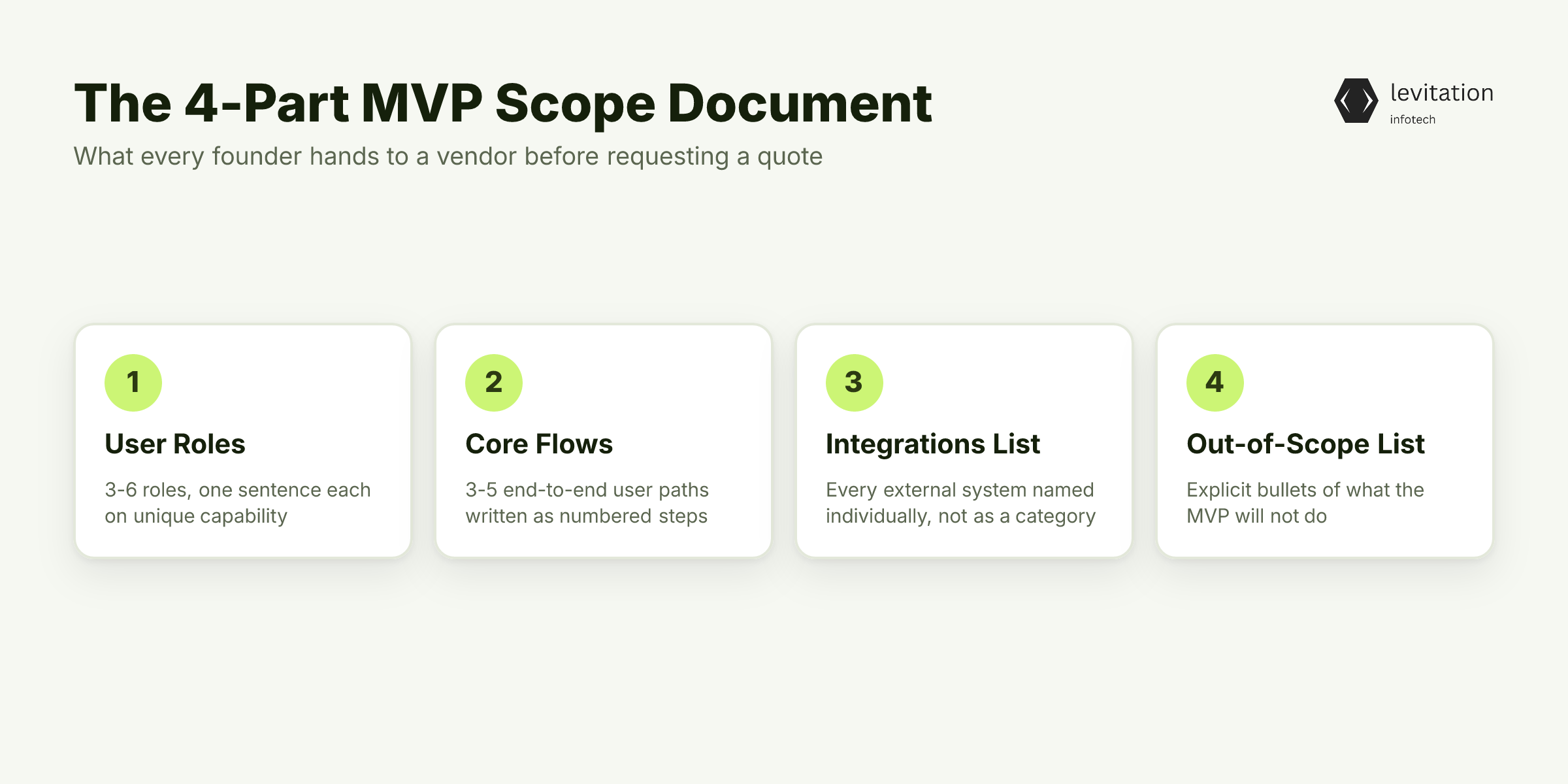
The fix is not a better vendor. It is a better spec. And the founder owns the spec, not the agency. Here is the four-part scope document that prevents the 40% gap before any quote is requested.
1. User roles. List every distinct role the product will support. For a SaaS MVP that is usually three to six: end user, admin, billing manager, support agent, and so on. For each role, write one sentence describing what they can do that no other role can. This is where RBAC gets priced correctly. Without it, the vendor assumes one role and bills for one role. When sprint three reveals five, the cost grows.
2. Core flows. A core flow is the shortest path through the product for one user, end to end. Sign up, browse, pay, receive confirmation. Write three to five of them in numbered steps. Writing them forces decisions you would otherwise make in sprint three, like "do new users get a free trial" or "does checkout support guest mode". Each decision, made upfront, removes a change request later.
3. Integrations list. Every external system the product touches, named individually. Not "payments integration". Razorpay, UPI, Stripe, and any other provider you intend to support, each on its own line. Not "email". SendGrid, Postmark, or SES, with the specific transactional templates you need. The integration list is where most of the 40% hides. A scope that says "Razorpay + UPI + Stripe" prices three integrations. A scope that says "payment processing" prices one guess.
4. Explicit out-of-scope list. This is the section most founders skip, and it is the most powerful. A bullet list of things the MVP will not do. No mobile app. No AI features. No multi-currency. No admin analytics. No SOC 2 compliance. Writing the out-of-scope list forces you to accept that the MVP is small, and it gives the vendor permission to say no when scope requests appear mid-sprint.
This four-part document is what an experienced SaaS MVP team quotes against. With it, typical deployment completes much faster than the version built on a thin spec. Without it, the same team's quote is built on assumptions, and the re-work inside the project compounds, pushing the timeline out well past the original estimate. In-house teams, which already carry longer timelines because of hiring and onboarding overhead, compound the re-work problem on top of their baseline schedule.
A good scope document changes the kind of quote you get back. Here is how to read the quote once it arrives.
How to Pressure-Test Any India Web App Quote
A clean spec produces a different kind of quote. Here is the five-question filter that separates a real quote from a dressed-up estimate.
Question 1: Are features broken out line by line? A quote that bundles "user management" or "admin panel" is hiding the same ambiguity that produced the 40% gap. Look for discrete line items: auth, RBAC, each payment provider, each integration. If the quote groups them, ask the vendor to break them out. The vendor who cannot is the vendor you do not want.
Question 2: Is there an assumption list? This is the single highest-leverage item in any quote. A serious vendor writes down what they assumed when pricing. "We assumed three user roles." "We assumed one payment provider." "We assumed English-only UI." Read this list. Every assumption you disagree with is a line item the vendor will bill as a change order.
A Noida web development company quoting against a tight scope produces a long assumption list, because a tight scope forces more decisions. The same Noida web development company quoting against a one-pager produces a short one, because there is nothing to assume against.
Question 3: What is the change-order rate? Some vendors price change orders at the same blended rate as the original work. Others price them at a premium over the original blended rate. Get the rate in writing. The premium version is fair if the scope was tight. It is exploitative if the scope was thin and the change orders are filling gaps you did not know were gaps.
Question 4: What are the post-launch support terms? Bug fixes, minor enhancements, server hosting, and uptime commitments should all be in the quote. A quote without these is a quote that ends at deployment, and the real bill starts there.
Question 5: Who owns the source code? If the answer is not "you, on day one, in your own repository", walk away. This is the most common trap in India web app engagements, and it is one we have seen end engagements in ugly disputes. Any vendor who wants to retain code ownership is treating your build as a product, not a service. Do not negotiate on this.
These five questions, asked before you sign, turn a quote from a price tag into a contract. Any build a SaaS engagement that survives all five is one you can budget against. When founders do this, the quote conversation changes shape entirely. Here is what that looks like on the other side.
What Changes When You Scope Before You Quote
When founders re-order the sequence, the numbers shift. A quote built against a four-part scope lands close to the original number. That is the inverse of the 40% under-budget pattern, and it is the normal state of affairs when the input is complete. The same vendor that missed by 40% with a thin spec delivers close to budget when the spec is tight. The vendor was never the variable.
The speed gain is harder to ignore. A scoped MVP deploys much faster with an experienced India team than the same MVP does when the spec is thin. The same MVP built in-house takes far longer, not because the in-house team is slower per sprint, but because the re-work inside the project compounds without a tight spec. The gap between fast outsourced and slow in-house is almost entirely a scope discipline gap, not a team quality gap.
The founder-facing takeaway is short. The sprint three surprise is a process failure, not a vendor failure. Every quote that looks too clean to be true is too clean. The honest quotes come with long assumption lists, broken-out line items, and change-order rates in writing. Those are the quotes that land close to the original cost.
If you want to know how much does an app cost in India, the answer is simple. Whatever your spec says, plus or minus a small variance, if your spec is tight. Anything else is a guess. Write the four-part scope before the first vendor call, and the quote conversation becomes a contract you can budget against.
Frequently Asked Questions
Q: What is a realistic web [app development cost in India](/mobile-app-development) for an MVP in 2026?
A: A SaaS MVP in India typically ranges from $8,000 to $150,000 in 2026, depending on feature count, integrations, and team structure. The wide range reflects scope ambiguity more than vendor pricing. Tighter scope produces tighter quotes.
Q: Why do India web app quotes change after sprint two or three?
A: Quotes change because the original scope document did not define behaviors for edge cases, role hierarchies, or third-party integration failures.
Sources
Research and references cited in this article:
- How Much Does a Website Cost in India in 2026? Honest Guide - Infinite Option
- India Budget 2026: Latest News, Updates, Key highlights and Announcements | The Economic Times
- Union Budget 2026-27 Analysis
- How to turn bad data into actionable insights with clean data. | 🧲 Adam Kitchen posted on the topic | LinkedIn
- 2026 IT Spending and Budget Forecasts: Where Organizations Are Investing | Splunk
- MVP Development Cost, Timeline & Process (2026 Guide) | AcornGlobus
- SaaS MVP Development Cost in 2026: $25K–$150K+ Breakdown
- How Much Does MVP Development Cost in 2026 A Data-Backed Breakdown for Startup Founders
- SaaS MVP Cost in 2026: What You Actually Spend | Design Key
- MVP Development Cost in 2026: Full Breakdown & Strategies
- A complete Guide to Mobile App Development Cost In India 2026
- Web application development cost: A breakdown
About the author
Mayank Singh is a software developer at Levitation Infotech, where he builds web and AI-powered applications across the company’s fintech, healthcare, and enterprise projects.