


TL;DR: A release sprint can absorb a WCAG scan. It cannot absorb a defensible audit with unresolved blockers across critical journeys. Cost grows as findings are fixed, retested, and documented. Accessibility needs a remediation and evidence system, not a one-time report.
Key Takeaways: - Automated scans find some rule failures, but they cannot prove keyboard completability or close a finding. - Audit cost spans discovery, remediation, regression testing, evidence maintenance, VPAT updates, and retesting. - Track critical-flow blockers, violation density, keyboard completability, and remediation aging as release measures.
The Sprint Boundary Is Where Audit Cost Begins
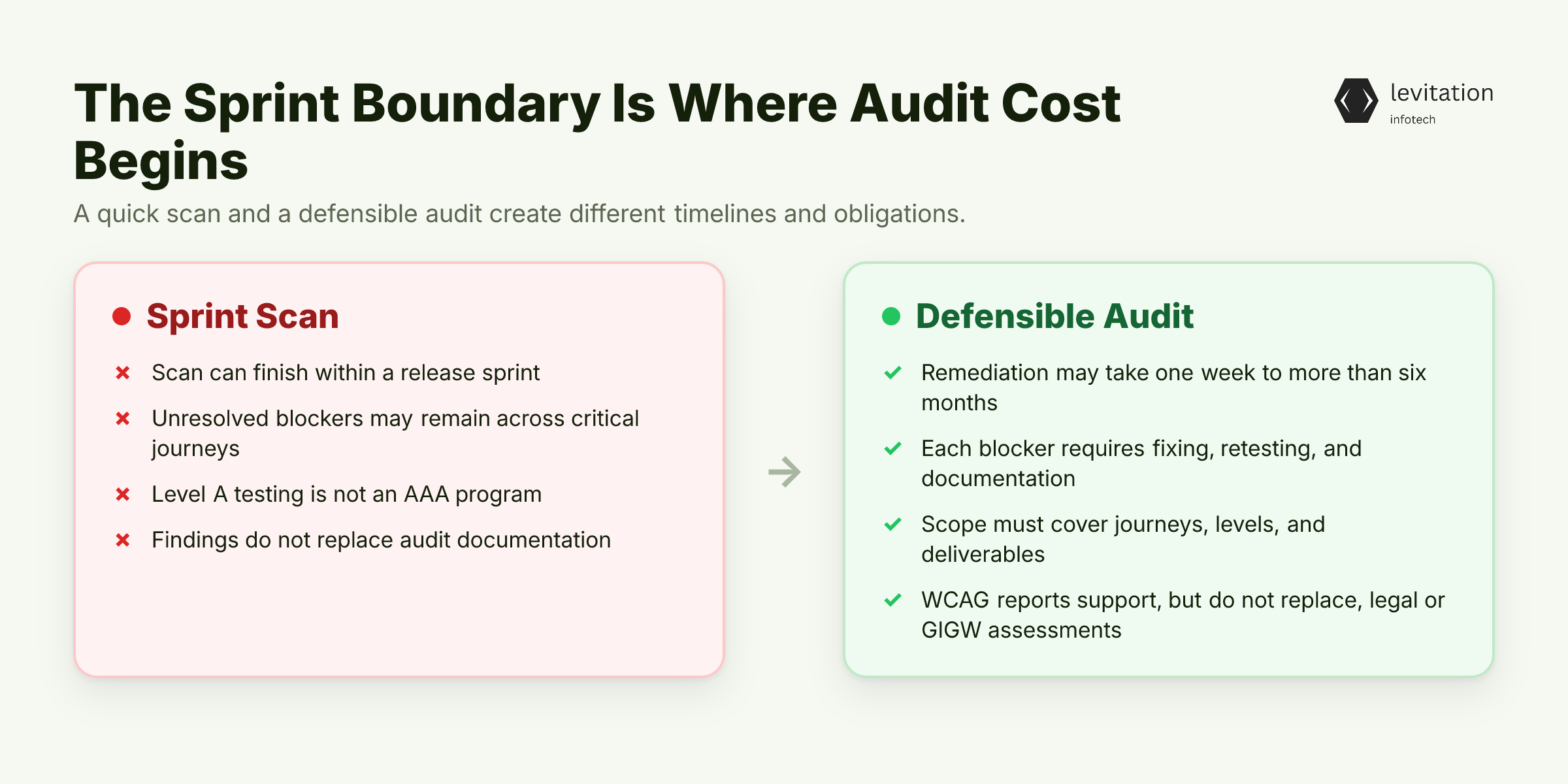
A scan can fit inside a release sprint. A defensible audit cannot be completed while unresolved blockers remain across critical journeys. The costly work begins when each blocker must be fixed, retested, and documented.
That tension explains why an Indian WCAG 2.2 audit can outlast a release sprint. A scan may finish quickly. Research on Indian audits, however, places remediation at about one week to more than six months. Complex websites and higher targets, especially AAA, can extend the work across several months or longer. A Level A test is not the same commercial promise as an AAA program.
WCAG 2.2 contains 86 testable success criteria. They sit under 13 guidelines, four principles, and Levels A, AA, and AAA. That breadth makes a one-sprint review unrealistic when critical journeys remain unresolved.
Buyers comparing top accessibility audit companies in India should ask about scope. Which journeys, levels, and deliverables sit in scope? A route list without critical-flow coverage isn't an audit plan. The skipped tests in criteria that budget audits often miss expose why scope choices matter.
For a CTO, the main cost is elapsed time, not the auditor's seat time. Teams wait for clear ownership, while product debates priority. Legal checks scope, and procurement tracks deliverables after the report arrives.
Consider a focus trap on a payment step. A shared component fix may be simple. However, related journeys need regression checks, and the conformance record needs an update. One defect creates several closure duties.
Legal scope adds another layer of complexity. WCAG 2.2 is a technical conformance standard. The RPwD Act is a legal framework, while GIGW is a guideline framework. Their application depends on the entity and service channel.
A WCAG 2.2 report can support that work. However, it cannot replace an RPwD Act assessment or a GIGW audit. The gap between WCAG conformance and RPwD acceptance shows why these labels aren't interchangeable.
In the vendor statement of work, separate discovery, remediation, retesting, and VPAT re-issue. Otherwise, a compressed report can be mistaken for completed compliance work.
If the success-criteria count explains only part of the delay, look further. The real bottleneck lies in how conformance is tested and closed. What must that process measure?
Why Automated Scans Cannot Prove WCAG 2.2 Conformance
Automated tools can inspect many rules quickly. A clean report remains a signal, not a conformance verdict.
On a checkout page, a scanner may flag a missing label. It cannot decide whether a keyboard user can reach payment, recover from an error, and finish the purchase. The markup looks valid, yet the journey still fails.
Keyboard completability is the missing measure. Ask whether every priority journey can be completed without a mouse. This includes focus movement, error recovery, and confirmation. Manual verification must answer this.
When evaluating WCAG audit and WCAG compliance services, ask who performs that test. Also ask how its evidence is stored. If the answer is "the scanner found nothing," the proposal has a blind spot.
Severity, conformance level, and remediation complexity set the schedule. A critical blocker on a shared checkout component can affect many routes. Published research associates longer timelines with complex sites and higher targets. AAA can require more manual checks, while complex sites add states and content variants. As a result, remediation can extend into months.
A finding isn't closed when code changes.
The fix must be retested. Related behavior must be checked for regression. Evidence or the VPAT must be updated when the change matters. That is the difference between remediation activity and verified conformance.
The same discipline applies across legal scopes. WCAG 2.2 can feed an accessibility audit. However, an RPwD Act assessment or GIGW audit needs extra scope and evidence. WCAG compliance can still break for screen reader users shows why automated rules cannot replace tested user paths.
The answer is not a better scanner. It is a system that measures, assigns, and verifies the work scanners cannot finish. Which measures should it track?
Measure Blockers, Not a Pretty Compliance Score
A report marked "mostly compliant" cannot guide a release decision. Replace the single pass-or-fail score with four operating measures. - Critical-flow blockers over time per flow. Count only issues that stop a user completing a priority journey. The target is zero, and a CI gate should block new critical-flow patterns from merging. - Violation density per route. Track violations per route each week. A rising trend means new code introduces failures faster than remediation removes them. - Keyboard completability. Record the share of priority journeys that can be completed without a mouse. Verify this quarterly through manual testing. - Time to fix by severity. Track blockers in days, not sprints. Every item needs an owner and a target date.
A quarterly compliance score can improve while weekly violation density worsens. The team may be clearing old debt while each new release adds fresh failures. The release dashboard should show both.
A critical-flow blocker belongs in normal delivery planning. It is not audit collateral to discuss later. If one sits for a month, the operating model is not working. This remains true even if the final report looks polished.
The evidence ledger adds a second layer of control. For each applicable success criterion, record the tested route or component. Record the result from each applicable test method as well. Also record the remediation ticket, retest result, and final conformance statement.
That ledger turns a report into proof. It also lets procurement compare accessibility compliance and VPAT specialists by evidence quality, not presentation quality. Ask for one sample record before accepting the final deliverable.
Move accessibility earlier in the delivery chain. Add acceptance criteria to requirements. Check components in design-system reviews, test pull requests, and tie release approval to critical-flow results. A later audit then verifies controls that are already operating.
These controls work only when translated into an operating model. That model needs clear handoffs between audit, engineering, and release teams. Who owns each handoff?
Run WCAG 2.2 as a Release Operating System
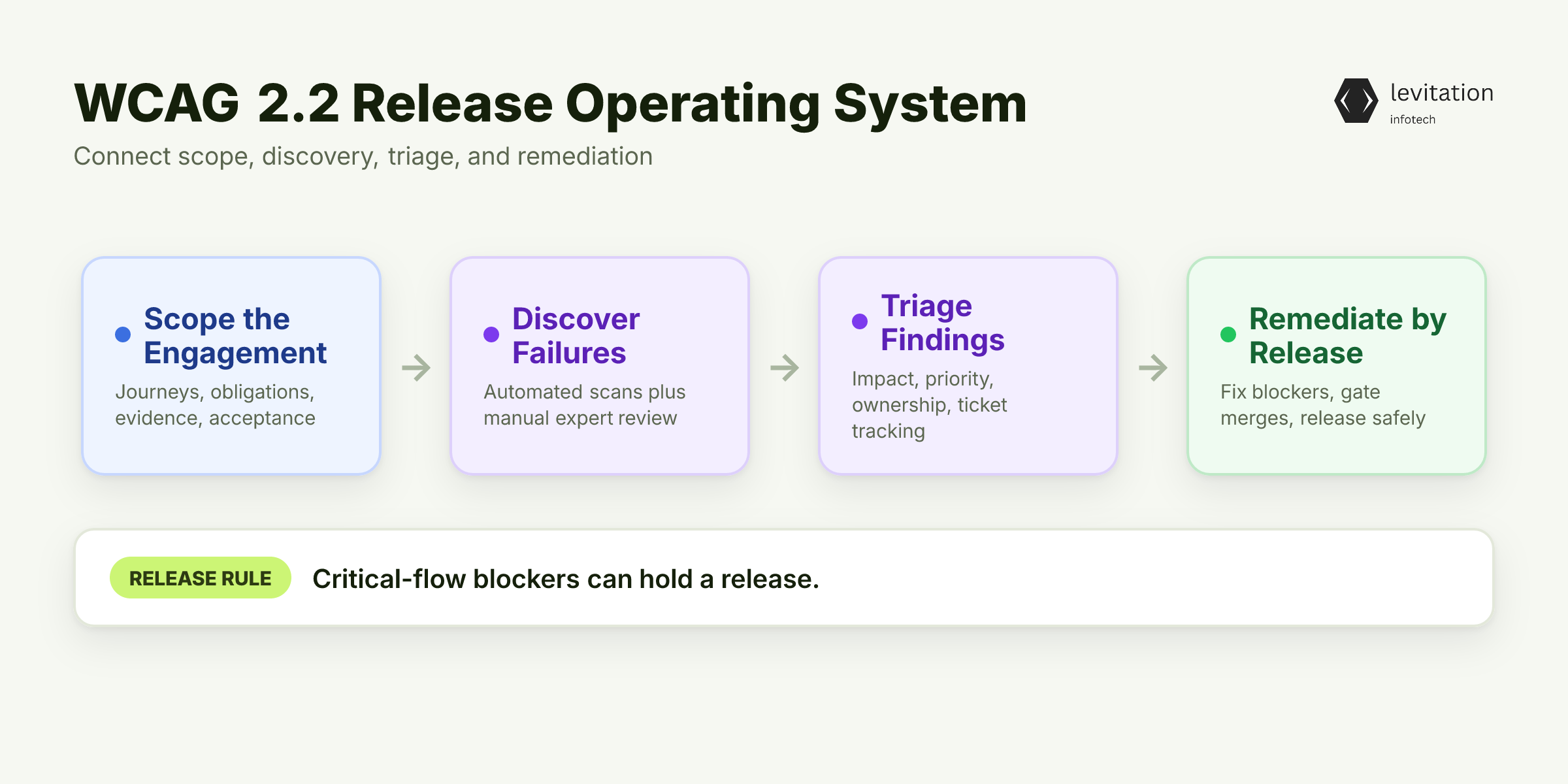
A ledger without handoffs remains a spreadsheet. The operating model must connect scope, testing, fixes, and release decisions.
Scope the engagement
Record these details in the audit brief: - Target WCAG version and conformance level. - Priority journeys and routes in scope. - Applicable RPwD Act and GIGW questions. - Required evidence and VPAT deliverables. - Definition of "done" for each finding. - Release acceptance rule for critical-flow blockers.
When shortlisting RPwD Act and GIGW audit partners, separate technical conformance from applicable framework questions. Name who validates each obligation. Missing scope is not a reporting detail.
Once scope is fixed, the next risk is missing a failure on a critical path. How should discovery expose it?
Discover failures
Combine automated route scanning with manual keyboard completion and expert review of the applicable success criteria. Store results by route and component, rather than relying on a report total.
Route-level records expose shared causes. A defective modal can affect several journeys, while a route-specific defect may need a local fix. This view also guides regression planning.
Discovery finds issues, but severity determines what enters the release queue. How should findings be triaged?
Triage findings
Classify severity by user impact and journey priority. Pull critical-flow blockers into the release-risk queue, then identify shared component causes.
Every finding needs an engineering owner and a tracked ticket. Link the affected route, observed behavior, expected result, success criteria, and retest evidence. A PDF finding without that chain creates another handoff problem.
Once findings have owners, the next question is when each fix enters delivery. How should remediation fit the release?
Remediate by release
Pull blocker fixes into current sprint planning. Fix shared failures in the design system when one change can remove the same problem across routes.
A CI gate should prevent new critical-flow blockers from merging. Critical-flow blockers can hold a release. Lower-severity findings need owned tickets and target dates, not silent backlog entries.
A deployed fix is not yet verified work. What must happen before the finding can close?
Verify and document
Retest each candidate fix before closing its finding. Run a regression pass on affected journeys and record the evidence. Update the VPAT or conformance statement when the change is material.
Audit completion and release readiness are different milestones. The release record must show which findings are closed, retested, and accepted.
A verified fix still needs a trend view, or recurring failures can hide inside a polished report. What should that view show?
Review the trend
Inspect blocker count per flow and violation density per route every week. Verify keyboard completability quarterly, and report remediation aging to the same forum used for release risk.
This turns accessibility into a delivery signal. It also gives procurement a lasting record of controls between formal audits. Which evidence should procurement review before the next formal audit?
This operating model changes both the pace of delivery and the kind of accessibility partner a CTO should procure. The contract must specify the evidence and ownership arrangements that make it work, or it remains a proposal. Which terms should the contract settle?
Buy Remediation Capability, Not Just an Audit Report
The cheapest audit fee can create the most expensive remediation. Judge total cost of ownership, not the discovery quote.
Require separate line items for: - Discovery and manual testing. - Engineering remediation. - Regression testing. - Evidence maintenance. - VPAT updates. - Independent retesting.
A single fee hides who pays for each stage. It also leaves release readiness undefined when the report lands.
The request for proposal should require: - A route-and-flow coverage matrix and conformance-level coverage. - The manual test method and severity definitions. - Sample evidence, remediation handoff, and retest policy. - Named delivery ownership.
When comparing GIGW accessibility audit firms, demand WCAG-specific evidence. Experience in regulated industries helps, but it does not replace documented outcomes against named criteria.
Keep independent conformance validation separate from remediation support. The party reporting conformance should validate fixes against an agreed retest method. Otherwise, it may mark its own work complete without proof.
Ask for a realistic remediation forecast based on submitted scope and engineering capacity. The published range of one week to more than six months is a planning signal. It is not a universal service-level agreement.
The final step is to pressure-test that commercial proposal with five questions. Which answers expose hidden scope, evidence, and schedule assumptions?
Five Questions That Expose Audit Scope Gaps
Put these questions directly into the statement of work:
- How long will remediation take? Separate discovery, fixing, retesting, and documentation.
- What drives the fee? Cover routes, flows, conformance levels, severity, regression, and evidence.
- Which Indian obligations apply? Name the entity, channel, RPwD Act questions, and GIGW questions.
- Can the work fit one sprint? Require a blocker-based forecast tied to engineering capacity.
- Which WCAG version is the contractual baseline? Name the version, level, routes, components, and deliverable.
Use the answers to set acceptance criteria, evidence rules, and retest ownership. Also set the link between audit completion and release readiness. If the answers disagree, the commercial model isn't ready.
Request a scoped proposal that names critical flows, success-criteria coverage, and blockers. It must also name remediation ownership, retest timing, and the final WCAG compliance deliverable. An accessibility audit company comparison helps shortlist firms, but the contract decides what "done" means.
The remaining question is simple: what does a credible answer look like in India?
Frequently Asked Questions
How long does a WCAG 2.2 accessibility audit take in India?
There is no universal duration because discovery, remediation, and retesting are separate activities. Published research on Indian audits gives a remediation range of about one week to more than six months. The range depends on complexity and conformance level.
Complex AAA work can take longer, so scope critical flows before accepting a timeline.
What determines accessibility audit cost in India?
Cost depends on routes and critical flows, conformance level, manual testing depth, and severity. It also depends on regression testing, documentation, and VPAT re-issues. It is not simply the page count.
Request costs listed separately for discovery, remediation support, retesting, and final evidence.
Is WCAG 2.2 sufficient for RPwD Act and GIGW compliance?
WCAG 2.2 is a technical conformance standard. It does not automatically constitute an RPwD Act assessment or a GIGW accessibility audit. Determine which frameworks apply to your organization and channel.
Map the relevant obligations and obtain legal validation where appropriate.
Can WCAG 2.2 remediation be completed in one release sprint?
One sprint can work when scope is stable and critical-flow findings are few. Ownership must also be clear, and fixes must be retested before release. A fixed deadline is unsafe when blocker count, violation density, or remediation aging is rising.
Integrate accessibility into earlier sprints instead.
Should an Indian organisation audit against WCAG 2.1 or WCAG 2.2?
WCAG 2.2 is backward-compatible. Content that conforms to WCAG 2.2 also conforms to WCAG 2.1 and WCAG 2.0. W3C also encourages use of the latest version.
State the precise target in the audit brief because contractual and regulatory scopes can differ. Which version can your legal scope, channel, and buyer evidence support?
About the author
Mayank Singh is a software developer at Levitation Infotech, where he builds web and AI-powered applications across the company’s fintech, healthcare, and enterprise projects.