


TL;DR: An MVP quote in India covers one core user experience, not a shippable product. The real cost of launching a functional app typically runs 2-3x the initial quote. Production-ready software demands payment flows, admin panels, security hardening, and integrations that MVP scoping deliberately excludes. The fix is a two-phase budget plan where the launch phase is funded before the first cheque is written.
Key Takeaways: - A ₹1.5 lakh MVP quote in India covers one core flow, not a production launch - The 3x jump reflects structural engineering needs, not vendor markup - Reserve 30-50% of total project budget for the launch phase before signing any contract
Your ₹1.5 Lakh MVP Quote Is the Entry Fee, Not the Bill
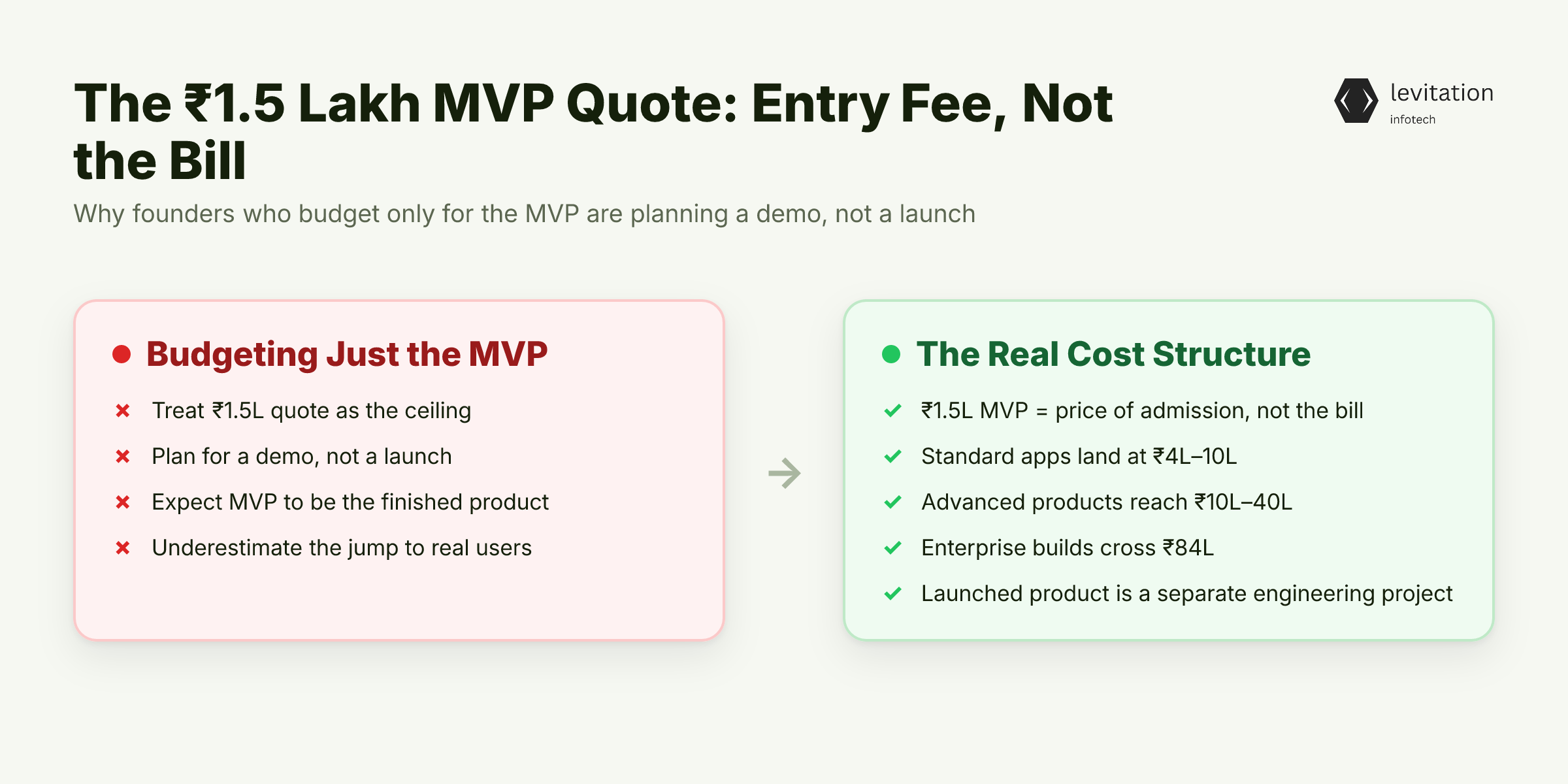
The ₹1.5 lakh was never the real number. It was the price of admission to a much larger bill.
Here's the truth most mobile app development cost in India guides won't tell you: a basic MVP in 2026 starts around ₹1,50,000. But no serious app launches at that price.
Standard business apps land in the ₹4,00,000 to ₹10,00,000 range. Advanced products hit ₹10-40 lakh. Enterprise-grade builds can cross ₹84 lakh.
The 3x jump isn't a vendor trick. It's structural.
The MVP proves the idea. The launched product is a different engineering project.
One tests whether anyone wants the thing. The other makes the thing survive real users, real data, and real failure modes.
Founders who budget for the first number alone are planning for a demo, not a launch. The vendors know this. The clients usually don't.
But most founders treat that first quote as a ceiling.
Why Founders Trust the First Number - and Why It's Wrong
Vendors quote MVPs low to win the deal. This isn't dishonesty; it's a sales pattern everyone in the industry recognizes. The real scope emerges only after user testing, and that scope isn't free.
MVP scoping strips out everything that makes an app shippable: - Payment flows and refunds - Admin panels for operations teams - Error handling and edge cases - Security hardening for production - User authentication beyond a simple login - Compliance and audit trails
A working prototype is a simpler engineering project than a production-grade app. The production version handles real users, stores sensitive data, integrates with payment systems, and survives a security audit. The difference between those two scopes is where the cost lives.
Once real users touch the app, the gap between "demo-able" and "launch-ready" becomes the second invoice. And by then, you're locked in. The vendor knows your codebase.
Switching costs are brutal. The scope expands. The bill follows.
Founders also underestimate because the app development cost india conversation typically happens before the product has any usage data. There's no way to scope launch costs accurately when you don't yet know how users will break your MVP.
Teams that budget for the full launch cycle, not just the prototype sprint, see this coming. Most don't, and pay for it in runway.
So if the triple is baked into the process, where exactly does the extra money go?
The Three Cost Multipliers Behind the 3x Jump
Three forces compound to create the 3x jump. Each is unavoidable. None are vendor markup.
1. Feature complexity. The MVP ships one core user experience, the single flow that proves the idea works. Launch requires everything that flow doesn't include: onboarding screens, settings panels, notification preferences, and support flows. It also includes edge cases that didn't exist in scope because no one had used the app yet.
2. Backend infrastructure. MVPs run on shared servers and minimal APIs. Launch demands proper databases, authentication layers, role-based access control, scaling logic, monitoring, and admin dashboards. None of that ships with the prototype. All of it must be built, tested, and deployed.
3. Third-party integrations. Payment gateways, SMS and email providers, analytics platforms, crash reporting, and push notifications: each adds cost, configuration time, and failure modes. MVPs skip most of these. Production can't. A failed payment flow or a broken notification system isn't an MVP problem; it's a launch blocker.
Each multiplier compounds. A more complex feature needs a more complex backend, which requires more integrations to function safely. The math isn't linear; it's multiplicative.
When you ask how much does an app cost in production, you're not asking the same question you asked at scoping. The scope itself has changed.
Teams that internalize this distinction early build launch-ready systems from the start. They don't bolt on production requirements after user testing reveals every gap.
These three forces explain the math. But knowing them isn't the same as budgeting for them.
Noida's Pricing Tiers vs. Your Actual Budget
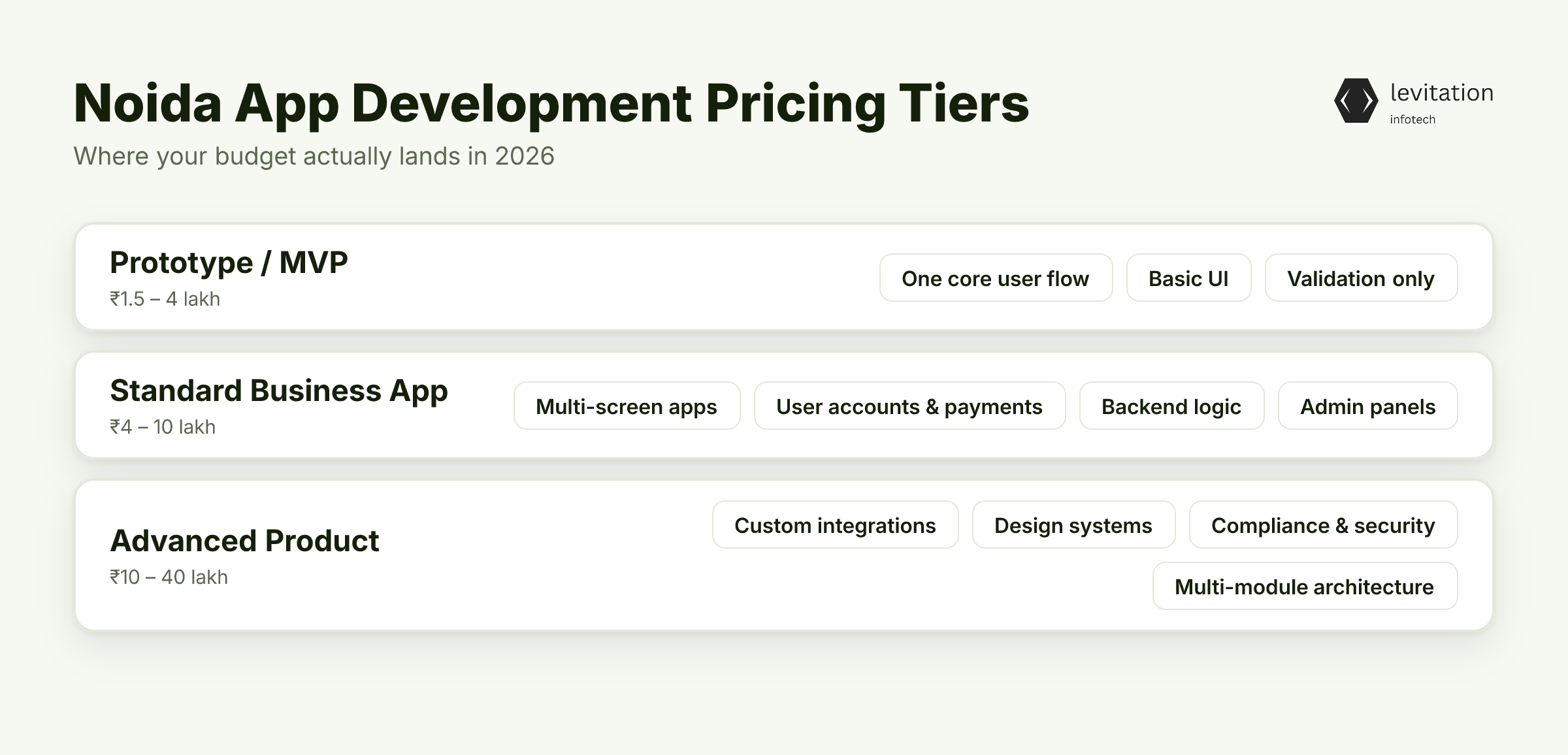
Noida app development pricing in 2026 follows three clear tiers: - Prototype or MVP: ₹1.5-4 lakh. One core user flow, basic UI, validation only. - Standard business app: ₹4-10 lakh. Multi-screen apps, user accounts, backend logic, payment flows, admin panels. - Advanced product: ₹10-40 lakh. Custom integrations, deeper logic, design systems, compliance, multi-module architecture.
Enterprise-grade and complex apps can exceed ₹84 lakh once compliance, custom integrations, and multi-region scaling enter the picture.
Firms like Appinventiv, Hidden Brains, and InnovationM operate across all three tiers. The tier you get quoted depends entirely on the scope you define, not the vendor you choose.
A Noida firm quoting ₹2 lakh for an "MVP" isn't cheaper than one quoting ₹6 lakh for a "business app." They're describing different products.
Understanding Noida app development pricing starts with understanding which tier your product actually requires. Most founders skip this analysis and treat the first quote as the final answer. The same pattern shows up across other software categories too: the sticker price describes a prototype, not a product.
The tier matters less than the process. The framework that follows is where the real protection lives.
The 5-Step Budgeting Framework That Prevents Cost Shock
A two-phase budget plan prevents the 3x shock. Five steps, executed before you sign the first contract.
Step 1: Define the MVP as a single core user experience. Not a mini version of the final product. One flow. One path. This keeps the initial quote honest about what it actually covers.
Step 2: Build a launch requirements list before signing the MVP contract. List every feature that must exist before real users touch the app: payment processing, authentication, admin panel, analytics, support flows, and a security review. Don't estimate cost yet; just list them.
Step 3: Ask the vendor for a two-phase quote. MVP price plus a separate launch-phase estimate with line items, not a single bundled number. Vendors who refuse this signal are not your long-term partners.
Step 4: Reserve 30-50% of total project budget for the launch phase. If the MVP quote is ₹3 lakh, plan for ₹9-12 lakh total before writing the first cheque. MVP app cost India is a fraction of the real number; the launch phase is the bulk.
Step 5: Lock the launch-phase scope in writing with a change-order process. Feature creep becomes a priced decision instead of a surprise. Every addition triggers a written estimate and your sign-off.
This framework isn't theoretical. Teams that use it ship on budget. Teams that skip it become the case studies about cost overruns. The hidden costs in Noida software quotes almost always trace back to founders who didn't follow a version of this discipline.
That's the tactical side. But what actually shifts when you budget for the full arc instead of just the first sprint?
What Changes When You Budget for the Full Arc
You stop making scope cuts under cash pressure and start making product decisions. Those are very different conversations.
Scope cuts under pressure mean cutting security reviews, admin tools, or error handling. The app launches anyway: fragile, under-monitored, and expensive to maintain. Product decisions, by contrast, mean choosing what to build next based on user data, not survival.
Runway extends naturally because the launch phase is funded. No more crowdfunding the next milestone from bridge rounds or credit lines. The team finishes the project instead of abandoning it at 70%, which is where most underfunded apps die.
Projects that budget for the full launch arc finish. Projects that budget only for the prototype stall. The hidden cost of "just the MVP" surfaces in year two when the rebuild begins. The questions below surface the same pattern earlier.
Frequently Asked Questions
Q: Why does mobile app development cost in India triple between MVP and launch?
A: The MVP covers one core user experience with minimal backend and no third-party integrations. Launch requires payment flows, admin panels, authentication, analytics, security hardening, and infrastructure scaling, each adding cost. The triple reflects the gap between a demo and a shippable product, not vendor markup.
Q: What is a realistic MVP app cost in India for 2026?
A: A simple MVP or prototype in India in 2026 typically costs ₹1,50,000 to ₹4,00,000. This covers validation, a single core user flow, and basic UI. Anything beyond that, including multi-screen apps, backend logic, or user accounts, moves you into the ₹4-10 lakh business app range. That shift happens immediately.
Q: How much does a full app launch cost in India?
A: A standard business app launch in India runs ₹4,00,000 to ₹10,00,000. Advanced products with custom integrations, admin dashboards, and compliance requirements reach ₹10-40 lakh. Enterprise-grade apps with multi-region scaling and regulated-industry compliance can exceed ₹84 lakh.
Q: How do Noida app development companies structure their pricing?
A: Noida firms typically price in three tiers: MVP/prototype (₹1.5-4 lakh), standard business app (₹4-10 lakh), and advanced/enterprise product (₹10-40 lakh+). The tier depends on scope you define, not the vendor you pick. Firms like Appinventiv, Hidden Brains, and InnovationM operate across all three.
Q: Can you keep mobile app development cost under ₹5 lakh in India?
A: Only if you stay at the prototype/MVP tier and avoid payment integrations, admin panels, and complex backend logic. Once you need real users, real data, and a production launch, the budget starts at ₹4 lakh. It usually climbs to ₹8-12 lakh for a functional business app.
Plan the launch phase before the first cheque is written, and the 3x shock becomes a line item, not a surprise.
Sources
Research and references cited in this article:
- MVP Development Cost in 2026 - Perimattic | Perimattic Blog
- Mobile App Development Cost Breakdown 2026: Where Does Your Money Go?
- MVP Development Cost in 2026: Full Breakdown & Strategies
- Mobile App Development Cost in 2026: A Comprehensive Guide
- MVP Development Cost and Timeline Guide 2026 - OMEGA SOLUTION
- MVP Development Cost in 2026: Startup App Budget ...
- MVP Development Guide 2026: Process, Costs, Examples
- How to Build an MVP App in 2026: Complete Development Guide (4-6 Weeks) | Minimum Code
- MVP App Development Cost For Startups: A Complete Breakdown
- A complete Guide to Mobile App Development Cost In India 2026
- Top 15 Mobile App Development Companies in India (2026)
- Top Mobile App Development Companies in India 2026
About the author
Mayank Singh is a software developer at Levitation Infotech, where he builds web and AI-powered applications across the company’s fintech, healthcare, and enterprise projects.