


TL;DR: SOC 2 Type 1 passes on the first try when you treat it as an operational program, not a legal documentation exercise. Roughly 4 in 10 Indian SaaS fail because they prepare for the wrong audit type, delegate to legal counsel, and lack the five control evidence streams auditors actually test. A focused readiness sprint, or a dual-track ISO 27001-then-SOC 2 sequence, turns the same controls into a first-time pass and reduces the second-framework cost by roughly 40%.
Key Takeaways: - About 40% of Indian SaaS fail their first SOC 2 Type 1 audit, and the retry costs ₹9 lakh on top of the ₹8.5-15 lakh already spent in Year 1. - The failure traces to a Type I vs Type II preparation mismatch and a legal-documentation mindset, not to auditor bias. - Five operational controls trip most Indian SaaS audits: access reviews, change management, vendor risk, incident logging, and HR controls. - A readiness sprint or a dual-track ISO 27001-then-SOC 2 sequence reduces the second-framework cost by about 40% and lets both audits run on a shared evidence base.
The 40% That Burn ₹9 Lakh Twice
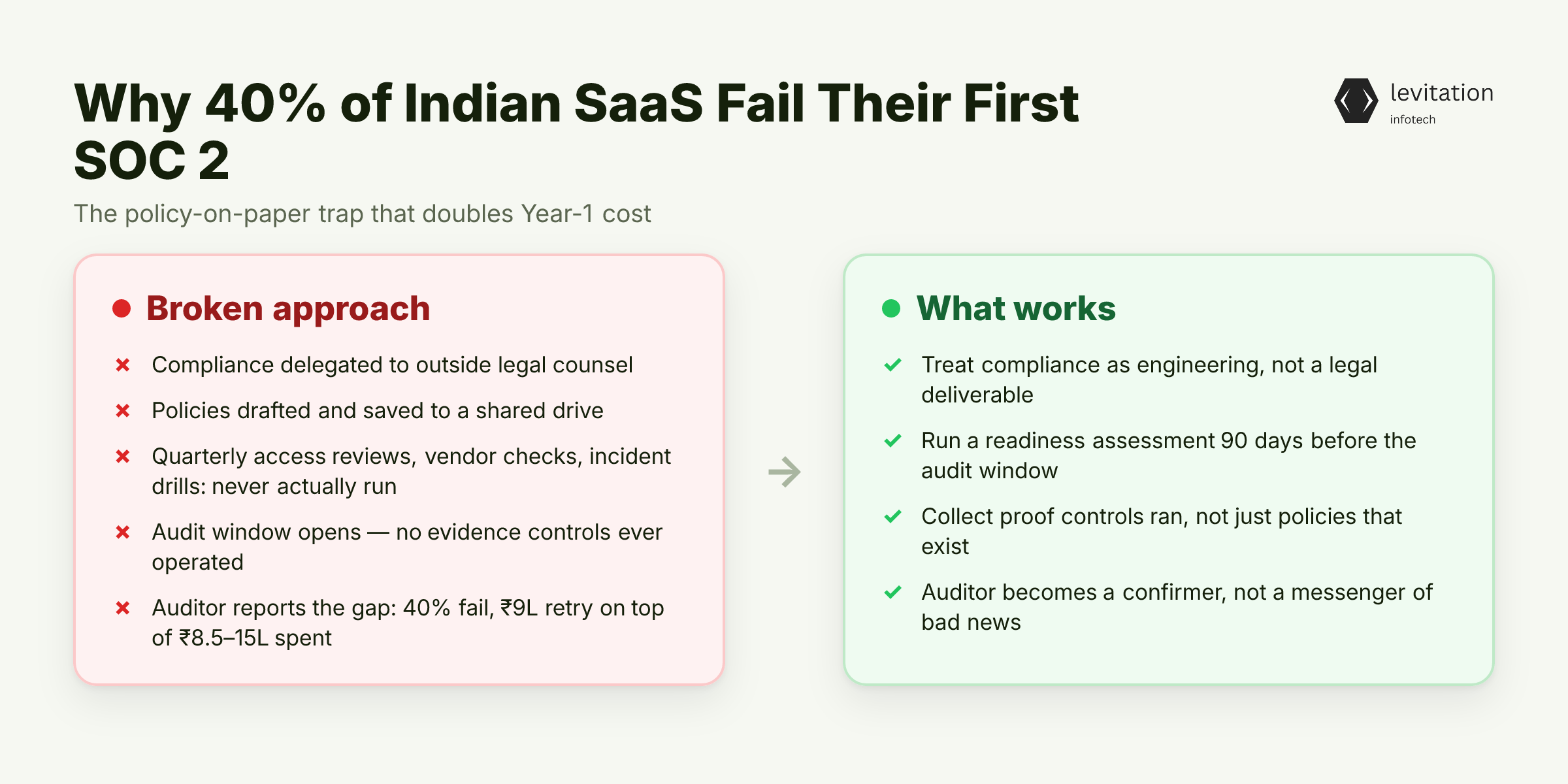
Four in ten Indian SaaS companies fail their first SOC 2 Type 1 audit, then pay ₹9 lakh to retry on top of the ₹8.5-15 lakh already spent in Year 1. The failure is almost never the auditor's fault.
The real damage is not the fee. A failed audit pushes a US enterprise deal back. The pipeline opportunity stalls in legal review while the team re-runs evidence collection, and a repeat failure signals control maturity issues to both buyers and investors. - Pre-Series A SaaS chasing US logos without an in-house compliance engineer is the most common failure profile. - The project gets delegated to outside legal counsel. - Counsel writes policies. Engineering saves them in a shared drive and calls it done. - The audit window opens, and an auditor asks for proof the controls in those policies actually operated.
That is when the team discovers the gap. The policy says access reviews happen quarterly. The audit window shows no evidence they did.
The policy says vendors are risk-assessed. The audit window shows no completed assessment for the AWS account, the payment gateway, or the AI API.
The policy says incidents are logged and tested. The runbook was approved once and never used.
The pattern repeats across most failures. Most teams assume the auditor is the gatekeeper. The auditor is actually the messenger. They report on a problem baked in months before the audit window opened.
The full breakdown of SOC 2 compliance cost in India shows how a missed first attempt doubles the per-year compliance spend. A proper SOC 2 readiness assessment run 90 days before the audit flags these evidence gaps early.
That problem starts with one specific misunderstanding, inherited from the legal team.
Why the Legal-Exercise Mindset Guarantees a Retry
SOC 2 lands on the desk of outside legal counsel because, to a non-specialist, it looks like a documentation project. Counsel drafts an information security policy, an acceptable use policy, a vendor management policy, and a change management policy. The package is sent to engineering. The shared drive is populated. Everyone assumes the audit will be a formality.
It will not be. SOC 2 is an attestation framework run by licensed CPAs. The auditor is testing whether controls operated, not whether policies exist.
This is where the legal mindset breaks. - Type I vs Type II confusion. Type I is a point-in-time check that controls are designed and exist as of a specific date. Type II tests whether those controls actually operated over a 3-12 month window. Most Indian SaaS prepare for Type I but get a Type II request from their US buyer, or they prepare for Type II with only three months of operational evidence to show. - No credit for remediation plans. Under SOC 2, an auditor cannot accept a remediation plan if a control did not exist or did not run during the window. The exception is written into the report and the report stays with you. ISO 27001, by contrast, certifies the management system itself and gives credit for a credible remediation timeline. The full SOC 2 Type 1 vs Type 2 comparison shows why the wrong preparation path costs Indian SaaS a second audit fee and rework. - Different output, different posture. SOC 2 produces an auditor's report, not a certificate. ISO 27001 produces a formal certificate from an accredited body. The ISO 27001 vs SOC 2 trade-off is the reason dual-track programs are gaining traction among Indian SaaS selling into both Europe and the US.
Once you accept that SOC 2 tests whether controls actually operated, not whether you have policies about them, a different set of failure points appears.
The Five Controls That Actually Trip Indian SaaS Audits
Auditors do not pick randomly. They test the same five control families on every SaaS audit, and the failure patterns are consistent. Teams that win on first-pass audits share a habit. They build auditable control evidence into operational systems from day one, rather than retrofitting it for the audit.
1. Logical access reviews. Auditors want evidence that quarterly user access reviews actually happened, with sign-off from a named owner, against a current user list. A Confluence page titled "Q3 Access Review" without a sign-off, ticket trail, or actual list of changes does not count.
2. Change management. Auditors want deployment logs, approval records, and rollback evidence for production releases. A policy document is irrelevant. The auditor will ask for five random production deploys in the audit window. They want to see who approved each one, what changed, and how rollback was tested.
3. Vendor and subprocess risk assessments. Auditors want a completed assessment for every system that touches customer data. The AWS account, the payment gateway, the customer support SaaS, the AI API, the email provider. Indian SaaS frequently skip this because the vendor is a household name. The auditor does not care about brand. They care about the assessment artefact.
4. Incident response and logging. Auditors want centralised logs that are retained and tested, plus evidence of an actual drill. A runbook that was approved once and never exercised is the most common gap. The auditor will ask: "Show me the last incident, the response timeline, and the post-mortem." If the answer is "we have not had one," they will ask for the tabletop exercise record instead.
5. HR controls. Auditors want background check records, security training completion logs, and termination access revocation evidence within 24 hours of role end. Off-boarding is the single most common HR control failure because the ticketing workflow rarely closes on the same day the HR ticket is opened.
These five control families map directly to the SOC 2 Trust Services Criteria security category. The fastest way to put them to work is a structured SOC 2 evidence repository template that names a folder per control, a file per audit period, and an owner per artefact. Purpose-built compliance platforms cut the time auditors spend chasing artefacts compared to a shared Google Drive.
Knowing the five failure points is half the battle. The other half is collecting evidence in a format an auditor can verify fast. The sprint that gets teams there takes about 90 days.
The Readiness Sprint: Done Right
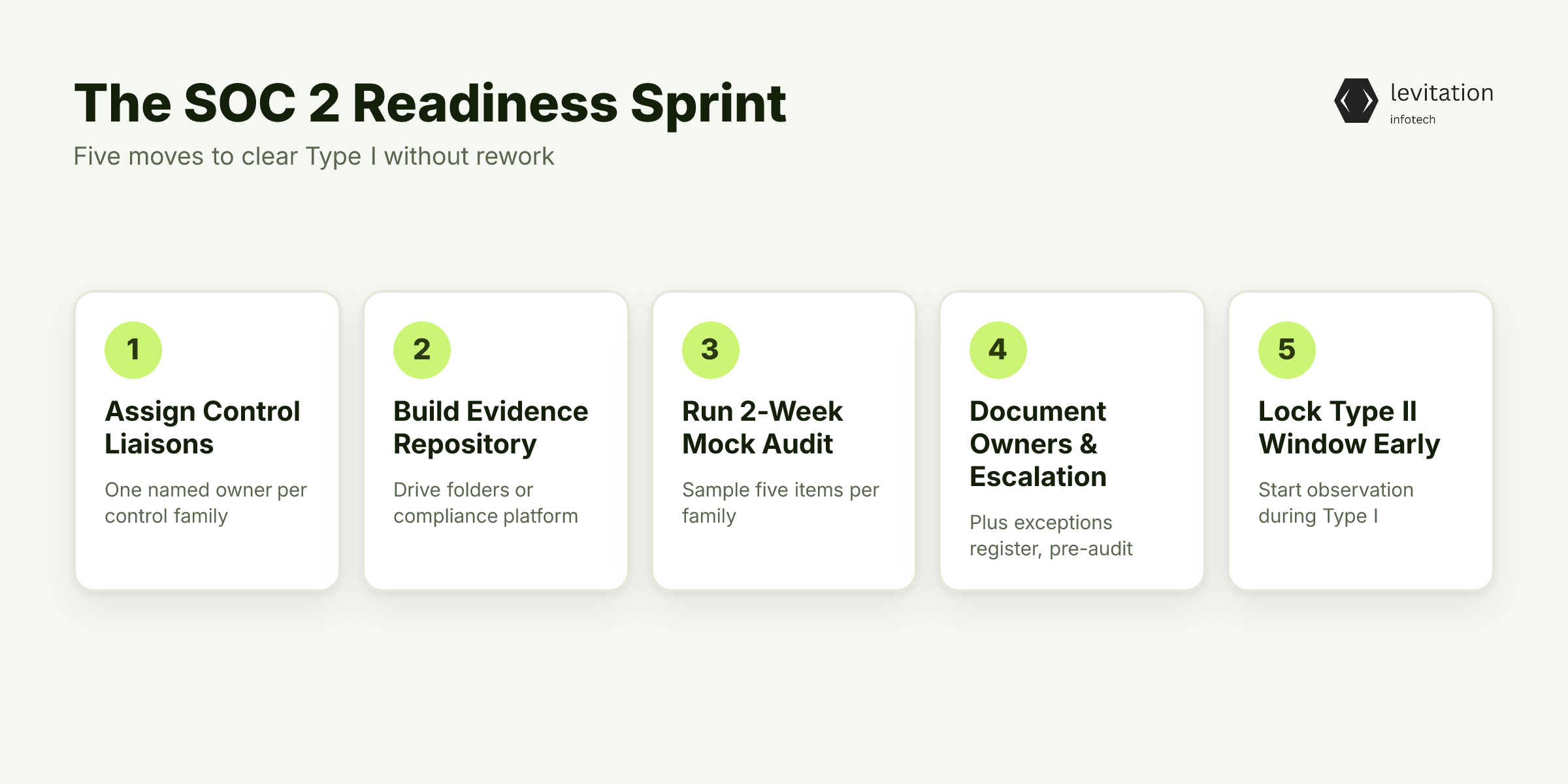
Most Indian SaaS can clear a first-time SOC 2 Type 1 with a structured readiness sprint. Teams that try to do it in-house without prior framework experience spend much longer. They mostly redo work the auditor did not accept the first time. The difference is sequencing and ownership.
Here is the sprint that works: - Assign one internal liaison per control area for access, change, vendor, incident, and HR. A single named owner per family beats a committee every time. Committees produce policies; owners produce evidence. - Stand up an evidence repository. A simple Google Drive with a naming convention and folder-per-control works for pre-Series A teams. For larger teams, a compliance automation platform cuts the time the auditor spends chasing artefacts. - Run a 2-week mock audit against the five control families. Treat it like the real thing. Sample five changes, five access reviews, five vendors. Document every gap you find. Fix the gaps. Then book the real auditor. - Document control owners, escalation paths, and an exceptions register before the audit window opens. Auditors look for these on day one. Teams that cannot produce them get a finding before the fieldwork even starts. - Lock the Type II observation window while Type I is in progress so you do not pay for two separate engagements. The marginal cost of starting the observation period early is zero. The marginal cost of restarting it is the second audit fee.
A detailed SOC 2 readiness checklist and a realistic SOC 2 implementation timeline make the sprint plan easier to defend internally. Most boards will sign off on a defined compliance budget with a clear exit. Few will sign off on a program that drags on without a finish line.
There is a faster path for teams willing to sequence two frameworks instead of fighting one at a time.
The Dual-Track Shortcut: ISO 27001 First, SOC 2 Second
ISO 27001 and SOC 2 look like separate worlds, but they are not. Build ISO 27001 first and the SOC 2 audit becomes a much smaller engagement. - ISO 27001 lands in 4-6 months for a focused team. It sets up the Information Security Management System, the risk register, the Statement of Applicability, and the management review cadence that SOC 2 auditors also ask for. - More than 70% of SOC 2 controls overlap with ISO 27001 Annex A. The shared controls run on the same evidence. The marginal effort for SOC 2 is the gap, not the framework. - Cost math: ISO 27001 mid-market runs ₹5.5L-₹8L. The marginal SOC 2 Type II cost drops to roughly ₹3L-₹4.8L. That is about 40% less than a standalone SOC 2 build. Start the SOC 2 Type II observation period while the ISMS is live. Do not wait for the ISO certificate to land.
The ISO 27001 to SOC 2 mapping document makes the overlap visible to your board. Founders who have taken this path often avoid the two-framework tax. That tax catches teams who build SOC 2 first and bolt on ISO 27001 later.
We wrote about that mistake in Why Indian SaaS Founders Buy SOC 2 When Buyers Want ISO 27001. A dual-track compliance engagement run by a single partner keeps both audits on a shared evidence base.
The readiness sprint and the dual-track approach both lead to the same outcome. The business payoff is what makes the compliance officer's case to the CFO.
What a First-Time Pass Actually Unlocks
A first-time pass is not the prize. The prize is what stops happening after you have the report on file. - US enterprise deals stop stalling at the security review. The SOC 2 report satisfies the vendor security questionnaire in one document. Procurement no longer needs to schedule an extra verification call for each control. - Procurement cycles compress. Teams that previously waited quarters for a Fortune 500 security review routinely close much faster once the trust report is on file. The impact on pipeline conversion is the single biggest ROI argument for compliance. It is documented in SOC 2 enterprise sales impact. - Renewal risk drops. Existing US customers who required SOC 2 to renew will not churn at year-end because the report is current. Missing a renewal report has ended more than one US enterprise contract. - A second framework becomes cheap. HIPAA, PCI DSS, ISO 27001, whichever comes next, lands for about 40% less because the control infrastructure already exists. The teams that have shipped this kind of multi-framework rigour find that the operational discipline transfers directly from one framework to the next. For a longer look at how that plays out in practice, our compliance case studies walk through the patterns.
The CFO stops reading the compliance line item as pure cost once the sales team starts attaching the trust report to the top three opportunities in the pipeline. The cost questions that follow are the ones CFOs ask once the pipeline math starts to land.
Frequently Asked Questions
How much does SOC 2 Type 1 cost for an Indian SaaS company?
Total Year 1 cost for SOC 2 Type I typically runs ₹8.5-15 lakh, including auditor fees, a compliance automation platform, and internal effort. SOC 2 Type II lands in the ₹5L-₹8L range once the control infrastructure is in place. Building ISO 27001 first reduces the second-framework cost by roughly 40%.
How long does a SOC 2 Type 1 audit take in India?
A focused readiness sprint runs shorter than an unstructured in-house build. That build typically drags far beyond the readiness window when no prior framework experience exists. The Type I audit fieldwork is the final step once readiness is complete.
What is the difference between SOC 2 Type 1 and Type 2?
Type I is a point-in-time assessment of whether controls are designed and exist as of a specific date. Type II tests whether those controls actually ran effectively over a 3-12 month observation period. Most Indian SaaS companies should plan to move from Type I to Type II within 12 months. US enterprise buyers increasingly refuse to sign without a Type II report.
Do I need SOC 2 to sell SaaS in the USA?
Not legally. SOC 2 is a voluntary AICPA framework. Practically, yes. Any US enterprise customer, healthcare system, or fintech will require a current SOC 2 Type II report before procurement will sign a contract. Without it, deals stall at the security review regardless of how good the product is.
Should I get ISO 27001 before SOC 2?
For Indian SaaS selling into both European and US markets, yes. ISO 27001 sets up the ISMS, risk register, and Annex A control set that 70%+ of SOC 2 controls map directly to. Building ISO 27001 first in 4-6 months means the SOC 2 Type II observation period can begin in parallel. Both frameworks then share the same evidence base, cutting the total compliance workload.
Want to skip the ₹9 lakh retry? Book a 30-minute SOC 2 readiness call and see where the gaps are.
Sources
Research and references cited in this article:
- SOC 2 Compliance for Indian SaaS Startups for USA Market 2026
- SOC 2 Compliance in India: Certification, Cost & Audit Guide
- SOC 2 Readiness for Indian SaaS: Pentest Evidence Guide
- Medium
- KLR | The Biggest SOC 2 Myths I Still Hear in 2026
- SOC 2 Compliance for SaaS: How to Win and Keep Client Trust - Information Security Consulting Company - VISTA InfoSec
- Maintaining SOC 2 Compliance in 2026 - Scytale
- SOC 2 For SaaS: A Walkthrough with Templates (2026) | Konfirmity
- SOC 2 Compliance for SaaS: A vCISO's 2026 Checklist
- SOC 2 Compliance for Startups: 2026 Guide to Success - CyberCrest
- SOC 2 Compliance Software: 10 Platforms Ranked (2026 ...
About the author
Mayank Singh is a software developer at Levitation Infotech, where he builds web and AI-powered applications across the company’s fintech, healthcare, and enterprise projects.