


TL;DR: Custom software that hums for 10 users usually collapses for 50. Indian startups hit a predictable 40-user breaking point. At that mark, login timeouts, sync failures, and bug fixes drain engineering hours that should go to product. The fix is not more developers. It is recognising that switching from custom to SaaS usually costs ₹0-10,000, not the ₹18 lakh most founders assume.
Key Takeaways: - The 40-user mark is where most custom internal tools (CRMs, dashboards, HRMS) start breaking under their own weight, not slowly slowing down. - Bought software has visible, predictable costs. Custom software's costs scatter across cloud bills, headcount, and missed features. - For commodity functions under 100 employees, buying almost always wins. Build only when the software is your actual moat.
The 40-User Wall: Where Custom Software Stops Scaling
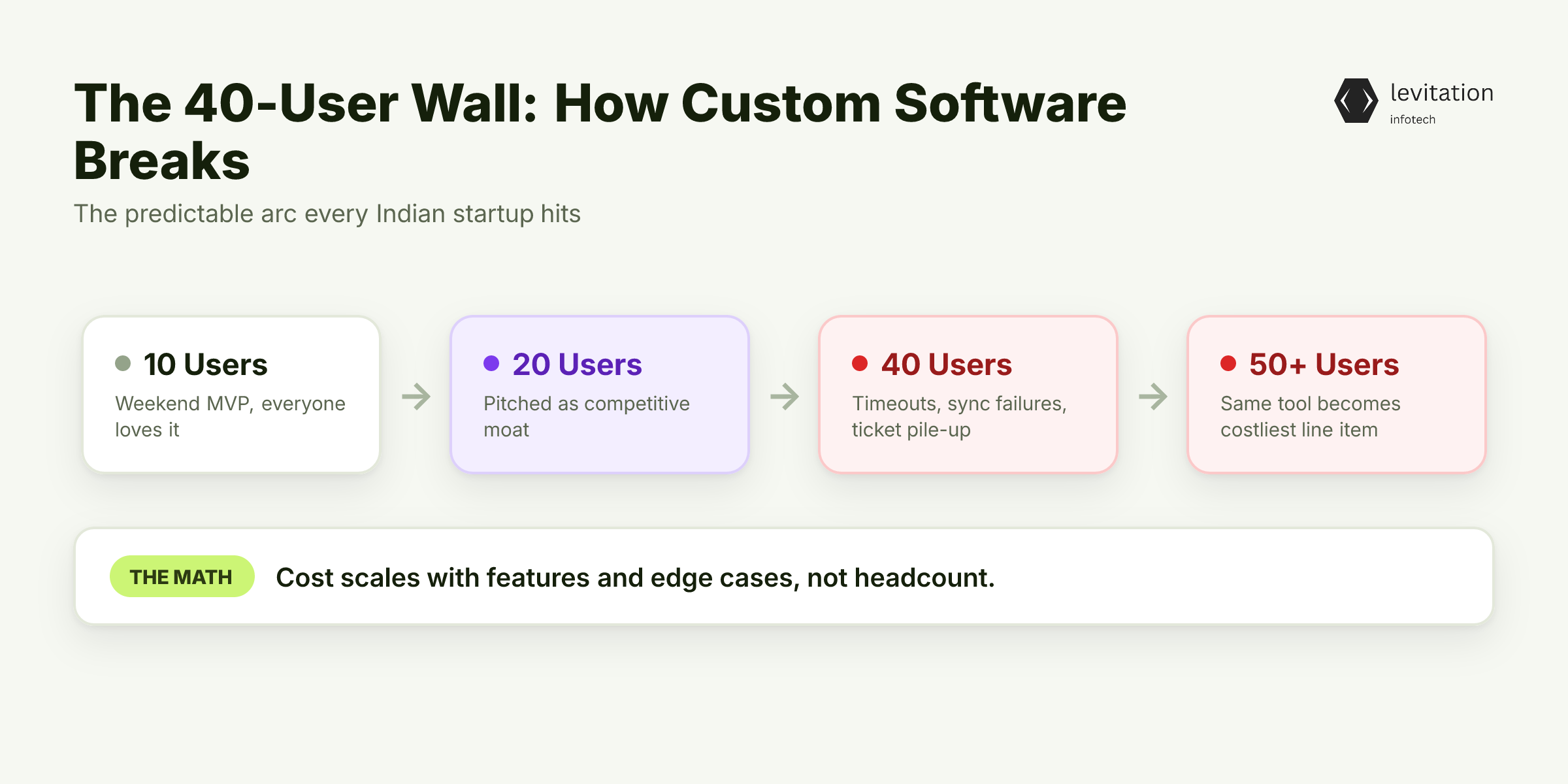
You built it. It worked for 12 people. Then your team doubled, and the same software that saved you last quarter started bleeding money. Here is the math most Indian founders don't run until it's too late.
Every Indian startup goes through the same arc. The first 10 employees use a Notion-style internal tool or a custom dashboard a developer built in a weekend. It feels like a moat because nobody else has it.
By user 20, the founder pitches it as a competitive advantage. By user 40, the cracks show.
Symptoms are easy to spot once you know them: - Login timeouts during peak hours, especially month-end - Sync failures between the internal tool and the accounting system - Support tickets piling up while engineering gets pulled off roadmap work - The same developer who built it now spends Fridays patching infrastructure instead of shipping features
The painful irony: the same choice that saved lakhs at 10 users becomes the most expensive line item at 50. Custom software costs don't scale linearly with users. They scale with features, integrations, edge cases, and the inevitable compliance churn. A tool that handled light traffic grinds to a halt as user load grows. A workflow that worked for one department buckles when three others want access.
This isn't a failure of engineering. It is a predictable inflection point that almost no founder plans for. The team that built the tool is proud of it. The CEO is protective of "our" software. The CTO knows it's a problem but is too busy to address it.
So why doesn't the obvious fix, throwing more engineers at the problem, actually work?
Why "Just Add More Developers" Makes It Worse
The instinct is to hire two more engineers. They'll optimise the queries, add caching, fix the bugs, write tests, harden security. It sounds reasonable. It is, in fact, the most expensive decision a founder can make at this stage.
Every new requirement becomes a sprint. Every new integration becomes a small microservices project. Every new hire needs an onboarding flow rebuilt from scratch. And Indian compliance churn never stops.
Hidden cost buckets founders consistently underestimate: - Bug fixes that multiply faster than the team can squash them - Security patches for dependencies that weren't updated in 18 months - Compliance updates when GST rules, TDS slabs, or labour law changes land - Infrastructure scaling that turns into a 3 a.m. pager - DevOps overhead for monitoring, logging, and backup that nobody planned for
Zoho People, Keka, and similar tools exist precisely because this pain repeats across hundreds of Indian companies every quarter. They didn't win by being clever. They won by absorbing the maintenance burden founders didn't want to carry.
The full custom software development cost in India picture includes senior developer salaries, a DevOps engineer, QA contractors, cloud bills, monitoring tools, and security tooling. None of these line items appear on a single invoice. That is exactly why founders underestimate the total. A SaaS alternative consolidates most of these into a single, predictable subscription.
But the worst cost is the one that doesn't appear on any invoice. Every sprint your engineering team spends on internal maintenance is a sprint they don't spend on the product your customers pay for.
Once you see the compounding cost structure, the real question becomes: what would you have spent if you'd bought instead?
The ₹18 Lakh Switch: Real Cost Math Indian Founders Ignore
Here is the number that scares most Indian founders: ₹18 lakh. That's roughly what an in-house team spends to build a custom CRM, HRMS, or internal dashboard. The number is real. What isn't real is the assumption that switching away from that custom tool costs another ₹18 lakh.
The actual switch cost is almost embarrassingly small: - Migration: ₹0. Most Indian SaaS vendors (ViveLead, Zoho, Keka) do data import free as part of onboarding. - Training: ₹0. Webinars, recorded videos, and help docs replace consultant fees that used to run ₹30-50K per year. - Downtime: half a day, if you run the old and new systems in parallel for 2-4 weeks. - Total real switch cost: ₹0-10,000. That covers edge-case data cleanup or a paid support hour.
The annual waste from staying on overbuilt custom or enterprise software runs ₹2.5-3 lakh. That includes the wasted subscription, the separate HRMS you now need, and the consultant fees for ongoing support. Indian founders who switch typically save ₹1.8 lakh annually on software alone.
The FinOps insight most articles miss: bought software has visible, predictable costs. A SaaS bill appears in the expense feed, the renewal calendar, and procurement's spend reports. Anyone can see and question it. A built tool's cost scatters across cloud infrastructure invoices, headcount allocations, regulatory-update sprints, and features never shipped. That invisible cost is what kills your P&L.
Deployment time is the other hidden variable. SaaS deployments for a 40-user team typically run on the order of weeks. In-house custom builds can stretch to over a year when you include requirements drift, testing, and scope creep. The custom software development cost in India tends to climb between the original quote and the final invoice as these factors accumulate.
You breakeven on a switch in month one. You are not investing ₹18 lakh. You are recovering it. The next hire your engineering team makes should be solving customer problems, not babysitting an internal tool.
But this math only works if the problem you're solving is a commodity, not a differentiator. Here is how to tell which side you're on.
The Build vs Buy Framework: 3 Questions Before You Write a Line of Code
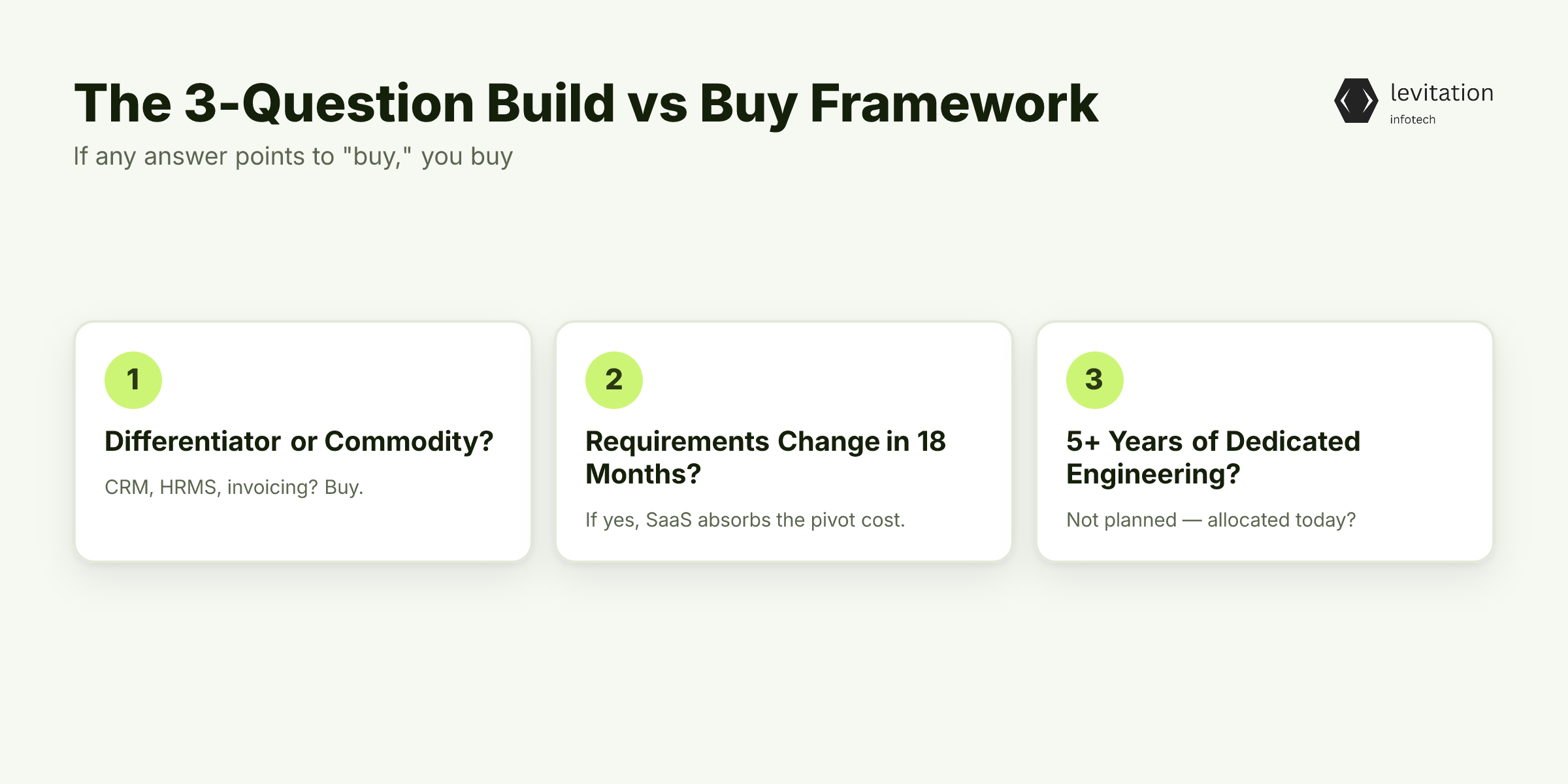
Most "build vs buy" advice stops at "it depends." That is correct but useless. Here is the framework that makes the decision mechanical, not philosophical. Three questions. If any answer points to "buy," you buy.
Question 1: Is this software a competitive differentiator, or does it let you do commodity work?
If the answer is the latter (CRM, HRMS, invoicing, basic analytics), buy. No customer ever chose your product because you had a custom-built invoicing system.
The same logic applies to internal dashboards, employee onboarding flows, and ticketing tools. If a credible vendor already solves 80% of the problem, the 20% you build custom will consume 200% of your engineering budget within 18 months.
Question 2: Will your requirements change in the next 18 months?
If yes, custom becomes a liability every time you pivot. You will rewrite the same feature two, three, four times. SaaS vendors absorb that cost across their entire customer base. You absorb it alone.
Pivoting is normal in Indian startups. The tool you use should pivot with you without a six-week engineering sprint.
Question 3: Do you have dedicated engineering capacity to maintain this for 5+ years?
Not "will you hire for it." Do you have it today, allocated specifically to this tool, with a multi-year commitment?
If maintenance is going to crowd out product work, the answer is no. And that is the answer for most sub-100-person startups.
Build when the software is your moat, your integration density is unique, and you have a multi-year commitment. Buy when a credible vendor already solves 80% of the problem. The SaaS development ecosystem in India has matured enough that this answer points to "buy" more often than founders want to admit. The framework makes most decisions easy. The hard part is admitting you picked the wrong one 18 months ago.
If the framework points you toward buying, the actual switch is less painful than you think. Here is exactly how it runs.
What a Switch Actually Looks Like (Step by Step)
The reason most founders avoid the switch isn't the cost. It is the imagined disruption. They picture weeks of downtime, retraining, lost data, angry sales reps, and a six-figure migration bill. None of that is true for most moves. Here is what actually happens, in order.
Step 1: Audit your custom software's actual usage. Most teams find that features accumulate faster than anyone uses them. They were built for a hypothetical requirement that never materialised. Knowing what you actually use collapses the SaaS shortlist to two or three tools, not twenty.
Step 2: Shortlist 2-3 SaaS alternatives built for Indian compliance. Look for vendors that handle GST, TDS, and Indian data residency out of the box. Indian-built custom software alternatives have already absorbed the compliance complexity that your in-house tool is still patching today.
Step 3: Run parallel for 2-4 weeks. Export your data, import it into the new tool, and let both systems run side by side. Most Indian SaaS vendors complete data migration in 1-2 weeks at no cost. Your team uses the new tool while the old one runs in the background as a safety net. Downtime: half a day at cutover.
Step 4: Train via vendor webinars instead of consultants. Most vendors offer free training sessions, recorded walkthroughs, and dedicated Slack channels for the first 60 days. The consultant your current vendor bills ₹30-50K per year for is mostly a substitute for documentation. Use the vendor's docs instead.
Total real cost: ₹0-10,000. Not ₹18 lakh. Not even close. The math is so lopsided that "let me think about it for another quarter" usually costs more than the switch itself. The same pattern shows up in custom CRM migrations that cost Indian SMEs hidden lakhs precisely because they waited too long to act.
The surprising part is not how cheap the switch is. It is what your team does with the engineering hours you just freed up.
What Changes When You Stop Building and Start Buying
The visible change is the invoice. A predictable monthly subscription replaces a quarterly surprise cloud bill. It also replaces the salary of a developer who is now back on the product roadmap.
The invisible change is bigger, and it accumulates over the next 12 months.
Engineering gets pulled off maintenance. Roadmap items that had been stalled start shipping. The CTO stops firefighting at 11 p.m. and starts planning. The product finally gets the version it should have had six months ago. Indian SaaS development vendors absorb the cost of upstream library updates, security patches, and compliance shifts that your in-house team was handling manually.
Procurement, finance, and ops get predictable monthly costs. No more surprise infrastructure bills. No more emergency sprints to fix a security CVE. No more "we need two more weeks to migrate the database." The software line item on the P&L is now something a CFO can model, not something she dreads.
You regain the option to rebuild later, from a position of strength. Buying now does not lock you out of building a custom tool later, when you have 200 employees, dedicated platform engineers, and a real differentiator. You are buying optionality, not surrendering it. Indian teams that follow this discipline avoid the year-two bill that kills custom CRMs and redirect that budget toward differentiated work.
If you have fewer than 100 employees and your needs are straightforward (track leads, manage pipeline, serve customers), buying almost always wins. The framework is not subtle. The discipline to follow it is what most founders lack. The next quarter is where that discipline either pays off or quietly compounds into another year of internal-tool firefighting.
Frequently Asked Questions
How much does custom software development cost in India for a startup?
Custom software costs depend heavily on scope, team composition, and how many integrations you need. The real number most founders miss is ongoing maintenance. Bug fixes, security patches, and scaling work recur every year the tool is in production.
At what point should a startup switch from custom to SaaS?
The 40-user mark is where many custom internal tools (CRMs, dashboards, HRMS) start breaking under their own weight. If your engineering team is spending more time on maintenance than on shipping new features, the math has already flipped toward buying.
Is it cheaper to build or buy software for a small Indian startup?
Buy wins for commodity functions (CRM, HRMS, invoicing, analytics) at every team size under 100 people. Build only wins when the software is a direct competitive differentiator, no mature vendor covers your requirements, and you have multi-year engineering capacity to maintain it.
How long does it take to migrate from custom software to a SaaS alternative?
Most Indian SaaS vendors complete data migration in 1-2 weeks at no cost. With parallel running for 2-4 weeks, total downtime is typically half a day. The full transition is usually done in under 6 weeks.
What are the hidden costs of custom software for startups?
Beyond the initial build cost, founders consistently underestimate security patch cycles, compliance updates (especially Indian GST/TDS changes), infrastructure scaling bills, and the opportunity cost of engineers fixing bugs instead of shipping customer-facing features.
If you want a quick audit of whether your current custom stack has crossed the 40-user wall, reach out for a one-hour review.
About the author
Mayank Singh is a software developer at Levitation Infotech, where he builds web and AI-powered applications across the company’s fintech, healthcare, and enterprise projects.