


TL;DR: Most Noida app quotes price the "app shell" (screens, frontend, admin) but skip the third-party APIs (payments, SMS, maps, cloud) that make the app work. The real cost to launch runs well above the quoted number. An addendum forces agencies to itemize integration work upfront, closing the gap before you sign.
Key Takeaways: - A ₹5L Noida quote and a ₹9L quote can describe the same app. One is honest about integrations. One is not. - Third-party API integration is treated as a "client dependency" in SOWs, so it never appears in the base number. - Insist on a separate "Integration Scope" line item and a "What's Not Included" appendix to catch hidden costs before signing.
You got three quotes. All around ₹5 lakh. All from Noida. None include the payment gateway, SMS OTP, maps, or email service your app needs to function. By the time you spot the gap, you've signed the SOW and paid the first milestone.
The ₹9 Lakh App That Was Actually a ₹5 Lakh App
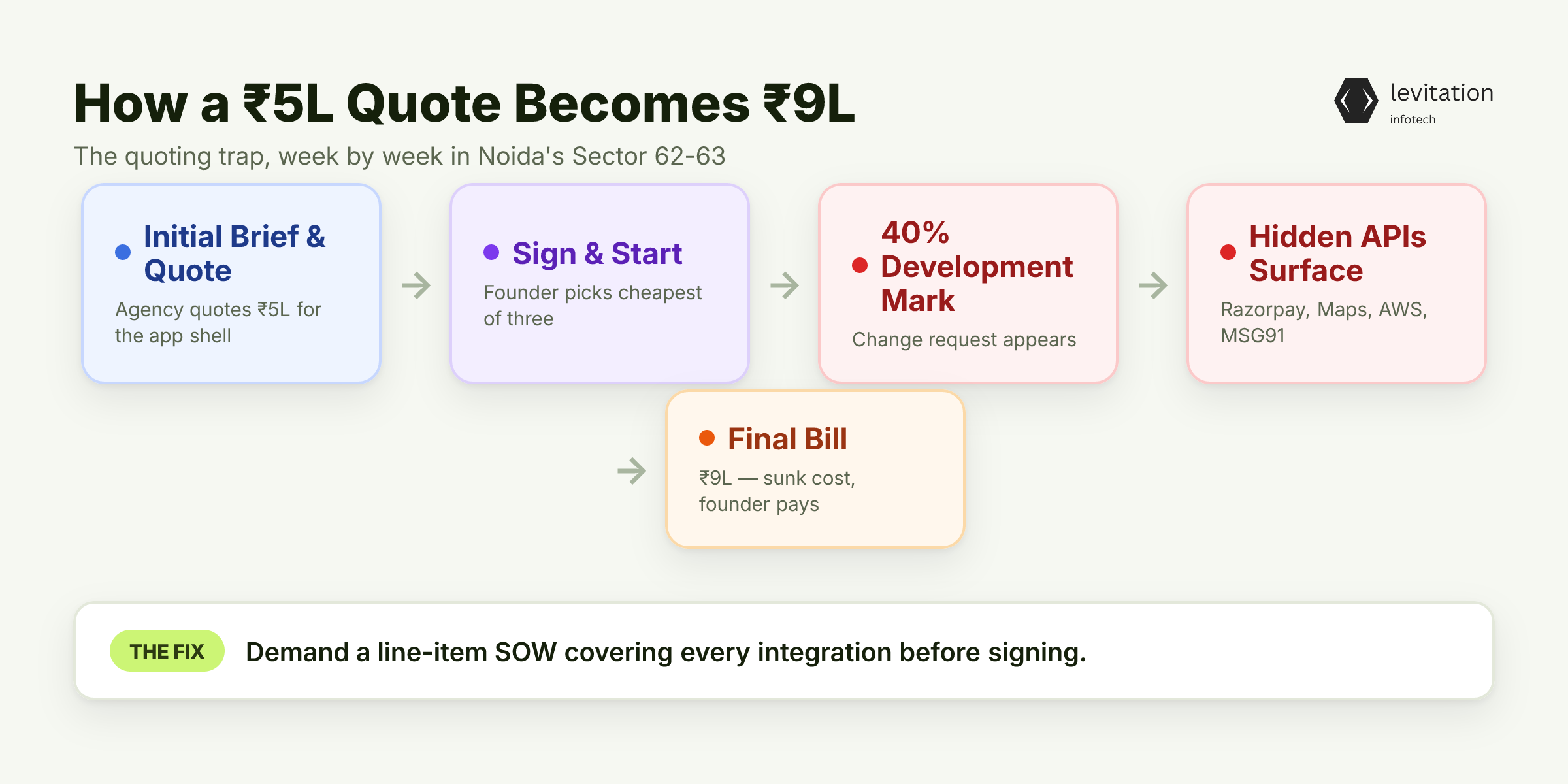
Here's how it plays out every week across Noida's Sector 62 and Sector 63 offices. A founder walks in with a brief. The agency scopes it against what's written: screens, user flows, a basic admin panel. That bundle, the "app shell," gets a clean ₹5 lakh number. The founder compares three such quotes, picks the cheapest, signs.
Then development hits 40%. The agency sends a "change request" for API integration scope. Razorpay, MSG91, Google Maps, AWS hosting. None of it was in the original SOW. The new line item adds roughly ₹4 lakh. The founder pays because stopping means losing the first milestone payment.
This isn't one bad agency. It's the quoting process. The app development cost in India guides that compare hourly rates almost never break down what those hours cover. "Development hours" becomes a black box where integration effort disappears.
The brutal truth: two Noida agencies quoting ₹5L and ₹9L for the same app aren't competing. One is showing you the full project. The other is showing you the project minus everything that isn't code they write in-house.
That's not an accident. It's how the quoting process is structured. So how do you spot the structure before you sign?
Why Noida Agencies Quote the App, But Not the Plumbing
The mechanism is simple. Agencies scope the SOW against your written requirements. If your brief says "users can pay for orders" but doesn't list "Razorpay integration," the agency treats payment as a feature. Not as an integration. The feature is "in scope." The integration is not.
Third-party APIs get classified as "client dependencies." The agency's job, as they see it, is to write the code that calls the API. You provide the API keys, the merchant accounts, the billing relationships.
This classification is technically defensible. It's also financially devastating for founders who don't know to push back.
The hourly model makes it worse. Mid-sized Noida firms bill integration work at their standard hourly rates. That work, reading API docs, handling webhooks, building reconciliation logic, easily eats dozens of engineering hours per service.
But that effort gets buried in a line called "miscellaneous development hours" or "backend integration" with no breakdown.
Most founders confuse app development cost with cost to launch the app. The gap between those two numbers is where APIs live.
A properly scoped custom software development engagement treats both numbers as one project. A typical SOW treats them as separate universes.
So what does the plumbing look like? Here's the stack almost every modern app needs, and most quotes skip it.
The Hidden API Stack: 12 Integrations Your App Probably Needs
Every production app touches external services. Here are the categories that show up in nearly every launch: - Payments: Razorpay, Stripe, or Cashfree. Required for any monetized app. Webhook handling, refund logic, reconciliation. All custom code. - Authentication and OTP: Firebase Auth, MSG91, or Twilio. Per-message costs scale with signups. A real app sending tens of thousands of OTPs monthly faces a real line item. - Maps and geolocation: Google Maps Platform. Pricing scales with API calls. Once a user base crosses tens of thousands of map loads, monthly costs become large. - Push notifications: Firebase Cloud Messaging (FCM) is free. The integration logic (device registration, token refresh, segmentation) isn't. - Email: SendGrid or Amazon SES. Cheap per email. The integration (templates, bounce handling, DKIM setup) takes days. - Analytics: Mixpanel, GA4, or Amplitude. The SDK integration and event taxonomy design is its own deliverable. - Cloud infrastructure: AWS, GCP, or DigitalOcean. Backend hosting, managed databases, object storage, CDN. This is the line item that scales hardest with user growth. - Specialized APIs: KYC verification for fintech, ABHA for healthtech, WhatsApp Business for commerce, error tracking (Sentry), uptime monitoring.
Individually, each one looks small. The integration code might be a few thousand lines. The API usage fees feel like "operating costs," not project costs. But the API integration cost adds up because you're not paying for one API. You're paying for the integration layer across a dozen services, plus the ongoing subscriptions.
This is where the real scope lives. Stacked together, they double or even triple the "base" quote. Here's the real math.
The Real Cost Breakdown: What Each API Category Adds to Your Quote
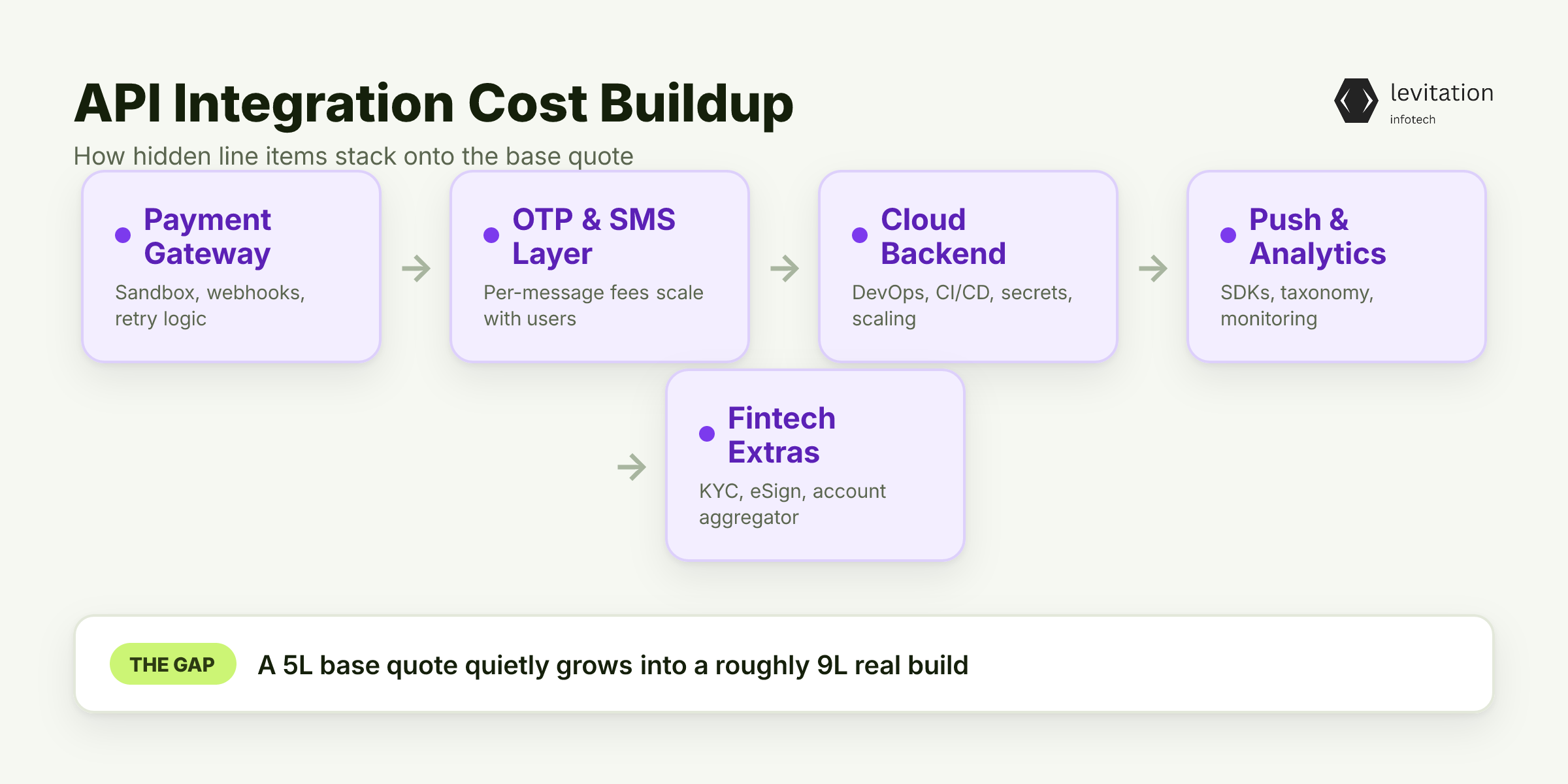
Now we get specific. These are the integration line items that disappear from Noida SOWs, ranked by cost impact: - Payment gateway integration: The engineering covers sandbox setup, webhook handling, retry logic, and admin reconciliation views. The cost scales with how many payment flows the app needs. Doesn't include the payment gateway's own transaction fees, which are a separate operating cost. - OTP and SMS layer: Integration code is one cost. Per-message fees that scale with users are another. A fintech onboarding tens of thousands of KYC users faces a large SMS spend before factoring integration effort. - Google Maps and geolocation: Integration effort plus the requirement to set up a Google Cloud billing account. A client dependency the agency won't touch. - Cloud backend (AWS/GCP): DevOps setup, CI/CD pipelines, database configuration, auto-scaling rules, and secrets management. This is the line item most founders don't even know exists, and it scales with infrastructure complexity. - Push, email, analytics bundle: SDK integration, event taxonomy, template systems, delivery monitoring. - Fintech extras (KYC, eSign, account aggregator): This is where the ₹4 lakh number in the title comes from for compliance-heavy apps. DigiLocker, CKYC, Video KYC, eSign via Leegality or Digio. Each one is a separate integration with its own sandbox, webhook flow, and failure modes.
Add these to a ₹5 lakh base and you're at roughly ₹9 lakh, the mobile app development cost in India the industry should be quoting, but almost never does.
The third-party API integration effort is the single largest variable in any honest app estimate. The same Noida team will quote ₹5L and ₹9L for the same project depending on whether integrations are in scope.
Now that you know the real number, the question shifts from "how much does it cost" to "how do I get this in writing before I sign."
How to Get an Honest Quote: The 5-Line RFP Addendum
Here's the fix. Add this block to your RFP before sending it to any agency:
1REQUIRED RFP ADDENDUM - INTEGRATION SCOPE231. List every external service the app will integrate, by name4 (not category). Example: "Razorpay Payment Gateway, MSG91 OTP,5 Google Maps Platform, AWS S3, Firebase Cloud Messaging."672. For each service, provide a separate line item for integration8 effort. Do not bundle into "development hours."9103. Provide an itemized monthly recurring cost (MRC) estimate at11 our projected user volume: SMS, maps, cloud, payment gateway.12134. Include a "What's Not Included" appendix listing every service,14 fee, and scope item excluded from this quote.15165. Tie payment milestones to integration completion, not just17 feature delivery.
Five lines. That's it.
This single document catches most of the hidden costs because it forces the agency to itemize what they're not quoting. Most agencies will respond in one of two ways. They'll revise the quote to include integrations (now you're comparing apples to apples). Or they'll explicitly exclude them in writing (now you can negotiate from strength or walk away).
The bespoke software firms that survive long-term already do this. Mid-sized Noida agencies that resist this addendum are signaling exactly the problem you should be worried about.
Do this right and the ₹9 lakh you actually needed becomes a planned budget, not a surprise. Here's what that budget buys you.
What a Properly-Scoped ₹9 Lakh App Actually Gets You
The difference between a ₹5L quote and a ₹9L quote isn't gold-plating. It's completeness. Here's what lands in your hands when the scope is honest: - A production-ready app with all integrations live, tested, and monitored. Not a demo that breaks the moment a real user tries to sign up and the SMS gateway rate-limits you. - Predictable monthly operating costs from day one. The API billing is scoped against real user numbers, so you know your unit economics before launch, not six months in when the cloud bill arrives. - No change-order disputes mid-project. The integration scope was agreed upfront. When the agency says "Razorpay integration is complete," you have a checklist: sandbox tested, webhooks verified, refund flow working, reconciliation dashboard built. - A decoupled integration layer. When SMS provider X goes down at 2 AM, you swap to provider Y without rewriting the app. This is architecture, not cost. It only happens when the integration layer is scoped as its own deliverable.
The app development price conversation changes entirely when integrations are visible. You're not paying more. You're seeing the full number for the first time.
The same logic that hides API costs in quotes also blows up timelines. It triggers scope creep and produces apps that "work in staging" but fail in production. Knowing this puts you ahead of most founders walking into their first Noida pitch.
Frequently Asked Questions
Q: How much do third-party API integrations actually cost in an Indian app project?
A: For a typical Indian startup app, third-party API integration work adds a large amount to the base quote, often comparable to the base itself, depending on the number of services and regulatory requirements. The integration code is one cost. The ongoing API usage fees (SMS, maps, cloud) are a separate monthly recurring expense that scales with your users.
Q: Why do Noida app development quotes seem cheaper than Bangalore or Hyderabad?
A: Noida firms often quote lower base numbers. Their scope documents skip third-party integrations, DevOps, and post-launch services. When those are added, the gap between Noida and Bangalore quotes shrinks fast, sometimes to zero.
Q: What is the difference between app development cost and cost to launch an app?
A: App development cost covers the code your agency writes. Cost to launch covers everything else. That means API subscriptions, cloud hosting, app store fees, SSL certificates, and the integration work to connect external services. A ₹5 lakh app can easily cost far more to actually launch.
Q: Should I hire a Noida agency or an in-house team for API-heavy apps?
A: For API-heavy apps (fintech, healthtech, marketplace), agency experience with specific integrations matters more than location. Ask for a portfolio of past projects that used the exact APIs you need: payment gateway, KYC, SMS, maps. A Noida team with deep Razorpay experience beats a Bangalore team that has never integrated a payment gateway.
Q: Can I add API integrations after the MVP launches?
A: Technically yes, but retrofitting costs much more. Adding a payment gateway after launch means rewriting the checkout flow, updating the database schema for transactions, and rebuilding admin reconciliation. The rework multiplies because each integration was designed against assumptions that no longer hold once the app is live.
Send the addendum to your top three Noida shortlist and compare what comes back.
About the author
Mayank Singh is a software developer at Levitation Infotech, where he builds web and AI-powered applications across the company’s fintech, healthcare, and enterprise projects.