


TL;DR: Sixty MERN developers were hired in a single Noida cycle. Only eighteen made it past month six. The bottleneck isn't salary or vetting speed, it's a hiring process that rewards placement over stayability. The fix is a four-step filter that takes several weeks per hire but compounds into a much higher survival rate on long engagements.
Key Takeaways: - Six-month retention is the metric that actually matters, and the industry is built around the wrong one. - Three variables predict who stays: project clarity, visible growth path, and codebase dignity. - A paid 5-day trial sprint separates stayers from leavers better than any technical screen.
The 70% Attrition Rate Nobody Mentions in Noida's MERN Market
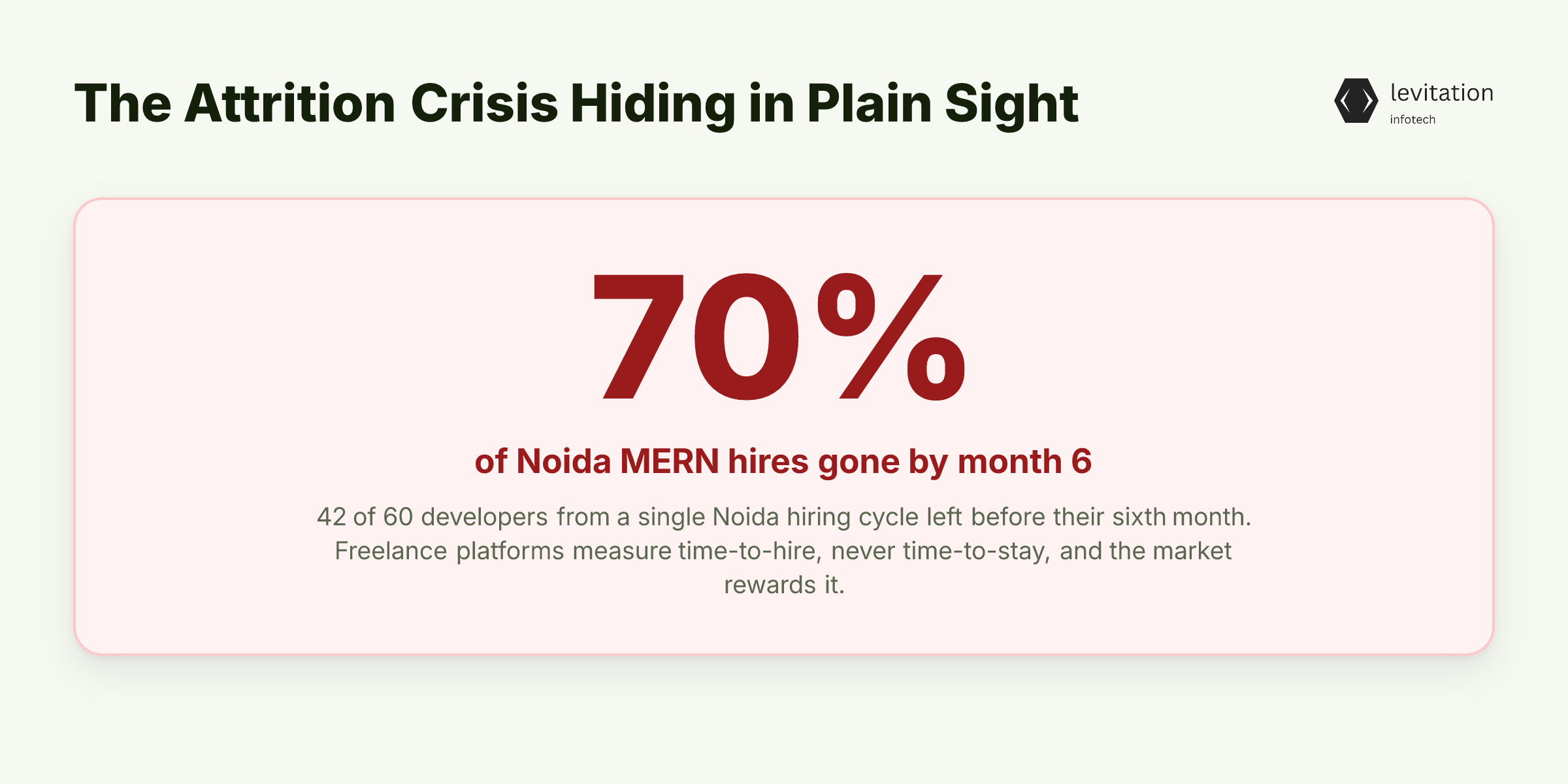
Forty-two developers walked out the door before their sixth month and became someone else's retention problem. Here's the math no one in Noida's MERN hiring market wants to talk about, and what the 18 who stayed had in common.
Sixty hires. Eighteen still on payroll at the six-month mark. That's a 30% survival rate from a single Noida hiring cycle, and the volume behind it is staggering.
As of this writing, LinkedIn lists 749 open MERN roles in Noida. Indeed carries another 132. The market isn't thin. The market is leaking.
What's leaking is structural, not anecdotal. Every month, dozens of companies in Noida's tech corridors run the same hiring playbook. They post on a job board and run a 90-minute React screen. They ship an offer letter fast, and hope the developer survives the first quarter.
The market rewards this behavior because freelance platforms measure time-to-hire as their primary metric. They never measure time-to-stay.
The cost frame makes the stakes real. A MERN developer in Noida runs ₹90,000 to ₹2.4 lakh per month depending on experience.
When one walks at month three, you've burned several months of salary before any stable output. Repeat that across the 42 departures and the total cost of churn dwarfs what a longer hiring process would have cost.
The current Noida market rates for React developers only make sense if the developer stays long enough to repay ramp-up. Most don't.
But this isn't a Noida problem. It's a hiring-process problem, and the obvious fixes are the ones making it worse.
Why Salary Bumps, Freelance Platforms, and Faster Vetting All Miss the Mark
The reflexive response to attrition is to pay more. Raise the offer toward the top of the market band and assume the developer will think twice before leaving.
This fails for a simple reason: money doesn't change the underlying reason people leave. It only delays the exit by one pay cycle.
Consider the 42 departures in the Noida cycle. Almost every exit came with a two-week notice and a vague reason.
"Code reviews were harsh." "Scope kept shifting." "Got a better opportunity."
The stated reasons varied. The structural pattern didn't. The underlying cause in nearly every case was one of three things. Unclear scope, no growth path, or a codebase they couldn't respect.
Higher pay makes those problems tolerable for a few months. It doesn't fix them. The true cost of a MERN developer in India is cycle time, not salary. That is exactly what a churn cycle destroys.
The vetting theatre compounds the problem. Most technical screens test React component knowledge: hooks, state management, build a counter, deploy a route.
These are necessary skills. They tell you almost nothing about whether the candidate will tolerate your actual codebase for six months. You can pass every React screen and still quit in week four. That can happen when the first ticket you receive is a large Express migration with no tests.
The freelance-to-full-time conversion myth deserves a separate callout. Hiring a freelancer who performs well on a short sprint and then converting them to a full-time role rarely survives the transition.
The incentives shift. A freelancer bills for hours and moves on. A full-timer ships to a roadmap and inherits a backlog. The two roles require different temperaments, and most companies don't test for the second one.
The same pattern shows up with so-called dedicated India teams that quietly serve three clients. The unit-of-account is wrong from day one.
A related trap: the Noida startup developer hiring pitfalls almost always include a "we'll figure out the role as we go" promise. That promise is what the 42 hires were reacting to, not the salary figure in the offer letter.
So if salary, platform choice, and interview rigor aren't the predictors, what actually separates the 18 who stayed from the 42 who left?
The Three Variables That Actually Predict Six-Month Retention
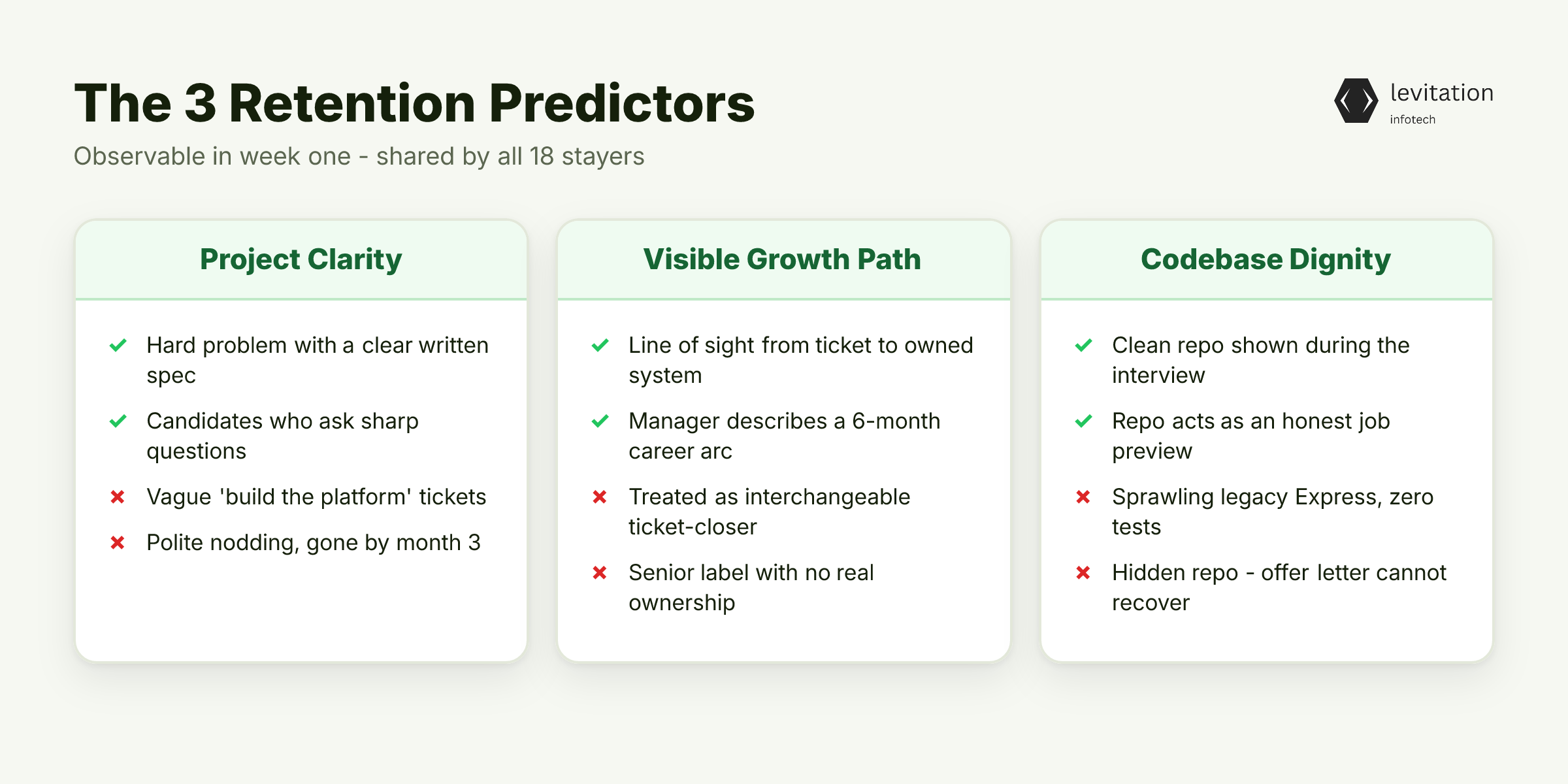
The 18 who stayed didn't share a school, a salary band, or a previous employer. They shared three conditions that were observable in week one. Once you name them, the pattern is obvious.
Variable 1: Project clarity over project complexity. The developers who joined a clearly-scoped MVP with written acceptance criteria stayed. The ones dropped into a Jira board full of "build the platform" tickets left within 90 days.
This isn't about difficulty. A hard problem with a clear spec attracts good engineers. A vague problem with no spec repels them.
The MERN developer evaluation framework tested for retention by showing candidates a real ticket from the backlog. Candidates were then asked how they'd decompose it. The candidates who asked sharp questions stayed. The ones who nodded politely left.
Variable 2: Visible growth path. All 18 stayers had a line of sight from their current ticket to a system they would own in six months. They could answer the question "what will you be responsible for in March?"
The 42 leavers were treated as interchangeable ticket-closers. The signal in week one was simple: did the hiring manager describe a career arc, or just a sprint board? A top-of-band "senior" developer label is exactly what you produce when you optimize for placement speed and ignore this variable.
Variable 3: Codebase dignity. Developers who saw a clean repo during the interview stayed. Those shown a sprawling legacy Express codebase with no tests left before month three.
The repo is a job preview. If the interview hides it, the offer letter can't recover.
These three work because they map to the actual reasons developers quit. Not the stated reasons in exit interviews, but the structural ones observable in week one. The developer retention strategies that compound screen for these before the offer goes out. They don't try to fix them after.
The pattern holds at team sizes from 5 to 50. The same three variables predict retention across different stacks and engagement types. The stack changes. The variables don't.
Knowing the variables is half the battle. The other half is redesigning the interview process. Test for the variables before the offer letter goes out.
A 4-Step Vetting Process That Filters for Stayability
The traditional four-round interview optimizes for signal extraction. The retention-focused process optimizes for survival. The difference is structural, and it shows up in the timeline.
Step 1: Codebase tour as interview. Walk the candidate through your actual repo for 45 minutes. Don't show them a sandbox. Show them the real thing: the legacy folder, the API quirks, the test gaps.
Their questions reveal whether they tolerate the work or will resent it. A good developer will ask about migration plans. A flight risk will ask when the rewrite starts.
Step 2: Paid 5-day trial sprint. Pay a modest stipend for a real ticket from your backlog. Evaluate on output and on how they handled ambiguity, not just correctness. Use the MERN developer trial project template to keep the scope tight.
A trial sprint costs less than one month of a bad hire, and it surfaces the three retention variables from the previous section. A clean repo, a clear ticket, and a growth conversation are all visible in five days.
Step 3: Scenario interview on retention triggers. Ask how they handled unclear requirements in a past role. Answers predict how they'll handle yours.
The developer interview scorecard used in this cycle scored candidates on how they described past ambiguity, not on how they solved contrived puzzles. The pattern was stark: candidates who described collaborative navigation stayed. Candidates who described solo heroics left.
Step 4: Reverse references. Call their last two managers and ask one question: "Would you re-hire this person for a six-month project?"
Most references are prepped for "are they skilled?" They are not prepped for re-hire intent. The answer tells you more than any technical screen.
This process takes several weeks per hire. That timeline is the filter. It only works when the goal is six-month retention, not fast placement. The trial sprint already validated fit. The developer has shipped in your actual environment. The day-90 numbers tell the rest of the story.
What Changes When You Hire for Retention Instead of Speed
The math inverts when you switch metrics. The same Noida hiring funnel produced 18 of 60. Once the process changed, the survival rate climbed.
The downstream result is stronger client retention on long engagements. The teams that stayed through delivery are the ones you can retain as a partner.
A simple comparison makes the cost case. A developer who stays 12 months at a market-rate salary costs the full 12 months of compensation. Three developers who each stay four months at the same rate cost the same in salary, plus recruiting overhead for each replacement and lost ramp-up time on every restart.
The retained hire also starts producing stable output earlier. The churn-and-replace cycle resets that clock every few months.
The deployment story is equally stark. A retention-focused MERN team reaches a working sprint faster than a build-and-replace cycle, because every replacement restarts the codebase-learning curve.
The MERN team deployment timelines track this directly: the trial sprint already validated fit, so the ramp-up is mechanical, not cultural.
The founder takeaway is sharp. Stop optimizing for the speed of the offer letter. Start optimizing for the length of the second project.
The client retention data from teams built this way is the strongest evidence the process works. The metric you're optimizing for becomes the metric your customer inherits. Teams that stayed through delivery built the credibility, and teams that turned over mid-build forfeited it. The variable you hire for is the variable your customer experiences.
Frequently Asked Questions
How much does it cost to hire a MERN developer in Noida in 2026?
Full-time MERN developers in Noida currently run ₹90,000 to ₹2.4 lakh per month depending on experience. Freelance hourly rates on developer platforms are typically higher than equivalent full-time monthly rates. This reflects the project-based pricing model.
Why do MERN developers quit startups within six months?
The three structural predictors are unclear project scope, no visible growth path from current work, and a legacy codebase presented without context. Salary is rarely the real driver. Most exits cite "better opportunity," but the pattern traces back to one of these three conditions being present from week one.
How long does it actually take to hire and deploy a MERN developer in Noida?
A retention-focused process takes several weeks to close a hire. That includes a paid 5-day trial sprint. After the hire closes, the developer needs additional months to fully deploy into a working team. That is still faster than a build-and-replace cycle that restarts with every churn event, because the trial validates codebase fit before the offer.
Is it better to hire a freelance MERN developer or a full-time one in Noida?
Freelance works for well-scoped sprints under eight weeks. It breaks down on longer builds because the incentive structure shifts once the contract is up. For any engagement expected to run past three months, a full-time hire with a trial sprint converts at a much higher rate.
What is a normal attrition rate for MERN developers in Indian tech hubs?
The 18-of-60 figure from the Noida hiring cycle described above reflects a process optimized for placement speed rather than retention. When the process changes to screen for the three retention variables early, survival rates improve sharply.
Worth running the three variables against your last three Noida hires; the pattern will surface fast.
About the author
Mayank Singh is a software developer at Levitation Infotech, where he builds web and AI-powered applications across the company’s fintech, healthcare, and enterprise projects.