


TL;DR: Three Noida vendors quoted ₹8 lakh, ₹18 lakh, and ₹30 lakh for the same brief because each silently built a different product inside their proposal. The gap is not about greed, location, or quality. It is about scope decisions the founder never knew were being made. Normalize any quote with a six-step framework and the build-vs-buy question answers itself.
Key Takeaways: - Scope decisions explain the bulk of the quote gap. Hourly rate and city explain a much smaller share. - The cost difference between a basic MVP and a feature-rich platform tracks workflows, integrations, security, and compliance. Vendors quoting at the top of any range are doing real workflow, integration, or compliance work. - Build-vs-buy is not a philosophy. It is a per-feature test: if multiple off-the-shelf SaaS tools cover most of a requirement, buy and configure. Only custom-build the workflow that is genuinely yours.
Three Noida Vendors, Three Different Apps: The ₹22 Lakh Reality
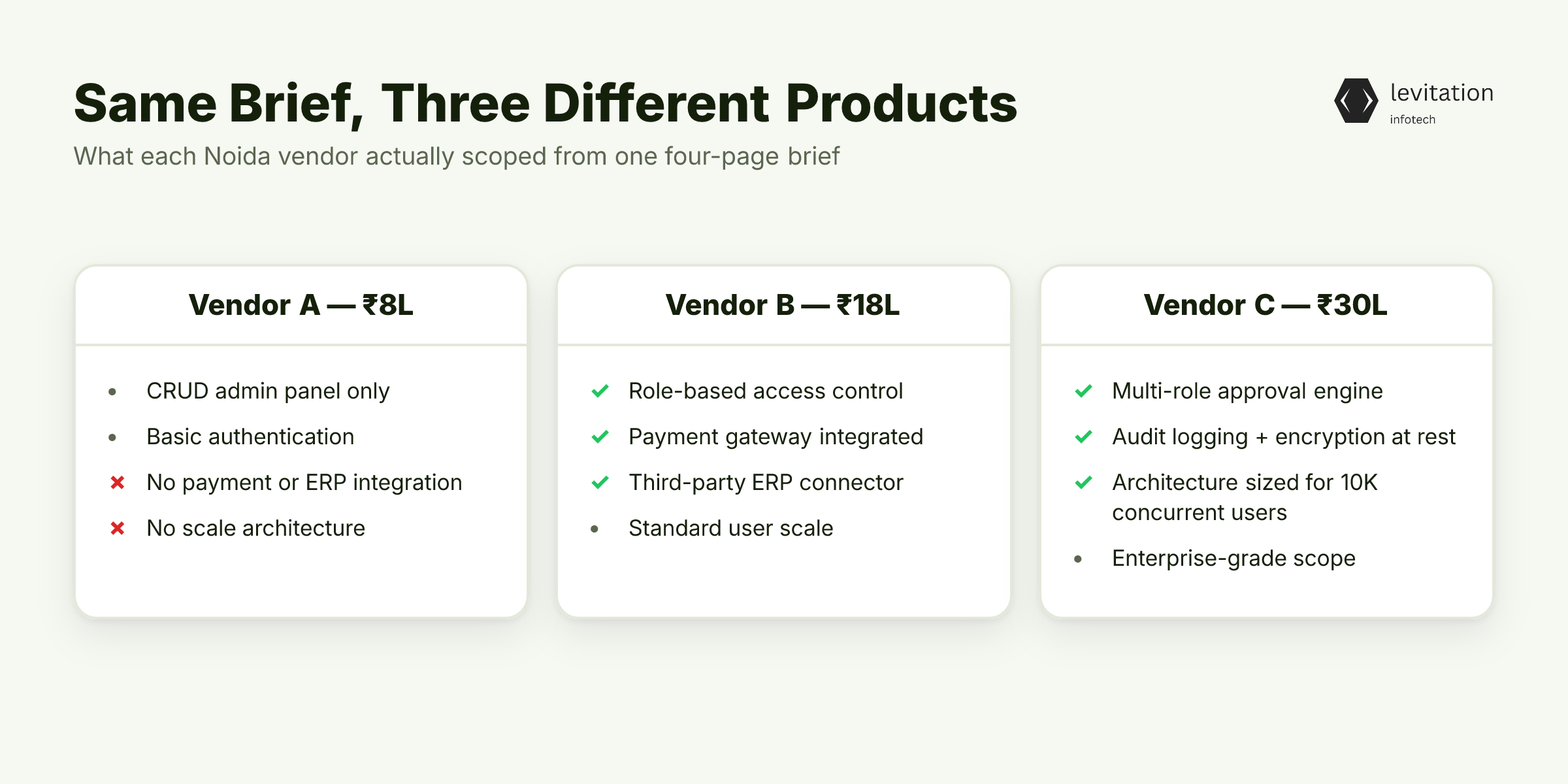
A founder in Sector 62 sends the same four-page brief to three Noida software vendors. Two weeks later, the inbox holds three quotes: ₹8 lakh, ₹18 lakh, and ₹30 lakh. Same city. Same brief.
A 3.75x spread.
The instinctive read is that one vendor is honest and the other two are gaming the founder. That read is wrong, and acting on it will cost far more than ₹22 lakh.
Here is what actually happened. Vendor A read the brief and built a CRUD admin panel with basic authentication. Vendor B read the same brief and added role-based access, a payment gateway, and a third-party ERP connector. Vendor C added a multi-role approval engine, audit logging, encryption at rest, and an architecture sized for ten thousand concurrent users.
The screenshots in the three proposals would look similar. The systems underneath would not.
The naive explanation is that Noida vendors price by gut feel or by how badly they need the work. The data on software company Noida pricing says something else. The gap tracks what each vendor decided to include, not what they decided to charge per hour.
When three vendors return three prices for one brief, you are looking at three different products. The first job is to figure out which one you actually asked for.
Why "Noida" Is Not the Variable That Matters
Most cost guides open with a metro-versus-Tier-2 comparison and stop there. That framing is useless here, because all three vendors sit in the same city. Noida is a constant, not a variable.
Holding location fixed strips the most common excuse and exposes what is actually moving the number.
The next move is to blame the hourly rate. Indian developer rates of £15-£50 per hour already undercut UK and US benchmarks. Two firms at similar rate points cannot produce a 3.75x gap on rate alone.
The math does not work. Something else has to explain the spread between ₹8 lakh and ₹30 lakh.
That something is scope. Each vendor decided privately what "custom software development" meant inside their proposal. Those decisions are not visible in the headline number.
Studying software development cost India ranges without decoding scope is like reading restaurant menus in three currencies. The numbers look comparable until you realize one menu is in rupees, one in dollars, and one in baht. The conversion hides the meal.
So if location and rate do not drive the gap, what does? Five hidden scope decisions, and most founders never realize they are making them.
The Five Hidden Scope Decisions Behind Every Quote
Every quote, no matter how clean, rests on five silent choices. The vendor makes them, and the founder inherits them.
Workflow complexity. A basic CRUD admin panel with three roles is a fraction of the cost of a multi-role approval engine with state machines, branching rules, and exception paths. Same screens. Different logic. Different weeks of engineering.
Integrations. Each payment gateway, ERP connector, or third-party API adds backend work that compounds quickly. This is the single most common line item vendors bury inside a flat fee. More integrations without changing a single screen can change a quote a lot.
Security and compliance. A CRM that handles PII and a CRM that handles financial transactions will diverge in cost, even when the user interface looks identical. Encryption, audit trails, role separation, and key management are invisible until a regulator asks for them.
Scalability. Vendors who architect for 10,000 concurrent users from day one price higher than those who design for 1,000 and patch later. The cheaper quote is not lying. It is betting you will not need the scale, and that bet fails visibly when your campaign goes viral.
Stack choice. Open-source MERN and LAMP stacks keep licensing costs near zero. Proprietary platforms, AI/ML pipelines, or blockchain components command premium rates because the talent pool is thin. Two vendors building "the same app" on different stacks can land far apart in price without either being wrong.
These five levers explain the quote gap. The next decision multiplies them, and most founders never think to ask the question.
Build vs Buy: The Question Vendors Hope You Won't Ask
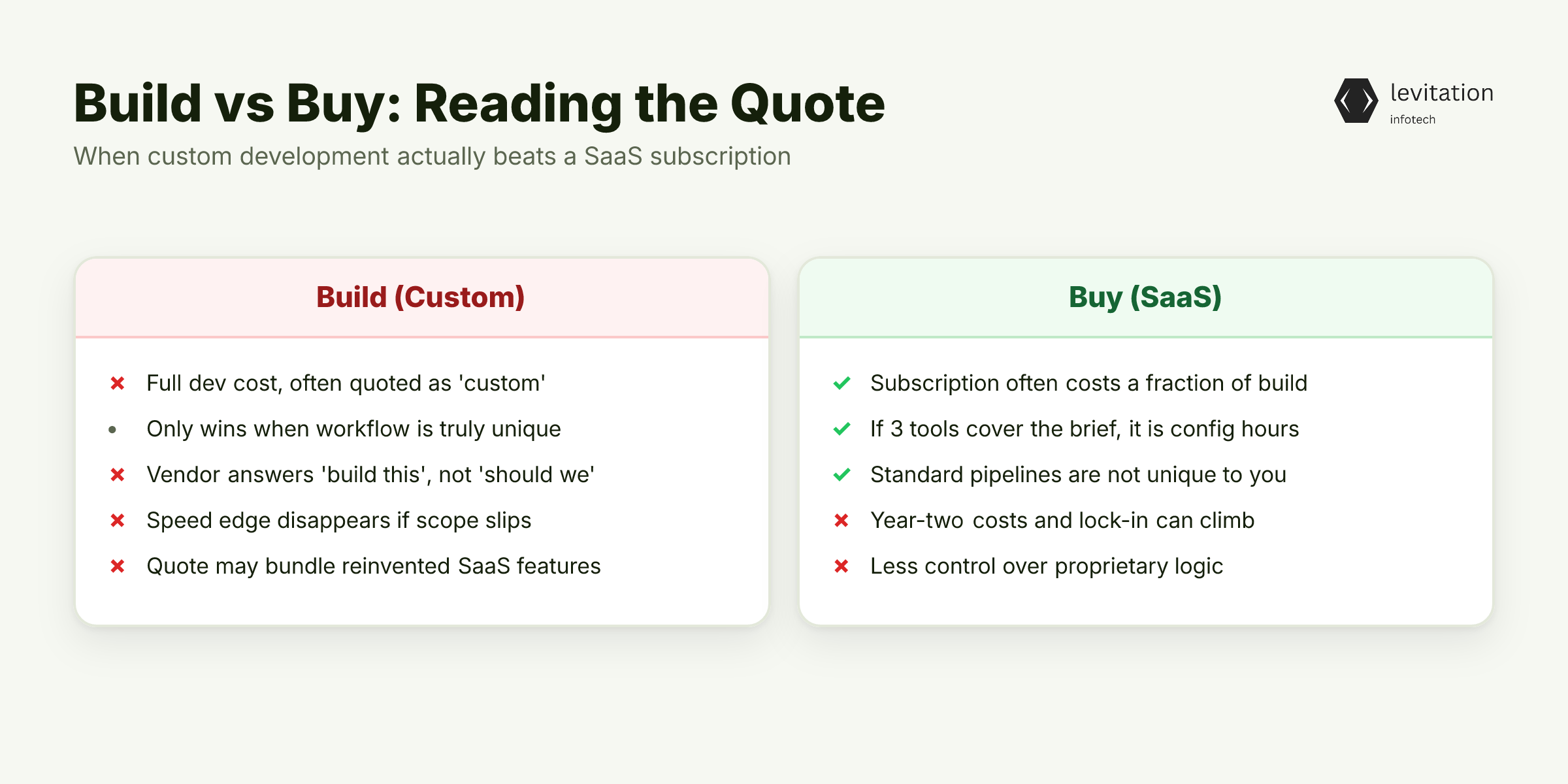
Part of what gets quoted as "custom" is actually configuration of existing SaaS. A subscription tool can replicate what a vendor wants to build from scratch, often for a fraction of the cost.
The vendor is not dishonest. They are answering the question you asked, which is "build this." They are not answering the question you should have asked: "should this even be built?"
Indian developer rates of £15-£50 per hour already undercut UK in-house costs, where engineers earn £70,000 or more per year. A fully outsourced build only beats a SaaS license when the workflow is unique to your business. A standard lead pipeline is not unique. A proprietary underwriting engine is.
Here is the real build-vs-buy test, one feature at a time. If three off-the-shelf tools cover most of a brief, you are buying configuration hours, not custom software cost. Your quote should reflect that, and if it does not, you are paying for reinvention.
This is also why AI Agent Frameworks Killed the Build-vs-Buy Question hits a growing slice of internal tooling. It is also why the Off-the-Shelf Looks Cheaper. Year Two Tells Otherwise trap is real for the rest.
Speed is the second axis. Outsourced deployments depend on scope and team size, and the speed advantage over in-house builds is real when senior bench depth is available. But it only holds when scope is locked, which is the part of the job that no vendor volunteers to do for free.
You now have the lens to read any quote. Here is the exact sequence to normalize three wildly different proposals into a comparable decision.
The 6-Step Quote Normalization Framework
Run every proposal through these six steps before you pick a number. The output is a single comparable figure, not a vendor preference.
Step 1: Demand a line-item breakdown. Every quote must separate UI design, custom software frontend, API and backend, DevOps, QA, and project management hours. A flat ₹30 lakh number is a black box. A breakdown tells you what the vendor thinks the work is.
Step 2: Convert every number to one unit. Total hours times blended hourly rate. A ₹30 lakh fixed bid and a ₹8 lakh time-and-materials quote become comparable once you see the hour counts. One is 2,500 hours at ₹1,200, the other is 600 hours at ₹1,333. The first is doing more work, not charging more per hour.
Step 3: Flag every assumption in writing. A vendor who writes "includes basic auth" may mean JWT tokens. Another may mean OAuth plus SSO plus RBAC plus audit logging. The cost difference between those two can be large. If the assumption is not written, it is not in the price.
Step 4: Score each quote against the five scope variables. Workflows, integrations, security, compliance, scalability. A vendor who skips one of these is quoting a different product. A scorecard makes that visible in fifteen minutes.
Step 5: Ask for a reference client. A serious software development company Noida will produce a client on a similar project, with a name you can call. Vendors who plan to be in business next year quote what they actually intend to build.
Step 6: Lock the MVP scope and price separately from "phase 2." This is how real MVP cost benchmarks stay honest instead of ballooning into much larger projects. If the vendor refuses to scope a phase 1, they are planning to renegotiate later. The Five Lines That Double Your India Software Quote post maps exactly where that ballooning happens.
Run that framework and the ₹22 lakh gap collapses into a real number. Here is what the founder's decision looks like once it does.
What Changes When You Read a Quote Like an Engineer
The cheapest quote almost always expands mid-project. Hidden scope assumptions get billed as change requests, a pattern well documented across outsource software development to India engagements. The low number climbs by month four, and the founder is locked in because switching vendors costs more than finishing.
The most expensive quote often wins on total cost of ownership. Factor in rework, security retrofits, and the lost time from scaling rewrites. The vendor who did it right the first time is cheaper than the vendor who did it twice. The Why Founders Pay ₹35 Lakh for a ₹12 Lakh App piece traces this exact dynamic in production work.
Once you read a quote like an engineer, three numbers become one number. The build-vs-buy question becomes a per-feature test instead of a gut call. The ₹22 lakh gap is not a mystery. It is a measurement problem, and measurement problems are solvable in an afternoon.
Frequently Asked Questions
How much does custom software development actually cost in India?
Costs vary widely based on scope. For a startup, a basic MVP costs less than a medium-complexity application. A medium-complexity app costs less than a feature-rich platform with heavy workflows, integrations, and compliance. Three vendors can legitimately quote three different numbers for the same brief because they are not actually quoting the same product.
Is outsourcing software development to India really 40-70% cheaper?
Yes, but only when you compare like-for-like scope. Indian developer rates of £15-£50 per hour undercut UK and US in-house costs. The savings disappear if you skip scope normalization and pay for change requests later.
Build vs buy: how should a startup decide?
Run a build-vs-buy test on each major feature. If three off-the-shelf SaaS tools cover most of the requirement, buy and configure. Custom-build only the workflows that are unique to your business model. This single question often cuts the quote down without losing capability.
Why do Noida software companies give such different quotes?
The variation comes from silent scope decisions. Each vendor weights workflows, integrations, security, compliance, and scalability differently. The same brief produces three different products inside three different quotes. Hourly rate and city explain a small share of the gap. The rest is what each vendor chose to include or exclude.
What is a realistic timeline to build a custom app with an Indian vendor?
Timelines depend on scope, team size, and the build-vs-buy mix. Outsourced teams with senior bench depth can move faster than fully in-house builds of equivalent scope. The speed advantage only holds when scope is locked. That is why quote normalization matters as much as vendor selection.
Run the framework on your next vendor proposal and the spread will shrink before you sign.
Sources
Research and references cited in this article:
- Software Development Cost (2026) — Estimate, Breakdown & How to Reduce
- Software Development Cost Estimation: A 2026 Calculator + AI Guide
- How to Estimate Software Development Costs: Key factors
- Identifying Factors Affecting Software Development Cost
- Outsourcing Software Development Pricing and Influencing Factors – NIX United
- Build vs Buy Software in 2026: Cost, ROI and Decision Guide
- Cost of Outsourcing Software Development in 2026 (UK Business Guide) - Wise
- Build vs Buy Software: Cost, Benefits & Decision Guide
- Build vs Buy Software: How to Make the Right Decision for Your Business - Saigon Technology
- Build vs. Buy Software Decision: Your Strategic Guide
- Outsource Software Development to India: Full Guide (2026)
- 5 Best Countries for Outsourcing Software Development in 2026 · TalentHero
About the author
Mayank Singh is a software developer at Levitation Infotech, where he builds web and AI-powered applications across the company’s fintech, healthcare, and enterprise projects.