


TL;DR: App development in India almost always costs more than the first quote. The reason isn't vendor greed or "scope creep" as a vibe. Three cost multipliers (user roles, integrations, and platform choice) get added as change requests after the contract is signed. Scope the project before you sign, and the final invoice stays close to the quote. Sign first, and the same project costs much more than the original number, because the scope was never actually agreed.
Key Takeaways: - A ₹12 Lakh quote often grows well beyond the original number because user roles, integrations, and platform decisions get added as "change requests" after the contract is signed. - The vendor's first quote is a sales tool, not an estimate. Real cost lives in what you failed to name in the scope document. - A one-page scoping document with roles, screens, integrations, and platform choice can keep the final invoice close to the original quote.
The ₹35 Lakh Headline Hides a Bigger Problem
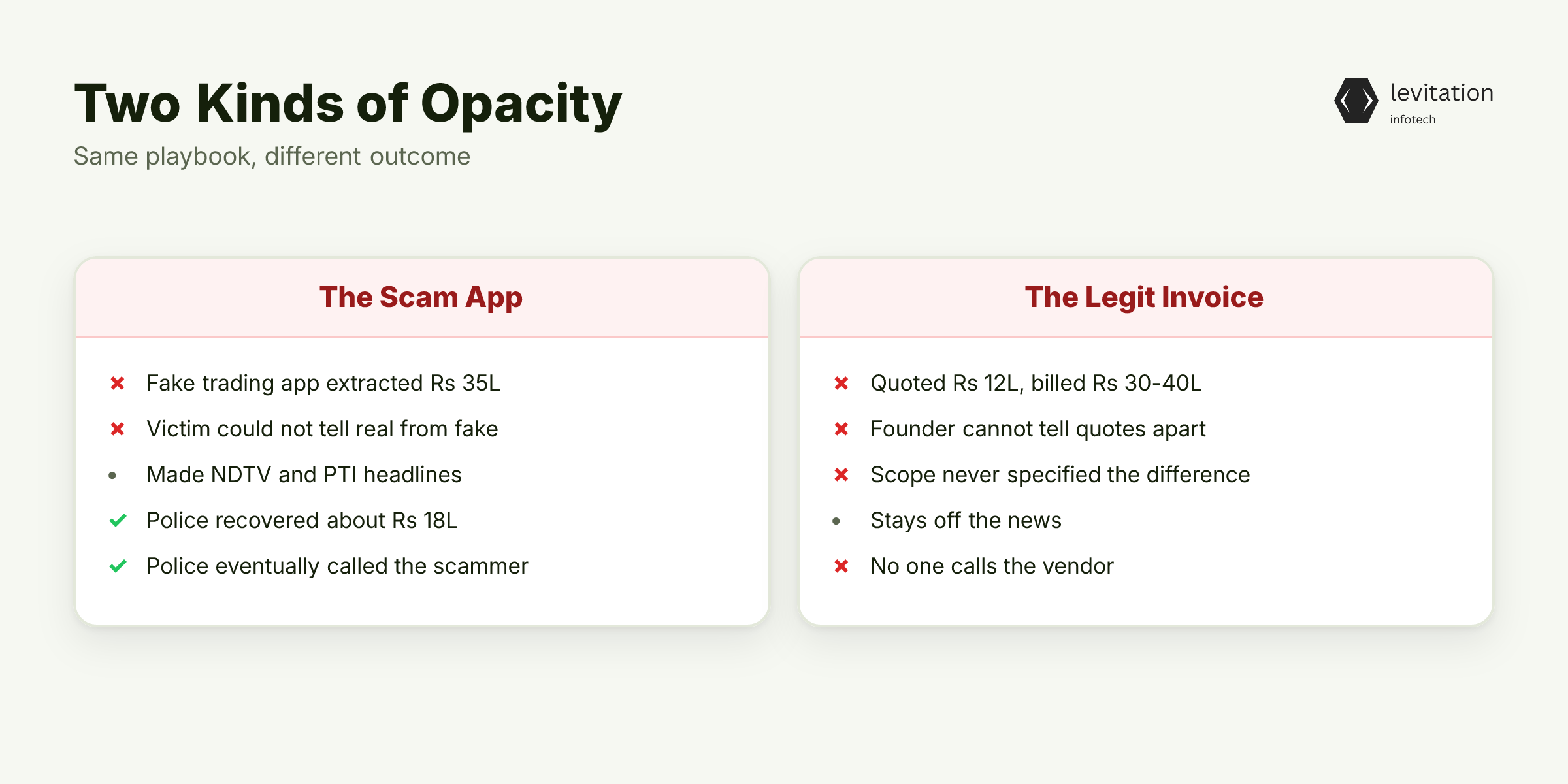
A 71-year-old man in Alpha 2, Greater Noida, lost ₹35 Lakh to a fake trading app. He was promised returns on share-market tips. Police later recovered about ₹18 Lakh. The case made NDTV and PTI, and the number became shorthand for app fraud in India.
Here is what did not make the news. The same opacity that lets a scam app extract ₹35 Lakh from a retired man plays out in legitimate contracts too. The scales are smaller. The pain is just as real. The scam worked because the victim could not tell a fake investment product from a real one.
The invoice problem works the same way. Most founders cannot tell a ₹12 Lakh app from a ₹30-40 Lakh one until the bill arrives, because the scope document never specified the difference.
The difference is that the police eventually called the scammer. No one calls the vendor.
If a retired man can be fooled by a fake app, what does that say about how opaque real app pricing actually is?
The ₹12 Lakh App That Quietly Becomes ₹35 Lakh
Here is the founder journey that nobody warns you about.
A startup gets a ₹12 Lakh quote for an MVP. The proposal looks professional. The vendor's portfolio is solid. The founder signs.
Three months in, the "small additions" start. An admin panel wasn't in the original spec. Role-based dashboards are needed. Payment retries for failed transactions. KYC flows for onboarding.
Each addition is a few lakhs. The total lands well above the original quote, often in the ₹30-40 Lakh range or higher for complex products.
The vendor isn't lying. Discovery is expensive, and sales teams price to win the deal, then recover margin through change requests. The custom software development cost in India you see in proposals is anchored to a stripped-down version of your product.
The published range for startup MVPs sits between $15,000 and $150,000. Most projects fall between $30,000 and $100,000. That range is meaningless once scope is undefined, because both ends of the range describe the same product depending on which version of "done" you mean.
But "scope creep" is the diagnosis founders hear after the damage is done. The actual question is: what specifically inside the scope multiplies the price?
Three Cost Multipliers That Vendors Don't Put on Page One
Three variables explain most of the gap between your first quote and your final invoice.
Multiplier 1: User roles. Each distinct role (customer, vendor, admin, ops, support) is a separate product with its own screens, permissions, and edge cases. A multi-role app is much more than a single-role app, because shared infrastructure (auth, navigation, layout) absorbs some overlap but each role still adds a separate test matrix, separate permission logic, and separate UI states. The app development cost India estimate on a vendor's homepage is almost always for a single-role app.
Multiplier 2: Integrations. A third-party API sounds like a one-line add. It isn't. Each integration means auth flows, webhook handlers, retry logic, sandbox testing, and failure states. A typical fintech stack can add major build time. Think Stripe plus Razorpay plus a KYC provider plus an SMS gateway. Each external system has its own quirks, its own outage modes, and its own testing requirements.
Multiplier 3: Platform choice. Cross-platform frameworks can reduce build cost versus separate native iOS and Android codebases, because one codebase ships to two stores. The catch: the savings shrink or disappear if your app needs deep native modules (Bluetooth LE, background sync, custom AR) or platform-specific UI patterns. The decision to go cross-platform isn't a vibe. It is a technical constraint that should be made before the MVP cost India is quoted.
One more data point. Research shows that outsourcing to freelance MERN developers can cut costs by up to 70% compared to a local agency. That number is real, and it ignores the cost of coordination, QA, and rework that an agency absorbs. A low-rate freelancer becomes more expensive once you add a PM, because coordination, QA, and rework that an agency normally absorbs all land on you.
Once you see the three multipliers, the next question is unavoidable: where does the honest ₹12 Lakh app actually live?
What ₹12 Lakh Actually Buys You in 2026
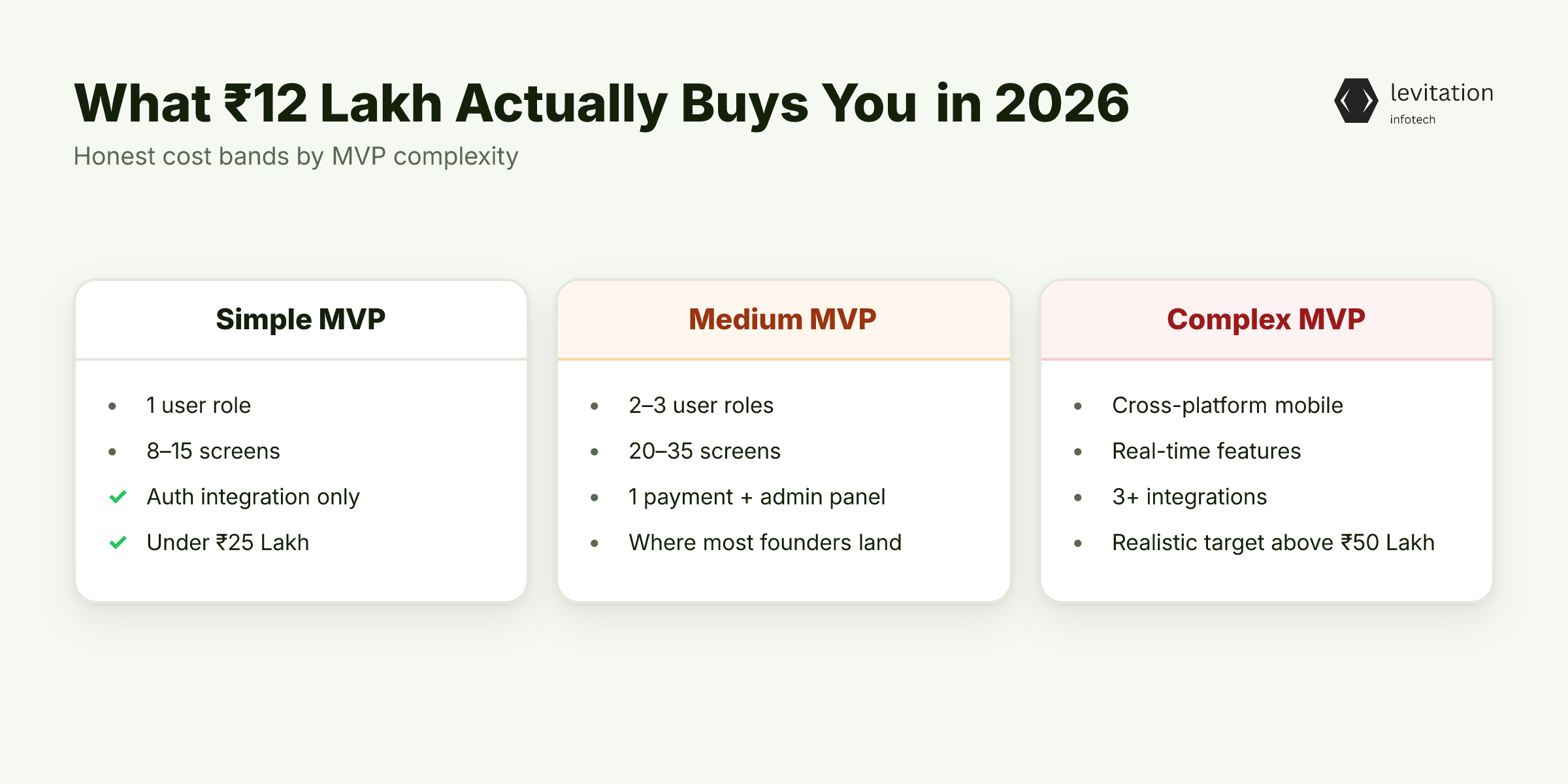
Honest cost bands exist, and they do not overlap with vendor headlines.
A simple web MVP (one user role, 8-15 screens, no payment processing, no third-party integrations beyond auth) costs $10,000 to $30,000. That is a how much does an app cost question with a clean answer: under ₹25 Lakh, in scope.
A medium MVP (2-3 user roles, 20-35 screens, one payment integration, basic admin panel) costs more than a simple MVP. The price scales with role count, screen count, and integration complexity. This is where most founder "MVPs" actually land once you count what they need. Think B2B SaaS with a customer portal, an ops dashboard, and a payment flow.
A complex MVP (cross-platform mobile, role-based experiences, real-time features, 3+ integrations) starts at the upper end of the MVP range and goes well beyond it. If your custom software cost target is under ₹50 Lakh for this category, the vendor is either loss-leading or stripping scope you haven't noticed yet.
The hourly rate is a trap. A low-rate MERN developer sounds cheap. A full team (designer, QA, DevOps, PM) at that rate is fantasy. The all-in team rate for production-grade work is what matters, and that is where the ₹12 Lakh you budgeted either survives or dies. Production-grade apps at this price point are achievable, but they require engineering discipline most shops skip.
The cost band only matters if your scoping document maps to it. Most founders' scoping documents do not, which is the gap the framework below closes.
The Scoping Document That Stops the ₹35 Lakh Quote
Five steps turn a surprise invoice into an honest one.
Step 1: List every user role on a single page. One sentence per role describing what they do differently. This alone cuts "admin panel" ambiguity in half, because "admin" usually means five different products to five different stakeholders.
Step 2: List screens per role in a flat list. A "must have" line and a "nice to have" line. Cap the MVP at 20 screens. Anything beyond 20 is a phase 2, not an MVP.
Step 3: Name every external integration with a one-line use case. Note which ones are paid APIs. Vendors price "integrations" generically until you name them, and a named list forces specificity on both sides.
Step 4: Pick the platform decision before the quote. Mobile, web, or both. "Cross-platform app development using React Native" is a specific answer that changes the app development price a lot versus "we'll figure it out later."
Step 5: Ask vendors to quote against your document. Not their template. Ask them to flag anything in your doc they think is missing before signing. The vendor who pushes back on scope is the vendor who will not surprise you with a change request.
This kind of disciplined scoping is not founder folklore. It is a practiced craft in regulated industries, where the cost of custom software is audited down to the line item. The systems still running in production long after deployment are the ones where the scoping happened before the contract.
A scoped project is the difference between a ₹12 Lakh invoice and a surprise, because clear scope is what keeps the final number honest.
What Changes When You Scope Before You Sign
The variance drops. When scope is defined upfront, the final invoice lands closer to the quote, because the scope was never actually agreed at the original price. The honest invoice was always higher, and now it lands closer to what was discussed.
Timeline variance follows the same pattern. A scoped MVP ships faster because the team is not re-discovering requirements mid-build.
The founder-vendor relationship changes too. It shifts from adversarial ("why is this extra?") to collaborative ("here's the next slice we can fund"). Software development cost India stops being a debate and becomes a roadmap.
If you have already signed an unscoped contract, the ₹15 Lakh quote that actually costs ₹40-75 Lakh breakdown shows how to recover. And if you are choosing between building and buying, the year-two cost reality of off-the-shelf is the comparison that actually matters.
Frequently Asked Questions
What is the actual cost to build a mobile app in India in 2026?
A basic app with 1 user role and 8-15 screens costs in the range of $10,000 to $30,000 (roughly ₹8-25 Lakh). A medium MVP with 2-3 roles, 20-35 screens, and one payment integration costs more, scaling with complexity. Anything quoted below this without strict scope is either loss-leading or stripped of essentials you will pay for later.
Is it cheaper to hire freelance MERN developers or an app development company in Noida?
Freelancers can cost up to 70% less per hour than an agency, but you absorb the cost of project management, QA, and rework. For a well-defined MVP, freelancers win on price. For anything with compliance, payments, or multi-role complexity, the agency math usually beats the freelancer math once you count the hidden hours.
How does cross-platform app development affect the total cost?
Cross-platform frameworks like React Native or Flutter reduce build cost versus separate native iOS and Android codebases, because you ship one codebase to two stores. The savings shrink if your app needs deep native modules (Bluetooth LE, background sync, custom AR) or platform-specific UI patterns.
What should a startup MVP scope document contain?
Every user role with a one-line description. A flat list of screens per role, capped around 20. A named list of third-party integrations. A chosen platform decision (web, native, or cross-platform). And explicit "not in scope" items. This is what converts an ambiguous quote into an honest one.
How long does it take to build an MVP in India?
A scoped MVP ships faster with a small team (2-3 engineers, 1 designer, 0.5 PM). An unscoped MVP takes longer. It usually ships with fewer features than originally planned. Requirements are discovered mid-build. The timeline variance is almost entirely a function of the scoping document, not the developer's speed.
Send vendors your scope before you sign, and watch the quotes converge.
Sources
Research and references cited in this article:
- App Development Cost in India 2026: Full Guide
- Cross-platform App Development Cost Every Founder Should Know
- How Much Does Mobile App Development Cost in India ...
- Cost to Develop an App in 2026: Comprehensive Guide
- How Much Does App Development Cost in India? (2026 Honest ...
- MVP App Development Cost Breakdown for Startups in 2026
- MVP Development Cost in 2026: Realistic Budgets by App ...
- MVP Development Cost in 2026: Startup App Budget ...
- MVP Development Cost in 2026: How Much Does It Cost to ...
- MVP App Development Cost 2026 | Full Cost Breakdown Guide
- App development company vs freelancers(2026) | PDF
- Hire an App Developer Cost in 2026: Full Pricing Guide
About the author
Mayank Singh is a software developer at Levitation Infotech, where he builds web and AI-powered applications across the company’s fintech, healthcare, and enterprise projects.