


TL;DR: The AWS demo your vendor flashes isn't a blueprint for production. It's theater designed to close the sale. Mature Noida vendors will show you the production architecture on day one, because cheap servers running well-engineered code often outperform expensive clouds running rushed code. Six specific questions separate honest vendors from the ones hiding the stack mismatch until after the SOW is signed.
Key Takeaways: - Demo infrastructure exists to impress procurement, not to predict production cost or performance - A dedicated server costing a fraction of cloud running bespoke software is rational engineering, not a red flag - The real signal is vendor transparency about what actually runs in production after the deal closes
Your vendor's sales deck shows auto-scaling groups, managed Kubernetes, and CloudFront edges. Six months in, you discover production runs on a single Hetzner box in Falkenstein. That gap is the most important signal in your entire engagement, and almost no CTO reads it correctly.
The Demo Stack Is a Stage, Not a Blueprint
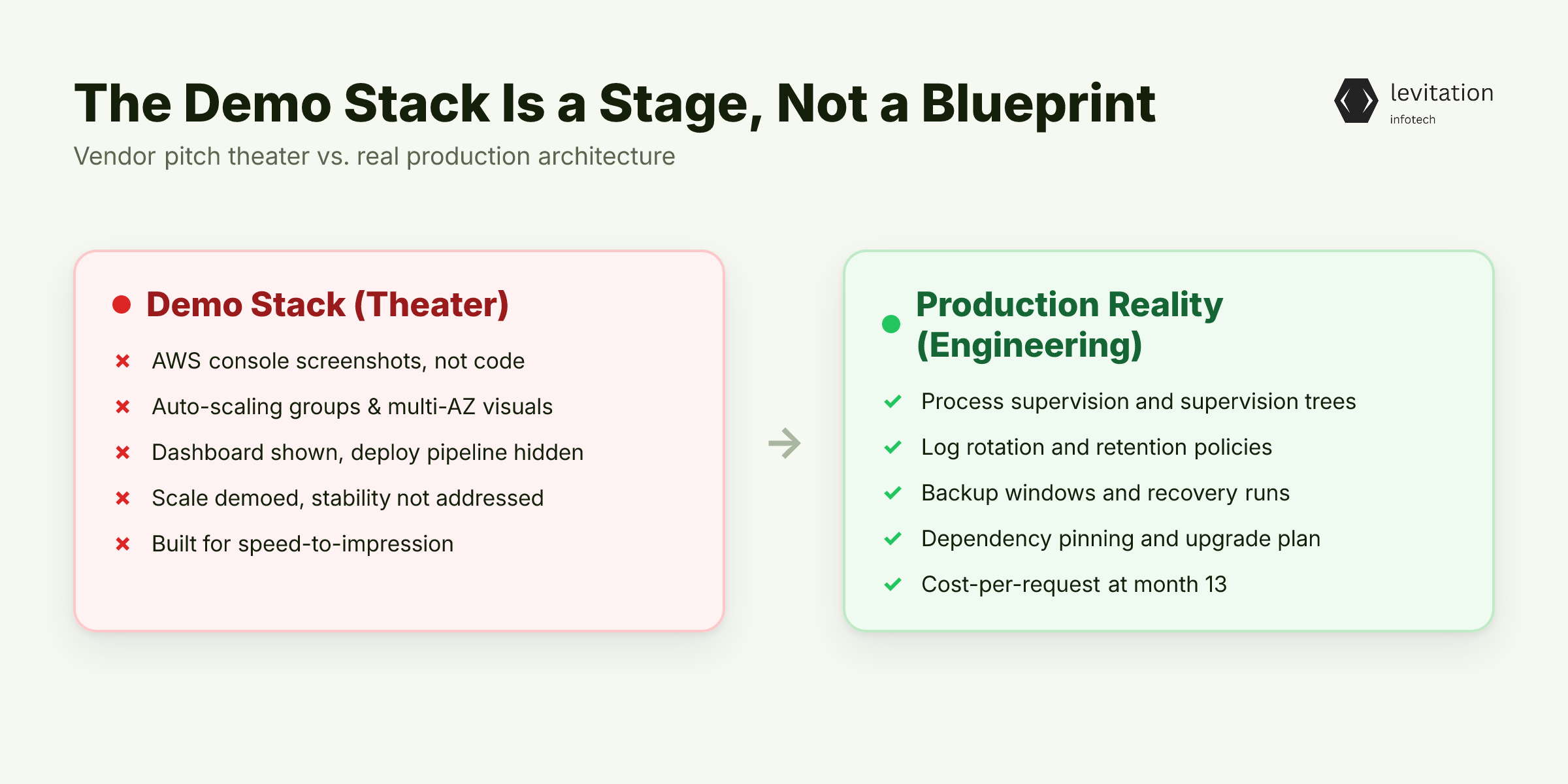
The AWS architecture diagram in your vendor's pitch deck is not a commitment. It's a prop. Every serious Noida software vendor opens with auto-scaling groups, multi-AZ deployments, and CloudFront edges because procurement buyers expect that visual language. The session "0 to Production in 40 Minutes" frames cloud as a vehicle for app focus, not future-state architecture. The demo is selling you speed-to-impression, not the system you'll run in year two.
Consider what happens in that 40-minute window. The presenter spins up a database, a queue, a serverless function, and a CDN. The audience sees the AWS console, not the code. They see the dashboard, not the deploy pipeline. They see scale, not stability. None of that tells you what your system will cost in month 13, when real traffic hits. The real architecture (process supervision, log rotation, backup windows, dependency pinning) never makes the screenshot.
CTOs who confuse demo polish with production architecture inherit stacks built for screenshot appeal rather than cost-per-request. The top software development companies in Noida know this, and they use it. Their pitch decks aren't lying. They're just not showing you the part that matters yet. When you evaluate a vendor on demo beauty alone, you're buying theater, not engineering. The reason every serious vendor leads with AWS has less to do with the cloud and more to do with how fast a sales cycle needs to close.
Why Every Serious Vendor Opens With AWS
AWS removes infrastructure friction during the sales cycle. That's the whole game. A vendor can stand up a demo in an afternoon, run it through procurement, and tear it down the same day. They never see the bill, because the prospect pays. Firms like Vofox use AWS-native services to demo mission-critical operations in aviation and travel because provisioning takes minutes, not weeks.
Demo speed is a sales weapon. The faster a vendor can iterate on a live environment, the more procurement meetings they can run in a quarter. A demo that took three weeks to provision loses to one built in an afternoon. The economics of pre-sales reward velocity, not architectural accuracy, and that bias is baked into every pitch. The top custom software development companies in India have built entire pre-sales teams around this loop. The pattern is simple: spin up, demo, tear down, repeat. The polished architecture diagram you saw was rehearsed. It isn't a forecast of your bill.
A custom software company knows that the buyer who loved the multi-AZ diagram rarely asks for the same architecture at the SOW stage. The demo is designed to win the room, not to ship the product.
So the demo is theater. The question becomes: what is the production server actually telling you, and why is it so much cheaper?
What the Low-Cost Server Actually Reveals
A dedicated server costing a fraction of cloud is rational engineering, not corner-cutting. For many B2B workloads at MVP scale, a single well-tuned box outperforms cloud microservices on both latency and total cost. The reason is simple: most B2B SaaS serves a few hundred concurrent users at peak, not millions. A modest NVMe-backed server with a reverse proxy, a process manager, and a managed database handles that load without breaking a sweat.
The real signal isn't the price tag. It's whether the vendor told you. Teams that quietly swap architectures between demo and production are hiding tradeoffs they didn't want to explain in the sales cycle. They showed you the AWS logo because it sells. They moved to Hetzner because it works, and the hidden infrastructure cost of cloud-native for a workload that doesn't need it is enormous. Mature vendors surface that tradeoff in the proposal, not in the post-launch autopsy.
Mature vendors will show you the production architecture diagram on day one. The reason isn't that their custom software is inferior. It's that their software development discipline is superior. They designed the backend for the cheap target from the start, not retrofitted it after the SOW was signed. The architecture decision was made in week one, not in the panic of the first cloud bill.
Watch what happens in the early sprints. A vendor who planned for cheap production is shipping a Dockerfile, a systemd unit, and a backup cron job. A vendor who planned for the demo is refactoring from Fargate to EC2 because the bill crossed a SOW line item.
This is why short vendor deployment windows force the architecture decision upfront. An in-house team might take much longer and discover their stack choices too late to fix cheaply. A vendor shipping a product on a compressed timeline can't afford to pivot to cloud-native halfway through. They pick the stack that pays back fastest and stay there. Architecture is decided before the scope is honest.
The same vendor who runs lean for a cost-sensitive client will run a properly hardened AWS architecture for a regulated buyer. The stack isn't dogma. The opacity about it is the problem. What that cheap box actually runs under the hood is where the engineering signal gets loud.
The Architecture Behind the Cost Gap
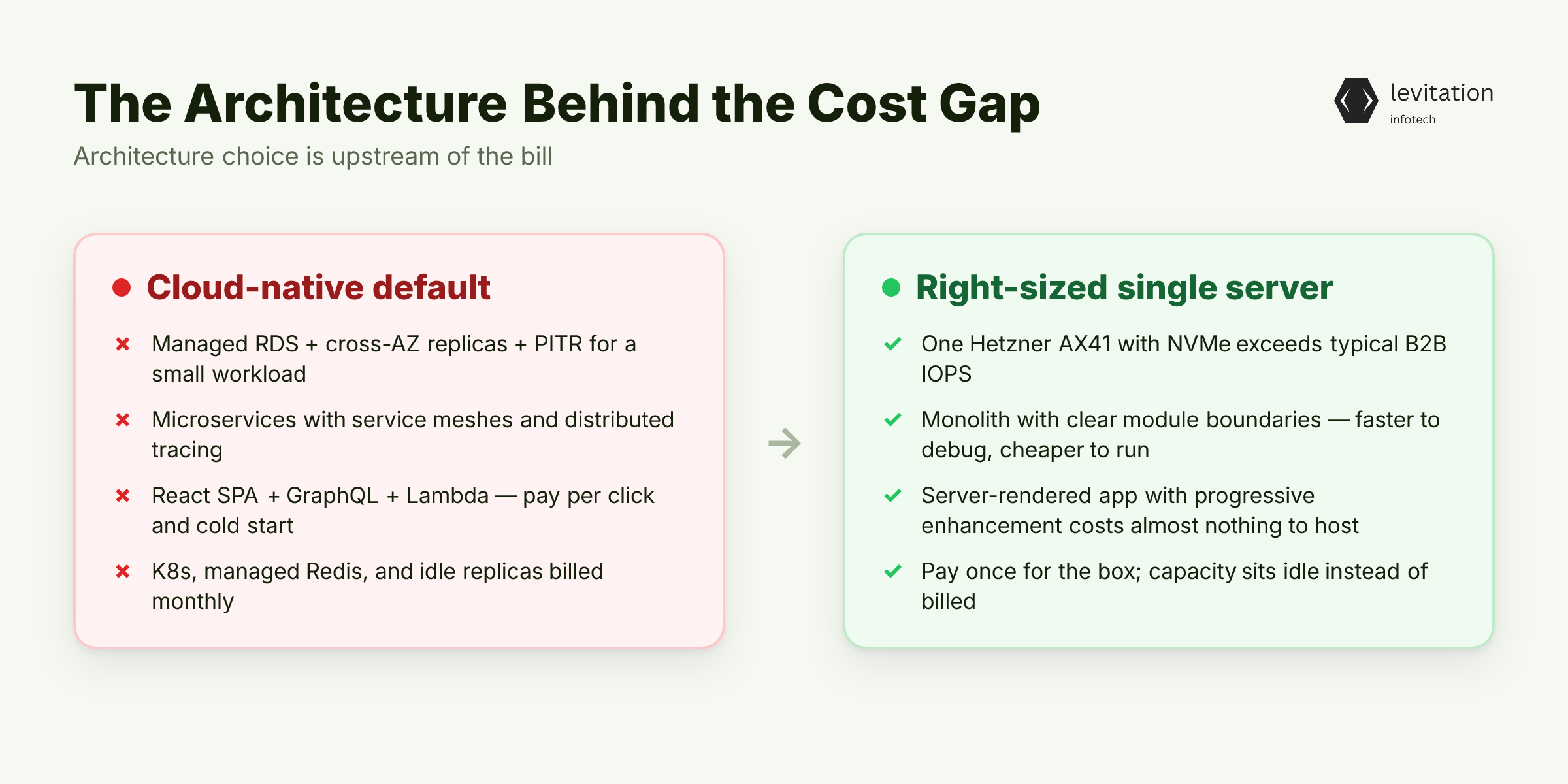
A single Hetzner AX41 with NVMe storage can deliver IOPS that exceed the needs of typical B2B workloads. It costs less than one AWS EBS gp3 volume provisioned at production scale. The math changes once you move past MVP traffic, but most B2B products never move past MVP traffic. A typical Noida-built SaaS serving modest user bases will idle on a low-cost server, leaving most of its capacity unused.
The cloud bill for the same workload would pay for idle replicas, cross-AZ data transfer, and managed service markups. Those charges exist to solve problems the workload doesn't have. Storage is the silent killer of cloud-native stacks. A managed PostgreSQL on RDS for a small workload costs more than a dedicated NVMe server with ample storage and full root access. Add cross-AZ replication, point-in-time recovery, and read replicas for "just in case." Now you're paying for capacity you will never use. The cloud bill is paid monthly; the architecture debt compounds yearly.
Cloud-native microservices and API designs often collapse into a monolith on a single server without performance loss when load profiles are well understood. This isn't anti-pattern; it's engineering. A monolith with clear module boundaries is faster to debug, easier to deploy, and cheaper to run. The microservices tax (service meshes, distributed tracing, eventual consistency) is only worth paying when you've outgrown a single box. Most B2B products never do.
The frontend choices made at architecture time determine whether cheap production is possible. A server-rendered application with progressive enhancement costs almost nothing to host. A React SPA talking to a GraphQL layer behind a Lambda function costs a small fortune. You pay per click, per cold start, per concurrent user. Vendors who reach for k8s, Lambda, and managed Redis by default will never hit a low-cost server, no matter the traffic profile. They will, however, hit a very high AWS bill that gets passed to you.
The architecture choice is upstream of the bill, and most CTOs only check the bill after it's too late.
Six Questions That Expose the Stack Mismatch
Ask six questions. The answers will filter your shortlist faster than any RFP scorecard. - "Show me the production architecture diagram, not the demo one." Mature vendors pull it up immediately. Vendors running different stacks in production than they demoed will deflect, postpone, or send a sanitized version after the call. - "What does the MVP development cost in India breakdown look like at month 3 vs month 12?" The gap reveals cloud lock-in risk. If month-12 infrastructure costs balloon far beyond month-3 projections, the demo stack wasn't built to last. - "Which reference customers are running on a stack identical to what you'd build for us?" Past production deployments are the only honest portfolio. Reference customers running different stacks prove the vendor tailors architecture to budget. That's not a problem, unless they didn't tell you. - "Who owns the cloud account, the DNS, and the deployment keys on day 365?" A vendor who insists on owning all three has built lock-in into the contract. Mature vendors hand over the keys at handoff. - "What's the p99 latency for your last three production deployments, measured at the customer?" Vendors who track this ship stable systems. Vendors who can't answer it ship demos. - "How many of your deployed systems are still running years after deployment?" Systems still running in production years later are the only real evidence that an architecture decision was right. Anything else is a guess wrapped in a dashboard.
Ask those six questions and you'll filter your shortlist to vendors whose production architecture matches their promises. The remaining candidates will save you infrastructure rework. The same it company Noida filter applies: vendors who can't answer in a single call are the ones whose production looks nothing like the demo. What the answering vendors ship to production is the answer to every question the demo never asked.
What Production-Ready Custom Software Looks Like
Production-grade software development in Noida means documented architecture and reproducible deploys. It means a vendor who shows you the production stack before you sign the SOW. It means handoff documentation a new engineer can read on day one and ship a fix on day two. It means monitoring that pages someone when p99 latency crosses a threshold, not when the server falls over. It means a post-mortem culture where the fifth incident triggers a refactor, not a Slack thread.
The best software development company is the one that runs lean infrastructure in production because the code deserves it. Not because they cut corners to win the bid. When the architecture is honest, the bespoke software is fast, the bill is predictable, and the system runs for years without rework. Short vendor deployment windows versus much longer in-house builds mean your team is gathering real user data while competitors are still in sprint planning. That credibility is earned in production, not in the demo room. Systems still running in production years after deployment are the only proof that any of it worked.
If you need a partner who treats the production stack as seriously as the sales deck, Levitation's engineering teams ship systems designed for the workload they actually run, not the one that photographs well. The right vendor treats infrastructure cost as a feature of disciplined engineering, not a confession of cheap bidding.
Frequently Asked Questions
Q: Why do software vendors demo on AWS but run production on cheaper servers?
A: AWS lets vendors spin up demo environments in minutes, which shortens the sales cycle. Production servers are chosen later based on workload economics. For many B2B systems, a dedicated box at a fraction of the cloud cost beats a cloud microservices stack on both latency and cost. The mismatch is rational; the problem is only when vendors hide it.
Q: How much does MVP development cost in India for a typical SaaS product?
A: An MVP from a serious Noida or Indian software vendor varies widely in cost. The range depends on scope, but vendor deployment windows are far shorter than the multi-year timelines of in-house builds. Infrastructure costs in early production are often low because the workload doesn't justify cloud-native complexity yet.
Q: Is a cheap production server a sign of a low-quality vendor?
A: No. It's a sign the vendor understands unit economics. A low-quality vendor will run an expensive cloud stack for a small user base, then quietly pass the bill to you. The real red flag is opacity about what production actually runs on, not the price of the server itself.
Q: How do I evaluate a custom software development company in Noida before signing?
A: Ask for the production architecture diagram (not the demo one). Request two reference customers running the same stack. Then ask for a month-3 versus month-12 cost projection. Mature vendors answer all three in a single call. Vendors who deflect are the ones whose production looks nothing like the demo.
Q: What's the difference between custom software and SaaS for an enterprise CTO?
A: SaaS gives you shared infrastructure with configuration knobs. Custom software gives you code and architecture tuned to your workflow, data model, and integration surface. For regulated industries, complex internal processes, or any workflow where off-the-shelf tools force compromise, custom software pays back through operational fit. The application development cost is amortized across years of avoided workarounds.
About the author
Mayank Singh is a software developer at Levitation Infotech, where he builds web and AI-powered applications across the company’s fintech, healthcare, and enterprise projects.