


TL;DR: A patient deduplication benchmark can contain many unique rows while representing very few independent patients. Separate identity, base cases, runs, and context variants, then make dependency checks release gates.
Key Takeaways: - Raw rows, pair rows, outputs, base cases, and patients measure different forms of evidence. - A dependency graph must connect every artifact before a split is assigned. - Release should fail when identity, provenance, leakage, or cluster-aware uncertainty is missing.
A Large Test Set Can Hide a Narrow Patient Population
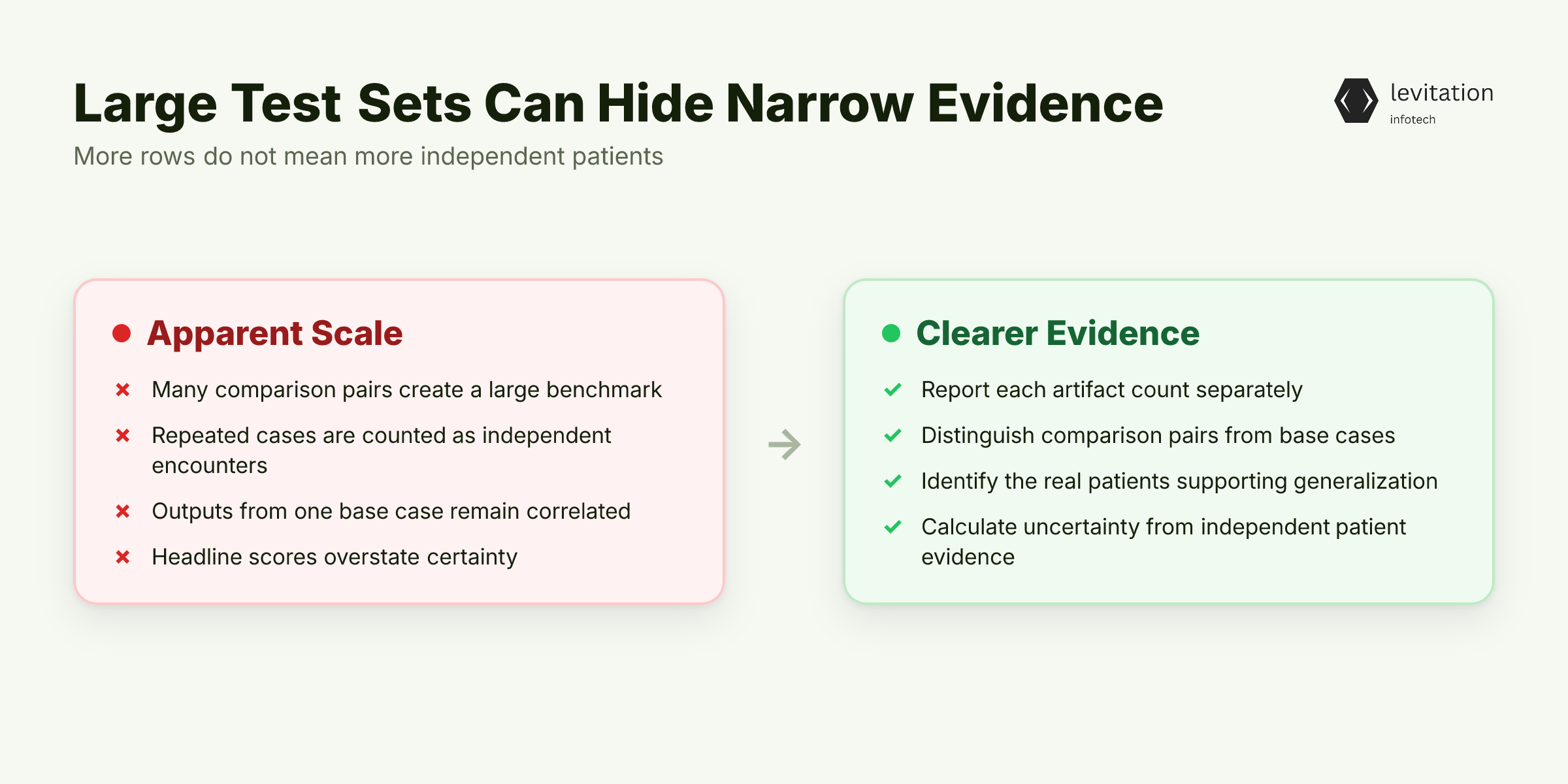
A benchmark can show a large test set while drawing every case from the same narrow patient population. Its headline score then overstates certainty. The benchmark counts repeated cases as if they were independent clinical encounters.
Separate counts from evidence
Start with the artifact being counted. Each number answers a different question and cannot substitute for another. - Raw records: How much source data entered the benchmark? - Comparison pairs: How many identity decisions did the matcher make? - Prompts: How many instructions were submitted to the model? - Model outputs: How many responses were produced? - Base cases: How many distinct clinical situations were tested? - Real patients: How many independent people support the generalization claim?
A set of unique comparison rows can still come from one patient. Several encounters from one patient can create many pairwise rows, each carrying a different record identifier.
Expose the row-count illusion
A deduplication benchmark can multiply one patient's records into many pair rows. Repeated outputs from the same base case add more rows, but not more independent clinical facts.
Those outputs remain correlated because they start with the same clinical facts. A model that repeats a familiar pattern looks steadier because the benchmark keeps asking about that pattern.
State the evaluation risk
Ordinary accuracy and confidence calculations treat observations as separate. When that assumption fails, uncertainty looks narrower than patient-level evidence allows. The model then appears more consistent than it is.
The fix is not fewer rows. It is a clearer unit of evidence. A benchmark can contain unique rows while representing too few independent patients.
Within the broader healthcare technology data layer, identity, provenance, and quality controls decide whether downstream analytics deserve trust.
So where does the second copy enter, and why do ordinary train-test splits fail to reveal it?
Three Paths Lead to the Same Patient
The second copy enters through three paths that look different in storage but create the same statistical problem.
Identity collision
Records can represent one person while carrying different identifiers. If the benchmark treats them as different people, the apparent population grows. The split can then place one version in training and another in testing.
Ordinary row-level splits miss that leakage because they split artifacts, not the person behind them.
Repeated run
A repeated run asks the same model to handle the same base case. It can expose useful run-to-run variation, but it cannot create a new patient or clinical situation.
Counting each response separately turns correlated behavior into apparent broader evidence. The benchmark makes the model look stable by drawing from the same clinical facts.
Context variant
A context variant changes the setting or available pathway while preserving the patient's clinical facts. It is still a stress test, but it remains linked to its base case and patient cluster.
Without that link, contextual robustness looks like broad clinical generalization. The benchmark is testing a changed condition, not a new patient.
Treating any of these observations as independent understates uncertainty. It also rewards consistency on facts the model has seen rather than transfer to new patients.
Identity resolution therefore must precede clinical AI evaluation. It is a quality control, not cleanup performed after the leaderboard appears.
When reviewing top AI companies for healthcare in India, ask whether the team can detect, preserve, and audit identity dependencies. Can they explain where each observation came from and what it depends on?
The fix begins with a unit-of-analysis contract, not another deduplication pass. What must that contract declare before scoring?
Declare the Independent Unit Before Scoring
That contract names the unit whose independence the score is allowed to claim. Without it, the denominator changes silently depending on who prepares the report.
Build a dependency graph
Give every benchmark artifact stable identifiers for the patient cluster, base case, run, and context variant. An artifact can have several links without losing its own identity.
Think of the graph as lineage, not cleanup metadata. One output can link to one run, one base case, and one patient cluster at once.
Resolve identity deliberately
Use deterministic matching when identifiers are verified. Use probabilistic matching to generate candidates, never silent truth. Send ambiguous clusters to human adjudication.
Every merge, split, or quarantine decision must be reversible and recorded. An unresolved identity should remain visible, not disappear inside a score.
Publish the benchmark manifest
The manifest is the benchmark's public contract. It should record: - Provenance and source identifiers - Matching confidence and adjudication status - Inclusion rules and exclusion reasons - Split assignment - Every transformation applied to the case
Expert reviewers should validate cluster assignments and confirm that cases preserve their intended clinical facts. Different rows can change presentation without changing the clinical reason for the answer.
The independent unit is the highest-level cluster supported by the comparison: patient for generalization questions and base case for model-specific comparisons. The scorecard should show raw benchmark volume and genuinely independent units side by side.
This is the same lesson behind Vector Speed Loses to AI Data Provenance: downstream confidence cannot outrun upstream lineage.
At the healthcare technology layer, the manifest gives reviewers evidence they can reproduce and challenge the evaluation. If a score cannot be traced to these decisions, its precision is borrowed, not earned.
That contract works only when identity, repetition, and leakage sit in separate benchmark layers. How should those layers divide the work?
Build the Benchmark as Three Test Layers
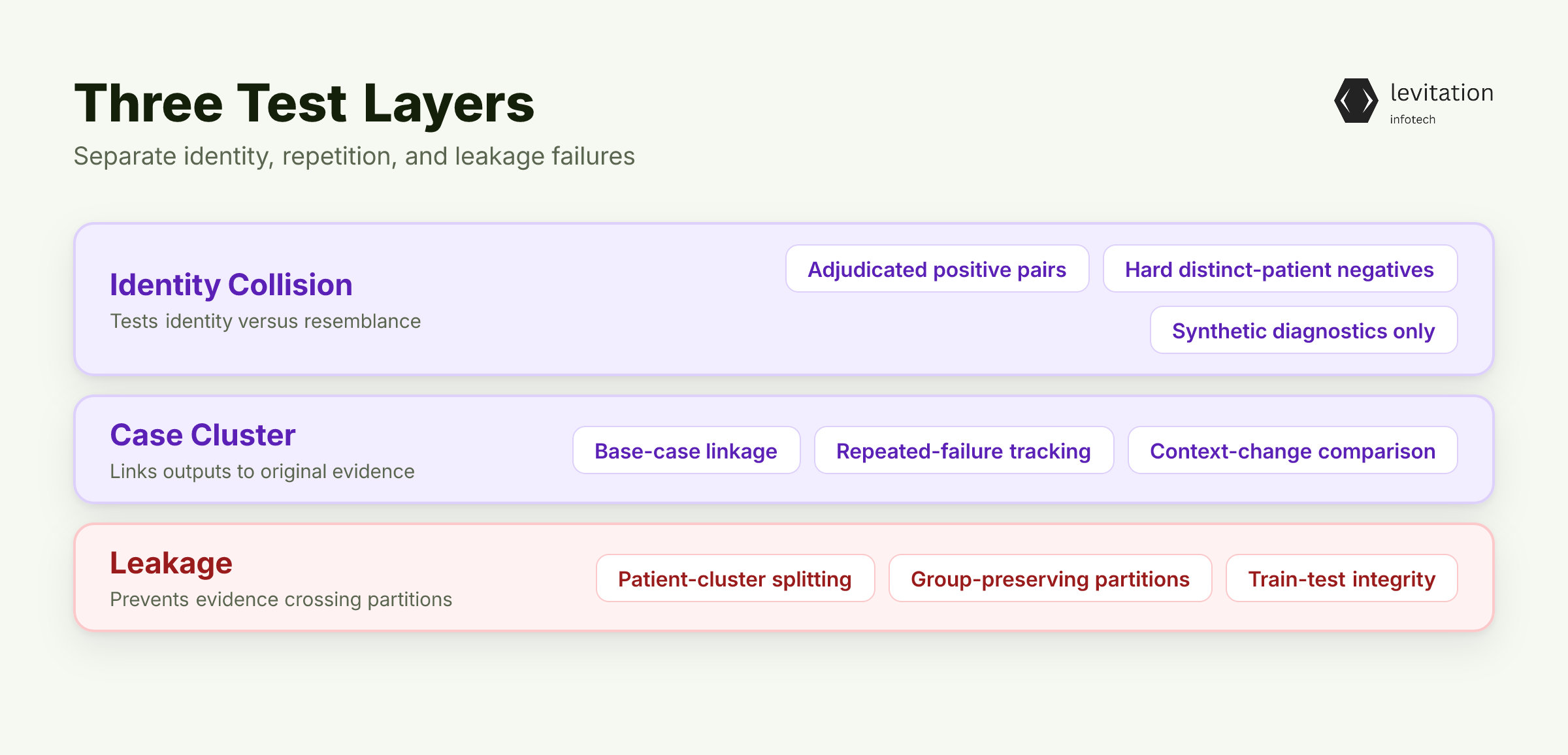
The dependency graph becomes enforceable only when identity, repetition, and leakage live in separate test layers. Each layer catches a different failure.
Identity-collision layer
Create adjudicated positive pairs for records belonging to the same person. Include hard negatives containing similar but confirmed distinct patients.
The hard cases matter more than easy negatives. A benchmark should test whether the matcher can distinguish resemblance from identity.
Use synthetic pair sets only as controlled diagnostics. A strong synthetic score is not proof of production effectiveness without independently adjudicated real records.
Case-cluster layer
Link every model output and context variant to its originating base case. A new prompt does not create a new case when the clinical facts remain unchanged.
This layer lets you ask useful questions: Which cases fail repeatedly? Which context changes alter the answer? Which outputs belong to the same underlying evidence?
Leakage layer
Split by patient cluster, not by row. Every record, pair, run, and derived variant from that cluster must remain in the same partition.
A training encounter and its test paraphrase cannot sit on opposite sides of the split. Splitting them apart creates leakage, even when each row looks different.
At minimum, each benchmark artifact should carry: - patient_cluster_id: Stable identity cluster for the underlying person - base_case_id: Originating clinical case - run_id: Specific evaluation execution - context_variant_id: Changed setting or available pathway - source_record_ids: Source records used to construct the case - split: Train, validation, test, or another declared partition - provenance: Origin and transformation history - match_confidence: Strength of the identity assignment - adjudication_status: Review state for the identity cluster
Pair-level sensitivity, specificity, and F-score answer a narrower question: can a matcher link records? They do not prove that a clinical model generalizes.
Publish split integrity, unresolved-cluster counts, dependency coverage, and the number of genuinely independent units. These measures expose benchmark weaknesses that aggregate accuracy can hide.
When comparing top AI companies for healthcare in India, require healthcare-grade controls. The identity workflow still deserves direct audit.
A clean registry still does not make repeated outputs statistically independent. How should the scoring model reflect that dependency?
Analyze Clusters and Stress the Clinical Context
Correct dependency metadata changes the statistics, not just the spreadsheet. The analysis must now respect the clusters you have declared.
Estimate at the independent level
Calculate patient-level or case-level summaries before aggregating results. This stops prolific records from dominating the benchmark.
A patient with many encounters should not receive more statistical weight than a patient with fewer encounters. Each independent unit needs an appropriate voice in the final estimate.
Quantify clustered uncertainty
Use a cluster bootstrap or hierarchical method that resamples the highest-level independent clusters. Use multiway clustering when both patient and base case define dependence.
This approach estimates uncertainty from the units that can plausibly vary independently. A narrow interval built from correlated rows offers false comfort.
Retain diagnostics without inflating sample size
Keep run-level variation, repeated failures, and subgroup behavior as supporting evidence. They reveal instability that a single aggregate score can conceal.
Repeated runs can reveal instability, but they do not become fresh patients.
Design context perturbations with a clinical panel
Have locally relevant clinicians identify the features that determine acceptable reasoning. Then alter one context variable while keeping the patient's clinical facts constant.
One case can state that a relevant investigation is available through an approved pathway. Another can withhold that pathway while preserving the same clinical facts.
This reveals whether performance depends on context rather than clinical knowledge. It also exposes whether the deployed workflow can support the model's reasoning.
Choose sample size from the intended comparison, expected variability, and required precision. A large-looking row count cannot replace that design work.
A model can handle a case while the deployed workflow fails because the required context or pathway is unavailable. Benchmark the product pathway when that is the intended use.
Dependency-aware evaluation belongs in the healthcare technology stack from source record through model output.
These checks must become non-negotiable at release time. What should happen when one fails?
Turn Independence Checks into Release Gates
Release gates turn a sound benchmark design into an operating control. They stop a flawed evaluation from becoming an approved release.
Enforce a release checklist
Require all of the following before publication or deployment: - Zero patient-cluster overlap across splits - Complete provenance for every output - Resolved or quarantined uncertain identities - Cluster-aware uncertainty estimates - Documented expert review
No unresolved cluster should enter scoring silently. A quarantined case can remain visible without contaminating the release evidence.
Make failures actionable
Report the exact dependency that broke the benchmark. Name the affected cases, the adjudication required, and whether the result must be recomputed.
A useful failure message says what broke, where it broke, and who must act. “Dataset quality issue” is not an actionable release decision.
Measure the payoff
Trustworthy benchmarks account for dependence when estimating uncertainty. They enable cleaner model-versus-product comparisons and show whether performance remains stable when context changes.
Use operational track record as due-diligence context, not proof of benchmark methodology. Ask about enterprise deployment count, client retention, production longevity, and delivery speed.
Long-lived systems still running in production after years can indicate maintainability. Delivery speed can indicate execution discipline. Neither proves that patient identity resolution is sound.
Compare vendor timelines with the time and overhead of building an in-house team. Delivery pace remains context, not an independent audit.
Technical architects should evaluate clinical credibility and engineering longevity across the broader top AI companies for healthcare in India ecosystem. They should also inspect the underlying healthcare technology architecture.
Ask the team to show the dependency map, adjudication trail, and release gate. Can that evidence survive contact with your own clinical workflow?
Frequently Asked Questions
What is a patient deduplication benchmark?
A patient deduplication benchmark tests whether records or cases assigned to the same person can be identified. It also checks whether look-alike records stay separate.
Within clinical AI evaluation, it prevents one patient from inflating test-set size. It also stops that patient from leaking across splits.
How do you prevent the same patient from leaking across benchmark splits?
Split by patient cluster rather than by individual row, pair, or run. Keep all records and derived comparisons for that cluster in one partition. This prevents information from the same person appearing in both training and evaluation.
How should sample size be chosen for a clustered clinical AI benchmark?
Base sample size on the comparison being tested, the expected variability, and the precision required. The number of raw outputs is not the effective sample size when several outputs depend on the same patient or base case.
How should metrics be calculated when one patient has multiple runs?
Aggregate repeated outputs into patient-level or case-level estimates, or use cluster-aware bootstrapping and hierarchical methods. Keep run-level results as diagnostics rather than treating each run as an independent observation.
How can a clinical AI benchmark test different care settings?
Use a locally relevant clinical panel to select a context variable. Then change only that context while holding the patient's clinical facts constant. For example, vary whether a relevant investigation is available through an approved pathway.
Which of these safeguards would most improve confidence in the next benchmark you commission?
About the author
Mayank Singh is a software developer at Levitation Infotech, where he builds web and AI-powered applications across the company’s fintech, healthcare, and enterprise projects.