


TL;DR: Fast vector retrieval finds likely evidence, but it cannot prove source identity, transformation history, or authorization. Enterprise RAG needs provenance across ingestion, indexing, retrieval, and response. Vector databases should work as indexes inside an auditable AI data control plane.
Key Takeaways: - Similarity establishes relevance, not defensibility. - Retrofitting provenance after launch is extremely hard. - Source IDs, policy context, and manifests must be first-class records.
Fast Retrieval Can Still Produce an Undefensible Answer
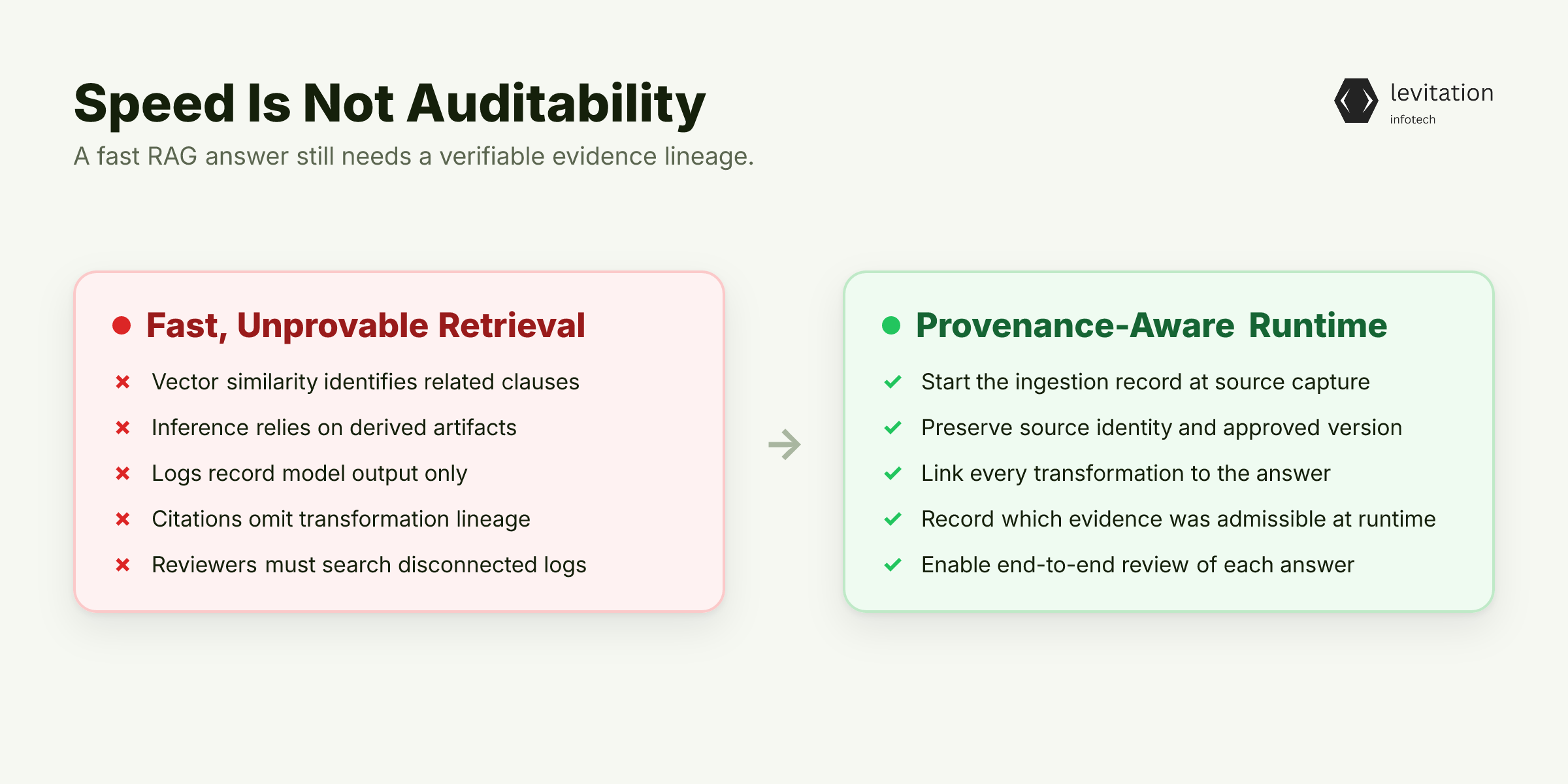
A RAG system can return a plausible answer at production speed. It can still fail the CTO's hardest question: can you prove where that answer came from? That gap, not vector performance, now shapes enterprise buying decisions.
Suppose a policy assistant returns a clean refund clause. The vector index shows that the clause resembles the question. It cannot show who supplied the policy, which version won approval, or whether redaction altered its meaning.
Latency solves only the easy part.
Inference consumes derived artifacts such as embeddings, tokens, hashes, and model outputs. It does not consult the original record for each question.
This lineage problem also matters across AI/ML training and inference. A fast answer can still rest on an untraceable transformation.
Apply this CTO-level test to every answer that affects a decision: - Can the team reproduce the exact source chain? - Can it identify every transformation between source and answer? - Can it show the policy basis for retrieval and use? - Can a reviewer answer all three without searching disconnected logs?
RAG auditability is a runtime control problem. It cannot be paperwork produced after an incident.
Logs can show that a model returned text. They should also explain which evidence was admissible when the request ran. A citation alone cannot carry that burden, as why RAG citations aren't audit trails explains.
The tempting response is to add a metadata column to the vector index. But can that column repair missing identity and lost transformation links? No. Retrofitting provenance is extremely hard. The first provenance design decision comes before retrieval. Where should the ingestion record begin?
Why Provenance Cannot Be Bolted On After Launch
Retrieval begins long before the user asks a question.
Suppose a policy document enters the pipeline. Extraction can reproduce its text imperfectly. Redaction can remove a qualifier.
Chunking can join separate sections. Embedding changes again when the model changes.
Each step creates derived state. A vector row that stores only text and coordinates cannot reconstruct those changes. Stable identifiers and version relationships must survive every transition.
Much of the audit material already exists. Application logs often record extraction calls, while database logs record source reads.
Operational traces record jobs and failures. These facts sit in separate systems. They cannot explain one complete lineage chain without manual correlation.
This scattered evidence turns retrofitting into archaeology with timestamps.
There is no widely established software bill of materials equivalent for AI models. The gap is even clearer for AI data. Provenance needs context, not merely change tracking. - Lineage answers: How did this data move and change? - Provenance answers: Who supplied it, under what conditions, and may we use it now?
Both views must also meet in AI/ML training, where dataset preparation can alter model behavior.
Updates make the problem worse. A changed source can produce a new chunk, embedding, and index entry. If entries lack stable source and transformation identities, regeneration creates synchronization risk.
The vector database can show fresh text while its lineage points to an older transformation. That breaks systems that must reproduce a decision.
Governance cannot remain a wrapper around the database. It must shape the database's core records. What unit can preserve that context without turning every retrieval into a document chase?
Make Provenance the Control Plane for Retrieval
A restricted policy can rank first for a question. The control plane can still reject it because the requester lacks access. That is admissibility, not ranking.
The fix is to separate candidate discovery from admissibility. The vector index selects candidate evidence. A provenance control plane decides which candidates are admissible, current, authorized, and explainable.
This split turns the gap between engineering and audit views into an architectural boundary.
Think of each retrieved chunk as an evidence packet, not bare text. It carries: - An immutable source identifier and source version. - A content hash that detects changes. - Ownership context, collection method, and applicable rights or policy. - Transformation history, chunk version, and embedding version.
A retrieval manifest joins the request, index snapshot, filters, and candidate chunks. It also records policy decisions, prompt components, model version, generated answer, and cited source versions. That bundle is one traceable unit.
The vector database still performs similarity search. It can also accelerate filters. It does not automatically own source identity, transformation history, or usage decisions.
Those records belong outside the index, even if the index carries useful metadata. Relying on one vector store as the only defense is weak architecture.
Use layered controls matched to risk: fast retrieval, provenance verification, access policy, and human review for high-risk decisions. Apply the same depth to AI/ML training, where each model release depends on a defensible data chain.
MIT's Data Provenance project treats dataset origin as a first-class engineering concern, not an administrative attachment. This control-plane model works only if the ingestion pipeline records provenance before the vector index is populated. Which records must become durable before that first index entry appears?
Build the Ledger Before the Index
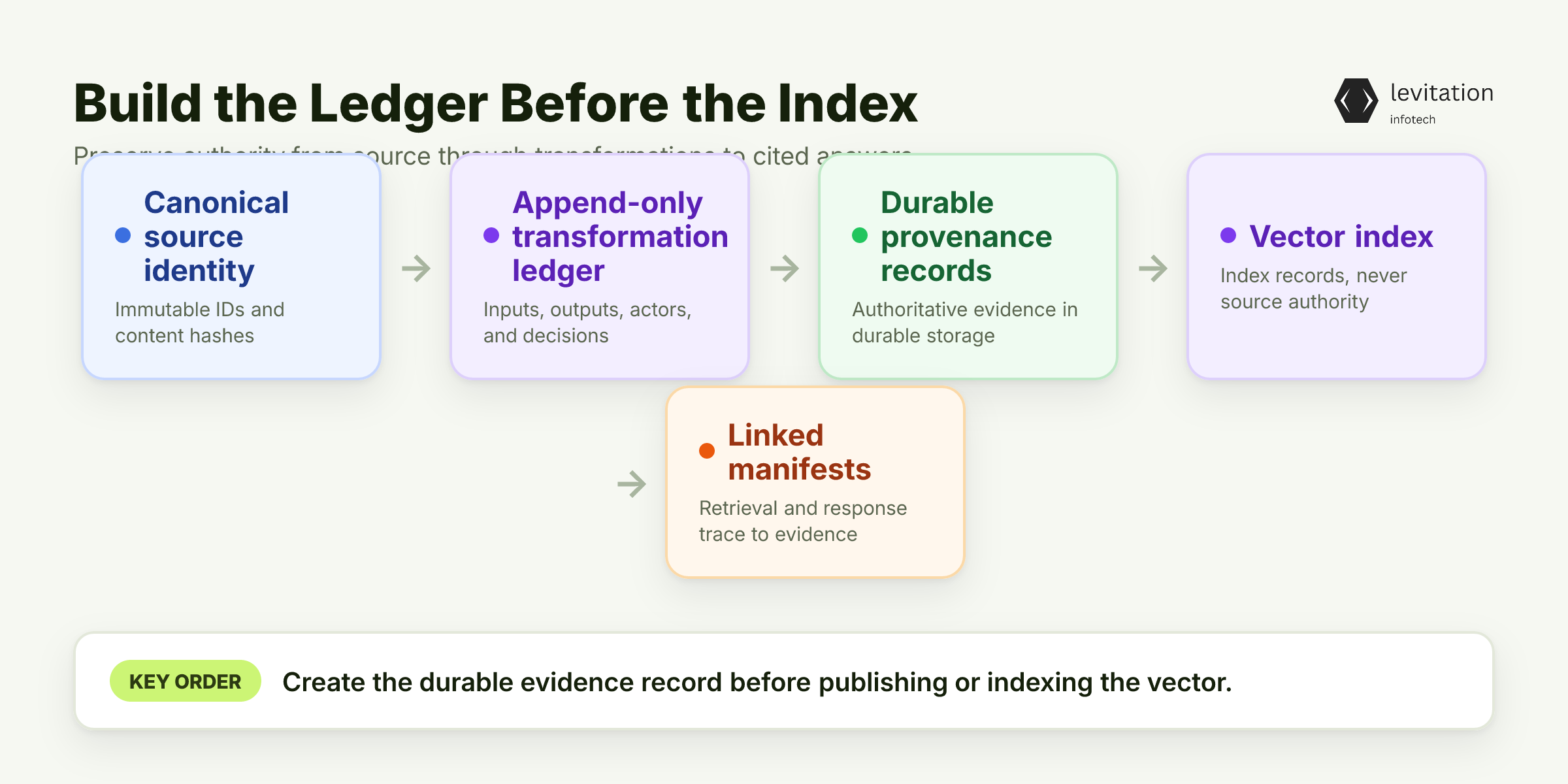
A vector can be published before its evidence record is durable. That ordering can break the chain before retrieval begins. The ledger must describe both the artifact and the decision that admitted it.
Canonical source identity
Assign immutable identifiers to the source document, source version, extracted chunk, transformation run, embedding version, and index entry. Use content hashes to detect changes. Never treat a mutable database row as the source identity.
Consider a legal policy that moves from version one to version two. The document identifier stays stable.
The version and hash change. Without this separation, an updated row can inherit the authority of an older source. How can that separation hold when each ingestion step creates another artifact?
Append-only transformation ledger
Record every ingestion and preparation step. Each entry must include inputs, outputs, tool or model version, actor, timestamp, policy decision, and upstream and downstream identifiers.
Each record answers one question: what produced this artifact? Preserve deletions as explicit events.
A silent edit makes the ledger lie. Append-only history also exposes embedding migrations that quietly break vector indexes.
The ledger must also capture what the retriever used. What belongs in a retrieval manifest?
Retrieval and response manifests
Generate a retrieval manifest when candidates are selected. Generate another when the response is produced. A reviewer should move from the answer to cited evidence, then backward through every transformation.
A compact manifest can carry:
`{"source_id":"src-441","source_version":"v3","chunk_id":"chunk-441-07","transformation_ids":["tx-redact-12","tx-embed-08"],"embedding_version":"emb-08","index_snapshot":"snap-1842","policy_decision":"allow","prompt_version":"prompt-19","model_version":"model-12","cited_source_versions":["src-441@v3"]}`
Store authoritative provenance records in a durable system of record. Options include an append-oriented ledger, relational metadata store, or governed object store. Use the vector database as an index over those records, not their only home.
Using transactional publication or an outbox pattern keeps approved artifacts and index entries aligned. Commit provenance first, then publish the index entry. Reconcile later to catch missing or stale writes.
The same pipeline concerns apply to AI/ML training, where dataset and model artifacts need reproducible promotion. Recording manifests helps only if auditors and operators can query them through a routine interface.
Otherwise, evidence remains trapped in logs and custom scripts. Can this model scale into an enterprise control?
Turn RAG Auditability into an API Contract
A reviewer should not need database credentials or access to the vector vendor's console. The endpoint should resolve references through the provenance store and return only evidence allowed for that review.
Make RAG auditability an API contract, not a special request to the database team. Define a minimal endpoint such as `GET /v1/rag-audits/{request_id}`.
It should return: - The source chain and transformation history. - Candidate and selected chunks. - Policy outcomes. - Prompt and model versions. - The generated answer and its citations.
The request ID becomes the entry point, not a search string across systems. Version the contract. Changing field names or policy meanings can break downstream review tools just as surely as changing an API.
Contract tests should challenge five promises: - Can the reviewer identify the exact source version? - Can the system detect an unauthorized or stale chunk? - Can the reviewer reproduce the retrieval snapshot? - Can the response distinguish no-answer behavior from policy rejection? - Does every cited claim that affects the answer link to evidence?
For example, if a cited clause was redacted before embedding, the trace should expose that transformation. The reviewer can then judge the actual evidence, not the pre-redaction text.
The same manifests support incident response. When someone challenges an answer, start with the request identifier. Do not search disconnected vector, application, and model logs.
Run continuous checks for missing source identifiers, unrecorded transformations, mismatched embedding versions, incomplete citations, and manifest write failures. Fail closed when a high-impact source lacks required provenance.
Roll out in stages: - Start with high-risk or high-value sources. - Record current ingestion and retrieval activity. - Backfill only metadata that existing records can verify. - Expand coverage by risk. - Mark unknown history as unknown.
Apply the audit contract to AI/ML training and RAG evaluation workflows. Use the same identifiers across both.
Once provenance becomes a tested interface, database comparison changes. Speed no longer tells the whole story. What should teams compare instead?
Provenance Becomes the New AI Database Moat
Vector speed remains necessary. It is not the moat.
Durable differentiation comes from preserving trustworthy evidence across ingestion, retrieval, prompt construction, and output. The same source discipline applies to AI/ML training, even though its outputs are model behavior rather than retrieved text.
Use this rubric when comparing AI databases: - Source identity: Can every chunk resolve to an immutable source and version? - Transformation lineage: Can each derivation be replayed? - Policy enforcement: Can the system reject stale or unauthorized evidence? - Retrieval manifests: Can every request expose its exact snapshot? - Version reproduction: Can reviewers recreate source, prompt, model, and index state? - Deletion propagation: Can a source removal reach every derived artifact? - Evidence export: Can auditors receive the chain without custom log work?
These controls support risk reviews, source disputes, model updates, content removals, and procurement. They explain why an answer appeared and which changes could alter it.
Keep the vector database replaceable. Treat it as one component inside a broader AI data control plane.
The questions below are practical: how provenance differs from lineage, whether RAG needs it, and what a minimum viable implementation contains.
Frequently Asked Questions
What is the difference between AI data provenance and data lineage?
Data lineage records how data moved and changed across systems. AI data provenance adds origin context, ownership, collection conditions, governance controls, and evidence that handling supports current use.
Lineage helps reconstruct the path. Provenance helps determine whether that path is defensible.
Is AI data provenance required for RAG, or only for model training?
RAG systems need provenance for every retrieved source and the transformations applied before retrieval. Training-specific provenance adds dataset composition, licensing, and preparation history.
Both depend on traceable source identity and versioned handling. See AI/ML training for the deployment workflow.
Can a vector database provide RAG auditability on its own?
No. A vector database can select candidates and filter metadata. Durable RAG auditability also requires source identifiers, transformation records, policy outcomes, and retrieval and response manifests outside the vector index.
What is the minimum viable provenance record for an enterprise RAG system?
Record an immutable source ID and version, content hash, transformation history, and relevant ownership or usage policy. Also record chunk and embedding versions, plus the retrieval-to-citation manifest.
These records must connect an answer to the exact evidence used without manual log correlation.
How do we retrofit provenance onto an existing RAG system?
Start with high-risk or high-value sources, assign stable IDs, and record new transformations and retrieval manifests.
Backfill only history that existing records can verify. Mark unknown historical details explicitly rather than manufacturing a lineage that never existed.
Which high-risk source will you make defensible first?
About the author
Mayank Singh is a software developer at Levitation Infotech, where he builds web and AI-powered applications across the company’s fintech, healthcare, and enterprise projects.