


TL;DR: Citations prove your RAG system answered a question. Regulators want proof it was allowed to answer, with that data, in that context. Most enterprise RAG stacks can't reconstruct that record. A regulator-ready audit trail logs corpus governance, retrieval decisions, and human review at every pipeline stage. It stores them immutably for the applicable retention period.
Key Takeaways: - A citation is UX. An audit trail is evidence. Regulators treat only the second as compliance proof. - Three records are missing from most RAG stacks: corpus governance, rejected retrieval candidates, and post-generation human review. - Audit-grade logging must be pipeline-native and async by default. Governance stops trading off against latency. - Append-only, tamper-evident storage with six-to-seven year retention is the floor, not the ceiling, for regulated deployments.
The Citation Trap: Why Showing Sources Doesn't Satisfy Regulators
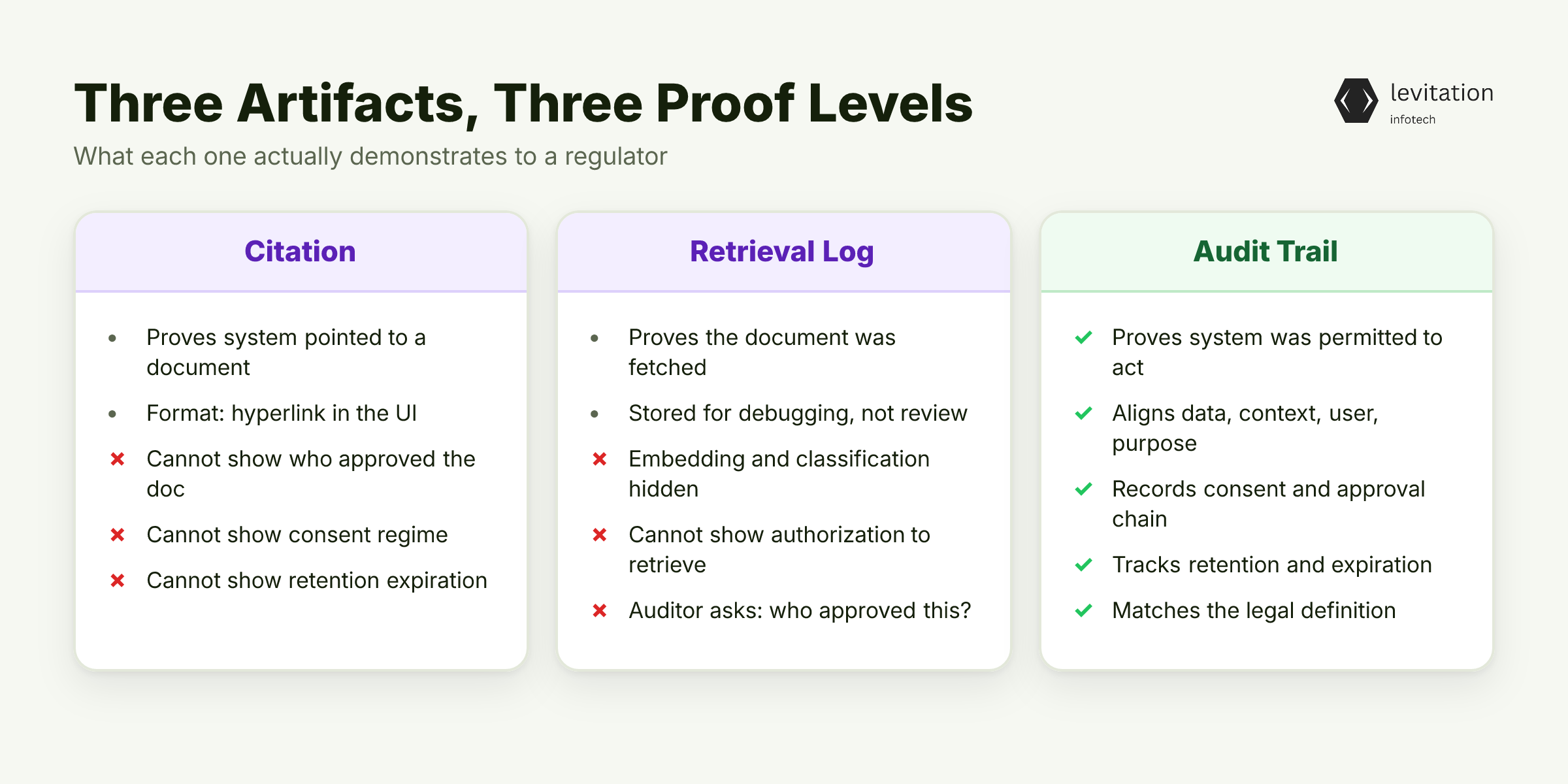
Your RAG system cites its sources, logs every query, and stores retrieval metadata. None of that will satisfy a regulator.
Citations prove your AI answered. Regulators want proof your AI was allowed to answer. Most deployments can't produce that record.
This is the gap that keeps compliance teams awake. Not hallucinations. Not prompt injection. The gap between "the AI retrieved a document and used it" and "the AI was authorized to retrieve that document." The second requires data, context, user, and purpose to all align.
A citation in the UI is a hyperlink. A log entry is observability. Neither is a reviewed audit trail. The distinction matters: - A citation proves the system could point to a document. - A retrieval log proves the document was fetched. - An audit trail proves the system was permitted to do both.
Most enterprise RAG systems cite the source after generation, store the retrieval event for debugging, and call it done. This pattern collapses under audit pressure. The team shows the auditor a log of queries and retrieved documents. The auditor asks: who approved that document? Under what consent regime? When does retention expire? Silence.
The deeper problem sits below the application layer. Embedding pipelines, vector stores, and document classification labels don't appear in standard observability tools. A citation in the chat window is the visible tip of an iceberg. The work we do on RAG inference and retrieval architecture treats the iceberg as the primary surface, not the chat output above it.
The definition of "audit trail" regulators enforce is already written into law, and it asks for more than most RAG stacks can produce.
What 'Audit Trail' Actually Means to Regulators
When a regulator says "audit trail," they mean a specific artifact. Not best effort. Not a debugging log. A reconstructable record of who triggered an action. The record must show what data the system touched, what output it produced, and what downstream effect followed. Storage must be immutable for the full retention period of the applicable regime.
Financial regulators treat a missing decision trace as a books-and-records violation, not a best-practice gap. HIPAA requires compliance documentation to be retained for at least six years. If your RAG retrieval log touches patient data, it falls inside that perimeter, whether you labeled it that way or not.
The cost of getting this wrong hits the balance sheet. Healthcare breaches in 2025 averaged $7.42M per incident. A missing audit trail pushes a routine incident into "willful neglect" territory.
Two practical consequences get missed:
- Retention isn't a per-deployment decision. It's a per-data-class decision. One patient record in your index, and the whole retrieval log inherits HIPAA retention.
- Immutability isn't a backup. It's a property of the write path. Editable logs are logs a regulator treats as untrustworthy.
The same logic applies to insurance, legal, and credit decisioning systems. A retrieval log that exposes which documents a model saw, when, and why is itself regulated evidence. Lose it, mutate it, or fail to produce it on demand, and the violation isn't "we didn't log enough." The violation is "we destroyed records we were required to keep."
The law is clear. The technical reality inside most RAG stacks is not. Three critical records go missing, and audit logging for model inference has to be designed as a first-class pipeline stage.
The Three Records Your RAG System Doesn't Log
Three event classes vanish from most RAG pipelines. Each one is the kind of record a regulator will ask for under subpoena. None of them appear in a standard retrieval log.
Record #1: Corpus Governance. Who approved a document for ingestion? What classification label did it carry? What consent and retention policy applies? Without this, your system retrieves unauthorized content, and a citation makes that worse, not better.
A document in the index without a provenance trail is a record the system "should not have had." The audit question isn't "did it cite correctly." It's "was it allowed to cite at all." Ingest pipelines that bypass approval workflows because "we'll audit later" produce systems with no record of authorization.
Record #2: Retrieval Decisions. Your retriever scored and ranked every candidate. The top three were shown to the LLM. The next twelve were rejected. Regulators want the rejected list, not the shown list. That's where bias, leakage, and policy violations hide.
A retriever that considered a protected-class document and then filtered it out is still a system that "saw" that document. The audit log has to record what was considered, not just what survived.
The same logic applies to documents rejected by access control. A user without permission triggers a query. A confidential record appears in the candidate set. The access filter blocks it. The audit trail must show that block. Otherwise the regulator sees only that the document existed, not that access was enforced.
This is the exact pattern that breaks systems built around RAG embedding and retrieval pipeline design without governance as a pipeline boundary.
Record #3: Human Review and Override. Who reviewed the output before it reached the user? Was there a policy override? A redaction? A post-hoc correction? Most RAG logs record "output delivered" and stop.
Unreviewed AI output logged as "reviewed" is the failure mode regulators are now naming in enforcement actions. A reviewer field that's always null is not a review process. It's a confession.
Each missing record is a gap a regulator can exploit. The retriever's rejected list, the ingest-time consent record, and the human approval field are not nice-to-haves. They separate a system that demonstrated authorization from a system that demonstrated only that it ran.
Each missing record has a specific pipeline boundary where it gets created. The architecture has to capture all three automatically. Miss the boundary, and the record vanishes.
Anatomy of a Regulator-Ready RAG Audit Trail
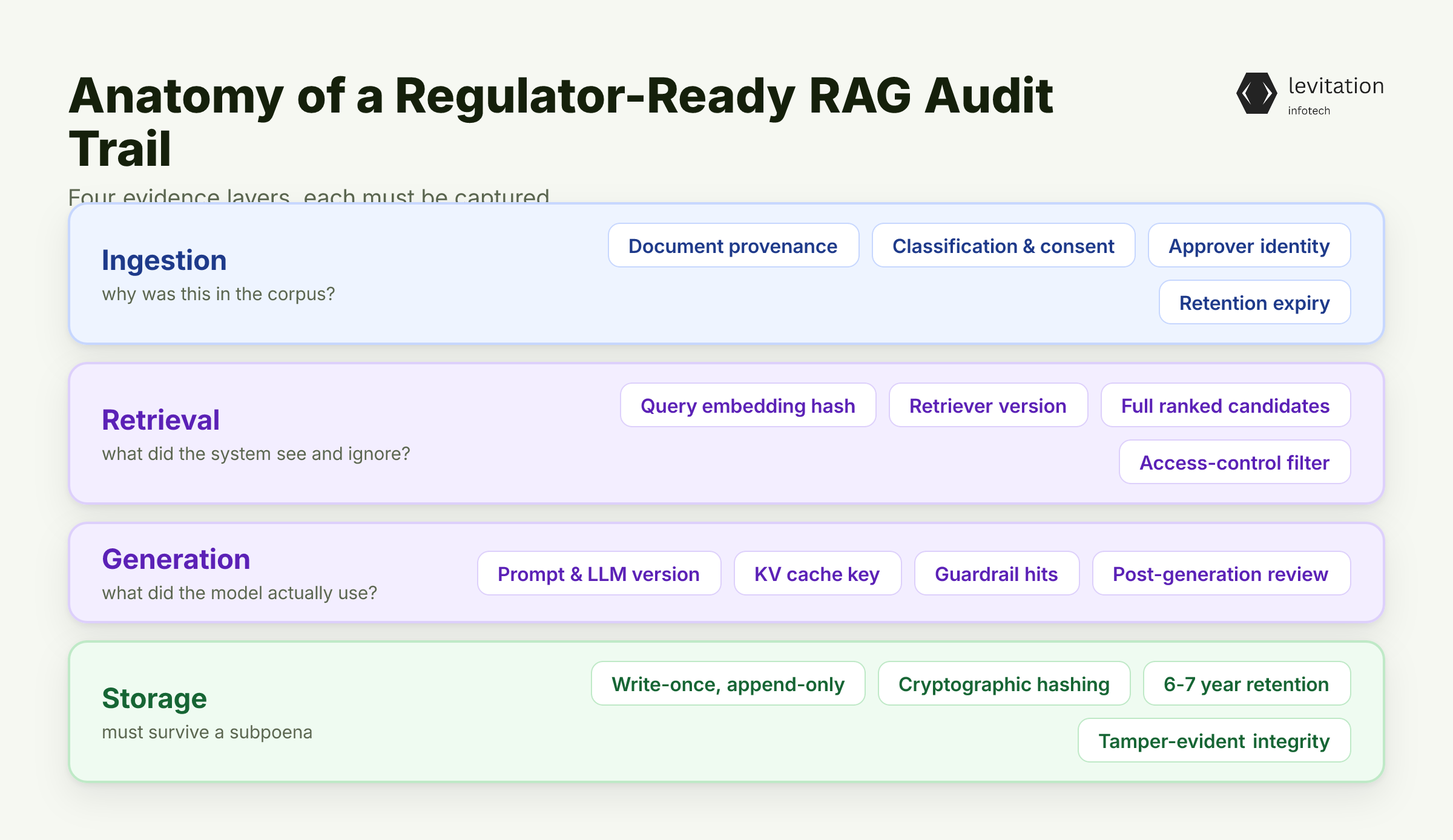
The four layers of a RAG system each produce a distinct class of evidence. Get all four right, and you have a reconstructable audit trail. Miss one, and you have a debugging log that won't survive a subpoena.
Ingestion layer. Log document provenance, source system, classification label, consent record, and retention expiry. Log the identity of whoever approved the document for the index. This record travels with the document through every downstream stage. Without it, the system can't answer "why was this in the corpus?"
Retrieval layer. Log the query embedding hash, the retriever version, the full ranked candidate list (not just the top-k), the relevance scores, and the access-control filter that was applied. The rejected documents are the evidence. A retrieval log that only shows what was used hides what the system decided to ignore.
Generation layer. Log the prompt template version, the LLM version, the KV cache key, the output, and any guardrail hits. Then log the post-generation review: who saw it, what was modified, and what action the user took downstream. This is also where LLM inference and transformer attention logging matters. Most inference engines discard the activations that would prove what the model actually saw.
Storage layer. Write-once, tamper-evident storage with cryptographic hashing. Six-year retention minimum for HIPAA-adjacent systems; seven years for financial services. Append-only, not overwriteable. If your log can be deleted by a developer with database access, it isn't an audit trail. It's a confession waiting to happen.
Treat your audit log the same way you treat the model weights it was produced from. Both are evidence. Both may need to survive model rollbacks, infrastructure swaps, and personnel changes for the full regulatory window.
A reference event schema:
1# Ingestion event2ingest_event = {3 "event_id": uuid4(),4 "timestamp": now(),5 "document_id": doc.id,6 "source_system": "sharepoint://legal/contracts",7 "classification": "confidential",8 "consent_id": "C-2024-1147",9 "retention_until": "2030-12-31",10 "approved_by": "[email protected]"11}
1# Retrieval event2retrieval_event = {3 "event_id": uuid4(),4 "user_id": user.id,5 "query_hash": sha256(query),6 "retriever_version": "v2.4.1",7 "candidates": [c.to_dict() for c in top_50],8 "shown": [c.to_dict() for c in top_3],9 "rejected": [c.to_dict() for c in top_50 if c not in top_3],10 "access_filter": "role:legal-ops"11}
1# Generation event2generation_event = {3 "event_id": uuid4(),4 "prompt_template": "v1.7",5 "llm_version": "gpt-4-0613",6 "output": response.text,7 "guardrail_hits": [],8 "reviewer_id": reviewer.id if reviewer else None,9 "review_action": "approved",10 "downstream_action": user_action11}
That architecture works in theory. Production-ready integration requires three things in place.
Implementation: What to Log at Each Pipeline Stage
Logging the right things at the right boundaries separates an audit trail from a debugging log. Three boundaries matter: the retriever boundary, the prompt-assembly boundary, and the output boundary. Emit an event at each one.
Structured event schema. Every event gets a unique, immutable event ID. The schema has to travel with the data:
1{2 "event_id": "550e8400-e29b-41d4-a716-446655440000",3 "timestamp": "2026-09-14T08:23:11.412Z",4 "user_id": "u-7721",5 "session_id": "s-abc",6 "document_id": "doc-18472",7 "retriever_version": "v2.4.1",8 "candidates": ["..."],9 "shown": ["..."],10 "rejected": ["..."],11 "llm_version": "gpt-4-0613",12 "output": "...",13 "reviewer_id": "r-114",14 "action_taken": "approved"15}
Pipeline integration. Emit events at the retriever boundary, the prompt-assembly boundary, and the output boundary. Use OpenTelemetry-compatible spans so traces survive model and infrastructure swaps. Vendor-specific event formats are an audit liability. Migrate retrievers, and your historical evidence becomes unreadable. This is one reason we standardize on OTel across GPU-accelerated inference and KV cache management deployments.
Review workflow. Route low-confidence or high-stakes outputs to a human approver before the user sees them. Log the approval, the reviewer, and the timestamp. This record converts an "unreviewed audit trail" into a "reviewed audit trail." Without it, the audit shows only that the system ran, not that a person stood behind the output.
Retention and immutability. Push logs to append-only storage. S3 Object Lock, WORM volumes, or blockchain-anchored hashing all work. Lifecycle policies must match the strictest applicable regulation. Six years for HIPAA. Seven for financial services. If your retention is shorter than the longest applicable window, your audit trail has a gap. Gaps are what regulators find first.
The objection you'll hear from engineering is the latency cost. Doesn't all this logging and review destroy the speed that makes RAG valuable?
The Velocity Paradox: Governance That Doesn't Slow You Down
The objection is reasonable. Every output requires review. Every retrieval logs twenty candidates. Latency goes up. Throughput goes down. The AI feature gets cut from the roadmap. This is the velocity paradox: governance done badly throttles the speed that makes AI worth adopting.
The paradox only applies to governance done badly. Governance done right produces regulator-ready evidence as a byproduct of normal work. Compliance and velocity stop trading off.
The mechanism is async, pipeline-native logging. Logging and review don't sit on the critical path of the user-facing response. Emitting an event is fast. Writing to an append-only log happens in a background worker. The user sees the same response time, and the audit trail records the same evidence.
Tiered review solves the rest. Auto-approve high-confidence, low-stakes outputs. Async-review medium-risk outputs after the user sees them. Sync-review only low-confidence or high-stakes cases. Latency overhead stays minimal, and the audit trail records which tier applied to every response.
When the architecture is right, compliance stops being a project. It becomes a runtime property. The work we do on production-grade ML training and inference governance is built on this principle.
The result changes three things about how the team operates, and the first one is the one most leadership teams underestimate.
About the author
Mayank Singh is a software developer at Levitation Infotech, where he builds web and AI-powered applications across the company’s fintech, healthcare, and enterprise projects.