


TL;DR: The RBI's 2026 AI audit holds banks fully accountable for third-party models. Most vendor documentation will not survive: not SOC2 reports, not sales-deck claims, not silent model updates. The fix is a six-artifact vendor checklist. Pair it with an internal evidence pipeline. This pipeline must run for months before the audit window opens. It cannot be retrofitted the week before.
Key Takeaways: - The audit shifts accountability onto the bank for every third-party AI model in production. - Five specific evidence gaps cause most first-time AI audit failures. They are basics, not edge cases. - A kill-switch on the model's decision layer, not the UI, is non-negotiable for compliance. - Retrofitting audit documentation is detectable and inadmissible. Logs must exist from day one. - Agentic AI can automate the evidence chain the regulator wants, across all three lines of defence.
Your SOC2 Report Won't Save You: The Accountability Shift
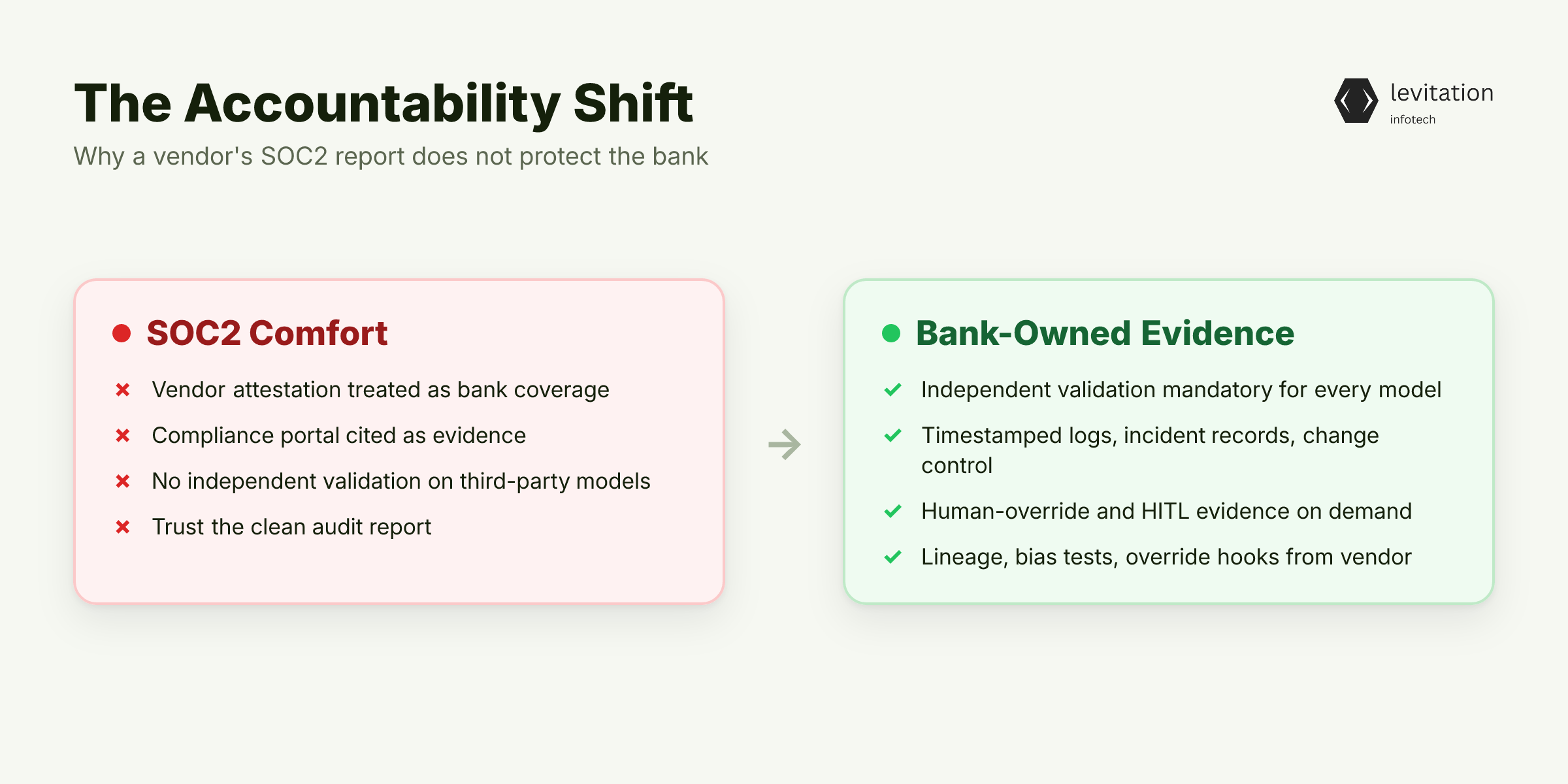
Your vendor's SOC2 report is irrelevant. The RBI's 2026 AI audit will hold your bank accountable for every model you didn't build. Most vendor documentation will not survive the first week of auditor scrutiny.
The Reserve Bank of India's draft AI guidance makes a clear break from past practice. Banks are now fully accountable for third-party AI models. This includes models they did not build themselves.
A vendor's clean attestation report does not transfer responsibility. It never did. The bank that signs the production deployment is the bank that signs the audit finding.
Independent validation is mandatory for every model. This includes vendor-supplied systems. The regulator does not care who trained the model. It cares whether the bank can prove three things. First, the model is fit for purpose. Second, it is monitored in production. Third, it is overrideable on demand.
Vendor transparency gaps trigger extra safeguards the bank must design, fund, and run. If the vendor refuses to share training data lineage, the bank must act. If the vendor refuses to share bias test results, the bank must act. If the vendor refuses to share override hooks, the bank must act. In all these cases, the bank must run its own monitoring, validation, and human-in-the-loop layers. That is not optional. It is a written expectation in the draft guidance.
The audit focuses on evidence chains the bank owns. It does not focus on certifications the vendor holds. Auditors will look for timestamped logs. They will look for incident records. They will look for change control entries. They will look for human-override evidence. None of these can be produced by pointing at a vendor's compliance portal.
This is the same pattern we have seen in why cloud setups fail RBI data localization audits. It is also the way RBI AI rules are reshaping fintech architecture. In both cases, the regulator wants bank-owned evidence, not vendor promises.
But if the rules are clear, why are most organizations already failing their first AI audit?
The Five Things That Fail Every First AI Audit
Because the rules are clear on paper and brutally specific in practice. The first AI audits of 2026 are running now. The same five gaps are showing up across banks, insurers, and fintechs.
Industry analysis puts first-time AI audit failure rates near 90 percent. The causes are not exotic. They are the basics. - No risk classifications. Vendors ship models without a documented risk tier. The bank cannot answer the auditor's first question. Is this a Tier 1 credit decisioning model? Or is it a Tier 4 marketing-recommendation model? The bank must know. - No bias testing evidence. Testing was done internally at the vendor. Reports are proprietary, redacted, or absent. The auditor needs the method, the dataset, the protected classes, and the result. Without these, the audit fails. - No oversight documentation. Human-in-the-loop claims live in sales decks, not in operational logs. There is no timestamped record of a human reviewing, approving, or overriding a model decision. - No incident records. Vendors do not share drift, hallucination, or failure logs. What the bank sees is a customer-facing outage. What the auditor wants is the underlying model behaviour log. - No change control logs. Vendor model updates happen silently. This breaks the bank's frozen-baseline assumption. The bank thinks it is running model v3.2. In fact, it is running v3.4, retrained last Tuesday.
The last gap is the most expensive. If a vendor silently changes a model in production, the bank may not know. From that day forward, the bank's evidence chain is wrong.
Most banks do not run drift detection on vendor models. That single omission invalidates an extended period of audit prep.
These are not exotic requirements. They are the basics. They reveal a deeper problem about how vendor relationships were structured in the first place.
Why Vendor Lock-In Quietly Becomes Audit Lock-In
The deeper problem is structural. Vendor contracts were written for commercial reasons, not for audit survival.
The bank signed a great deal on price, performance, and SLAs. It did not sign for evidence.
When a vendor cannot produce the five artifacts, the bank bears the compliance penalty. The vendor does not. The regulator does not fine the vendor. It issues a finding to the bank. The bank pays for the re-audit. The bank pays for the remediation. The bank also pays for the regulatory scrutiny that follows on other products in the portfolio.
Re-audits cost money. But timeline delays kill deals. They also trigger regulatory scrutiny on adjacent products. A multi-month re-audit cycle means frozen roadmaps. It means board-level risk reporting. It means regulator attention on every other AI system the bank operates.
Documentation and monitoring logs cannot be created after the fact. If they were not running for months, they are gone. There is no "we started last week" workaround. Auditors know what retroactive data looks like. They treat it as a separate finding.
Vendor contracts typically grant access to performance metrics. They do not grant access to model internals, training data lineage, or override hooks. The bank has a dashboard. It does not have the audit artifacts. This is the standard SaaS contract structure. It is also the standard reason banks fail audits on systems they do not own.
It is also the same blind spot we covered in why fintech AI passes QA but RBI still rejects it. Passing the build-time test is not the same as surviving a regulator's evidence check.
There is one requirement that turns vendor lock-in from a commercial problem into an existential one: the kill-switch.
The Kill-Switch Problem Nobody on the Board Is Talking About
The RBI proposes a mandatory kill-switch. It can override or stop any AI model operating inside a bank. This includes third-party models. The bank must hold a technical override path on the model's decision layer. It cannot be a UI toggle. It cannot be a settings checkbox. It cannot be a "contact your account manager" workflow.
Most vendor contracts do not grant the bank technical override rights on the model's decision layer. The bank can disable its own integration. It cannot stop the vendor's model from returning a recommendation. If that recommendation reaches a downstream system that acts on it, the kill-switch did nothing.
A kill-switch that only disables the bank's UI is not a kill-switch. It must also disable the vendor's model decision. Otherwise, it fails for audit purposes. The auditor will ask: "Show me the override that stops the model from returning a decision." If the answer is "we turn off our front-end," the audit fails on the spot.
This is also why zero-trust architecture in fintech AI cannot be bolted on after procurement. The override path has to be designed in. It must be designed in contractually. It must be designed in technically. Both must happen before the model goes live.
So what does a defensible vendor posture actually look like under the 2026 framework?
Your Vendor Audit Checklist: Six Artifacts to Demand This Quarter
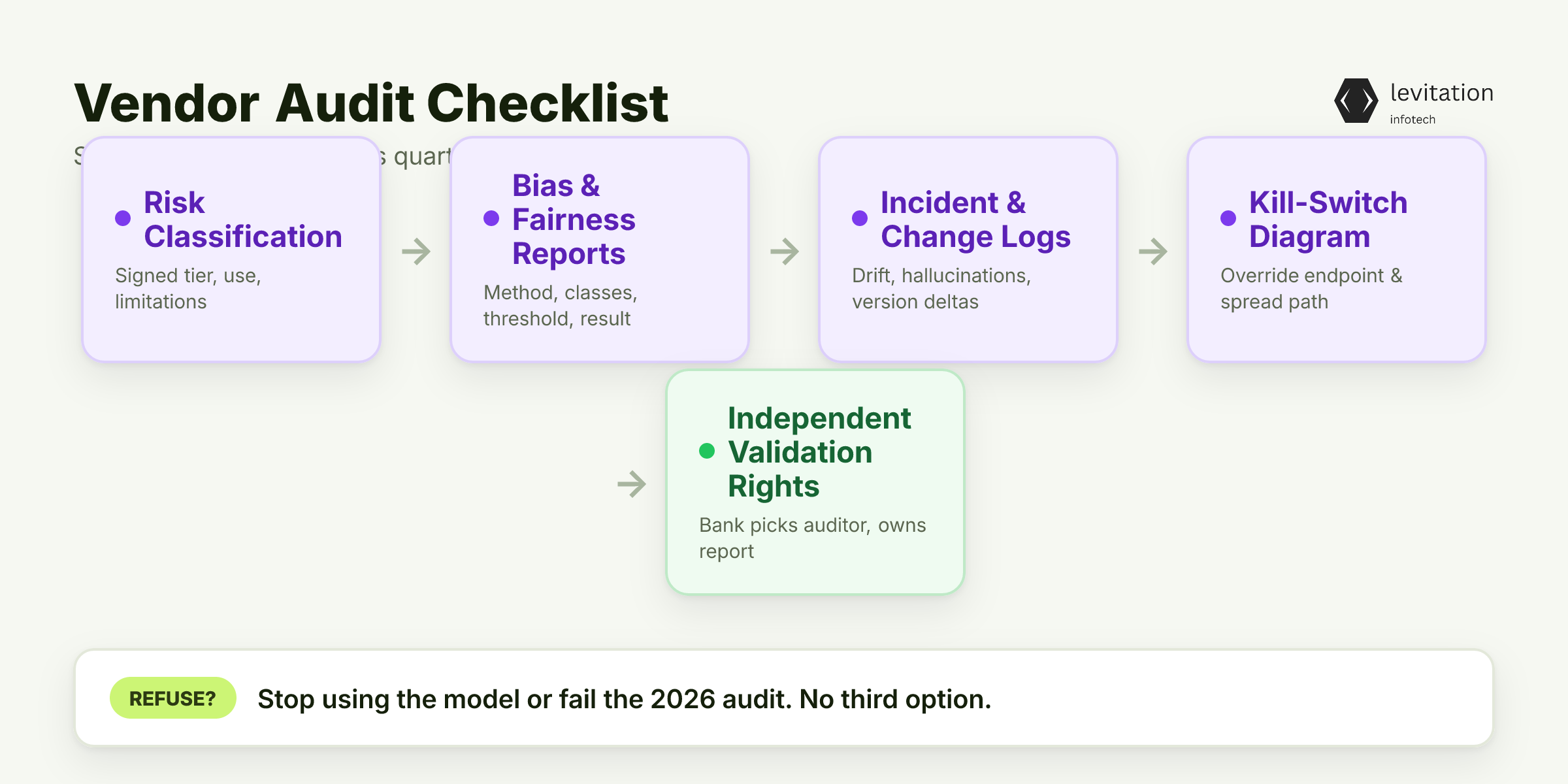
A defensible posture starts with the artifacts. The bank's procurement and risk teams must add six specific items to every vendor model contract renewal. They must also add them to every new procurement. This work must start this quarter. - Written risk classification for each deployed model, signed by the vendor's model owner. Not a marketing one-pager. A signed statement of risk tier, intended use, and known limitations. - Bias and fairness testing reports with method disclosed. The dataset. The protected classes tested. The metric. The threshold. The result. No redactions. - Incident logs covering drift, hallucinations, and downtime, not just customer-facing outages. The bank needs to see the model behaving badly before customers do. - Change control log showing every model version deployed, with timestamp and behavioural delta. The bank must know when the model changed. It must know what changed. It must know what the blast radius was. - Technical kill-switch architecture diagram showing the bank's override endpoint, not just an admin panel. The diagram must show the decision layer. It must show the override point. It must show the spread path. - Contractual right to independent validation by the bank's chosen third-party auditor. The vendor cannot pick the validator. The bank picks. The bank pays. The bank owns the report.
If a vendor refuses any of these, the bank has a choice. It can stop using the model. Or it can accept that it will fail the 2026 audit on this system. There is no third option.
Demanding the artifacts is step one. Producing the bank's own evidence chain is the harder, longer, more important problem.
Building the Audit-Ready Evidence Chain Before the Deadline Hits
The bank's own evidence chain is what the auditor actually inspects. Vendor artifacts are inputs. The bank's pipeline is the deliverable.
Agentic AI can automatically pull required evidence across systems. It can flag policy exceptions. It can assemble audit-ready documents. Instead of a team of analysts chasing screenshots from twelve tools, AI agents do the work. They read model logs. They fetch incident records. They cross-reference change tickets. They produce a pre-validated evidence pack.
This is the direction we have already documented in open-source agent toolkits threatening compliance. The next compliance layer is automated, not manual.
The three lines of defence each need their own data pipeline. The first line is model owners. The second line is independent validation. The third line is internal audit. The first line produces the evidence. The second line validates it. The third line audits the first two. If any of the three lines is reading screenshots manually, the audit will fail on cycle time alone.
Evidence must be timestamped and unchangeable from day one. Retrofitted logs are detectable and inadmissible. This is why agentic systems that have been running for an extended period produce a continuous, hash-chained evidence trail. Auditors accept this trail. A "we built the pipeline last month" project does not get the same trust.
When this evidence chain exists before the audit, the dynamic changes. It changes with vendors. It also changes with the regulator.
What Changes When You Walk Into the Audit Prepared
The audit stops being a threat. It becomes a checkpoint. The bank walks in with months of evidence per model. The three lines of defence run cleanly. A kill-switch test report from the previous quarter is ready. The auditor's questions already have answers.
First-time audit pass. No re-audit cost. No deal delays. No public compliance failure. The product roadmap stays on schedule. The board risk report gets cleaner each quarter, not louder.
Vendor risk becomes a measured line item in board reporting. It is no longer a vague procurement checkbox. The bank can show, in numbers, which vendors passed the six-artifact check. It can show which failed. It can show the remediation timeline.
The kill-switch is tested, not theoretical. The bank can prove override capability on every production model. This includes the third-party ones. The proof comes from a timestamped drill log from the most recent exercise.
AI deployment speed actually increases. This is because the governance framework is already built, not bolted on. The bank can sign off new models in weeks, not months. The pipeline is reusable.
Frequently Asked Questions
Q: What does the RBI 2026 AI audit actually require from banks?
A: A board-approved Model Risk Management Framework. It must cover all AI and ML models. It must include mandatory independent validation for every model. This includes third-party systems. It must include risk-based classification of all models. It must also include documented human oversight with a kill-switch feature.
Q: Is the bank liable if a third-party AI vendor fails the audit requirements?
A: Yes. Under the RBI's draft guidance, banks stay fully accountable for third-party models. If a vendor cannot produce risk classifications, bias testing, oversight evidence, incident logs, or change control records, the bank bears the penalty. The vendor does not. The bank pays the re-audit cost.
Q: What is the RBI kill-switch requirement for AI systems?
A: The RBI proposes a mandatory kill-switch. It can override or stop any AI model in production. This includes third-party and vendor-supplied models. The bank must hold a technical override path on the model's decision layer. A UI-level admin toggle is not enough for compliance.
Q: How should a CTO prepare a bank for the RBI 2026 AI audit?
A: Start by inventorying every AI model in production. This includes vendor models. Demand six artifacts from each vendor. These are risk classification, bias testing reports, incident logs, change control logs, kill-switch architecture, and contractual independent validation rights. Then build an internal evidence pipeline. It must timestamp and store these records without changes from day one.
Q: Can AI compliance documentation be created retroactively before the audit?
A: No. Monitoring logs, incident records, and change control entries must be running in real time. Auditors can detect retrofitted evidence. The absence of an extended operational history is itself a documented finding. This triggers deeper scrutiny.
Start the evidence pipeline now, before the audit window forces your hand.
Sources
Research and references cited in this article:
- RBI sets compliance blueprint for AI-driven finance under draft framework
- RBI proposes AI governance framework for banks, mandates ...
- RBI proposes guidelines for banks to manage AI risks
- RBI 2026 Update: AI Compliance for NBFC/Bank Recovery
- RBI wants to mandate AI kill switch for all banks, human oversight ...
- RBI Panel: AI Risks in Finance & Mitigation
- RBI Proposes AI Risk Management Framework
- Indian banks may face an AI compliance bill: Who will bear the cost?
- RBI's AI risk framework to strengthen governance ...
- Agentic AI Examples in Banking (2026): 13 Real-World Use Cases for Compliance & Risk
- Agentic AI Examples in Banking (2026): 13 Real-World Use Cases for Compliance & Risk
- Agentic AI Examples in Banking (2026): 13 Real-World Use Cases for Compliance & Risk
About the author
Mayank Singh is a software developer at Levitation Infotech, where he builds web and AI-powered applications across the company’s fintech, healthcare, and enterprise projects.