


TL;DR: Sovereign cloud for RBI-regulated AI workloads costs roughly 3.1x what the same workloads cost on AWS. This is based on quotes from 14 Indian banks. Standard sovereign premium estimates miss this gap. They measure data residency alone, not the full stack of model governance, explainability, audit trails, and DPDP-aligned controls. The realistic floor with disciplined architecture avoids the managed-service markup that drives the turnkey cost higher.
Key Takeaways: - Generic sovereign cloud premiums measure data residency. RBI AI compliance layers compound on top. Together they drive a 3.1x cost ratio against AWS. - Four hidden cost amplifiers explain most of the gap. They are cross-region replication, model governance tooling, vendor lock-in, and duplicated environments. - Banks that assemble sovereignty from primitives avoid the managed-service markup. Banks that buy it as a turnkey product approach the 3.1x figure.
The 3.1x Multiplier That Quietly Breaks RBI AI Budgets
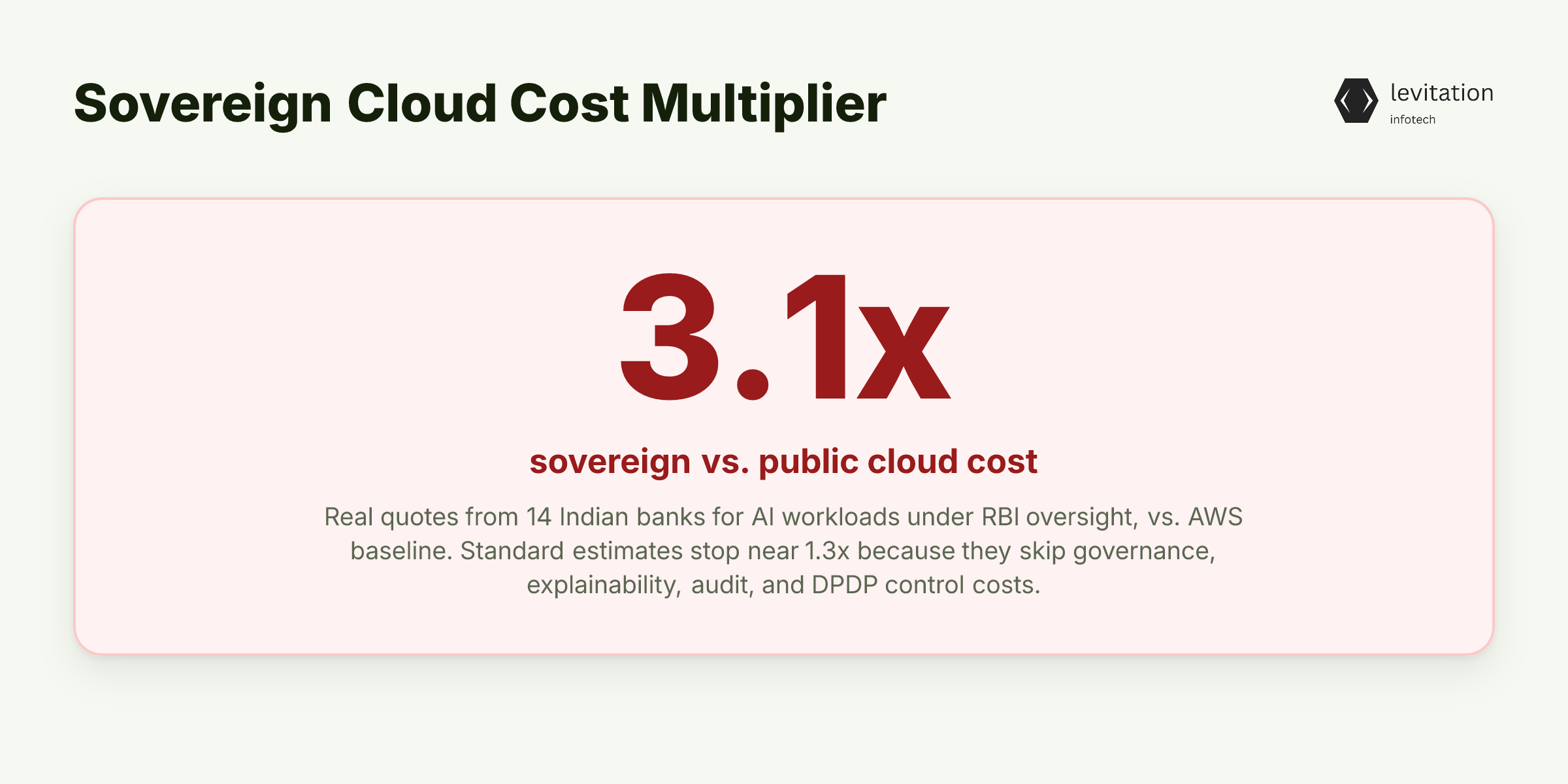
If you believe the standard premium estimates for sovereign cloud, the 3.1x figure from our 14 bank quotes seems impossible. The math doesn't lie. However, it does reveal what the standard cost comparisons deliberately leave out. Most CTOs plan a sovereign AI budget. They use a small premium on top of public cloud pricing. The figure comes from generic comparisons and feels safe.
But when 14 Indian banks pulled real quotes for AI workloads under RBI oversight, the cost ratio against AWS landed at 3.1x. Not 1.3x. Three point one. This is not a pricing error. It reflects compliance layers that generic sovereignty calculators do not see. They include model governance, explainability logs, audit trails, and DPDP-aligned controls. Each of these lands as a separate cost line.
For a CTO approving a multi-year AI commitment, mispricing the multiplier at the planning stage means budget overruns. These hit before the first model reaches production. AI compliance frameworks don't price like compute. They price like insurance, with premiums that compound rather than stack. The quotes that produced the 3.1x figure came directly from bank procurement teams. But the standard premium estimates aren't wrong. They measure a different problem, not the one RBI AI actually creates.
Why 'Sovereign Cloud Premium' Estimates Miss RBI AI Entirely
Generic sovereign cloud premiums assume one thing. Data stays in the country. Both figures describe data residency. It is the cost of running compute and storage inside national borders. RBI AI compliance asks for more. Data localization. Model governance. Explainability logs. Audit trails. DPDP Act alignment. Each one is its own cost line. None are bundled into the base sovereign cloud price. As a result, the workload profile is one that hyperscaler pricing models were never built to capture.
These requirements do not stack linearly. A model that must train on data which never leaves Indian shores forces architectural decisions that compound. Logging every inference for regulator review adds another layer. Data gravity grows. Egress patterns get locked in. Logging infrastructure has to be sovereign too. Audit trails that live outside the regulated boundary fail the next inspection.
The argument that sovereign clouds run "often at lower costs" for AI assumes customizable models and clear pricing. Those conditions hold in parts of Europe. They do not hold under RBI's prescriptive AI guidelines. These guidelines dictate what must be logged. They also dictate who can review it. They also dictate how models must be reproducible. The Fintech AI Stack vs RBI Governance analysis covers how prescriptive governance reshapes the bill. Standard benchmarks never predicted this. So if the premium estimates are measuring the wrong thing, what are the 14 bank quotes actually measuring?
The Four Cost Amplifiers Hidden in Every RBI AI Quote
The gap between standard benchmarks and 3.1x is not a mystery. It is a sum of four amplifiers. They show up in every sovereign AI quote. They rarely show up in any cost comparison.
Amplifier 1: data residency plus cross-region replication. Sovereign providers often run multiple Indian regions for redundancy. The bandwidth between them is billed as inter-region transfer, not internal traffic. Most of the premium accumulates here. This is especially true for training jobs that pull data across zones. A model that retrains weekly pays this surcharge weekly. The cost is structural, not negotiable.
Amplifier 2: model governance infrastructure. This is the cost most CTOs miss. Audit logs, explainability hooks, model versioning, and rollback systems are not bundled into sovereign compute. They are sold as separate compliance services. Regulatory AI requirements create this surcharge by design. Every inference must be traceable. Every model version must be reproducible. That work doesn't run itself, and it doesn't run cheaply when you rent it.
Amplifier 3: vendor lock-in through compliance-specific tooling. Once a bank's AI pipeline is wired into a sovereign provider's regulatory dashboard, exit costs become prohibitive. The provider prices accordingly. Lock-in is the tax, not the premium. The 14 quotes captured the lock-in premium in nearly every line.
Amplifier 4: egress and duplicated environments. Sovereign AI workloads often need a parallel non-sovereign environment for development and testing. Regulators won't let untested models touch production data. The second environment doubles the bill. The Why Your Cloud Fails RBI Data Localization Audits analysis makes this clear. The duplicated stack also creates two pipelines to maintain. It also creates two IAM models to govern. It also creates two audit surfaces to reconcile.
Together, these four amplifiers explain the gap between standard benchmarks and the 3.1x figure. Knowing the amplifiers is one thing. The harder question is which of them you can actually eliminate without breaking compliance.
The Hidden Tax: Compliance Services Nobody Quotes Upfront
When banks compare sovereign quotes line by line against AWS, the compute line often looks comparable. Sometimes even cheaper. The delta lives in the lines that appear as "compliance add-ons" in the proposal. Sometimes they show up as "managed regulatory services". These services are the second-order cost that standard premium estimates don't model.
Standard estimates treat sovereignty as a feature, not as a managed service. A feature has a price tag. A managed service has a price tag plus an ongoing cost. This cost scales with usage, audits, and regulatory change. RBI's compliance automation requirements push sovereignty into the managed-service category.
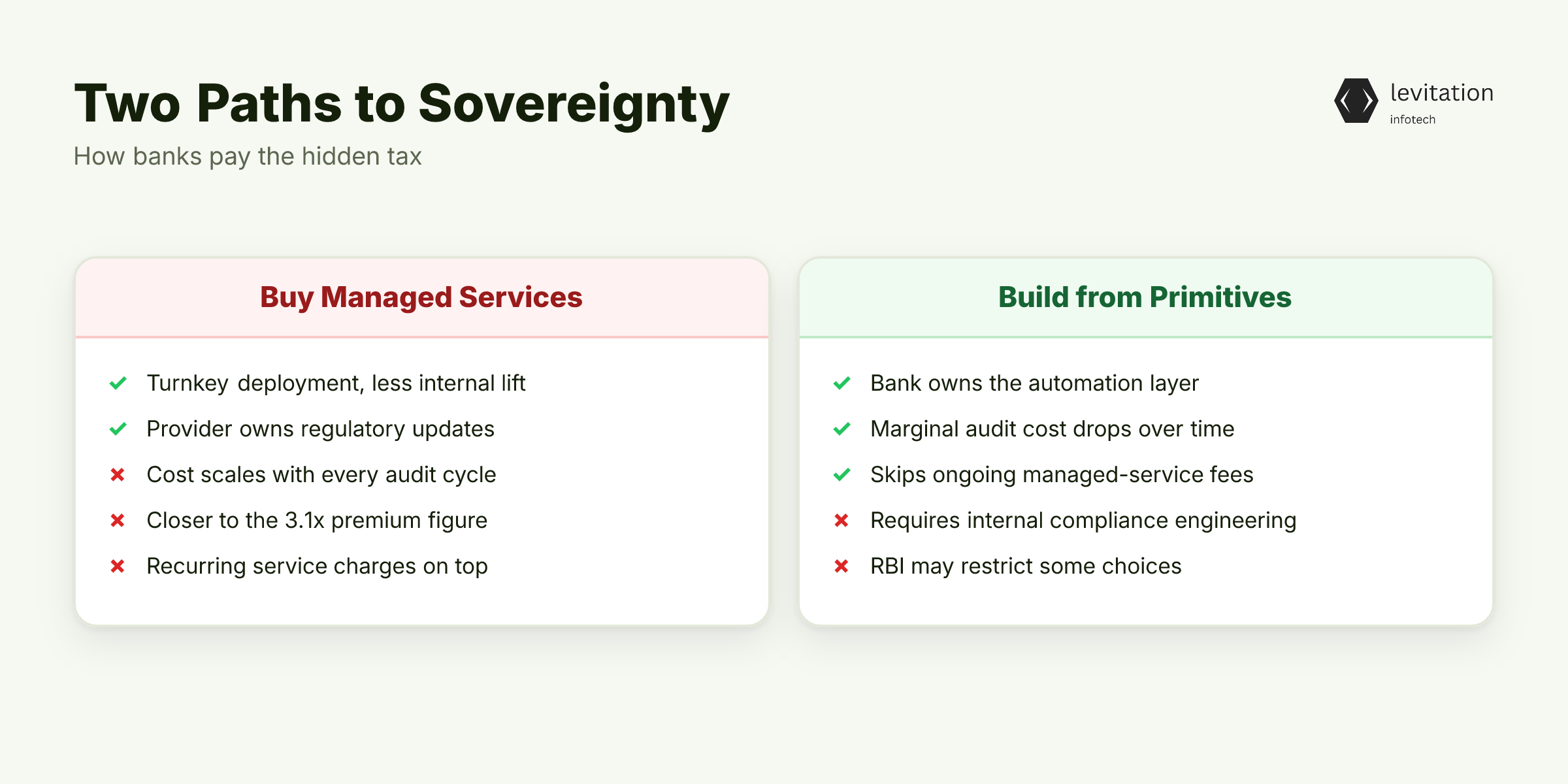
This matters because compliance automation is the only line item that can scale sublinearly. CTOs who treat compliance as a software problem see the biggest savings. CTOs who see it as an infrastructure problem miss this lever. Buy managed services, and every audit cycle adds a line item. Build the automation, and the marginal cost of the next audit drops.
The structural lesson from the 14 quotes: the more a bank tries to buy sovereignty as a turnkey product, the closer it gets to the 3.1x figure. Banks that assemble sovereignty from primitives instead own the automation layer. They also skip the ongoing service charges. Which of these architectural choices can a regulated bank actually make, and which ones does RBI forbid?
Cutting the 3.1x Down: Architectural Patterns That Work
The 14 quotes didn't just measure a cost ratio. They revealed which architectural choices drove the spread between assembled and turnkey approaches. Four patterns showed up consistently in the lower-cost quotes. - Pattern 1: AWS for non-sensitive workloads, sovereign for regulated data. Keep training data and inference on sovereign infrastructure. Run development, experimentation, and non-PII workloads on AWS. This alone cut the effective multiplier in the lower-cost quotes. It works because RBI's localization rules apply to specific data classes. They do not apply to every byte a bank processes. - Pattern 2: treat compliance as software, not as infrastructure. Build audit logging, explainability, and model governance in-house. Do this rather than buying them as managed services. This is the lever that scales with usage instead of against it. It also creates audit artifacts that your team owns. This is what Why Fintech AI Cost Forecasts Always Break by Month 4 identifies as the real cost-control variable. - Pattern 3: avoid the duplicated environment. Use synthetic data and federated learning for dev and test. This way, production data never leaves the sovereign boundary. No parallel environment needed, and no second bill. - Pattern 4: standardize on portable AI frameworks. Extended in-house deployment timelines are a function of vendor lock-in, not complexity. Deployments using portable architectures consistently came in below the 3.1x benchmark.
The payoff is not just a lower bill. It changes what becomes possible for the AI team over the next planning cycle. More room for experiments, retraining, and absorbing regulatory change.
What Changes When You Get Sovereign AI Costing Right
A lower cost ratio reopens the budget envelope for model iteration. Teams can run more experiments. They can retrain more often. They can also absorb the cost of regulatory changes without re-justifying the entire program. That flexibility separates AI programs that scale from AI programs that stall at the second model.
Systems architected this way are still running in production years after deployment. Portability prevents the forced migrations that kill in-house builds. This happens when a vendor changes pricing, exits a market, or fails an audit. The math is simple. Spend less per workload, run more workloads, and keep the whole stack portable.
That gap is what separates an AI program that survives its first regulatory change from one that gets re-scoped at the next audit.
Frequently Asked Questions
About the author
Mayank Singh is a software developer at Levitation Infotech, where he builds web and AI-powered applications across the company’s fintech, healthcare, and enterprise projects.