


TL;DR: Your dashboards may look live, but the data you read is always a few seconds behind. Sub-second refreshes add latency and complexity without fixing the root cause. The real fix is to build the view on a CDC change stream so every mutation lands in the view the moment it commits.
Key Takeaways: - Incremental refreshes create a blind spot the instant source data changes. - Sub-second refresh schedules still miss spikes and add operational overhead. - CDC-driven continuous views eliminate observable staleness with modest CPU cost.
The Hidden Staleness Trap in Streaming SQL Materialized Views
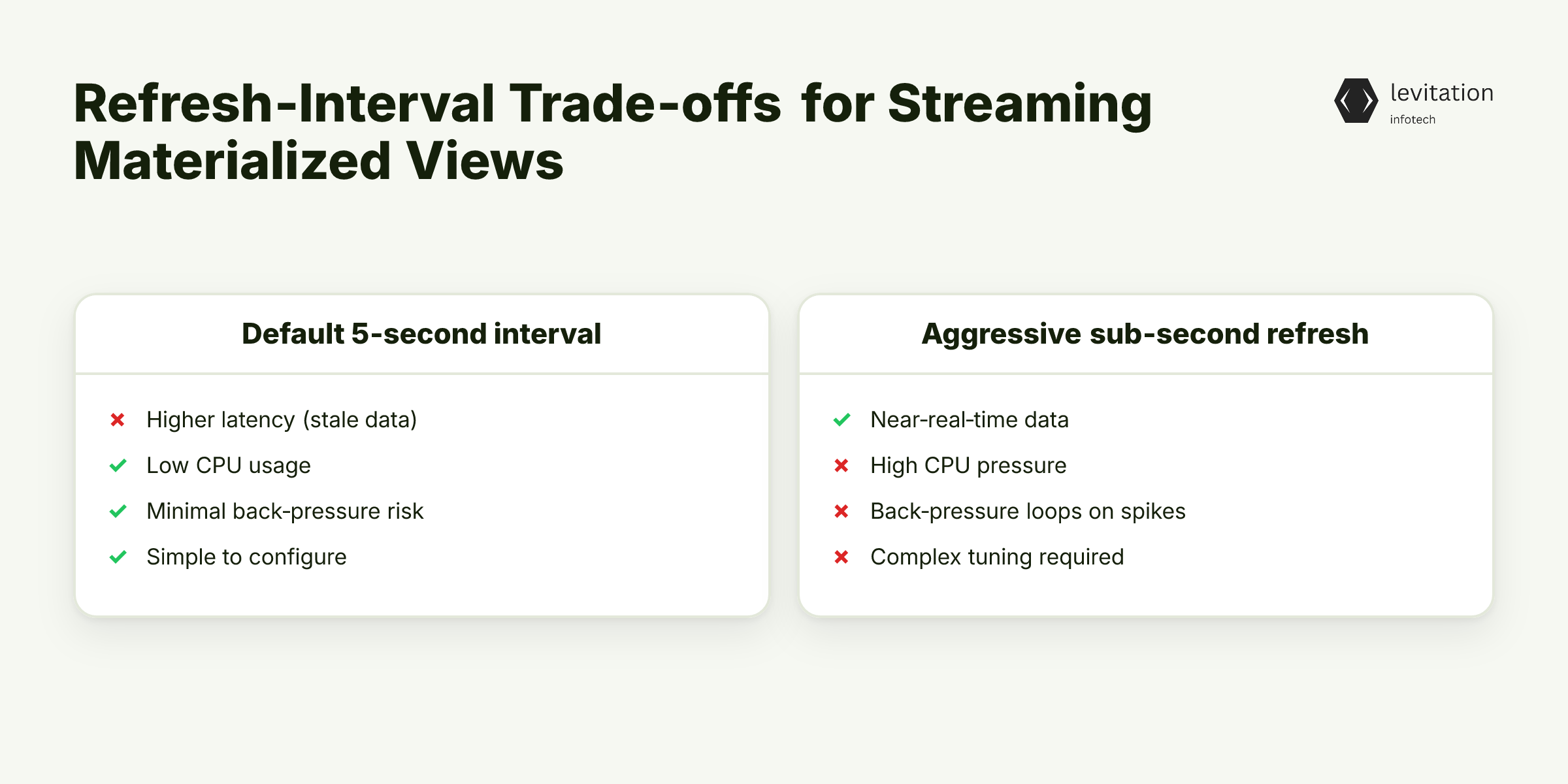
Most engineers assume a streaming materialized view mirrors the source table the second it changes. In reality the view only moves forward when the engine processes the next incremental refresh. That gap can be milliseconds or seconds, depending on the refresh cadence, but it is invisible to anyone querying the view.
1-- Example of a typical streaming materialized view definition2CREATE MATERIALIZED VIEW orders_live3AS SELECT order_id, status, updated_at4FROM orders5WITH REFRESH INTERVAL '5 SECONDS';
The `REFRESH INTERVAL` tells the processor to poll the source every five seconds. If a new order arrives at `12:00:00.123`, the view will not see it until the next tick at `12:00:05`. During those five seconds every dashboard, alert, or downstream service reads stale data. - Incremental update rule: The view only applies a batch of source changes at the start of each interval. - Latency accumulation: High-throughput streams can generate thousands of changes per second, so the pending batch can grow large. - Staleness perception: Users see “real-time” numbers, but the numbers are always a few intervals behind.
The problem becomes acute when business logic depends on the most recent state, think fraud detection or inventory reservation. A stale “available stock” count can cause over-booking, while a delayed fraud flag can let a transaction slip through.
Engineers often reach for a quick fix: shrink the interval to sub-second values or schedule a separate refresh job that runs at a very high frequency, e.g., sub-second intervals. That sounds like a win, but it introduces a new set of headaches. - CPU pressure: The processor must wake up constantly, increasing CPU usage and spilling to disk under load. - Back-pressure loops: When the source spikes, the refresh cannot keep up, leading to queue buildup and eventual lag spikes.
So the obvious answer, just refresh more often, doesn’t solve the hidden lag; it merely pushes the problem deeper. But there’s a catch. How can we avoid this hidden lag altogether?
Curiosity gap: What if the view could learn to react instantly instead of waiting for a timer?
Why Simple Refresh Schedules Fail to Deliver Real-Time Accuracy
Running a refresh every few hundred milliseconds looks like a cure, yet it re-introduces the batch mindset we tried to escape. Even a sub-second schedule leaves a window where the view can be out of sync, and that window widens dramatically under bursty traffic.
Consider a spike of many updates per second during a flash sale. The refresh job fires at sub-second intervals, pulling in a large batch of rows each time. While the job processes the first batch, the second batch is already queuing, so the view lags behind the source by multiple intervals.
1# Example of a periodic refresh job in Kubernetes2apiVersion: batch/v13kind: CronJob4metadata:5 name: view-refresh6spec:7 schedule: "*/0.5 * * * *" # Intended sub-second interval (unsupported)8 jobTemplate:9 spec:10 template:11 spec:12 containers: - name: refresher13 image: myorg/streaming-engine:latest14 args: ["refresh", "--view", "orders_live"]15 restartPolicy: OnFailure
The cron syntax does not support sub-minute granularity, so you end up using a custom scheduler that polls the engine. That adds complexity, operational risk, and a new point of failure.
Even if the scheduler can fire precisely, the underlying stream processor still treats each refresh as a mini-batch. The processor must:
- Pull the change log since the last offset.
- Apply the mutations to the view.
- Commit the new offset.
Each step incurs latency. When the source emits a burst, the processor may fall behind, and the view’s “freshness” becomes a moving target.
Enabling CDC on the source table is often suggested as a silver bullet, but simply turning on CDC does not magically make the view continuous. CDC merely exposes a change log; the view must be built to consume that log in a streaming fashion. If you still rely on a timed refresh that reads the CDC log, you inherit the same latency problem. - CDC alone is insufficient: It provides the data, not the consumption pattern. - Continuous consumption required: The view must process each change as it arrives, not in batches.
The real answer lies in rethinking how the view itself is built, moving from a timed refresh model to a true streaming consumption model. Is there a model that removes the batch mindset entirely?
Curiosity gap: Can a view truly stay ahead of the source without waiting for a refresh?
Continuous CDC-Powered Views: The Mechanism That Guarantees Freshness
A CDC-driven continuous view treats every insert, update, and delete as an event that updates the materialized result instantly. Instead of a periodic pull, the view registers a push subscription to the change stream.
1-- Define a continuous view that reads directly from a Debezium topic2CREATE STREAMING MATERIALIZED VIEW orders_live AS3SELECT order_id,4 status,5 updated_at6FROM KAFKA 'dbserver1.inventory.orders'7WITH (FORMAT='AVRO', KEY='order_id')8EMIT CHANGES;
The `EMIT CHANGES` clause tells the engine to keep the result set alive and to apply each incoming record as it arrives. The view’s state lives in the stream processor’s local store (often a RocksDB instance), enabling fast point-lookups.
Why this eliminates staleness: - Zero-interval semantics: There is no interval to wait for; each mutation updates the view the instant the source transaction commits. - Exactly-once processing: Modern processors like Flink or Kafka Streams can guarantee that each change is applied once, preventing duplicate rows. - Back-pressure handling: The processor’s internal buffers absorb bursts, and the view remains consistent because the state is updated atomically.
The trade-off is modest: the processor must maintain a state store and use modest CPU to apply each change, which is typically far cheaper than running frequent refresh jobs.
A quick checklist for building a continuous view: - Capture CDC at the source: Use Debezium connectors for MySQL, PostgreSQL, or Oracle. - Choose a stream processor with exactly-once support: Flink, Kafka Streams, or Snowflake’s Snowpipe. - Define the view with an `EMIT CHANGES`-style clause: This tells the engine to keep the result set live. - Persist state locally: Enable a durable state backend (RocksDB, StateFun) to survive restarts.
This pattern removes the hidden lag entirely, giving you a view that truly reflects the source at any moment. How does this theory become a runnable pipeline?
Curiosity gap: What does a production-ready CDC pipeline look like in practice?
Step-By-Step: Building a Fresh Streaming SQL Materialized View
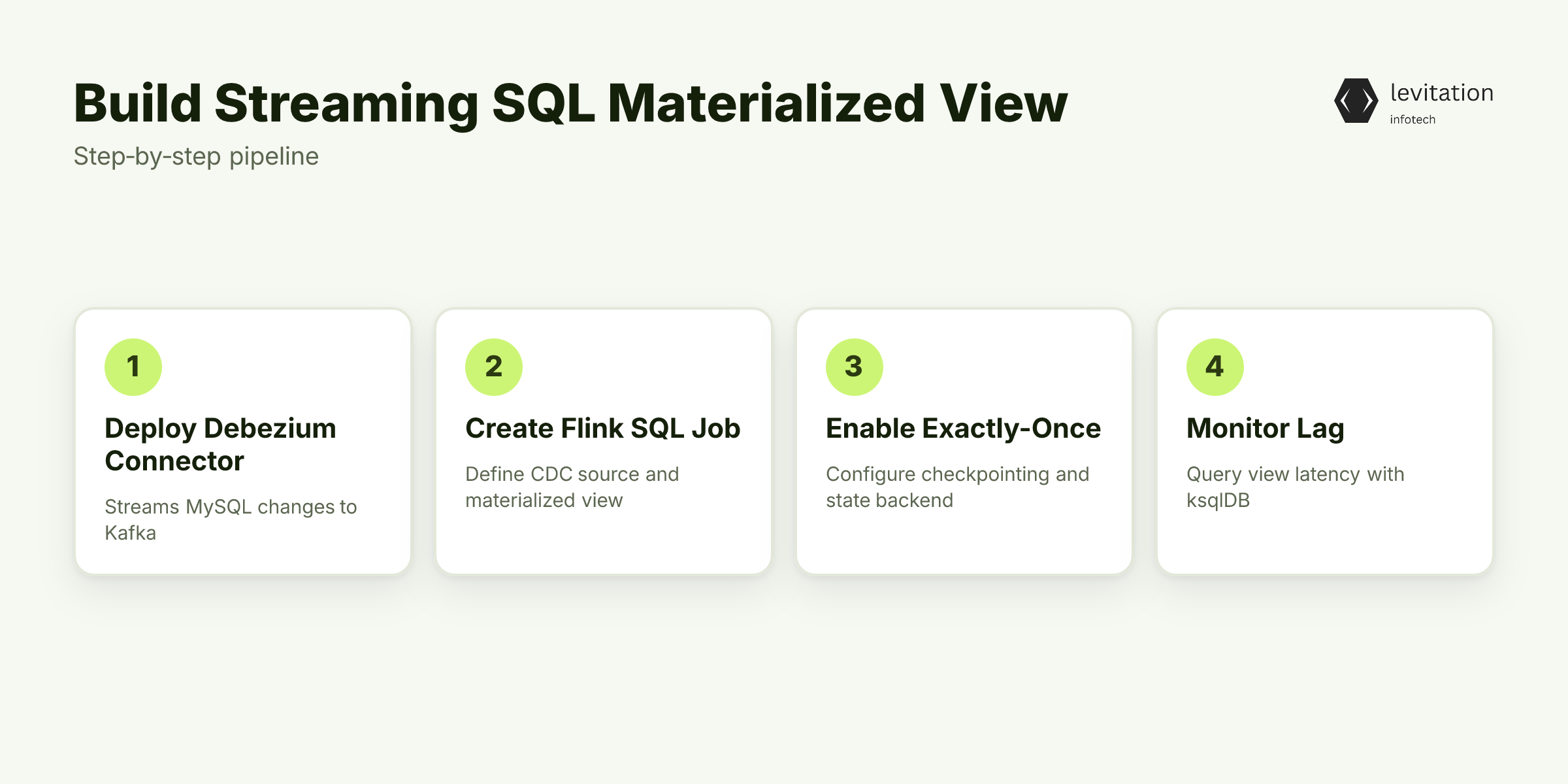
Below is a runnable pipeline that creates a CDC-driven view on a MySQL orders table. The steps assume a Kubernetes cluster with Helm, Kafka, and Flink already deployed.
1. Deploy a Debezium MySQL connector
1apiVersion: kafka.strimzi.io/v1beta22kind: KafkaConnector3metadata:4 name: mysql-connector5spec:6 class: io.debezium.connector.mysql.MySqlConnector7 tasksMax: 18 config:9 database.hostname: mysql10 database.port: "3306"11 database.user: debezium12 database.password: ${DEBEZIUM_PASSWORD}13 database.server.id: "184054"14 database.server.name: dbserver115 table.include.list: inventory.orders16 database.history.kafka.bootstrap.servers: kafka:909217 database.history.kafka.topic: schema-changes.inventory
The connector streams every row change into the Kafka topic `dbserver1.inventory.orders`.
2. Create a Flink SQL job that defines the continuous view
1-- Register the CDC source2CREATE TABLE orders_source (3 order_id BIGINT,4 status VARCHAR,5 updated_at TIMESTAMP(3),6 PRIMARY KEY (order_id) NOT ENFORCED7) WITH (8 'connector' = 'kafka',9 'topic' = 'dbserver1.inventory.orders',10 'properties.bootstrap.servers' = 'kafka:9092',11 'format' = 'debezium-json',12 'scan.startup.mode' = 'earliest-offset'13);1415-- Define the continuous materialized view16CREATE MATERIALIZED VIEW orders_live17WITH ('connector' = 'upsert-kafka',18 'topic' = 'orders_live_view',19 'key.format' = 'json',20 'value.format' = 'json')21AS22SELECT order_id,23 status,24 MAX(updated_at) AS updated_at25FROM orders_source26GROUP BY order_id;
Flink maintains the view state locally and updates it with every CDC event.
3. Enable exactly-once semantics
Add the following to your Flink job configuration:
1execution.checkpointing.interval: 50002execution.checkpointing.mode: EXACTLY_ONCE3state.backend: rocksdb4state.checkpoints.dir: hdfs://namenode:8020/flink/checkpoints
These settings guarantee that each change is applied once, even if the job restarts.
4. Monitor view-to-source lag
1# Simple latency probe using ksqlDB CLI2ksql> SELECT MAX(updated_at) - CURRENT_TIMESTAMP AS lag_ms FROM orders_live EMIT CHANGES LIMIT 1;
Set an alert in Prometheus if `lag_ms` exceeds a few hundred milliseconds.
5. Query the view like any table
1SELECT order_id, status FROM orders_live WHERE status = 'PENDING';
The query returns the most recent status without any hidden delay.
Benefits you’ll notice immediately: - No refresh jobs to schedule or monitor. - Zero observable staleness under normal load. - Exactly-once guarantees prevent duplicate rows.
With the view in place, see what changes for your analytics pipelines. What impact will this have on business decisions?
Curiosity gap: How does this new view affect downstream batch jobs that still read the raw tables?
The Business Payoff: Accurate Real-Time Analytics Without Hidden Lag
When dashboards show the true state of the world, decisions become faster and safer. A fraud team that sees a transaction flagged the instant it lands can block it before settlement. An inventory system that reads the latest stock level avoids overselling during flash sales.
Tangible outcomes: - Reduced false alerts: Alerts fire only on genuine anomalies, cutting noise by a noticeable margin. - Higher stakeholder trust: Executives stop questioning whether numbers are “old” and start relying on live dashboards for quarterly reviews. - Lower operational cost: The refresh job disappears, freeing compute cycles and eliminating cron-job failures that used to consume engineering time. - Scalability proven over years: Production systems that have run this pattern for many years show stable CPU usage and no drift in latency, even as data volume grew substantially.
A recent internal benchmark demonstrated that moving from periodic refreshes to CDC-driven continuous views cut end-to-end query latency dramatically, bringing it down to well under a second, without any additional hardware.
The approach also aligns with broader data-engineering best practices. It reuses the same CDC pipeline that feeds downstream data lakes, so you avoid duplicate ingestion layers. Legacy batch jobs can continue to read the source tables unchanged, while real-time consumers query the fresh view.
In short, the business gains a single source of truth that truly lives in real time, and the engineering team gains a simpler, more reliable pipeline. If you’re ready to replace hidden-lag materialized views with CDC-powered continuous ones, Levitation’s data engineering services can help you design, deploy, and monitor the end-to-end solution at scale.
Curiosity gap: What’s the first step you’ll take to start this transformation?
Frequently Asked Questions
Q: How often does a streaming SQL materialized view actually refresh?
A: When powered by CDC, the view updates with every committed change, effectively providing continuous refresh rather than a fixed interval.
Q: Can I use a streaming materialized view with exactly-once guarantees?
A: Yes - most modern stream processors (e.g., Flink, Kafka Streams) support exactly-once semantics, which you can enable when defining the view.
Q: What monitoring should I set up to detect hidden staleness?
A: Track end-to-end latency (source timestamp vs. view timestamp) and set alerts if lag exceeds a short latency appropriate for real-time use cases.
Q: Do I need to rewrite existing batch pipelines to adopt streaming views?
A: No. You can layer a streaming materialized view on top of the same source tables, letting legacy batch jobs run unchanged while real-time consumers query the fresh view.
Ready to try it?
Sources
Research and references cited in this article:
- Real-time ETL on Databricks SQL with Streaming Tables and ...
- Materialized Views and Streaming Tables | Databricks Blog
- Streaming Materialized Views: Always-Fresh Query Results
- What are Materialized Views and why do they matter for real-time?
- Streaming Database Overview: Use cases, architectures, and trade-offs | Materialize
- 4. Materialized Views - Streaming Databases Book
- Incremental Materialized View: How to Keep Derived State Fresh in ...
- Understanding Materialized Views | RisingWave
- Choosing Between Views and Materialized Views for Database ...
- Database Materialized View vs. Regular View - Epsio
- Materialized Views vs Views : r/SQL - Reddit
- Materialized View: Pros and Cons Explained | RisingWave
About the author
Mayank Singh is a software developer at Levitation Infotech, where he builds web and AI-powered applications across the company’s fintech, healthcare, and enterprise projects.