


TL;DR: A `tenant_id` filter is necessary, but it is not a complete PHI boundary. Derive scope on the server, fail closed when it is missing, enforce record permissions before prompt assembly, and test retrieved candidates rather than the final answer.
Key Takeaways: - A harmless-looking answer can hide unauthorized PHI that already entered the prompt. - Tenant isolation and record authorization solve different problems. - Candidate-level tests and enforcement telemetry turn isolation into evidence.
A Passing Tenant Test Can Hide a Broken Boundary
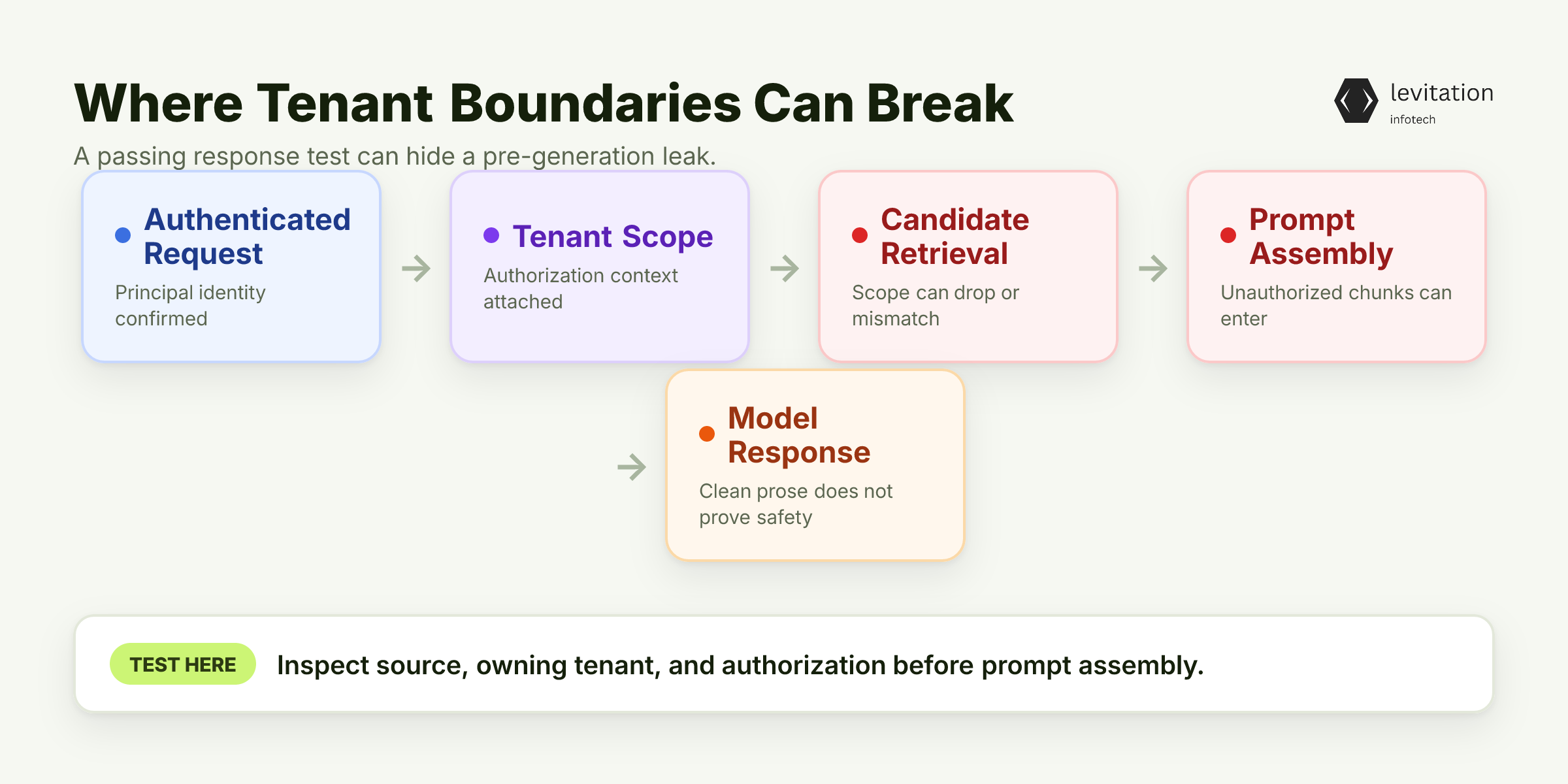
A green security test can still hide a cross-tenant PHI leak. If a request reaches the retriever without its required tenant scope, chunks from another tenant can enter the prompt. The model does nothing wrong, but unauthorized content may already be in the prompt.
The model is not the first boundary
Authentication can succeed while retrieval crosses a tenant boundary. In a shared index, a matching chunk can already sit inside the prompt when generation starts.
The model should not be trusted to detect that boundary crossing. It can paraphrase leaked content cleanly. That makes response review especially misleading.
Teams building healthcare technology should treat the retriever as a security boundary. It decides what the model can know.
The open question is how to prove that boundary held before generation began.
This is also why RAG citations aren't audit trails. A citation shows where text came from. It does not prove that retrieval was allowed.
1request2 -> authenticated principal3 -> tenant scope4 -> retrieval query5 -> candidate chunks6 -> prompt7 -> response
A leak becomes possible when scope can be dropped, transformed, or mismatched between two stages. The dangerous boundary can be the handoff, not the vector database. What should a test inspect before the prompt is built?
Test candidates, not only prose
Consider this sequence: - Tenant A submits a valid clinical question. - The application omits Tenant A's scope. - The vector database returns a matching chunk owned by Tenant B. - The model paraphrases that content without knowing it crossed a patient boundary.
This is an illustrative failure sequence, not an incident report. Its danger lies in a familiar code path.
Before invoking the LLM, capture the source document, owning tenant, and authorization decision for every candidate:
1{2 "request_id": "req-42",3 "principal_id": "clinician-7",4 "tenant_id": "tenant-a",5 "candidates": [6 {7 "document_id": "doc-91",8 "owner_tenant_id": "tenant-a",9 "acl_ref": "acl-91",10 "authorized": true11 }12 ]13}
A harmless final answer does not prove that unauthorized PHI was absent from the retrieval context. It only shows that the model did not repeat it clearly.
The CTO question should therefore change. Do not ask whether the vector database supports tenant filters. Ask whether any retrieval path can run without one.
Missing mandatory scope must stop the request. It must never trigger a broader search.
Adding a `tenant_id` filter looks like the obvious fix. If it remains the only defense, where does the next breach enter?
Why a Single Metadata Filter Is a Fragile Boundary
Six ways scope can erode
Scope can disappear through ordinary engineering changes, not only an exotic attack: - A required field is omitted during ingestion or query construction. - The application and index use different filter names. - A later ingestion job overwrites the owning tenant. - A cache key excludes tenant context. - A fallback path retries without the mandatory filter. - A late-stage cleanup step exposes unauthorized candidates to logs, caches, or shared memory.
Ownership errors corrupt records. Cache and fallback errors reuse or widen scope. Cleanup errors can expose rejected candidates elsewhere.
1{2 "retrieval_scope": {3 "required": true,4 "missing": "deny",5 "stale": "deny",6 "mismatch": "deny",7 "global_fallback": false8 }9}
Defaulting malformed ownership to a shared tenant is especially dangerous. It makes broken records searchable. Which rules inside the tenant still need enforcement?
Tenant isolation is not record authorization
Multi-tenant RAG security guidance draws a key distinction. Tenant membership does not grant access to every record inside the tenant.
Within a hospital, departments, clinician roles, care teams, and patient relationships define finer boundaries. Each boundary restricts a different set of records.
When comparing top AI companies for healthcare in India, ask how vendors enforce those inner boundaries. An enterprise deployment count cannot answer that question. Which deployment layers must preserve that distinction?
Topology changes operations, not the authorization contract
Common multi-tenant retrieval topologies include: - Silo: Each tenant receives a dedicated store. - Pool: Tenants share a store with logical partitions. - Bridge: A shared front door routes requests into tenant-specific resources.
These patterns change cost, latency, and operational complexity. None proves that identity-derived scope survives the full request path.
Pooled retrieval shares storage and compute, improving infrastructure utilization. That optimization model, however, encourages teams to treat application-level filtering as disposable logic. Where can scope break during those handoffs?
Make missing scope fail closed
A scoped search that fails must not become a global search.
1def retrieve(index, vector, tenant_id):2 if not tenant_id or not tenant_id.strip():3 raise PermissionError("tenant scope required")45 return index.query(vector, tenant_id=tenant_id)
The same rule applies to stale scope, inconsistent scope, and stores that cannot enforce the required scope. Deny the request. Record the rejection without copying candidate content into telemetry.
A durable design does not rely on a stronger `WHERE` clause. It derives, binds, and independently verifies tenant and user scope. How does that architecture separate tenant access from record access?
Separate Tenant Isolation From Record-Level Authorization
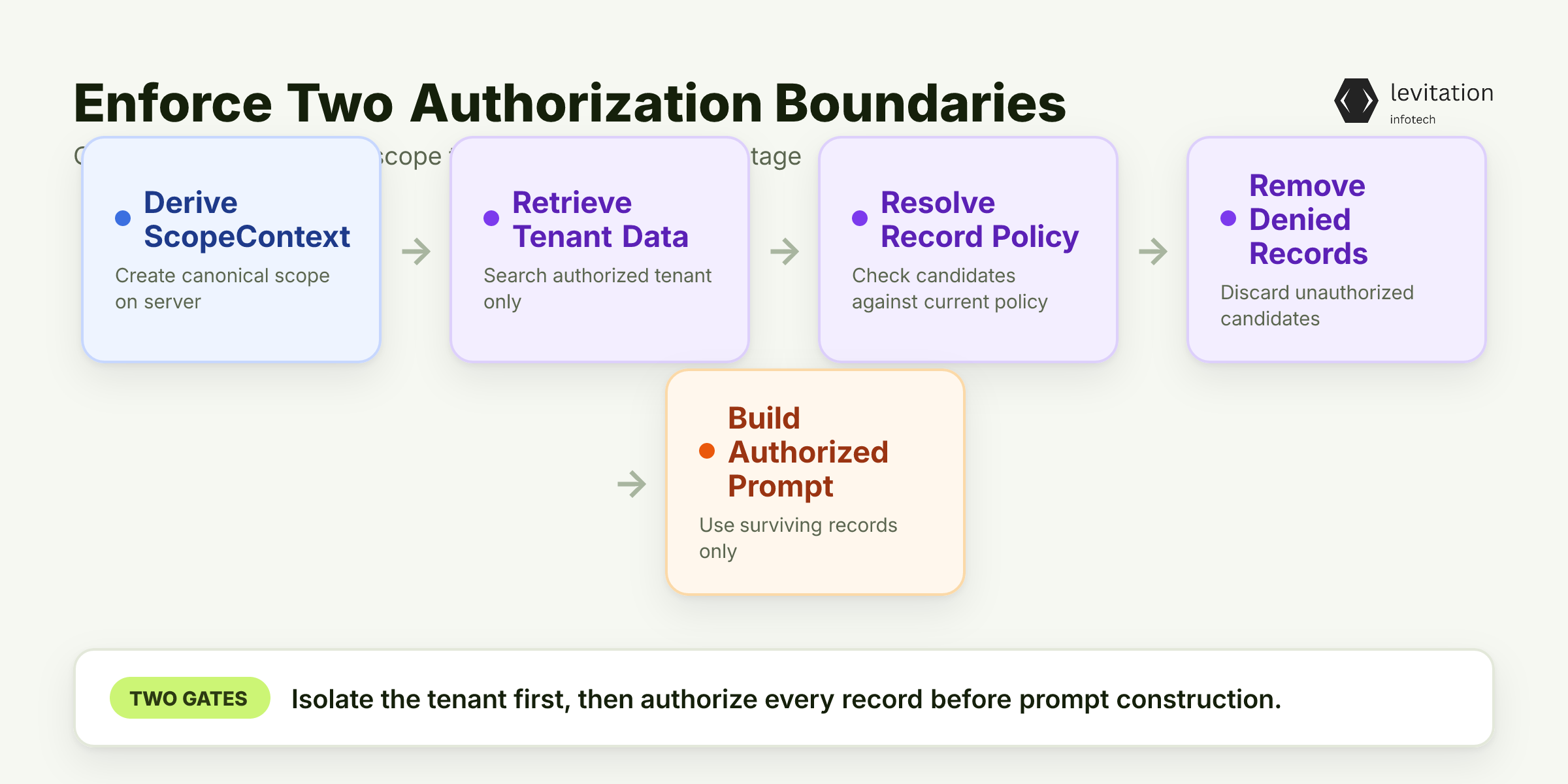
Make authorization produce a canonical `ScopeContext`
Derive every security dimension on the server. Clients request documents. They must never choose the scope used to retrieve them.
1from dataclasses import dataclass2from datetime import datetime34@dataclass(frozen=True)5class ScopeContext:6 tenant_id: str7 principal_id: str8 role: str9 resource_ids: frozenset[str]10 purpose: str11 policy_version: str12 expires_at: datetime
This object becomes the canonical request scope for healthcare technology systems. Vendor evidence for top AI companies for healthcare in India should show the same fields.
The expiry matters because authorization can change during a long session. The policy version matters because a record can become restricted after indexing. Which request stages must carry that scope unchanged?
Bind scope to the data plane
Carry the `ScopeContext` through every stage that handles candidates: - Retrieval and reranking - Caches and queues - Logging and tracing - Prompt and context assembly
Use a dedicated namespace, partition, row-level security, or required tenant field. Match the control to the topology, and enforce it at every relevant boundary.
Treat each stage as an enforcement point. A field name alone is not a security control. Where should record-level authorization enter the path?
Enforce both boundaries before prompt construction
The initial vector search must operate only within the authorized tenant’s data. Searching globally and asking the model to ignore irrelevant chunks creates privacy exposure. It also produces a weak isolation story.
Then apply the record boundary to every candidate. Resolve each source against the authoritative HIS, EHR, or document policy.
If the vector store cannot express fine-grained ACLs, use this sequence:
- Retrieve only from the authorized tenant.
- Resolve each candidate against current record policy.
- Remove denied records.
- Build the prompt only from surviving candidates.
Trimming is not a substitute for the tenant filter. A wrong-tenant candidate should never enter selection. What can leak beside the selected candidates?
Close shared-knowledge and cache side channels
Shared guidelines and common medical references need their own policy class. They must remain distinguishable from tenant-owned namespaces.
Authorization decisions must distinguish shared knowledge from tenant PHI. Shared documents still require request- and purpose-specific checks.
Close the remaining side channels: - Include tenant and policy version in cache keys. - Prevent prompt and embedding caches from crossing authorization contexts. - Scrub PHI from traces and rejection logs. - Propagate scope through asynchronous ingestion and retrieval jobs.
Missing evidence around these boundaries obscures the failure pattern described in Why Your Healthcare LLM Will Fail Its First HIPAA Audit.
But an architecture diagram is not evidence. The next question is how a team can make isolation observable and fail closed in code.
Ship a Fail-Closed Retrieval Path in Seven Controls
The fix is not a longer metadata clause. It is a retrieval path that fails whenever scope disappears.
1. Define a non-optional metadata contract
Require `tenant_id`, `document_id`, `acl_ref`, `classification`, and `policy_version` on every tenant-owned chunk.
Reject or quarantine ingestion records that lack required fields. Never repair missing tenant identity with a default value. A default creates searchable PHI with false ownership. How can the query path prove the contract remains intact?
2. Build the query from server-derived scope
The application flow should resemble this:
1def retrieve(index, vector, identity):2 scope = authorize(identity)3 if scope is None or not scope.tenant_id:4 raise PermissionError("tenant scope required")56 hits = index.query(vector, tenant_id=scope.tenant_id)7 if any(hit.tenant_id != scope.tenant_id for hit in hits):8 raise PermissionError("cross-tenant candidate blocked")910 return trim(hits, scope)
The final tenant assertion is a tripwire. The server-derived scope and vector-store filter remain the primary controls. What should happen when either control fails?
3. Encode fail-closed behavior
Return an authorization error when scope resolution fails. Deny a candidate whose tenant or ACL cannot be resolved.
Never retry a failed scoped search as an unfiltered search. Log the rejection using identifiers and policy metadata, not rejected PHI. Can a later stage undo that decision and reintroduce unsafe data?
4. Re-authorize at the source boundary
Before prompt assembly, compare every candidate’s tenant, document identity, classification, and current policy version with the `ScopeContext`.
Resolve suspicious records against the authoritative source. This second check catches incorrect metadata, stale indexing, and unsafe filter behavior. Which failure paths must the test suite reproduce?
5. Build an adversarial test matrix
Cover these failure paths: - Cross-tenant requests - Same-tenant record denial - Missing tenant metadata - Renamed filter keys - Ingestion tampering - Cache collisions - Retry fallbacks - Top-K starvation
Assert on the retrieved candidate set and generated prompt. Do not inspect only the final response. Which signals show whether the controls work in production?
6. Instrument enforcement rather than activity
Track the signals that reveal a broken boundary: - Scope-resolution failures - Required-filter omissions - Cross-tenant candidates blocked - Unclassified chunks rejected - Policy-version mismatches - Cache lookups missing tenant context
Any event indicating an unfiltered query should page the security owner. Query volume alone tells you nothing about isolation. How can rollout avoid creating a quiet bypass?
7. Roll out without a quiet bypass
Begin in shadow mode. Compare scope decisions and candidate identifiers, not raw PHI. Then introduce a canary tenant and make missing scope a hard failure.
Maintain an incident runbook that can: - Disable generation - Invalidate scoped caches - Preserve audit evidence - Identify prompts built during the exposure window
These controls also belong in AI/ML training. Delivery speed matters only when the shipped path includes them.
When they produce traceable evidence, tenant isolation becomes an operating property rather than an architecture-review claim. How can teams prove that property on every request?
Make Tenant Isolation an Operational Guarantee
A control that cannot be observed is only a configuration claim. Make enforcement visible on every request.
Measure assurance, not configuration
Maintain an assurance view showing: - Retrievals with a resolved `ScopeContext` - Required-filter enforcement - Candidate authorization coverage - Blocked cross-tenant attempts - Policy freshness
A low incident count is not enough. The goal is verifiable enforcement on every request.
1{2 "event": "retrieval.scope_required_filter_missing",3 "request_id": "req-42",4 "tenant_id": "tenant-a",5 "action": "deny"6}
This event records enforcement. It does not reproduce the rejected content. What should buyers ask vendors to prove?
Give the CTO a procurement checklist
For healthcare technology buyers and teams comparing top AI companies for healthcare in India, require vendors to demonstrate: - A cross-tenant adversarial test - A fail-closed missing-metadata response - Record-level trimming against current policy - Every cache and trace that can contain PHI - A tested incident runbook
The same questions belong in AI/ML training and vendor assurance reviews. How does a missing field affect the blast radius of an ordinary mistake?
Reduce the blast radius of ordinary mistakes
A missing field, renamed index, or faulty retry should produce a denied request. It must not create a cross-tenant disclosure.
This design separates release speed from access rules. The same identity and authorization rules apply across models, prompts, and vector stores. What evidence should determine whether a vendor can sustain those controls over time?
Use durability as a decision signal
Ask for evidence of HIPAA-compliant deployments for leading Indian hospital chains. Vendor evidence should cover client retention, production longevity, and regulated-industry delivery.
The goal is not a RAG system that appears multi-tenant. It is a system where no retrieval path can widen its own access. Security operators can then prove that property after the fact.
The remaining question is practical: what must CI, procurement, and incident response demand from the system?
Frequently Asked Questions
Is metadata filtering enough to prevent PHI leakage in multi-tenant RAG?
No. A tenant metadata filter can be the primary vector-store control. It must be server-derived, mandatory, and fail closed.
Combine it with record-level authorization, candidate verification, correctly scoped caches, and cross-tenant security tests. How should the deployment pattern change the answer?
Should `tenant_id` be metadata, a separate namespace, or a separate index?
All three are valid deployment patterns, but they are not interchangeable. A shared index requires strict, mandatory filtering.
A namespace or partition changes the enforcement boundary. A separate index provides stronger physical separation at greater operational cost. How should a team handle a chunk whose owner is unknown?
What should a RAG system do when a chunk has no `tenant_id`?
Reject or quarantine the chunk. Stop the retrieval path that returned it.
The system must never retry without a tenant filter. An unfiltered fallback turns missing metadata into a disclosure path. What else must the filter protect besides tenant ownership?
Can two users in the same hospital retrieve each other’s patient data?
Yes, if `tenant_id` is the only authorization dimension. Tenant isolation prevents hospital-to-hospital leakage.
Role, department, care-team, and patient relationships require a second record-level authorization layer. Apply it to every candidate. How can a team prove both boundaries hold in CI and production?
How should a team test tenant isolation in CI/CD and production?
Test the candidate set with cross-tenant, missing-metadata, wrong-tenant, cache-collision, and retry-fallback cases in CI. In production, alert on missing filters, candidate mismatches, and authorization failures. Rehearse the incident runbook. Test the candidate set before trusting a clean response.
About the author
Mayank Singh is a software developer at Levitation Infotech, where he builds web and AI-powered applications across the company’s fintech, healthcare, and enterprise projects.