


TL;DR: A web app quote is not complete until every charge has an owner, rate, usage rule, and cap. This includes API, hosting, payment, and app-store fees. Compare proposals on one first-year cost sheet, then test failure paths before signing.
Key Takeaways: - A build fee and a runtime bill belong in one business model. - Usage assumptions need provider rates, volume scenarios, and named owners. - Failure tests and spend controls must be contractual, not implied.
The Web App Quote Prices Code, Not Runtime
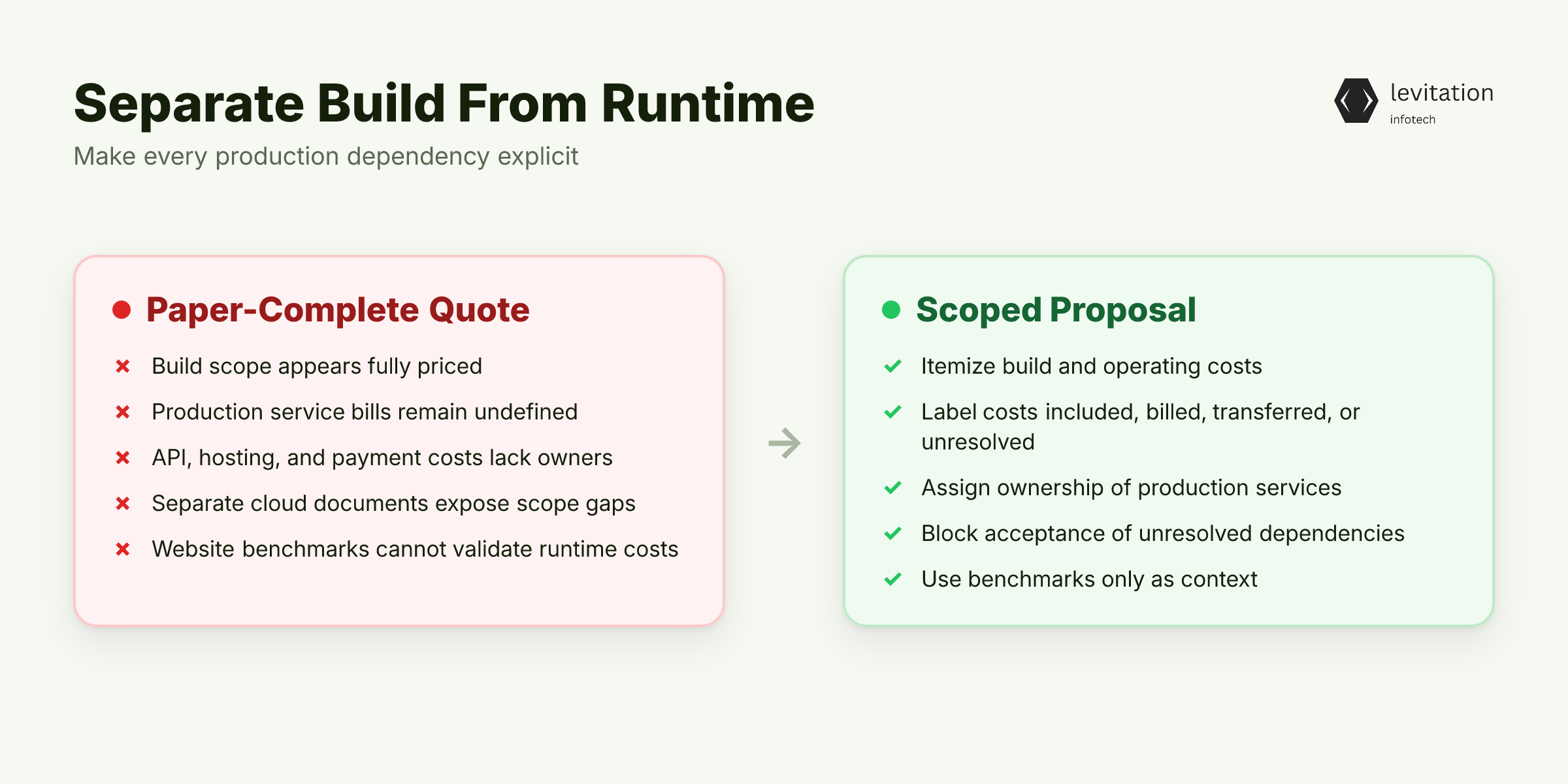
A polished web app quote looks complete on paper. It lists screens, workflows, and delivery dates, yet omits the bills that begin when users transact. The risk is a product whose API, hosting, and payment costs have no owner.
Separate the build fee from the operating bill
A founder receives one proposal covering design, development, testing, and delivery. Nothing states who pays for production services after launch.
Some vendors place those expenses in a separate cloud document. This isn't evidence of deliberate deception. It marks an undefined scope boundary.
According to Nordstone's 2026 guide, third-party API fees, cloud hosting, app-store accounts, and payment processing fall outside some quotes. The list depends on the agency and project scope.
1commercial_boundary:2 build_fee:3 design: included4 development: included5 testing: included6 delivery: included7 runtime:8 third_party_apis: unassigned9 cloud_hosting: unassigned10 payment_processing: unassigned11 app_store_accounts: applicable_only_for_native_distribution
Every proposal should state whether each cost is: - Included in the quoted build fee. - Billed separately during the engagement. - Transferred to the client at handoff. - Unresolved, which should block acceptance.
Use price benchmarks as context, not a verdict
The GoDaddy India guide places basic business websites at ₹40,000 to ₹1,00,000. It places larger business websites at ₹80,000 to ₹3,00,000.
These are website benchmarks. They don't validate a custom app's scope, architecture, or API-driven runtime cost.
When evaluating custom software development, use benchmarks as context. The quote must identify what the vendor builds and which third-party accounts, usage charges, and operating duties belong to the client.
Treating missing line items as later additions can distort the estimate and the product. What changes when those dependencies enter the revenue path?
Why "Add the APIs Later" Budgeting Fails
The post-launch add-on trap starts with a small deferral. The vendor leaves authentication, enrichment, messaging, payment confirmation, and notifications for a later phase.
An API integration isn't merely a plug-in. It changes frontend states, backend errors, retry logic, fallbacks, support duties, and retained data.
1{2 "state": "payment_pending",3 "dependencies": [4 "payment_gateway",5 "sms_provider",6 "address_validation"7 ],8 "on_timeout": "retain_pending_state",9 "on_declined": "show_actionable_failure",10 "billing_observation": "track_provider_attempts"11}
Each dependency adds work across several layers: - User experience: loading, pending, failed, and retry states. - Backend behavior: timeouts, invalid responses, and provider errors. - Billing: repeated calls, webhook attempts, and fallback traffic. - Operations: monitoring, support ownership, and incident response. - Data: required payloads, audit records, and retention rules.
Deferring integrations doesn't preserve the estimate. It moves design work into a phase with less context and a larger bill.
Variable usage defeats one generic contingency
A single percentage buffer can't represent request volume, payment activity, storage, traffic, or retry paths. Retries can increase billable traffic even when completed transactions don't rise.
Payment processing and many API charges include variable costs. Place fixed subscriptions and account charges in fixed columns. Cloud hosting can contain both.
App-store accounts matter only when the project includes native distribution or a store-delivered wrapper. They aren't unavoidable for a browser-only web app.
For buyers evaluating SaaS development, check production credentials, hosting, payment accounts, usage alerts, and spend controls. The quote must mark each one as included, excluded, or transferred. Even a complete-looking quote can create an uncapped runtime bill.
The cure isn't a larger contingency. It's making every external dependency visible before comparing proposals. Which line item would your current proposal omit?
Map Every External Dependency Before Comparing Quotes
A comparison starts only after every billable dependency has an owner and a billing rule. The ledger gives founders and vendors a shared language for costs.
1 business_action: null2 billing_unit: null3 contracted_rate: null4 included_allowance: null5 usage_driver: null6 retry_behavior: null7 failure_fallback: null8 account_owner: null9 spending_cap: null10 contract_terms: null
Every null field needs a named source. Founders supply expectations. Vendors supply contractual terms.
Add four cost classes to the map: - Third-party API fees: enrichment, communication, verification, location, and similar services. - Cloud hosting: compute, storage, traffic, databases, and managed platform services. - Payment processing: charges tied to payment activity and related services. - App-store accounts: only when native mobile distribution is included.
Don't assume every API charges per request. Ask each provider: - What event is billable? - Which information predicts that event? - Which billing unit applies? - What can raise usage without more completed transactions? - Which retry or fallback behavior can create extra charges?
Mark each item as fixed recurring, usage-variable, or conditional. A conditional charge applies only after traffic growth, an overage, or a premium feature is enabled.
For each service, monthly external cost equals fixed monthly charges plus billed units multiplied by contracted rates. Volumes come from founders. Rates come from providers.
With the ledger complete, compare proposals that draw scope boundaries differently. Which boundary should set the comparison?
Normalize Every Quote on One Total-Cost Sheet
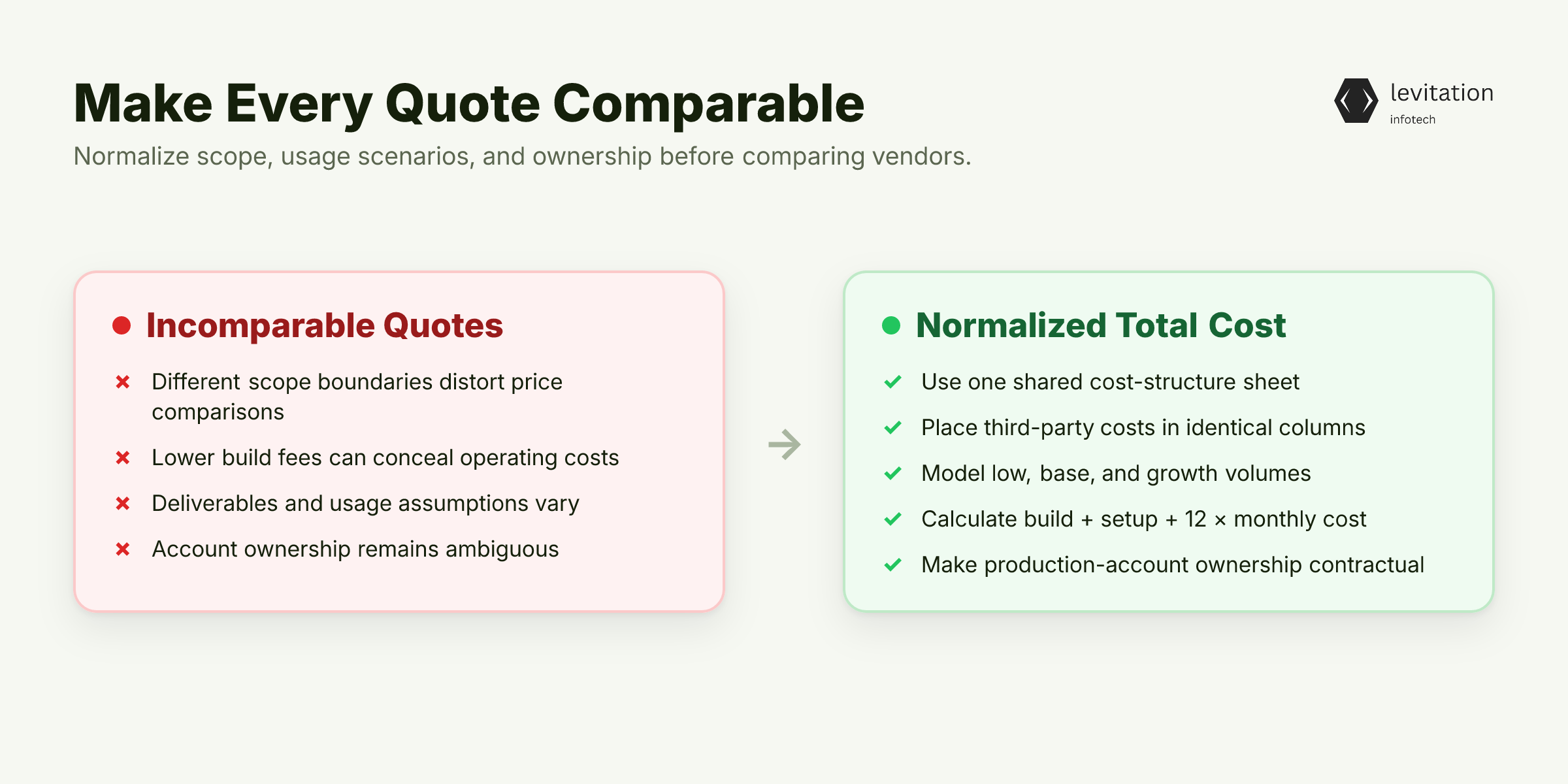
Different scope boundaries make direct price comparisons misleading. A lower build fee can hide more work in an undefined operating bill.
Give every vendor the same cost structure:
1comparison_scope:2 quoted_build_work: required3 one_time_setup_or_account_charges: required4 fixed_recurring_charges: required5 usage_variable_charges: required6 included_allowance: required7 overage_treatment: required8 spending_cap: required9 owner: required
The sheet should place third-party APIs, hosting, payment processing, and app-store accounts in the same columns. This compares cost commitments instead of incompatible deliverables.
A vendor that won't complete the shared sheet hasn't answered the cost question.
Add founder-supplied volume scenarios
Require low, base, and growth cases for transactions, API calls, storage, traffic, and other relevant usage. Don't insert generic benchmark volumes and call them market facts.
Label every input as one of three things: - Contract term: a documented provider or vendor commitment. - Founder assumption: an expected business scenario. - Vendor estimate: a forecast that still needs validation.
Keep the calculation clear:
First-year total cost = build fee + one-time setup and account charges + 12 × monthly operating cost.
1from decimal import Decimal23def first_year_total(4 build_fee: Decimal,5 setup_and_account_fees: Decimal,6 fixed_monthly: Decimal,7 billed_units: list[Decimal],8 contracted_rates: list[Decimal],9) -> Decimal:10 usage_cost = sum(11 units * rate12 for units, rate in zip(billed_units, contracted_rates)13 )14 monthly_external = fixed_monthly + usage_cost15 return build_fee + setup_and_account_fees + 12 * monthly_external
Make account ownership contractual
The proposal must name who: - Creates each production account. - Owns the billing relationship and receives invoices. - Controls quotas and spending caps. - Configures usage alerts. - Rotates credentials. - Owns exported data at the end of the engagement.
For SaaS development, add production account ownership, environment separation, included usage, and spending caps to the handoff checklist. An MVP isn't one-time code delivery.
Long-term support helps only when recurring API costs, account ownership, and escalation duties are documented.
For teams comparing Delhi NCR app development vendors, apply the same sheet to every proposal. Local or agency-specific scope differences mustn't masquerade as better value. Compare the operating model too, as shown in our fixed build versus dedicated team analysis.
A normalized sheet still rests on assumptions. The last procurement step is testing what happens when external services fail. Can the proposal survive a provider outage?
Test Failure Paths Before the Quote Becomes a Liability
Happy-path testing can leave cost risks hidden.
1failure_case: null2user_visible_state: null3retry_policy: null4fallback: null5logging_requirement: null6alert_threshold: null7spending_limit: null8incident_owner: null9final_billing_owner: null
Rehearse failure paths
Use a documented matrix covering: - Provider timeouts and rate limits. - Invalid or malformed responses. - Duplicate and out-of-order webhooks. - Declined or incomplete payments. - Vendor outages and expired credentials. - Retry exhaustion and fallback activation.
For each scenario, record the user-visible state and retry policy. Define the fallback, logging requirement, alert threshold, spending limit, incident owner, and final billing responsibility.
A bounded retry can protect the user experience. Without idempotency, it can also repeat billable work. That operating rule belongs beside the code.
Verify spend controls
Before launch, confirm that the team can: - See usage by service and environment. - Configure alerts before thresholds are crossed. - Set hard caps where the provider supports them. - Separate retry traffic from successful transactions. - Stop nonessential calls during abnormal demand. - Export usage records for review.
Verify credentials and account ownership. Know where credentials live, which environment they affect, and who can rotate them. Record how they transfer to the client.
Ask a custom software development partner to show its operating handoff. Use a walkthrough or examples with sensitive details removed.
For SaaS development, make this walkthrough part of acceptance. A slide titled "handoff" isn't evidence that the team can operate the system.
Once failure paths and spend controls are documented, the proposal becomes an operating plan. What still lacks an owner?
What a Clear Quote Changes Before Launch
Clear cost terms let founders compare the same scope, expect launch costs, and identify who owns each external bill. They replace a vague contingency with rates, assumptions, caps, alerts, and accountable owners.
1launch_handoff:2 signed_cost_ledger: required3 account_ownership_schedule: required4 failure_and_fallback_rules: required5 budget_intervention_thresholds: required
The practical handoff should include: - A signed cost ledger. - An account-ownership schedule. - Failure and fallback rules. - Thresholds that trigger budget or product intervention.
The goal isn't to choose the lowest headline quote. It's to choose the proposal whose launch and operating commitments can be understood, controlled, and funded. This method applies equally to SaaS development and custom software development.
Four questions can now expose an incomplete proposal: - Which external services can create charges? - What events are billable, and under which units? - Who owns each account, quota, and invoice? - What happens when a provider fails?
Which missing answer would change your vendor decision first?
Frequently Asked Questions About API Integration Costs
Benchmarks answer one narrow question. They can't tell you which custom proposal is complete.
Q: How much does web app development cost in India?
The cited GoDaddy India guide places basic business websites around ₹40,000 to ₹1,00,000. It places larger business websites around ₹80,000 to ₹3,00,000.
These are website benchmarks rather than custom web app totals. A custom web app quote still needs a line-by-line comparison that includes API, hosting, and payment-processing assumptions.
Q: What costs can an Indian web app quote exclude?
Nordstone's 2026 guide lists third-party API fees, cloud hosting, payment processing, and app-store accounts as costs outside some quotes.
The exact list varies by agency and project scope. The key question is whether the proposal identifies each cost, assigns ownership, and explains how it will be charged.
Q: Should a SaaS MVP development quote include API and hosting costs?
The quote should state whether each API, hosting, payment, and account charge is included, billed separately, or owned by the client.
At minimum, SaaS development proposals should include monthly operating costs, usage scenarios, quota terms, and a clear account-ownership handoff.
1saas_mvp_quote:2 monthly_operating_cost: required3 fixed_costs: required4 usage_scenarios: required5 included_usage: required6 quotas_or_caps: required7 account_ownership: required8 usage_alerts: required
Q: How do I compare two web app development quotes?
Normalize both proposals using the same build scope and external dependencies. Compare fixed charges, usage-based rates, volume assumptions, support duties, and ownership terms.
Then compare the resulting first-year cost and operating risk. Don't stop at the headline development fee.
Q: Are app-store accounts relevant to a web app?
They matter only when the project adds native mobile distribution or a store-delivered wrapper. For a browser-only application, don't treat an app-store account as unavoidable.
Founders should still verify hosting and API costs. A custom software development proposal remains incomplete if those bills lack an owner, usage rule, or cap. Which one would you add to your vendor checklist first?
About the author
Mayank Singh is a software developer at Levitation Infotech, where he builds web and AI-powered applications across the company’s fintech, healthcare, and enterprise projects.