


TL;DR: A ₹4 lakh generative AI chatbot stalls at 12% resolution not because the model is weak, but because the original budget skipped the four layers underneath: integration, retrieval, orchestration, and evaluation. Operations leaders who fund all five layers routinely cross 60-80% resolution, and the vendor checklist to get there is short.
Key Takeaways: - The 12% wall is an architecture problem, not a model problem - Integration work is the largest budget line and is the most underquoted item - Reasoning-based systems with RAG, tool-use, and agent layers age better than scripted alternatives because the architecture, not the model, carries the load - Eight specific vendor questions separate architects from resellers
The 12% Wall: What Your Dashboard Is Telling You
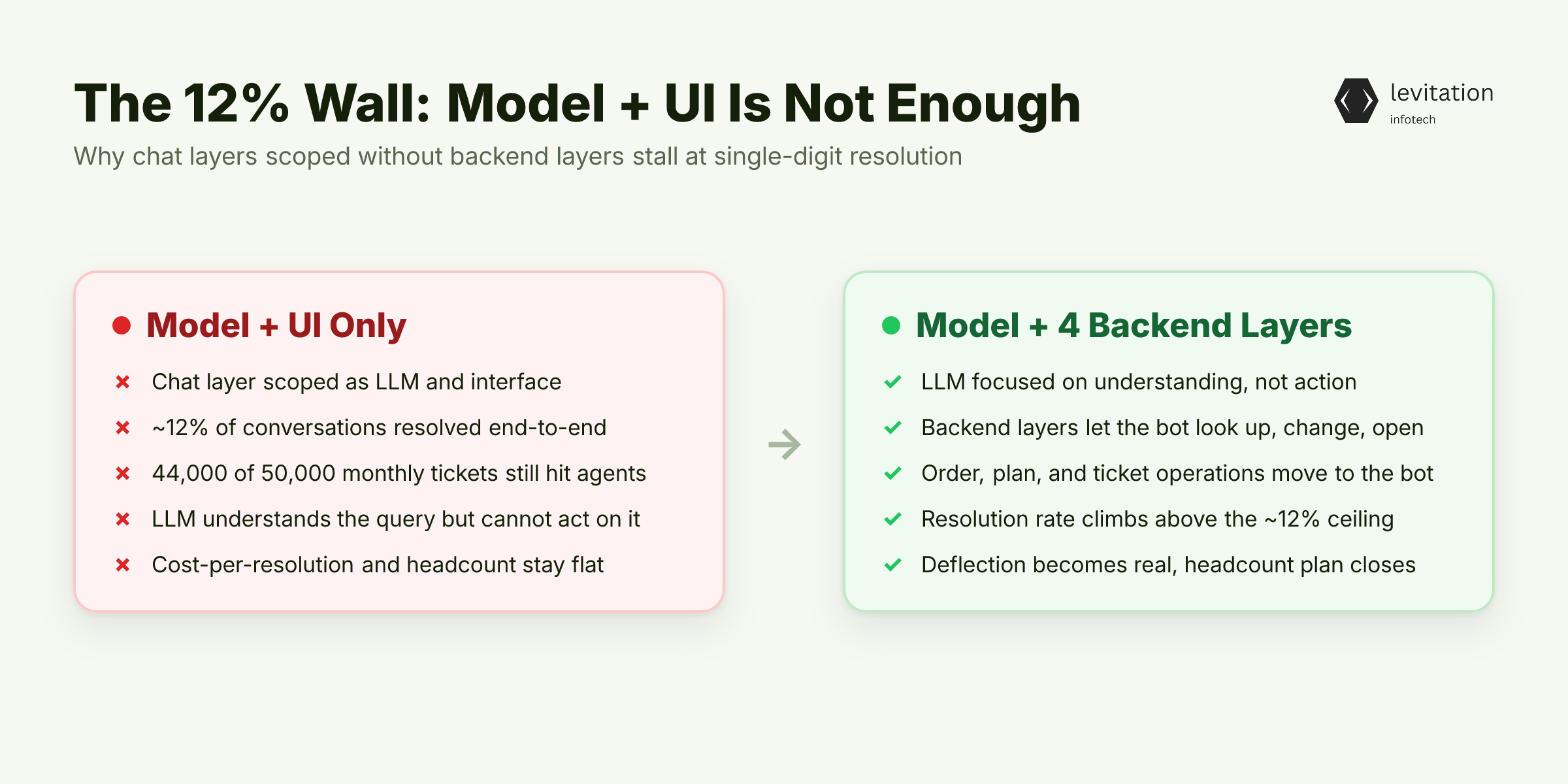
You signed off on a ₹4 lakh generative AI build. Six months in, the dashboard shows 12% resolution.
The other 88% of conversations still land in a human queue, or worse, get abandoned. This is not a vendor problem. It is an architecture problem. And most operations leaders are paying for it twice.
Amazon's customer-facing AI system resolves about 12% of customer inquiries directly. The rest go to a human queue. That number is not a failure unique to your build. It is the natural landing zone for a chat layer scoped as a model and a UI, with nothing underneath.
Do the operations math. A support center handling 50,000 monthly inquiries that automates 12% still has agents working 44,000 tickets.
That is not deflection. That is decoration.
The cost-per-resolution stays high. Headcount stays flat. The business case never closes.
The painful part: the model is rarely the bottleneck. The LLM you bought can understand most of the queries it cannot resolve today.
What it cannot do is look up the order, change the plan, or open a ticket. A human has to pull that data from another tab.
The obvious fix, a bigger model, is what most teams buy first. It is also why they stay stuck at 12%.
See this breakdown of ai chatbot development cost in India for where the ₹4 lakh went and where it should have gone. The four missing layers are why scripted chatbots and vanilla LLMs both hit the same ceiling.
Why Scripted Chatbots and Vanilla LLMs Both Hit the Same Ceiling
Most production chatbots today come from one of two architectures, and both fail at the same point.
A flow-based decision tree chatbot follows predefined branches. A user who stays on script gets an answer. A user who types anything the script does not anticipate gets transferred to a human.
Or worse, they get stuck in a loop. This is the classic "press 1 for billing" failure mode dressed up in a chat window.
A vanilla LLM with no grounding handles open-ended questions well. It also hallucinates confidently.
In a billing context, that means a customer gets a refund promise that does not exist. In a KYC context, that means a policy answer that violates the actual policy.
Most compliance teams block these deployments the first time a hallucination reaches a customer.
The deeper issue: neither architecture can write to a backend. The scripted bot has no connection. The vanilla LLM has no permission.
So a "change my plan" request cannot change the plan. A "where is my order" request cannot check the order. A "block my SIM" request cannot block the SIM.
Every one of these routes to a human who has to switch screens and re-key the request. The result is a chatbot that answers FAQs confidently but escalates everything else.
Resolution caps at the share of inquiries that are pure information lookups. Most of those are already covered by your help center pages.
The ceiling is not about model quality. It is about the layers underneath the model that nobody scoped into the original budget. Teams that work with AI development services at the architecture level, not just the prompt level, hit a different curve. The same applies to anyone evaluating enterprise AI solutions as a stack rather than a feature.
The Integration Tax Nobody Budgets For
A production support chatbot needs to read from and write to a minimum of four to six enterprise systems. CRM, billing, ticketing, knowledge base, identity provider, and order management. None of these are optional.
A bot that can read but not write still leaves the actual work to a human switching screens and re-keying requests.
In telecom deployments, this gap is where budgets die. OSS/BSS stacks like Amdocs and Netcracker are not plug-and-play.
They expose hundreds of legacy endpoints, each with its own auth model and field schema. Hidden integration cost is the most common driver of telecom deployment overruns.
Most vendor quotes count "native integration" as a single line item, even when it means six months of connector work.
The phrase to watch in any vendor quote is "native integration." Native means a pre-built connector the vendor has shipped before. Anything else is custom API work, billed by the week.
A ₹4 lakh budget typically covers the LLM license and a chat UI. It does not cover the four to six enterprise connectors needed for real resolution. It does not cover the authentication layer.
It does not cover the data normalization between systems that were never designed to talk.
Teams that ignore this gap end up with a chatbot that knows a lot and does nothing. That is functionally identical to a chatbot that knows nothing.
This is also why enterprise AI solutions from serious engineering firms treat integration as the first conversation, not the last. These are the firms trusted by Fortune 500 brands for enterprise AI systems in India.
If a vendor cannot list the connectors they have shipped in the last twelve months, the integration tax is coming for your P&L.
The budget problem is real. But some teams are crossing 80% resolution without doubling their spend. The difference is in how the system reasons, not in how much it costs.
What a Reasoning Architecture Actually Changes
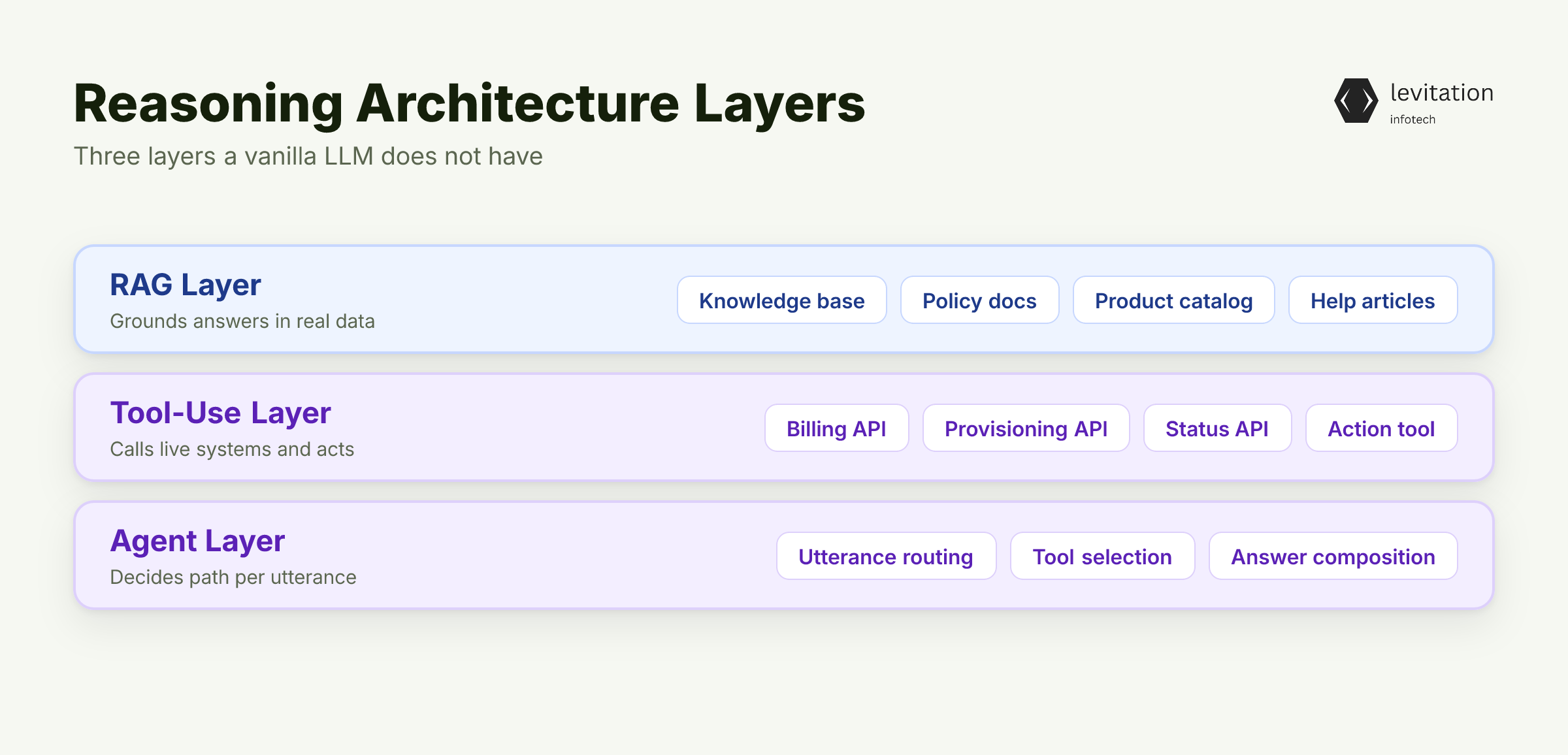
A reasoning architecture has three layers that a vanilla LLM does not. RAG over your knowledge base. Tool-use against live systems. And an agent layer that decides which tool to call, when, and how to compose the answer.
RAG grounds the model in your actual policy, your actual product catalog, your actual help articles. When a customer asks about a return window, the answer comes from today's policy.
Not from a 2024 training cutoff. Tool-use lets the model call a real API and act on the response.
A plan change request can hit the billing API, confirm the change, and reply with a real confirmation number. A SIM block request can hit the provisioning API, take effect, and reply with a real incident ID.
The agent layer decides which path to take for each utterance. It can route billing questions to the billing tool, outage questions to the status API, and plan-change questions to the action tool.
All from a single conversation, without scripted flows. Retrieval quality, not model size, determines whether the bot gives a correct answer about a customer's specific account.
A large model with bad retrieval gives confident, wrong answers. A smaller model with good retrieval gives accurate, grounded ones.
This is why teams who upgrade the model every quarter see flat resolution rates. Teams who upgrade the retrieval index see resolution climb.
Reasoning architectures age better than scripted ones because the architecture, not the model, carries the load. When a new model drops, you swap the model.
The connectors, the retrieval pipeline, and the agent layer stay. That is the opposite of a scripted bot, which is scrap the moment the script does not match the product.
For a deeper look at how to evaluate vendors who actually build this stack, see our roundup of the top generative AI companies in India. Most of the AI development services market sells the model layer. The differentiator is everything underneath.
The Real Cost Breakdown of a Chatbot That Resolves 80%
A chatbot that resolves 80% of inquiries has five budget buckets, not one. Here is what each one actually funds, and where the typical ₹4 lakh build goes wrong. - LLM and infrastructure: the model license, the inference cost, the chat UI. This is the only bucket most quotes cover. It is also the smallest one in a serious deployment. - Integration connectors: the CRM, billing, ticketing, knowledge base, and identity hooks. This is typically the largest line item in a real budget, and where most quotes are silently underbid. - Knowledge base curation: cleaning the source documents, chunking them, building the retrieval index, and keeping it fresh. Garbage in, retrieval out. This is the bucket most teams skip and then wonder why resolution stalls. - Agent orchestration: the layer that decides which tool to call, manages conversation state, and handles escalation logic. This is the engineering work that separates a chatbot from an agent. - Ongoing evaluation: a harness that runs regression tests against new prompts, new retrieval versions, and new model versions, and tells you when resolution starts to drift. Most teams skip this. Their resolution silently drops six months after launch and nobody notices until a customer complains.
A ₹4 lakh budget funds the first bucket and a sliver of the second. The other three are why resolution rates stay flat long after launch.
The line item most teams skip, ongoing evaluation, is the one that protects resolution rates from drifting downward after launch. We have written more about why small eval sets miss production reality in Your Eval Tests 200 Prompts. Production Hits 200,000.. The same dynamic kills chatbot resolution within a quarter.
Cost transparency gets you halfway. The other half is knowing which questions to put to a vendor before you sign. The quote alone will not reveal the architecture gaps.
The 8-Question Vendor Checklist for Operations Heads
Run these eight questions past any vendor before you sign. The answers tell you in fifteen minutes whether you are talking to an engineering team or a reseller. - Which systems have you built native connectors for in the last twelve months? Avoid "we can build any integration." That answer means every integration is a custom project billed by the week. - What was the resolution rate at 90 days post-launch for your last three deployments? No number, no reference, no deal. Teams confident in their work will share both. - How do you handle retrieval quality, and how is it measured? If the answer is "we use vector search," you are talking to someone who has not measured recall. The serious vendors measure retrieval hit rate by intent category, weekly. - What does your evaluation harness test, and how often does it run? Anything less than daily is a drift waiting to happen. - Which foundation model are you building on, and what is the fallback if pricing or availability changes? Vendor lock-in on a single model is a 2026 risk, not a 2024 risk. - How is conversation data isolated per client? If the answer is vague, the answer is "not well." This matters for compliance, for retrieval quality, and for contract renewal. - What is your escalation policy when the agent's confidence is low? A good answer includes a threshold, a handoff mechanism, and a human-readable reason for the escalation. - Can you share a reference customer we can talk to? If the answer is "we have NDAs in place," the answer is no. Vendors confident in their engineering quality will answer all eight without hesitation.
The pattern we see across the top generative AI companies in India is simple. They show the work, not the deck. Anything less is a sales pitch dressed as a solution.
When the answers line up, the operational upside is concrete. Here is what changes for the team once resolution crosses 60%.
What an Operations Team Actually Sees at 60%+ Resolution
Headcount planning becomes predictable. Tier-1 agent hiring slows.
Existing staff move into exception handling and quality roles, which are harder to outsource and harder to automate.
Turnover drops because the work is less repetitive.
Average handle time drops on the human queue, because escalations arrive with full conversation context already attached. The agent picks up a structured summary, not a transcript. That alone reduces handle time measurably on complex inquiries.
Customer satisfaction improves on the inquiries that previously waited in queue, not just the ones the bot handled. The hard truth: the customers stuck in the 12% were your most frustrated. When they get faster service, the CSAT lift is bigger than any chatbot-served reply could produce.
The bot becomes a data source. Every deflected conversation is a signal that improves retrieval and routing over time.
Every escalation is a label for the next training cycle. After six months, the system is materially better than the system you launched. That is the difference between a product and a project.
This is the operational reality teams building with serious enterprise AI solutions reach once the stack is complete.
The ones trusted by Fortune 500 brands for enterprise AI systems in India are not running flashier models. They are running more complete stacks.
The chat window is the smallest part.
Frequently Asked Questions
How much does AI chatbot development actually cost in India? Cost varies widely based on architecture, integration count, and data complexity. A flow-based FAQ deployment covers a narrow surface area. A reasoning-based system with native CRM, billing, and ticketing integrations plus RAG over a knowledge base costs more because it covers more. The cheapest quote usually leaves out integration and evaluation, which is why resolution rates stall.
What is the difference between a scripted chatbot and a generative AI chatbot? A scripted chatbot follows predefined decision trees and breaks on any user input outside its script. A generative AI chatbot uses a foundation model with retrieval and tool-use to interpret intent dynamically, look up live data, and compose answers. Generative systems handle unstructured queries. Scripted systems only handle predictable ones.
How long does it take to deploy an AI chatbot for customer support? Deployment timelines depend on connector availability, data readiness, and the scope of the use case. Pre-built platforms with native connectors ship faster than greenfield builds that need custom integration work.
About the author
Mayank Singh is a software developer at Levitation Infotech, where he builds web and AI-powered applications across the company’s fintech, healthcare, and enterprise projects.