


Your LLM evaluation suite covers 200 prompts with confidence. Your production system fielded 200,000 distinct inputs that your eval suite never tested, and you have no idea how it handled 199,800 of them. The gap isn't a testing problem. It's an architecture problem.
TL;DR: A 200-prompt evaluation suite is a frozen snapshot, but production traffic is a living, drifting distribution. The fix is not bigger test sets; it is treating prompts as versioned production artifacts and building evaluation pipelines that observe real traffic continuously, not just before release.
Key Takeaways: - A small static eval suite cannot represent the prompt distribution a production LLM system actually faces. - Scaling test cases does not help when the prompt itself is a mutable input to a frozen model doing inference. - Prompts need the same versioning, diffing, and gating discipline as production code and model training artifacts. - Effective evals layer offline regression, shadow evaluation, and online scoring on sampled live traffic. - Production-aware metrics track output drift and chain-step success, not just end-to-end accuracy on a fixed set.
The 200-to-200,000 Blind Spot in LLM Evaluation
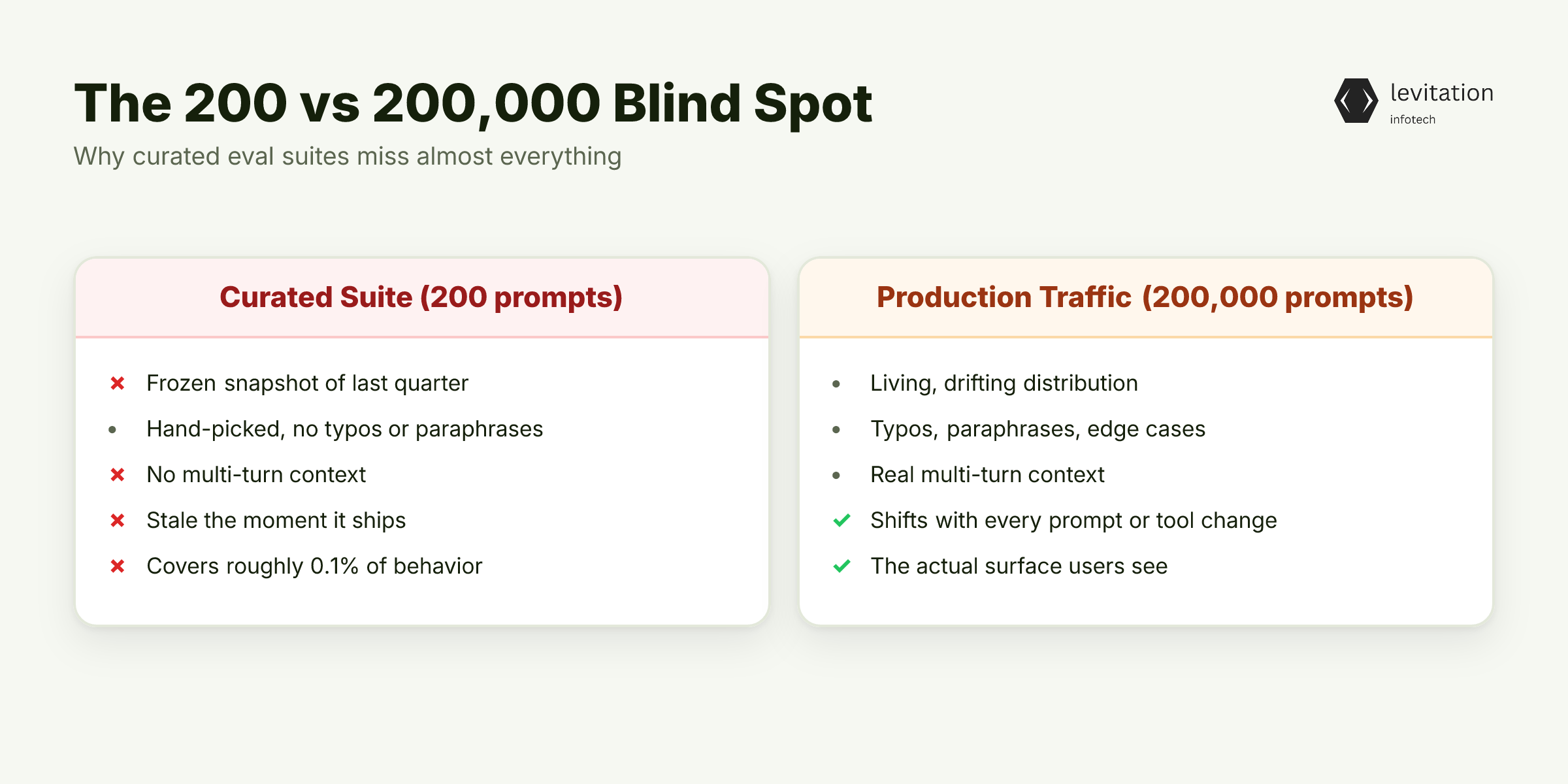
Most LLM teams ship with a quiet assumption. They write 200 golden prompts, run them through the model, score the results, and call it tested. It feels rigorous. It isn't.
The problem is that 200 prompts are a frozen snapshot. Production traffic is a living, drifting distribution shaped by real users typing real things. By the time your eval suite is written, it is already a museum exhibit of last quarter's behavior.
The 200,000 prompts your system actually saw include typos, paraphrases, multi-turn context, and edge cases no curated set anticipates. The 200-prompt suite predicts behavior on roughly 0.1% of the surface. That's not a coverage gap. That's almost no coverage at all.
Worse, prompts change constantly. Every tweak to a system prompt is functionally an untested code commit. So is every swap of a retrieval template or adjustment to a tool description. Most teams ship these changes without regression checks and discover regressions only when users complain.
In enterprise LLM deployment, this blind spot directly drives the outages and hallucinations that erode leadership trust in AI. Speed is the advantage of a focused build. But speed without quality is just fast failure.
The natural reaction is to write more test cases. That's the wrong reflex, and here's why.
Why "Just Add More Test Cases" Doesn't Close the Gap
The instinct to scale test data comes from classical software testing. More cases, more coverage, more confidence. That logic assumes the input space is bounded. For LLMs, it isn't.
Prompt space grows combinatorially. Two users asking the same question will phrase it differently. Add typos, code-switching, multi-turn context, and domain mixing, and the surface area explodes beyond any curated set. Even 200,000 historical prompts go stale quickly as user behavior evolves. The distribution shifts while your test set sits still.
Traditional ML evaluation was built on a different contract: a fixed test set, a fixed model, and a single inference call. LLM applications violate both halves of that contract. The prompt itself is a mutable input fed to a frozen transformer doing inference. When the input changes shape, the model's behavior on it changes too, even though the model weights haven't moved. The eval surface is the prompt, not the weights.
Here's what makes it worse: most production prompts arrive without ground truth. You can't compare an answer to a known correct response when the question itself was never seen before. The eval methodology that built the entire ML field held out a labeled test set and computed accuracy. That approach quietly breaks here. Reference-based scoring worked when you owned the dataset. Production traffic owns itself.
This is also why the eval problem gets harder as systems get smarter. Agentic systems produce intermediate outputs (tool calls, retrieval hits, reasoning traces), and each step is a place where things can go wrong. Scoring only the final answer misses the failure that lives in step three. The same blind spot that hides prompt variation also hides step-level failure.
Scaling test cases also tempts teams to chase the same coverage arms race they already lost once. The marginal 1,000th curated prompt adds almost no information about a live system that has already seen 200,000 distinct inputs. You're curating a better rearview mirror while the road ahead is moving.
Teams with 2,000-prompt suites see the same production failures as teams with 200-prompt suites. The size of the museum didn't matter. The museum was the wrong artifact.
If scaling test data won't save you, the answer has to come from a different mental model entirely, one that treats the prompt itself as a production artifact.
Treat Prompts Like Production Code, Not Config Files
If the prompt is code, it deserves the same engineering discipline. Version every prompt in a registry. Diff every change in a pull request. Gate every merge on a passing evaluation. The same discipline teams already apply to model training artifacts and serving infrastructure should extend to the prompt layer.
This sounds obvious and almost nobody does it. Most prompt edits still live in Notion docs, Slack threads, or buried inside a config file that hasn't been reviewed since launch. A junior engineer changes one word in a system prompt on a Friday afternoon and ships it without a test. By Monday, the support queue is full.
A production-grade prompt pipeline looks more like this: - A versioned registry where every prompt template is tracked with author, timestamp, and intent - A diff workflow that surfaces what changed and why, reviewed like any other code change - A regression gate that runs the new prompt against historical and live-sampled inputs before merge - A rollback path that's one click, not a war room
Characterize both inputs and outputs as first-class telemetry. That means logging prompt structure, retrieval context, tool calls, intermediate chain steps, and final responses. Not just the answer. The whole path. This is the difference between observing a system's outputs and understanding its behavior.
The framing shift matters: effective LLM evals stop measuring "did the model answer well" and start measuring "did the system behave within bounds on inputs like the ones production sends." That's a system-level question, not a model-level question. It treats the model training artifact as one component of a larger runtime, not the system itself.
It's the same principle that keeps well-engineered systems running in production long after deployment. Discipline at the artifact layer is what separates long-lived platforms from piles of one-off releases.
That framing changes the build. Here's what a production-aware evaluation stack actually looks like.
Build Evals That Observe Production, Not Just Pre-Release
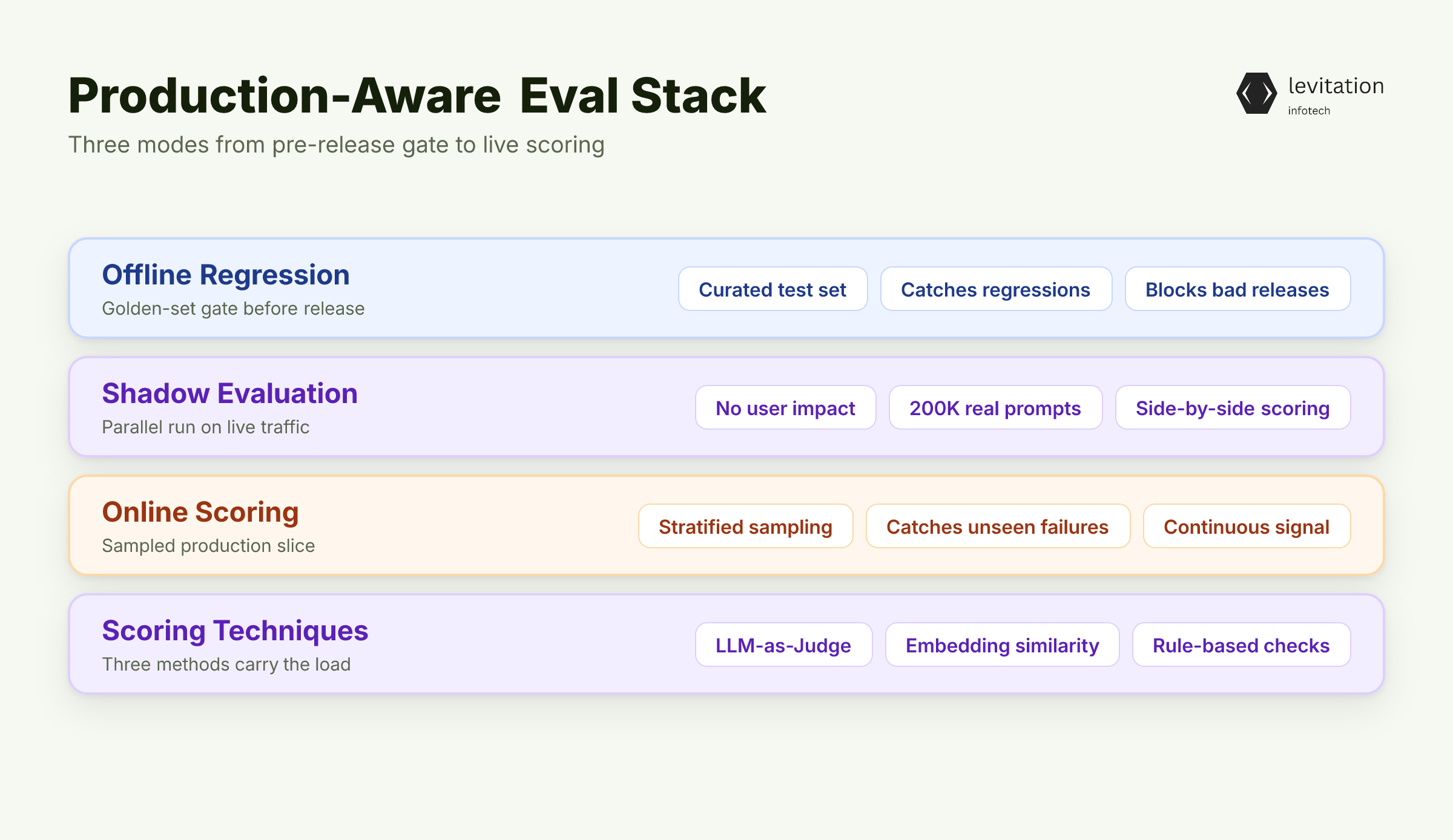
A production-aware eval system is a stack of three modes, each catching a different class of failure. Skip any one of them and the blind spot returns.
Offline regression on a golden set. Small, high-quality, representative. Used to catch regressions before a release ships. The eval that every prompt change must pass through the same gate that protects any other code change.
Shadow evaluation on live traffic. Run the new prompt or model in parallel with the current one, score both, compare. No user impact because the shadow doesn't serve responses. This is where you see how the new version behaves on the actual 200,000 prompts your users sent, not the 200 you curated.
Online scoring on a sampled production slice. The third mode is the one most teams skip. It runs continuously in production, scoring a stratified sample of real traffic in real time. This is the mode that catches the failure your offline suite guaranteed you'd never see.
Three techniques carry most of the load: - LLM-as-Judge for open-ended quality, covering relevance, tone, and completeness - Embedding similarity for semantic regression detection across paraphrased inputs - Rule-based checks for safety, format, and policy compliance
The instinct to score every prompt is expensive and unnecessary. Sample intelligently. Stratified sampling by intent, user segment, and input complexity beats random sampling and keeps GPU costs bounded. A well-stratified sample tells you more about your system than a larger but unstratified one.
This is also where observability budget matters. Teams that treat eval scoring as free quickly discover that GPU inference for judges competes with the inference their customers pay for. Budget the judge the way you budget anything else on the hot path. The cost of running your eval pipeline is part of the same equation as the cost of the inference it's measuring, and the metrics you choose will decide whether the whole stack earns its keep.
Choosing Metrics That Catch What Coverage Can't
Most teams start with accuracy on a fixed set. That's a 2021 metric for a 2026 problem. By the time your golden set is final, production has already moved past it.
The metrics that catch real failures look like this: - Output distribution drift, not point accuracy. A small shift in tone across many responses is a real regression that a fixed-set accuracy number will never surface. - Refusal rate shifts. A model that suddenly refuses a noticeably higher share of queries is breaking in a way that will reach users. - Retrieval embedding distance changes. If your RAG retriever starts returning semantically further results, the answers will degrade even if they still look fluent. - Chain step success in agentic flows. A four-step agent that succeeds at steps one, two, and four but fails at step three has a broken third step. End-to-end accuracy hides this.
Reference-free metrics win in production because ground truth is rarely available for the 199,800 prompts you didn't curate. You can't compare a response to a known answer when the question was never seen. The metric has to score the response against intent, policy, and behavior, not against a key.
The metric mix is also where teams discover that "quality" is not one number. Safety, helpfulness, format compliance, factual grounding, and latency are all quality dimensions. A system that scores high on helpfulness but low on safety is a system with a serious problem that a single accuracy score will hide.
Human spot-audits on judge-flagged samples close the loop. Automated judges drift, have blind spots, and reward the wrong things when left alone. Periodic human review of the lowest-confidence and highest-impact samples keeps the judge calibrated against actual quality. It's the same feedback loop that keeps any classifier honest.
Metrics also need to be cheap to compute at scale. A metric that costs more to run than the inference it's measuring will not survive contact with a real budget. Optimize for metrics that can run on sampled traffic without dominating the embedding and inference cost stack.
With the right prompts, the right pipeline, and the right metrics in place, the system starts behaving differently. Here's what that unlocks.
What a Production-Aware Eval System Actually Unlocks
When the eval system observes production, the organization moves faster. Not slower, despite the new pipeline.
Prompt changes ship with confidence. Every release is gated on real-traffic regression signals, not a frozen 200-prompt snapshot. The merge button knows whether the change is safe because the eval system has already watched the new prompt run against thousands of live inputs in shadow mode.
Outages drop. Drift in neural network output distributions, retrieval quality, and user-facing metrics triggers alerts before customers complain. The on-call rotation gets paged on signal, not noise. The system distinguishes a small but consistent drift in tone from a single frustrated customer.
Iteration cycles compress. Teams running fine-tuning experiments, swapping models, or modifying RAG pipelines get fast feedback grounded in actual usage. The loop from hypothesis to evidence compresses, because the evaluation is continuous rather than scheduled.
This is the same operational discipline that separates systems still running long after deployment from those rebuilt constantly. Treat the prompt as code. Treat the eval as production. Treat the metric as a contract with the user.
It's also why this matters beyond engineering hygiene. Enterprise teams operating in regulated industries have learned this the hard way. High client retention is built on systems that don't surprise the customer. The pattern is the same across industries: production-aware evaluation is the difference between an AI feature and an AI product.
Teams that want to operationalize this end to end often work with partners who have shipped it. Levitation is one such partner. The principles travel: the eval is the system, not a step before it.
Frequently Asked Questions
How many test prompts do you need for effective LLM evaluation?
There's no fixed number that works. The right approach is a small, high-quality golden set for regression testing plus a continuous, production-sampled set that grows with real traffic. Coverage matters less than representativeness of the prompt distribution your system actually faces.
What is the difference between offline and online LLM evals?
Offline evals run against curated datasets before deployment to catch regressions. Online evals score live production traffic, typically on a sampled subset, to detect drift, quality degradation, and emergent failure modes that curated sets miss.
Can LLM-as-Judge replace human evaluation entirely?
LLM-as-Judge scales to volumes humans cannot review, but it drifts and has blind spots. The reliable pattern is automated judging for the long tail, with periodic human spot-audits on judge-flagged or low-confidence samples to keep the judge calibrated.
How do you evaluate agentic or multi-step LLM applications?
You need to score each step: tool selection, intermediate outputs, retrieval relevance, and final response, not just the end result. A chain that reaches the right answer through broken reasoning is still a failure, and only step-level metrics surface that.
What is evaluation coverage and why does it matter for enterprise LLM deployment?
Evaluation coverage is the degree to which your eval suite represents the prompt distribution your system will encounter. Low coverage means the 200 prompts you tested don't predict behavior on the 200,000 your system actually sees, and that gap is where enterprise LLM deployments fail in production.
Sources
Research and references cited in this article:
- Building an LLM evaluation framework: best practices - Datadog
- The best LLM evaluation tools of 2026 | by Dave Davies - Medium
- Best Practices and Methods for LLM Evaluation | Databricks Blog
- LLM Evaluation: The Ultimate Guide to Metrics, Methods & Best ...
- Understanding the 4 Main Approaches to LLM Evaluation (From ...
- 95% of LLM evaluations fail to deliver value—why? | Jeffrey Ip
- How To Solve LLM Production Challenges & How Prompt Updates Drive Most Incidents | Deepchecks
- Mastering LLM Techniques: Evaluation | NVIDIA Technical Blog
- The LLM Evaluation Gap: How to Actually Measure What Matters
- Top 10 LLM Evaluation Questions Answered | Galileo
- LLM Evaluation in Production: Testing Pipelines (2026)
- The Complete Guide to LLM Evaluation Tools in 2026
About the author
Mayank Singh is a software developer at Levitation Infotech, where he builds web and AI-powered applications across the company’s fintech, healthcare, and enterprise projects.