


Your last ERP didn't fail because the software was bad. It failed because your team kept opening Excel the moment the consultant left the room, and 60% of Indian rollouts end exactly this way.
TL;DR: Most Indian ERP rollouts fail at user adoption, not at technology. The software usually works. The users walk away, the data is wrong, and the project manager hides the truth until leadership sees the bill. Fixing this requires guidance, stakeholder alignment, and an internal champion, not a bigger license.
Key Takeaways: - The 60% failure rate is a people and process problem disguised as a technology problem. - Price sensitivity and excessive customization are the two forces that turn a working ERP into shelfware. - Indian operations have three failure patterns that don't show up in vendor case studies: compliance whiplash, uninformed PMs, and the Excel underground. - The fix is a five-step framework that phases adoption by user trust, not by module. - Systems that follow this guidance tend to outlast the projects that skip it. The 60% that ignore the people layer often see their ERP abandoned before it matures.
The 60% Failure Nobody Wants to Own
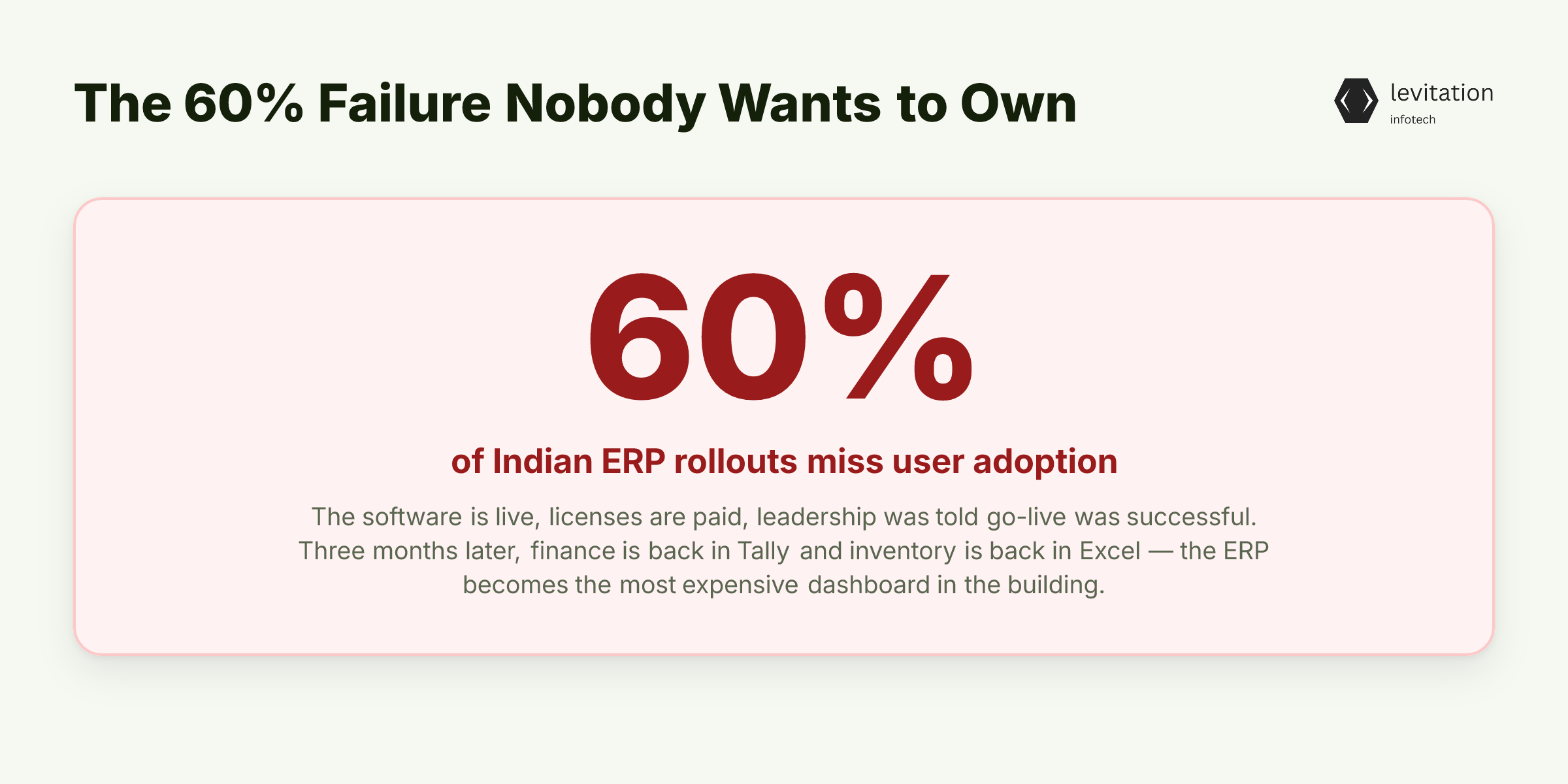
The number is uncomfortable. Roughly 60% of Indian ERP rollouts fail to achieve the user adoption the project was sold on. The reason everyone tiptoes around it is because the failure is silent. The software is live. The licenses are paid. Leadership was told go-live was successful.
Then, three months later, finance is back in Tally. Inventory is back in Excel. The ERP becomes the most expensive dashboard in the building.
This is not a software problem. The same SAP, Odoo, or custom platform that "failed" at your shop is running fine at a competitor down the road. The difference isn't the tool. It's the people, the data, and the project manager. That PM kept telling the board everything was on track. The actual configuration was half-done.
Three pressure points hit Indian operations harder than the vendor brochures admit: - Budget vs expectation mismatch. Operations heads want SAP-grade capability. The CFO approved Tally-grade money. The result is a half-baked rollout nobody trusts. - Data quality gaps. The master data is incomplete, inconsistent, or just plain wrong. Users log in, see garbage outputs, and never come back. - The Excel rebellion. Your team built parallel spreadsheets because the ERP felt slower. Now you have two systems, and trust in the new one is gone.
This pattern shows up across every ERP implementation in the mid-market, regardless of vendor. The people problem is consistent. The technology is incidental.
If the software isn't the problem, why do otherwise competent operations teams keep repeating the same expensive mistake?
Why Your Last ERP Failed Even Though the Software Worked
Most operations heads walk into an ERP evaluation with two contradictory beliefs. First, we need global-grade features to run a serious business. Second, we can't justify spending what global-grade features cost.
That tension is where rollouts go to die.
You buy a license that covers maybe 40% of what your team actually does. The consultant configures what they can. The rest gets parked in a "phase two" that never arrives. Users log in, find the system doesn't match their workflow, and conclude the ERP is the problem. It's not. The scope is the problem.
Data makes it worse. Most Indian mid-market companies run on years of inconsistent master data. Customer names are spelled three different ways. SKUs don't match across warehouses. Opening balances are wrong.
When users see the ERP output, it looks like the system is broken. The system is doing exactly what you told it to do. You fed it garbage.
Then comes the customization trap. The conventional wisdom says tailor the ERP to your business. The research says the opposite. Excessive customization, done to "fit the business," is one of the top documented causes of adoption failure.
Every custom field is another thing to train. Every bespoke workflow is another thing to maintain. The version upgrades break. The consultants bill more. The users retreat.
The counterintuitive finding is that strategic customization, not maximum customization, is what drives real returns. Platforms like Odoo work because they can be configured to mimic your operations. They don't get forced into a generic template. The goal is fit, not feature count.
An Odoo implementation done right feels like the ERP was built for your shop. Done wrong, it's a generic system with custom fields nobody understands.
Budget pressure and customization debates are surface symptoms. The real failure patterns run deeper, and almost no vendor case study will prepare you for them.
Three Failure Patterns That Hit Indian Operations Hardest
The 60% doesn't fail randomly. It fails in three repeatable ways that almost never make it into vendor case studies.
Pattern 1: Compliance whiplash. GST rule changes, e-invoicing updates, and TDS revisions land every few months. An SME without a dedicated ERP owner watches their system fall out of compliance alignment within months of go-live. The team patches what they can. They ignore what they can't. The ERP becomes a source of audit anxiety rather than audit readiness.
Pattern 2: The uninformed PM. This is the failure mode nobody admits to out loud. A project manager gets assigned to lead the ERP rollout because they have spare bandwidth, not because they understand ERP configuration. They give leadership optimistic progress reports because the board wants to hear green.
The actual system is half-configured. Go-live is a fiction. By the time the truth surfaces, the budget is gone. The patience is gone with it.
Pattern 3: The Excel underground. Your team didn't quit Excel. They just stopped telling you. The finance team keeps parallel sheets for "validation." The plant team tracks line stops in WhatsApp groups because the ERP module is too slow.
Sales runs their own pipeline tracker. Now you have two sources of truth. Every report the ERP produces is questioned against the spreadsheet version. Trust erodes fast.
These three patterns don't show up in vendor demos. They show up six months after go-live, when adoption is supposedly "in production." If any of them sound familiar, you're seeing a custom ERP decision that was made on the wrong criteria. The enterprise resource planning problem is rarely about the platform. It's about the layer underneath.
These patterns share a common root cause that most ERP vendors won't admit out loud, and once you see it, the fix becomes obvious.
Why Software Can't Fix What Process Breaks
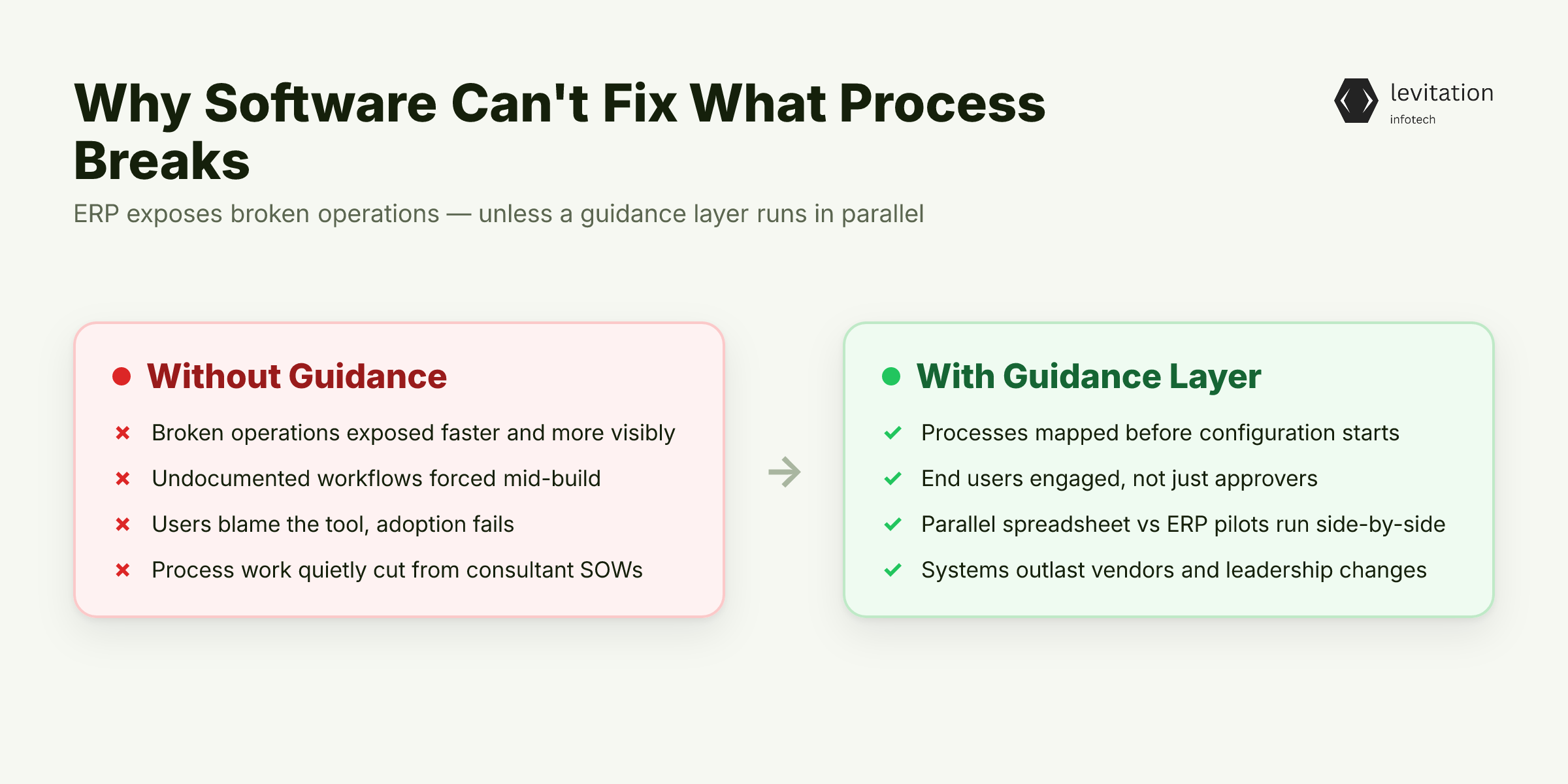
Here's the line that should be tattooed on every operations head: ERP doesn't fix broken operations. It exposes them.
If your inventory reconciliation was a mess in Excel, it will be a mess in the ERP. The same mess will be faster and more visible. If your approval workflow had three undocumented handoffs, the ERP will force you to define them. Most teams aren't ready for that exposure, so they blame the tool.
This is where "guidance" enters the picture. Most rollouts skip this work. Guidance isn't training videos. It isn't a help desk.
It's a structured layer of stakeholder engagement, process mapping, and expectation management. This runs in parallel with configuration. It's the work the consultant's statement of work quietly leaves out because nobody wants to pay for it.
What guidance actually looks like: - Mapping every process the ERP will touch before configuration starts. - Sitting with the end users who actually do the work, not just the managers who approve it. - Validating that the system's output matches the team's trusted workflows, not the consultant's assumptions. - Running parallel pilots where the spreadsheet and the ERP both run, and users compare.
The research is consistent on this point. Engaging stakeholders early and ensuring the system meets their real workflows is the single biggest predictor of adoption success. When users see the ERP replaces their spreadsheets rather than adding a second system to maintain, adoption follows naturally.
This is also why systems built around the team's actual work tend to outlast the projects that skipped this layer. They were built around the team's real workflows, not around the vendor's template.
Modules get refined, not decommissioned. Users trust the data because they validated it themselves.
The wrong ERP system choice, made for the wrong reasons, will fail regardless of vendor. The right choice, made with the right guidance layer, will outlast three finance heads and two CFOs.
Knowing that guidance is the answer is one thing. The harder question is what the actual rollout framework looks like in practice.
The Adoption Framework That Actually Works for Indian Operations
The five steps below are not theory. They are the difference between the minority of ERP rollouts that survive long-term and the 60% whose ERP becomes a line item nobody wants to explain.
Step 1: Map your shadow processes before go-live. Document every spreadsheet, WhatsApp group, and manual handoff your team currently uses. Plant managers logging line stops in WhatsApp. Finance re-keying invoices into a side tracker. Sales maintaining a private pipeline.
Your ERP must replace these specific workflows, not generic ones. If you don't know what you're replacing, you'll deploy a system nobody recognizes as theirs.
Step 2: Convert your Excel champions, don't fight them. Identify the power users still running parallel sheets. Make them module owners. Give them the authority to validate the ERP's outputs against their trusted spreadsheets.
The moment their spreadsheet agrees with the system, the system wins. The moment it disagrees, you have a real bug to fix. Either way, you lose nothing.
Step 3: Phase the rollout by user trust, not by module. Start with the team most willing to adopt. Get a visible win. Then expand. The big-bang cutover alienates everyone at once and gives resistance a critical mass.
A phased rollout, guided by user readiness, builds momentum that the late adopters want to join.
Step 4: Assign a guidance owner internally. Every ERP that survives in India has a named internal champion with real authority. Not a shared responsibility across three departments. Not a "ERP coordinator" with no power.
One person, accountable, with the CEO's backing to make process changes when the system requires it.
Step 5: Budget for guidance, not just licenses. Price sensitivity is the silent killer of Indian rollouts. Operations heads approve license costs and treat change management as a freebie. The research is clear: adequate investment in guidance is what separates the minority of surviving rollouts from the 60%.
If you only budgeted for software, you budgeted for failure.
When this framework is applied with engineering discipline, the timeline and outcomes look nothing like the cautionary tales. A focused implementation partner with prior ERP experience delivers a working system far faster than an in-house team learning as they go. That gap is almost entirely the guidance layer.
The ERP software development work is the visible portion of the project. The guidance, the stakeholder alignment, the process mapping: that invisible layer decides whether your system runs for the long term or gets quietly abandoned in the months after go-live.
Odoo development and custom builds are shaped around the team's real workflows. They don't follow vendor templates. The invisible layer gets treated as the actual deliverable.
So what does a properly adopted ERP actually look like six months after go-live?
What Changes When Your Team Actually Uses the System
The operational outcomes of a genuinely adopted ERP are not subtle. They show up in the first quarter.
One source of truth. Finance, inventory, and production data live in the same system. The weekly reconciliation meetings, the ones that exist only because two systems disagree, disappear. Your finance head stops asking "is this the ERP number or the Excel number" because there is only one number.
Compliance confidence. GST and e-invoicing updates land in workflows people trust, not in modules they bypass. Audit prep becomes a report pull instead of a fire drill. Your CA stops asking for manual reconciliations because the system already has them.
Decision-making speed. Operations heads lead with real-time dashboards instead of waiting for month-end Excel consolidations that were outdated the moment they were generated. Decisions move at the speed of the data, not the speed of the spreadsheet.
Long-term system health. Genuine adoption is what allows an ERP to compound in value over time rather than decay into shelfware. Used modules get refined with every upgrade. Unused modules get decommissioned. The system grows with the business because the business actually uses it.
The 60% failure rate isn't about ERP being a bad idea. It's about the gap between buying a system and building the conditions for it to be used. Closing that gap is what ERP integration work, done with the right guidance layer, actually delivers. The companies that close it stop thinking about their ERP. They just run their business.
Frequently Asked Questions
Q: What is the typical ERP implementation cost in India for a mid-sized operations team?
A: ERP implementation costs in India vary widely depending on module count, customization depth, data migration complexity, user licenses, and integration requirements. A common mistake is underbudgeting for change management, which is the real driver of the 60% adoption failure rate.
Q: How long does a custom ERP implementation actually take in India?
A: A focused implementation partner with prior ERP experience typically delivers a working system in a shorter window than an in-house team learning as they go, and the resulting adoption is usually stronger. The timeline gap comes down to guidance and stakeholder engagement, not the software configuration itself.
Q: Is Odoo a good choice for Indian manufacturing or distribution operations?
A: Odoo works well for Indian operations when it's configured to mimic your specific business processes rather than forced into generic templates. The key is choosing an Odoo implementation approach that prioritizes workflow fit over feature count. Over-customization is one of the documented causes of adoption failure, but strategic customization drives real operational returns.
Q: Why do ERP projects keep failing in India even with good software?
A: The research is consistent: projects fail because of people, processes, and lack of clear guidance, not because of technology. The most common patterns are project managers without deep ERP knowledge misleading leadership about progress, teams continuing to work in Excel out of habit, and price sensitivity producing half-baked rollouts that nobody trusts.
Q: What is the single biggest factor in successful ERP adoption?
A: Engaging stakeholders early and ensuring the system meets their actual workflows, not the workflows a consultant assumed. When end users see that the ERP replaces their trusted spreadsheets rather than adding a second system to maintain, adoption follows naturally.
Build the people layer first, then pick the software.
Sources
Research and references cited in this article:
- Why Most ERP Projects Fail in India (and Yours Might Too!)
- ERP Implementation In 2026: Avoid Common Failures
- ERP Implementation Failure Statistics: 2026 Research - Godlan
- ERP Implementation Failure Statistics
- 12 Reasons For ERP Implementation Failure | Priority Software
- Odoo ERP Software Guide 2026 | Odoo Customization Services
- Odoo Community vs Enterprise 2026: Cost, Pricing & Hidden Fees
- Unlock Success: ERP Systems Comparison 2026 Revealed!
- I Compared the Best ERP Systems for 2026 So You Don't Have To
- Odoo ERP Pricing Guide 2026 - Costs, Implementation & TCO
- 10 ERP Implementation Best Practices for a Successful Rollout in 2026
- Common ERP Challenges in 2026 and How to Overcome Them
About the author
Mayank Singh is a software developer at Levitation Infotech, where he builds web and AI-powered applications across the company’s fintech, healthcare, and enterprise projects.