


TL;DR: Indian custom software quotes capture only the build phase. They leave 60-80% of lifetime cost outside the contract. That cost covers infrastructure, maintenance, compliance, and integration drift. Founders who budget only the headline number get a half-built product 18 months later for two-and-a-half to five times the quoted price. The fix isn't finding a better vendor. It's demanding a two-column quote that separates build cost from run cost before signing.
Key Takeaways: - Initial build cost is 20-40% of total lifetime software spend. The other 60-80% arrives after launch. - Indian quotes are structured this way by design. Vendors price what they can defend in a contract. The rest stays open. - The hidden line items are predictable: cloud, third-party licensing, security, compliance, integration drift, post-launch iteration, and scalability rewrites. - Smart founders in 2026 demand build-vs-run separation upfront. They pick vendors whose systems are still running five years later. - Budgeting the full lifecycle changes vendor selection, funding conversations, and product longevity.
The ₹15 Lakh Quote That Quietly Becomes ₹40-75 Lakh

You compared three vendors. You picked the custom software development quote at ₹15 lakh. You celebrated the savings. Eighteen months later, you've spent ₹40-75 lakh. The product is half-done. The quote you signed never included the 60-80% of cost that comes after launch.
The vendor didn't lie. The quote just told you a fraction of the story.
That gap between the quoted number and the actual number is the rule, not the exception. Research across the Indian custom software market shows initial build cost represents only 20-40% of total lifetime software spend. The other 60-80% lands after the launch date. It rarely makes it into the original statement of work.
Here's the pattern that plays out across founder after founder. You sign at ₹15 lakh. The vendor delivers the build. Cloud bills arrive, separate. Third-party API charges start, separate. Security audits need to happen, separate. Performance breaks at scale, separate. Design iteration begins once real users touch the product, separate.
By month 18, your ₹15 lakh project has consumed ₹40-75 lakh and counting. The product is still incomplete.
A 2026 shift is happening quietly across the Indian startup ecosystem. Founders are cutting software costs by roughly 40%. They aren't finding cheaper vendors. They refuse to trust the headline number. They demand full-lifecycle quotes before signing. The savings come from killing rework, integration drift, and post-launch architecture rewrites that nobody priced in.
The gap is too consistent to be bad luck. It's how the quote is structured. Here's why every vendor in India stops the number at the build phase.
Why Every Indian Software Quote Stops at the Build
The quote isn't dishonest. It's just incomplete by design. Vendors price the defined scope, the features you both agreed to build. That scope is what's defensible in a contract. Unknowns get excluded because nobody can price them accurately upfront.
The same scoping exercise that misses infrastructure also misses compliance, licensing, and integration drift. The vendor isn't hiding these costs. They simply don't appear in the scope to begin with.
The obvious fix fails for a structural reason. Ask for a "more detailed quote" and the same scoping methodology runs again. It missed line items on the first pass. It will miss them on the second pass too. Adding the word "detailed" to the request doesn't change what gets surfaced. You need a different question, not a longer answer.
Technical debt compounds the problem. Industry studies put accumulated technical debt at 20-40% of total lifetime development cost. Every shortcut during the build, hardcoded values, skipped tests, monoliths where bespoke software microservices were warranted, becomes an interest payment on future change.
Vendors have no incentive to price this in. They get paid to deliver, not to maintain. Maintenance gets a one-line afterthought in the SOW if it appears at all.
There's also a deployment-cycle gap that few founders budget for. Outsourced delivery compresses timelines. In-house teams stretch those same timelines across extended build cycles. Those cycles burn runway without shipping features. The time-to-market difference alone often makes outsourcing cheaper in total cost of ownership.
That comparison only works when the outsourced quote captures lifetime cost, not just the build. The hidden TCO of real-time pipelines shows up in every infrastructure layer you ignore at contract time.
That gap is structural, not accidental. The next question is which specific costs are vanishing from that line item you signed.
The 7 Costs That Never Appear in Your Quote
Here's the inventory of line items that vanish from Indian custom software quotes. None of these are exotic. All of them arrive. - Infrastructure and cloud. Production traffic, CDNs, observability tooling, staging environments. These are usually a separate line or absent entirely. Cloud bills scale with usage. "Usage" is something the vendor can't price during scoping. - Third-party licensing. Payment gateways, SMS providers, identity verification APIs, mapping services. These recur monthly and scale with your volume. They look like operating cost in the vendor's mind, so they don't appear in the build quote. - Security and compliance. SOC 2 audits, DPDP Act readiness reviews, penetration tests, certificate renewals. For fintech founders this is non-negotiable, yet it's rarely scoped. The security line item is what separates a build quote from a project quote. It is rarely present at signing. - Integration drift. When a partner API changes version, when a payment provider deprecates an endpoint, when a KYC vendor shifts schema, your API integrations and backend services break. Nobody budgeted the fix. Integration maintenance is real engineering work that compounds over time. - Design iteration post-launch. Real users reveal UX gaps the wireframe never showed. The first round of iteration after launch is where most products either find product-market fit or stall. That iteration is real work, not a freebie. - Performance and scalability rewrites. The architecture that handled 1,000 users buckles at 50,000. Refactoring the frontend and backend for scale is a separate project and a separate invoice. The pattern of hidden costs killing fintech AI scaling repeats across every architecture choice you make on day one. - Team and knowledge transfer. Handover documentation, onboarding an internal team, extending the vendor contract. All of these get billed separately if they're billed at all.
Knowing the hidden line items is half the battle. The other half is forcing them onto the page before you sign.
The Custom Software Quote Breakdown You Should Demand
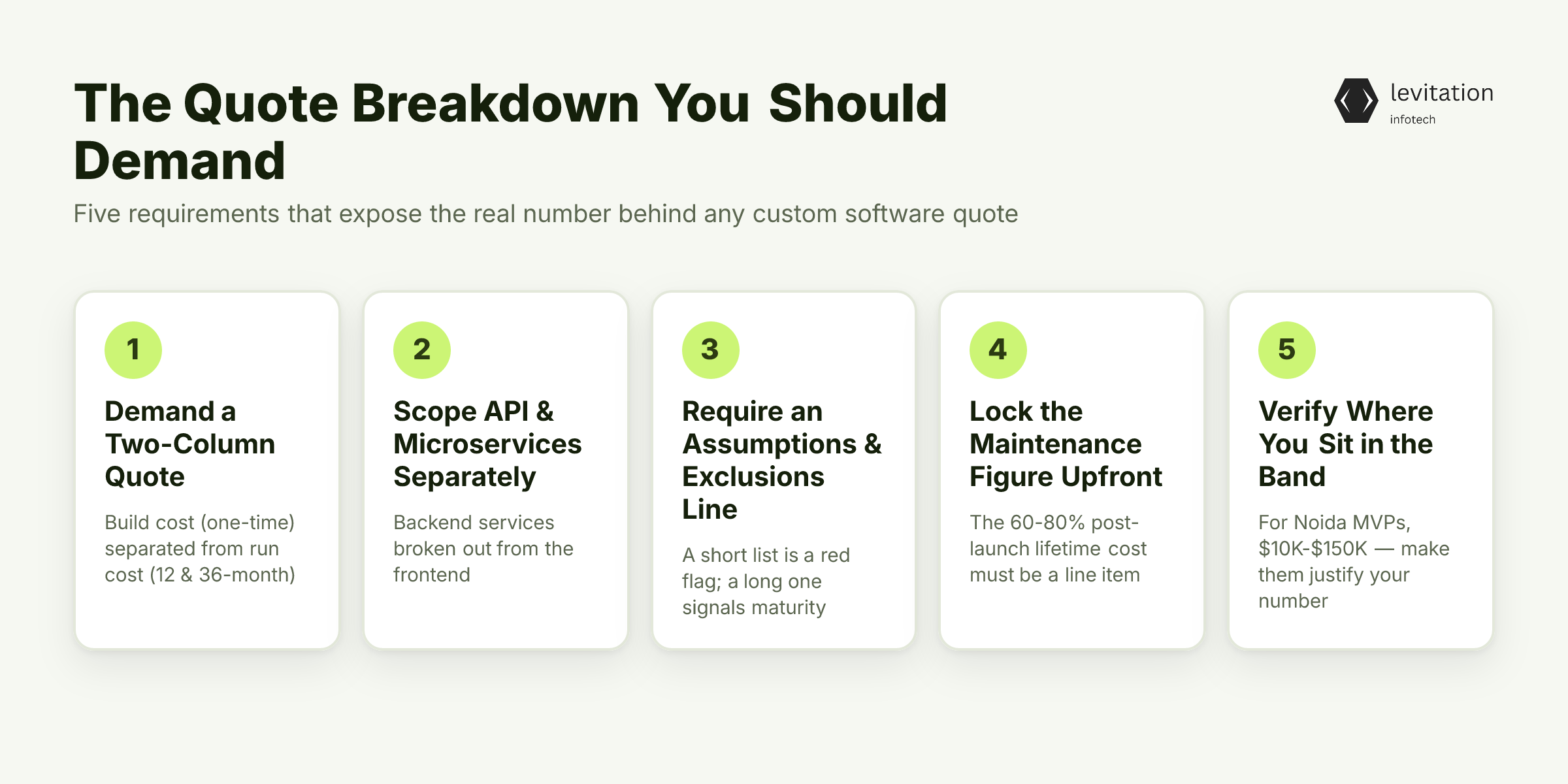
A build-only quote is incomplete by definition. Here's the framework that exposes the real number.
Demand a two-column quote. One column: Build Cost, one-time. Other column: Run Cost, with 12-month and 36-month projections. If a vendor can't or won't separate these, you're looking at a sales artifact, not a project plan. The run column should explicitly call out infrastructure, third-party licensing, security, maintenance, and a contingency buffer.
Ask for the microservices and API layer scoped separately from the frontend. Hidden coupling between layers drives up future change cost. If the vendor scopes everything as a single blob, every future change becomes a discovery project.
Require a line item called "Assumptions and Exclusions." This is where the real number hides. The exclusions list tells you which costs are the vendor's problem and which ones become yours. A short exclusions list is a red flag. A long, honest one is the sign of a mature vendor.
Insist on a maintenance figure stated upfront. The post-launch 60-80% of lifetime cost has to be allocated somewhere. If it isn't a line item, it becomes a future invoice. Refuse quotes that leave maintenance open. Open-ended maintenance is where vendors recoup margin on scope they didn't price correctly during the build.
For Noida-based MVP projects, the application development services build band runs from $10,000 to $150,000 depending on scope. Ask the vendor to show where in that band your project sits and why. If they can't justify the number, the quote is aspirational, not analytical.
This framework only matters if you can also spot the vendors who'll honor it. The smartest founders in 2026 are filtering vendors on something most sales decks never mention.
How Founders Are Quietly Cutting Software Costs by 40%
The lever isn't cheaper hourly rates. Indian vendor rates are already low by global standards. The savings come from killing rework, integration drift, and post-launch architecture rewrites. Those are the costs that nobody put on the original quote. The same dynamic driving cloud CRM and ERP budget bleed shows up across every software category.
The 2026 pattern across funded Indian startups looks like this. Founders reject quotes that don't separate build from run. They negotiate fixed-price run contracts upfront rather than waiting for month 12 to discover what infrastructure actually costs. They demand compressed delivery timelines instead of absorbing long in-house build cycles that burn runway without shipping features.
They're also picking vendors differently. The new proof of quality isn't a slick sales deck or a low hourly rate. It's longevity. Founders ask: which microservices and frontend architecture systems you built are still running in production five years later? If the vendor can't name three, the longevity question has answered itself.
The result is a 40% reduction in lifetime software spend for founders who adopt the pattern. Not because the build got cheaper. Because the run got scoped, the rework got prevented, and the architecture held up past year two.
When you budget the full lifecycle from day one, the math changes. Here's what that actually looks like in practice.
What Changes When You Budget the Full Lifecycle
The headline quote becomes honest. Instead of "₹15 lakh" floating in the pitch deck, you get a build number, a Year 1 run projection, and an ongoing maintenance figure. That figure reflects the 60-80% of lifetime cost arriving after launch. That's a real number. The founder can plan around it. The CFO can model it. The board can approve it.
Funding rounds align with actual spend. You're raising for lifetime cost, not just MVP burn. Investors respond better to a three-year cost model than to a build-only number that quietly multiplies in month 18.
Vendor selection changes too. You stop optimizing for the cheapest build quote. You start optimizing for long-term reliability. The vendor whose systems are still running in production five years after deployment becomes more valuable than the vendor who promises the lowest month-one price.
The outcome is software that compounds value instead of needing a rewrite at year two. For founders who've watched a "successful" launch turn into a two-year technical debt recovery project, that longevity is the entire point.
Pick a partner who budgets the full lifecycle from day one. Your year-three self will thank you for it.
Frequently Asked Questions
What is the average software development cost in India for a startup MVP?
MVP development in India ranges from $10,000 to $150,000 depending on scope, tech stack, and team structure. This is build cost only. Add 60-80% for post-launch infrastructure, maintenance, and iteration over a three-year lifecycle.
Why do Indian software quotes underestimate the real cost?
Quotes price the defined build scope, not the unknowns. Infrastructure, third-party licensing, security, compliance, and integration drift aren't in the SOW. Vendors can't price them defensibly upfront. Technical debt alone accounts for 20-40% of lifetime cost. The fix is demanding a two-column quote: build cost and run cost, separately.
What hidden costs should I ask a custom software vendor in Noida to itemize?
Force the quote to break out: cloud infrastructure, third-party API licensing, security and compliance, integration maintenance, design iteration post-launch, performance and scalability rewrites, and handover or knowledge-transfer costs. If a vendor can't or won't list these, you're seeing a build quote, not a project quote.
How much should I budget for software maintenance after launch in India?
The post-launch 60-80% of lifetime software spend covers maintenance, bug fixes, security patches, infrastructure, licensing, and ongoing iteration. For a ₹15 lakh build, the run cost over the software's lifetime is ₹22.5-60 lakh. That cost is distributed across infrastructure, licensing, maintenance, and major feature work. The exact split depends on product complexity, traffic patterns, and how many third-party services sit between you and your users.
Is it cheaper to hire in-house or outsource custom software development in India?
In-house teams carry fully-loaded engineering salaries, benefits, and management overhead. Those costs compound over long build cycles that ship fewer features per rupee of runway. Outsourced delivery compresses those timelines. When the outsourced quote captures lifetime cost rather than just the build, the total cost of ownership favors outsourcing for most funded startups. The comparison only holds if you're comparing full-lifecycle numbers, not just month-one invoices.
Sources
Research and references cited in this article:
- How Much Does Custom Software Development Cost in 2026? A Complete Guide | Cozcore Technology
- Custom Software Development Cost 2026: Pricing Guide & Trends | SDH global
- Custom Software Development Cost in 2026: Complete Pricing & Budgeting Guide | ConsoleOps Blog
- Custom Software Development Cost: 2026 Pricing & ...
- What are the hidden costs in custom software development projects?
- Total Cost of Ownership for Custom Software Projects: What Businesses Need to Know | Leobit
- Custom Software Development Services Company Reveals ...
- Total Cost of Ownership for Custom Software: The 2026 ...
- What are the hidden or ongoing costs often overlooked in quotes from software development vendors?
- Underestimated Costs of Custom Software Development
- MVP Development Cost and Timeline Guide 2026 - OMEGA SOLUTION
- MVP Development Cost in 2026: Full Breakdown & Strategies
About the author
Mayank Singh is a software developer at Levitation Infotech, where he builds web and AI-powered applications across the company’s fintech, healthcare, and enterprise projects.