


TL;DR: Most hospital AI pilots fail not because the models are wrong, but because the integration, orchestration, and clinical workflows around them were never built for production. The 27% that survive treat integration as the hard problem, and model accuracy as the easy one. Skip that lesson and your pilot joins the 73%.
Key Takeaways: - Roughly 3 in 4 hospital AI pilots die before their second budget cycle, and the model is rarely the reason. - Fragmented data, missing orchestration, and bolt-on architecture kill more pilots than bad accuracy. - Clinicians resist tools that don't fit their workflow, and they are usually right to. - Surviving programs build the data and integration layer first, and pick the model last. - Real ROI shows up after integration stabilizes, not during initial deployment.
The 73% Stat Your Vendor Won't Put in the Pitch Deck
Your AI model works in the demo. The accuracy numbers look great. The vendor has a slick pitch deck.
Months of investment later, the pilot is dead. Everyone blames the technology. But the technology wasn't the problem. It never is.
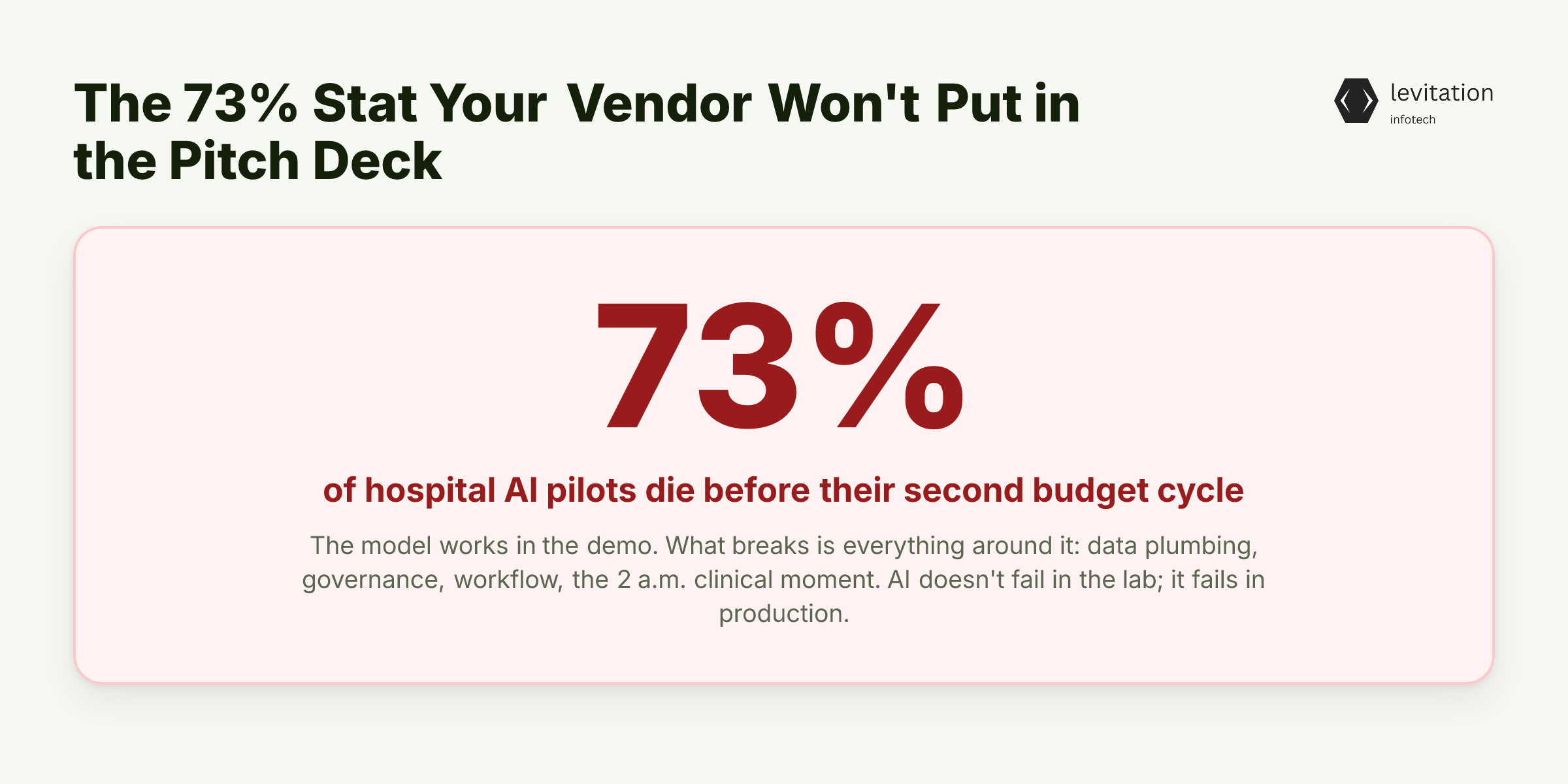
Roughly 73 of every 100 hospital AI pilots don't make it past their second budget cycle. The default story is familiar.
The model was wrong. The data was too messy. The use case wasn't viable. Each version is convenient, and each version is wrong.
AI doesn't fail in the lab. It fails in production. The model is usually the part that works.
What breaks is everything around it: the data plumbing, the governance, the workflow, the moment a clinician is supposed to use the thing at 2 a.m. on a Tuesday. The gap between a controlled benchmark and a real hospital floor is where pilots go to die.
In healthcare technology, the distance between proof of concept and production use is measured in integrations, not in clever prompts. Most teams underestimate that distance.
But if the model isn't the problem, what is?
Why Better Models and Bigger Compute Budgets Won't Save Your Pilot
AI adoption in healthcare has accelerated fast. Most health systems now have AI strategies on paper, and many have at least one funded pilot in flight.
McKinsey research confirms what most CTOs already feel. Adoption is real. Translating pilots into measurable outcomes is still early innings for almost everyone.
The temptation is to throw more compute at the problem. Or a fancier foundation model. Or both. That instinct is wrong.
The model is rarely the bottleneck. The bottleneck is everything wrapped around it: data plumbing, identity, audit, deployment topology, and the workflow hooks that make a tool feel like it belongs.
Vendor deployments can move faster than in-house builds because vendors arrive with pre-built integration patterns, security postures, and production templates. In-house teams build these from scratch during the pilot, which is a great way to learn and a terrible way to ship.
The hospital management problem is operational, not intellectual. No amount of GPU budget fixes a system that can't pull the right patient record at the right moment.
The RAG-style architectures many teams reach for first often run into the same wall. As we covered in RAG Is Dead for Healthcare AI, retrieval is rarely the hard part in clinical settings.
So if compute and models are off the suspect list, where does the gap actually live?
The Four Failure Modes Nobody Puts in the RFP
The failure modes that kill hospital AI pilots are well known. They are just not the ones anyone puts in the requirements doc. Here are the four that show up in nearly every post-mortem. - Fragmented data. Patient records sit in HIS, EMR, lab, imaging, and billing systems that barely talk. There is no canonical layer. At inference time, the model starves because the right data is locked behind three APIs and a manual export. The structural problem is well documented, and pieces like HIS Alchemy: Transforming Data into Patient-Centric Gold show what fixing it actually takes. - Security and compliance gaps. HIPAA-style requirements need to be engineered in from day one. When they get bolted on during a security review, every retrofit costs more and ships later. The audit you skipped in month two is the one that kills you in month fourteen. The trap is detailed in Why Your Healthcare LLM Will Fail Its First HIPAA Audit. - Missing orchestration layer. There is no shared operational and intelligence layer for enterprise-wide coordination. Each pilot becomes a snowflake. Nothing talks to anything else. Adding a second use case means starting over. - Bolt-on architecture. The AI is strapped onto existing workflows instead of designed into the decision points where clinicians actually work. It looks like an integration. It behaves like a popup.
That third failure mode, orchestration, is where most hospital AI programs quietly stall. The data problems get attention. The security problems get budget. The orchestration problem gets a shrug, because nobody owns it.
HIS integration lives or dies on whether someone actually draws the diagram of how every system connects before the model goes near a patient.
The pattern repeats inside every health information system deployment. The model works, the data works in isolation, and the system as a whole never quite works at all. The most expensive failure mode of all is the one that lives in the break room, not the server room. It looks like a change management problem, and it almost never is.
Why Clinician Resistance Is Rational, Not Irrational
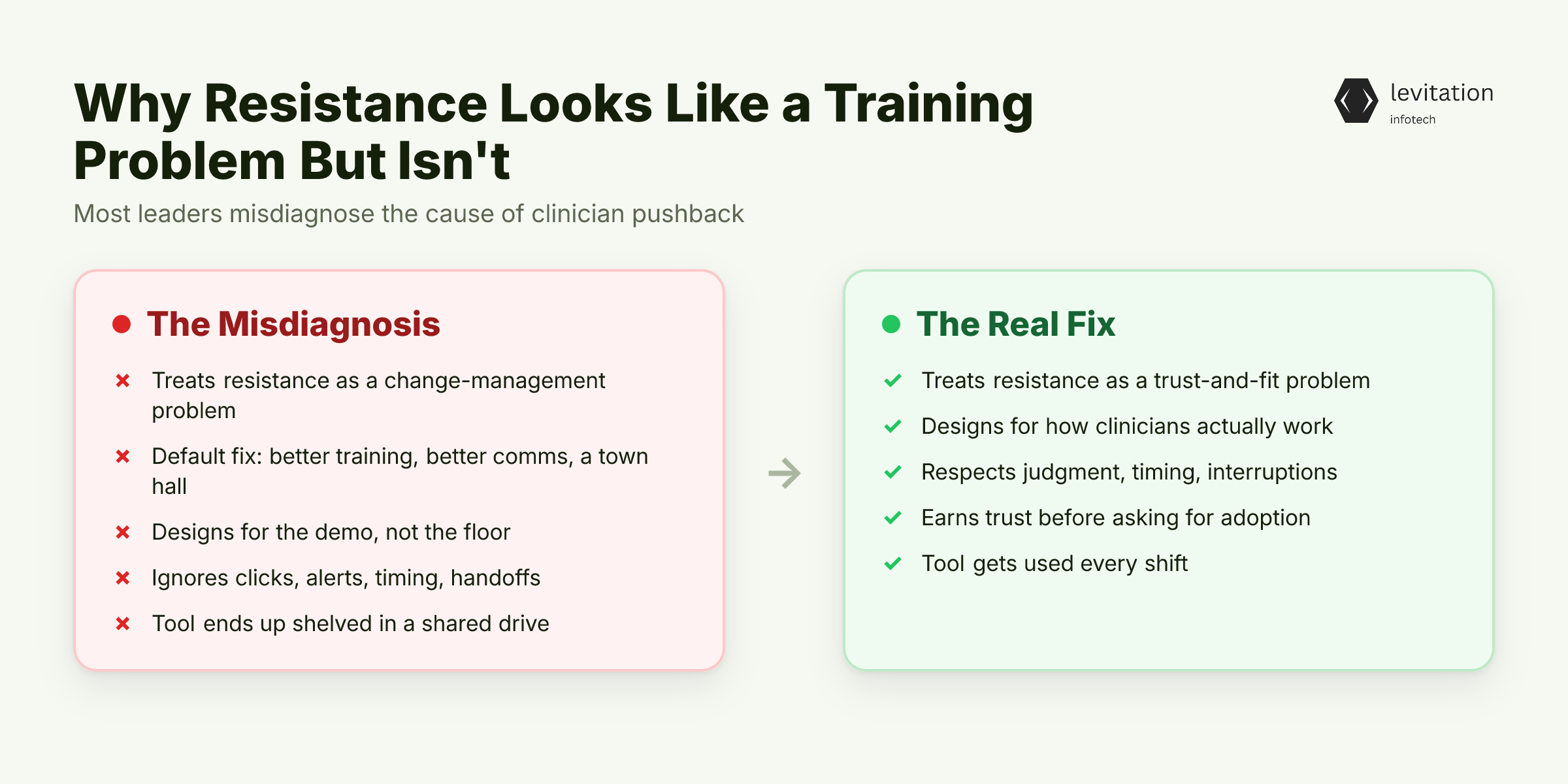
Staff resistance is the second-largest killer of hospital AI pilots, and most leaders misdiagnose it as a change management problem. The fix, they assume, is better training, better comms, a town hall. None of that is the real issue.
Clinicians resist for good reasons. The tool doesn't fit their workflow. It adds clicks. It fires alerts nobody trusts. Or it surfaces a recommendation that quietly threatens their professional judgment.
These are not Luddite objections. These are experienced practitioners telling you, in plain language, that you have not earned their trust yet.
Industry studies and practitioner reports consistently flag the same finding. Pilots that succeed are the ones that account for the practical realities of how nurses and doctors actually work.
The thinking, the timing, the interruptions, the chart handoffs. Designing for the demo ignores all of that. Designing for the floor respects it.
A user-centric approach isn't a soft skill. It is the difference between a system that gets used every shift and a license that gets shelved in a shared drive. The cost of skipping it shows up not as a complaint, but as silence. The tool just stops getting opened.
Understanding the problem is one thing. What does the 27% actually do differently?
What the 27% Do Differently: Integration-First, Not Intelligence-First
The pilots that survive have one thing in common. They treat integration as the hard problem, and model accuracy as the easy one. That single inversion changes almost every decision downstream.
Here is what that looks like in practice. - They build the data and orchestration layer before they pick the model. Plumbing, identity, audit, and rollback are first-class deliverables. The model is the last component, not the first. - They co-design with clinicians during the pilot itself. Nurses and doctors sit in on workflow design, alert tuning, and exception handling. Not as reviewers. As co-authors. - They evaluate partners on production track record, not demo-day accuracy. They look for systems that have run for years in regulated environments, not months in controlled ones. - They compress deployment timelines wherever possible. Every quarter a pilot sits in limbo, the budget clock ticks and stakeholder trust erodes. - They treat the AI as a component of a system, not a product. Governance, observability, and rollback are designed in from the start, not bolted on after an incident.
The patient data stack that survives year three is the one designed to survive year three, on day one. Vendors with a long production track record in regulated industries, including HIPAA-compliant deployments, tend to ship this discipline as a default.
What Changes When AI Makes It Past Year One
When a pilot survives its first year, something interesting happens. The system starts compounding value. A model that runs in production long enough generates the training data and operational feedback that makes subsequent years much better.
The accuracy numbers you had at deployment are the worst numbers you will ever have. Watching that curve requires active drift detection, not a quarterly review.
The real ROI is not accuracy. It is reduced documentation burden, faster decision cycles, and clinicians operating at the top of their license. It is the alert that didn't fire because the system actually understood context.
Those outcomes don't show up in a model card. They show up in a staffing report.
Systems designed for production keep running. Pilots designed for demos get decommissioned. The shift is from "AI project" to "AI infrastructure," from one-off wins to a platform the entire hospital chain can build on.
Healthcare AI stops being a line item and starts being a load-bearing layer.
The teams that get there did not get lucky. They picked integration over intelligence on purpose, from the first sprint. That is the working philosophy: the AI is one component in a much larger system, and the system is the deliverable.
Frequently Asked Questions
What is the average cost of a failed hospital AI pilot?
Failed pilots burn through real budget before they are shelved, once you include vendor fees, internal staff time, integration work, and the opportunity cost of delayed clinical improvements. The bigger cost is usually the second pilot the team is too burned out to start.
How long do hospital AI pilots typically take to show ROI?
Pilots that survive their first year usually show measurable ROI only after integration stabilizes and clinician adoption takes hold. The first stretch goes to plumbing and workflow tuning, not model performance. Teams that expect ROI during the initial deployment phase are usually measuring the wrong thing.
What is the most common reason hospital AI pilots fail?
Fragmented data combined with a missing orchestration layer is the most common root cause. The model works in isolation, but it has no reliable way to access the right patient data, get governance approval, or plug into the clinical workflow, so it never reaches the moments where decisions are made.
How do successful hospital AI deployments differ from failed ones?
Successful deployments treat integration, workflow design, and clinician co-design as the hard problem, and model accuracy as the solved problem. They also pick partners with a long production track record in regulated environments. This sharply reduces the chance the pilot ends up as a sunk cost.
Is the 73% hospital AI pilot failure rate really accurate?
Yes. Industry analyses and surveys consistently show roughly 70-75% of healthcare AI pilots fail to make it past their initial budget cycle. The exact number varies by source, but the order of magnitude is well established. The failure causes, including data fragmentation, workflow mismatch, and governance gaps, are consistent across studies.
Sources
Research and references cited in this article:
- Why So Many Healthcare AI Pilots Never Make It Past the Pilot Phase – Mobile Health Times
- What Are the Most Common AI Implementation Challenges in ...
- Why Most Healthcare AI Fails After the Pilot Phase - MedCity News
- Why 80% of Healthcare AI Projects Fail After Pilot - Nirmitee.io
- The AI pilot trap: Why promising tools fail to scale
- Healthcare AI ROI Is No Longer a Pilot Result, It's a Business Model
- 2026 Ends AI Pilots: How HCLS Must Scale AI Now
- Only 4% of health systems achieve scaled AI ROI: Report
- The High Failure Rate of Healthcare AI Projects — And How Calvient Is Different
- MIT: 95% of enterprise AI pilots fail to deliver measurable ROI
- The AI Implementation Gap: Why 80% of Healthcare AI Projects Fail to Scale Beyond Pilot Phase - Digital Health Technology News UK
- Why 90% of Enterprise AI Implementations Fail (2026)
About the author
Mayank Singh is a software developer at Levitation Infotech, where he builds web and AI-powered applications across the company’s fintech, healthcare, and enterprise projects.