

TL;DR: Clinical AI fails not because models are wrong. It fails because nurses lose trust in the alert source. The trust drains out from past noise. The fix is a 90-day sequence built around oversight. It rebuilds a clinician-facing trust ledger through review, tiered alert redesign, and a weekly feedback loop. CTOs who treat oversight as a post-launch afterthought end up defending a deployed model. That model is one that no one at the bedside reads.
Key Takeaways: - Between 90% and 96% of clinical decision support alerts are routinely overridden. The override rate is not a per-alert judgment. It is a running Bayesian update on the system's overall trust. - Validation accuracy is a measure of statistical performance, not clinical use. A model can be right and still be wrong for the workflow that receives it. - The thing to manage is a trust ledger, not a dashboard. Tier policy, override numbers, and silencing signs belong in a shared clinician-engineering review. They should not be buried in a tracking stack.
The Validation Paradox: Perfect Metrics, Silent Rejection
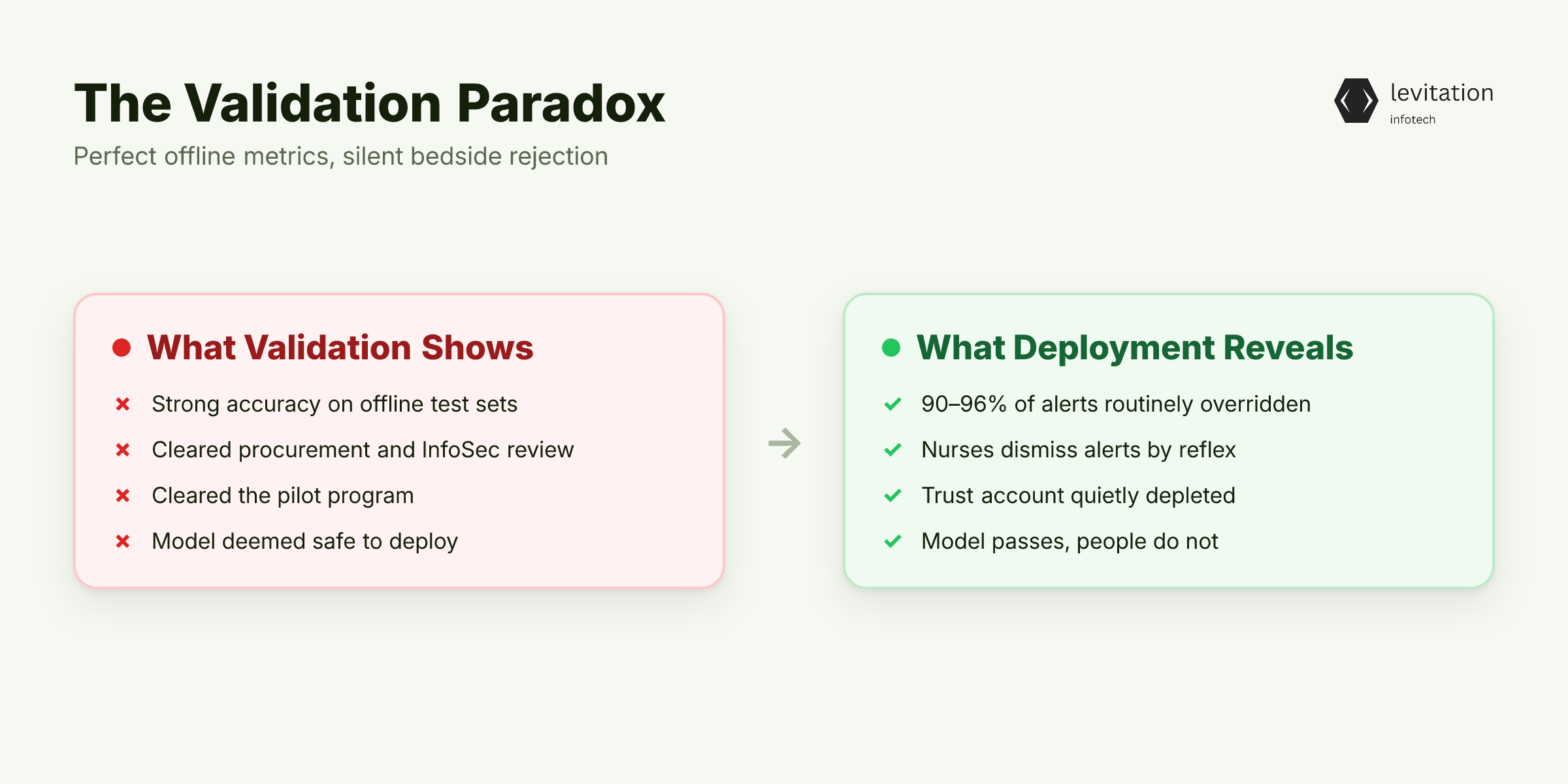
Your clinical AI cleared validation with strong accuracy numbers. It cleared procurement, cleared the information security review, and cleared the pilot. Six months into deployment, nurses are ignoring its alerts by reflex.
The model did not break. The trust did.
This is the validation paradox. The system passes every offline test the healthcare technology stack can throw at it. Then it collapses against the only test that matters. That test is the reflexive attention of a bedside clinician. Between 90% and 96% of clinical decision support alerts are routinely overridden. The numbers keep climbing in deployments where oversight was treated as a clinical concern. It should have been treated as an engineering surface instead.
The instinct is to blame the nurse. That instinct is wrong. Nurses are not misreading signs.
They have already stopped reading them. Each dismissed alert is a small withdrawal from a trust account. The system did not know it was keeping this account. The override rate you see in your logs is the balance on that account. That balance comes after months of compounded withdrawals.
So here is the question for any CTO. They are looking at a deployed clinical AI with a rising override rate. If your model passes every offline test, why is the real-world rejection climbing? The answer is not what most seller decks suggest. The failure is not happening where you think it is.
Why Lab Accuracy Is a Liar About Real-World Use
Validation datasets measure statistical performance. They do not measure clinical use. The gap between the two is where trust quietly drains.
Consider the COVID X-ray model. It performed well during testing but failed in practice. It had learned to identify the X-ray machines used in COVID wards, not the disease. The model was right for every sample in the validation set. It was wrong for every patient outside it.
This same pattern plays out at the alert level. In practice, a sepsis early-warning model can hit strong AUROC on past data. It can still fire at the wrong time, on the wrong patient, with copy that hides the model's uncertainty.
A drug-interaction alert can be technically correct and clinically irrelevant. The interaction is already managed. In both cases, the system is right and still wrong for the workflow.
Nurses do not evaluate each alert one by one. They evaluate the system's overall trust. Then they apply that judgment by reflex to the next alert that fires.
This is the process most clinical AI sellers miss. They chase per-alert precision. The real variable is the clinician's running trust score for the alert source.
A note on terms, because sellers blur it. Alert fatigue and alarm fatigue are not the same thing. Alarm fatigue refers to bedside physiological monitor signs. These are cardiac, pulse-oximetry, and ventilator signs. It falls under Joint Commission safety goals. Alert fatigue refers to clickable warnings. These are generated inside the EHR, clinical decision support, and AI models. Both dull responses through overexposure. They involve different systems, different ownership, and different fixes.
So if the problem is not accuracy and not volume alone, what process is actually driving the dismiss reflex?
The Trust Depletion Model: Why Nurses Silenced Your Alert Before Reading It
The process is a trust depletion model. Every clinician carries an unspoken, running trust score for every alert source in their environment. Each dismissed alert lowers the next one's attention budget.
Each false positive in a shift subtracts from the trust the next alert will inherit. An override is not a per-alert decision. It is a Bayesian update on the system's reliability.
The reflex-speed dismiss is the signal that matters. A nurse who pauses to read the alert is still evaluating. A nurse who ignores instantly has stopped evaluating. The shortcut has replaced the read.
This is why override delay matters more than override rate. The faster the dismiss, the deeper the trust depletion has already gone.
The technical levers that actually move this score are well understood. They are rarely used together. The levers are: - Alert tiering that maps model confidence and clinical urgency to interruptive, passive, or informational show - Context-aware silencing that knows the clinician already addressed this concern an hour ago - Clear confidence tuning surfaced in the alert copy. This way, the nurse sees what the model knows about its own uncertainty
The underused lever is the silence-and-acknowledge pattern. When a clinician right-clicks an alert, reads the reason, and chooses to silence it. They do this for a reason the system can capture. That action is a strong signal. The system should learn from it.
When the clinician fires-and-dismisses without reading, the system should treat it as a weak signal. It should avoid retraining on it. Most clinical AI platforms learn from overrides without telling these two cases apart. As a result, the trust score keeps falling.
If the trust ledger is the real thing to manage, then the question becomes which oversight structure actually rebuilds it.
The Oversight Gap Most CTOs Miss Between Deployment and Operation
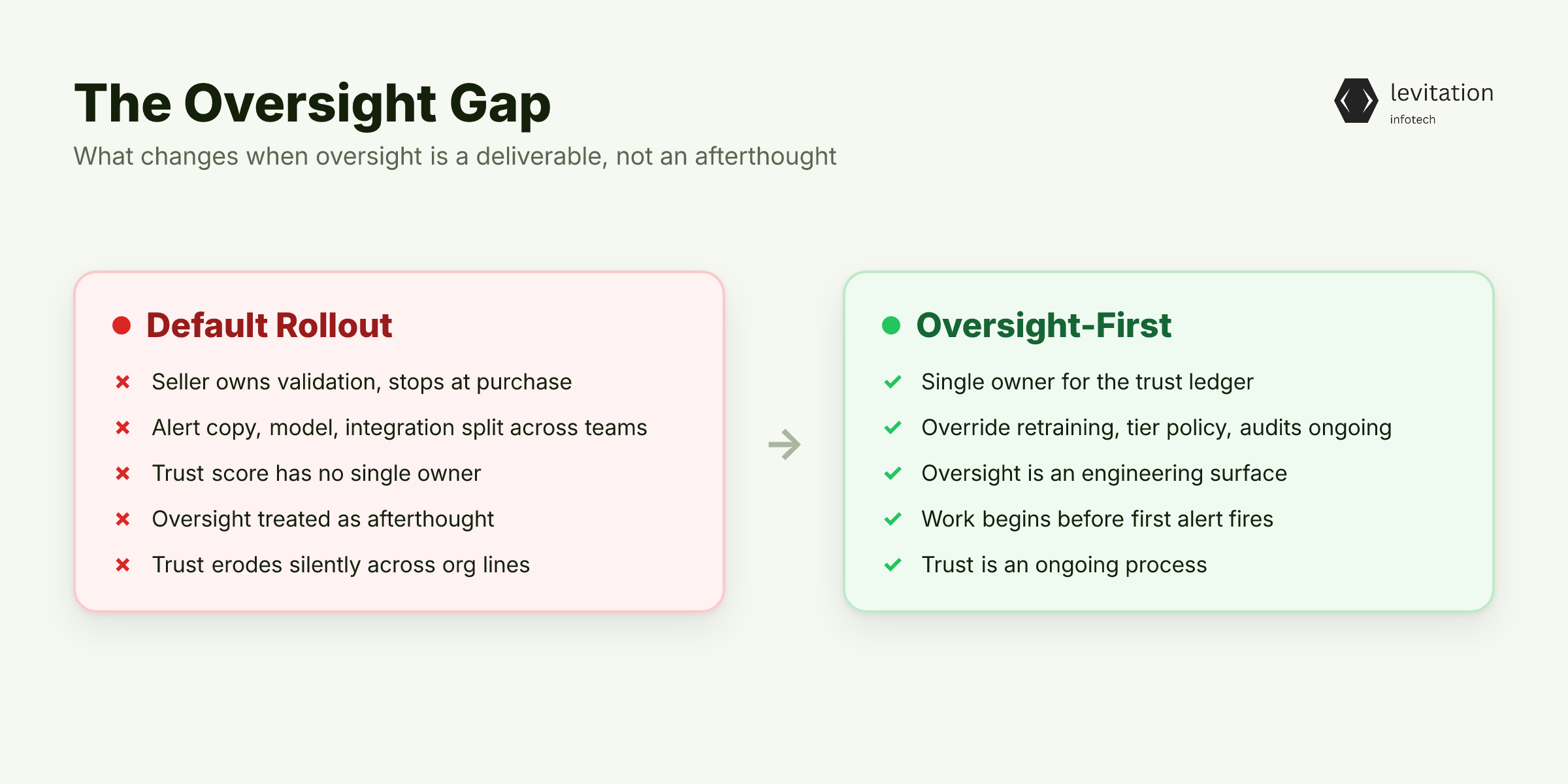
The oversight gap is the space between passing validation and running a trustworthy system in production. Seller validation is pre-deployment, controlled, and tied to a buying milestone. Operational oversight is post-deployment, ongoing, and tied to no one. That is, unless you assign it clearly.
A model can pass buying and still lack an owner. The owner would cover override numbers, alert-tier policy, or feedback review rhythm. That is the default state in most clinical ai rollouts. The clinical informatics team owns the alert copy. The data science team owns the model. The EHR team owns the integration. Nobody owns the trust score as a single thing. That is why it erodes silently across org chart lines.
From the CTO's seat, this is not a clinical concern to push down. Oversight is an engineering surface. It determines whether the system stays trustworthy. It is the place where override-driven retraining signs, tier policy revisions, and silencing-rule audits all live.
Without an owner, the trust ledger has no ledger keeper. This is also why the cleared audits customers don't trust it pattern shows up across regulated AI deployments. Passing the audit is a one-time check. Trust is an ongoing process.
Groups that have kept clinical AI deployments in production over many years almost always started oversight work first. They did this before the first alert fired in production. The ones whose systems stay trustworthy treat oversight as a key deliverable. They do not treat it as an afterthought.
What does an oversight-first 90-day sequence actually look like in practice?
A 90-Day Roadmap to Recover Alert Trust
The roadmap has three phases. Each phase is owned jointly by engineering and clinical leadership.
Weeks 1 to 3: Review. Track every alert with override delay, repeat-offender rules, and clinician silencing reasons. Rank alerts by override rate and clinical harm link.
The output is a short list of high-volume, high-override alerts. These alerts do the most damage to the trust score. The output also includes a baseline for measuring improvement.
Weeks 4 to 8: Tier and redesign. Build three levels tied to model confidence and clinical urgency: - Interruptive alerts for high-confidence, time-critical signs - Passive alerts surfaced in a clinician dashboard for moderate-confidence signs - Informational entries written to the chart for low-confidence or context-dependent signs
Rewrite the alert copy to show uncertainty instead of hiding it. A nurse who sees "model confidence 62%, sepsis criteria partially met" makes a better call. That is better than one who sees a binary red banner. This phase moves fastest when the alert-tier list and the copy patterns are reused from past deployments. They should not be reinvented.
Weeks 9 to 12: Oversight and feedback loop. Stand up a weekly clinician-AI review with a fixed agenda. The agenda covers tier policy, threshold drift, and override-driven retraining signs. The review owns the trust ledger.
Every redesign decision gets logged with the override number it targeted. Every silencing rule gets reviewed for whether it was silencing the right signs. This is the thing that separates a deployed model from a learning system.
When the ledger is rebuilt, the override curve flattens. It flattens in ways the buying numbers never predicted.
What Changes When Trust Returns to the Workflow
The override rate on critical alerts drops. It drops because the trust score is no longer being dragged down by low-value noise. Nurses resume reading the alerts that matter. They do this because the system stopped asking them to read the ones that did not.
Clinical time recovered translates into a reduction in alert volume per shift at the top interruptive level. Tiering moves most signs down a level. At the lower level, they do not consume cognitive budget.
Adoption numbers shift from "system is live" to "system is acted upon." That is the only number that actually matters for patient outcomes.
A deployed model that nurses dismiss is not deployed. It is parked. The health information system layer sees the same patient data. The AI layer above it is no longer adding signal.
The CTO stops defending a deployed model. Then they start running a learning system. That is what oversight was always supposed to enable. The deployments that survive contact with the nurses they were built to help did not get there by shipping a better model. They got there by treating the trust ledger as a production thing. It had an owner, a review rhythm, and a feedback loop that closed every week. That stance separates clinical AI that survives validation. It also separates it from one that survives contact with the nurses it was built to help.
Frequently Asked Questions
What is clinical AI alert fatigue and why does it matter?
Clinical AI alert fatigue is the dulling that occurs when clinicians see high volumes of AI-generated alerts. Many of them are low-value, and clinicians begin overriding or ignoring them by reflex. It matters because the same habit that dismisses irrelevant alerts also dulls the response to rare alerts. Those rare alerts are the ones that are clinically important. It undermines the whole purpose of the clinical decision support investment.
Why do nurses override clinical AI alerts even when the model is accurate?
Nurses do not evaluate each alert against the model's accuracy. They evaluate it against a built-up trust score for the alert source. Research shows 90 to 96% of CDS alerts are routinely ignored. This override behavior reflects systemic distrust from past false positives, not a per-alert judgment. Once the trust score drops, even correctly firing alerts get ignored at reflex speed.
How is alert fatigue different from alarm fatigue in hospitals?
Alarm fatigue refers to physiological monitor alarms at the bedside. These include cardiac and pulse-oximetry signs. It falls under Joint Commission safety goals. Alert fatigue refers to clickable warnings. These are generated inside the EHR, clinical decision support, and AI models. Both involve dulling through overexposure. However, they involve different systems, different ownership, and different fixes.
How long does it take to reduce clinical AI alert fatigue in a hospital?
A structured 90-day roadmap, covering review, tier redesign, and oversight, can really shift override rates. End-to-end, groups usually complete the cycle in months. That is faster than the longer rebuild timelines teams without past oversight patterns tend to encounter.
What is the most common cause of clinical decision support failure post-validation?
The most common cause is an oversight gap. AI adoption moves faster than the infrastructure to check, track, and respond to failures in production. Models pass pre-deployment checks, but no one owns override numbers, tier policy, or clinician feedback loops after go-live. As a result, the trust ledger erodes silently until the system is ignored by default.
Sources
Research and references cited in this article:
- Alert Fatigue in Healthcare: Causes and Solutions (2026)
- Experiences of Alert Fatigue and Its Contributing Factors in ...
- Reducing Alert Fatigue in Clinical AI Without Burning Out ...
- Alarm fatigue in healthcare: a scoping review of definitions, influencing factors, and mitigation strategies
- Exploring ICU nurses’ response to alarm management and strategies for alleviating alarm fatigue: a meta-synthesis and systematic review
- When Algorithms Fail: Preparing for AI Incidents in Clinical ...
- National Nurses United survey finds A.I. technology degrades and undermines patient safety | National Nurses United
- AI Alerts Versus Clinical Judgment: A Point-Counterpoint on the New Medical Error - The Hospitalist
- Nurses are setting rules about AI in their contracts
- Nurses are not resisting AI. They’re... - McKinsey & Company
- How to Reduce Alert Fatigue in Healthcare CDS (2026)
- Clinical Alerts and AI: Balancing Sensitivity with Alert Fatigue - Blog - Arkangel AI
About the author
Mayank Singh is a software developer at Levitation Infotech, where he builds web and AI-powered applications across the company’s fintech, healthcare, and enterprise projects.