


Every Indian founder budgets for Year One. Almost nobody budgets for Year Two. That's where most custom CRM projects quietly die, bleeding lakhs every month while the team pretends the build is done.
TL;DR: A custom CRM almost always costs more in Year One than a commercial license, then flips the script. Budget for the second year before you sign the first contract. That's where 60% of Indian CRM projects blow past their original number. Structure the build for stability, not just speed, and the three-year math starts working in your favour.
Key Takeaways: - The Year-Two bill is where custom CRMs live or die, not the build quote. - Maintenance, feature creep, compliance, and integration decay are the four real cost bombs vendors rarely surface. - A properly scoped 25-user custom CRM lands near $109,000 over three years, undercutting a $150/seat commercial stack at $135,000.
The Year-One Illusion: Why Your CRM Budget Looks Healthy
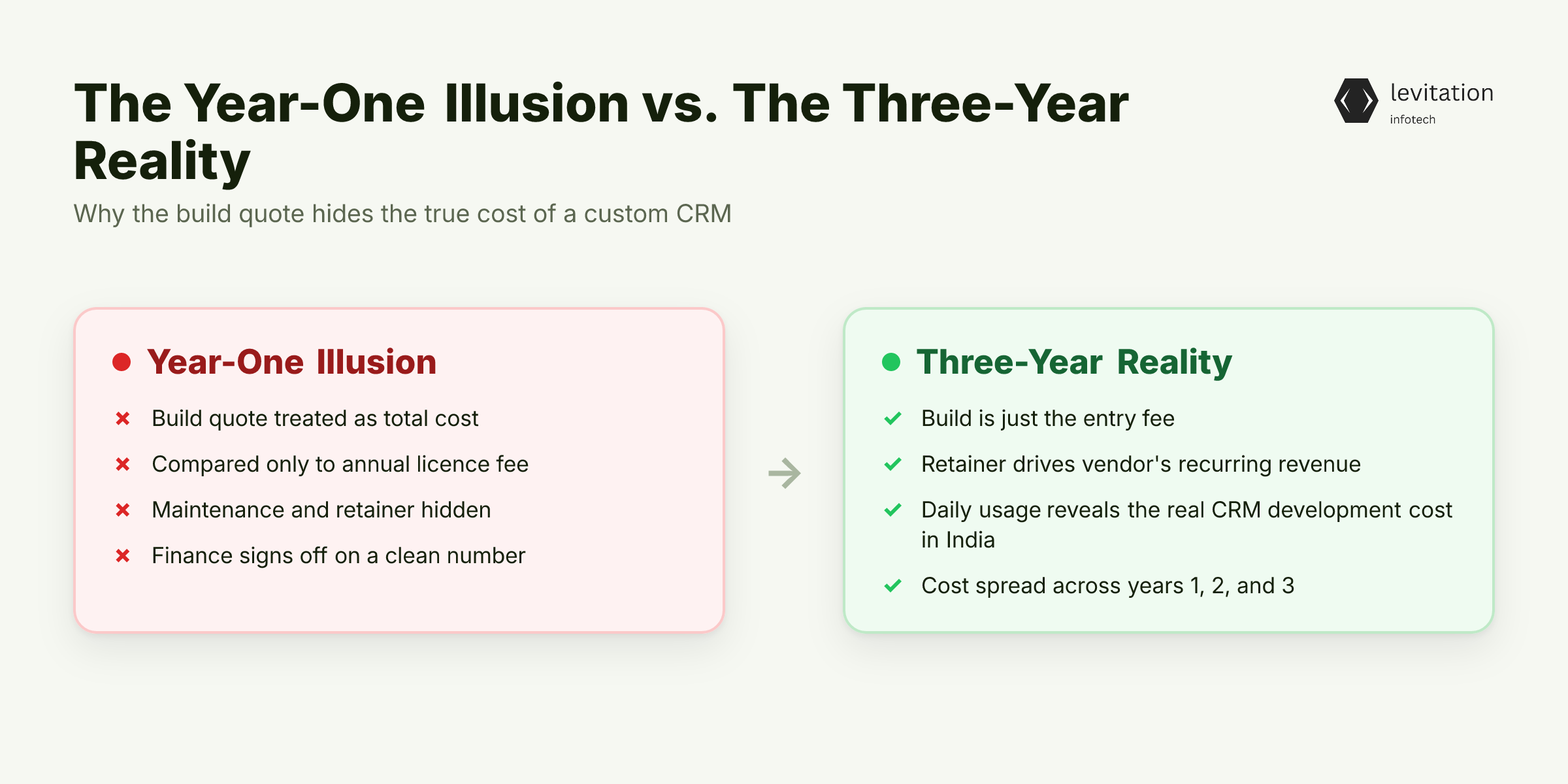
The build quote is seductive. A vendor walks in, shows you a headline near ₹50 lakh, and your finance team signs off because it fits the current quarter. Everyone leaves the room happy.
The problem is that quote is the cost of getting the system running. It is not the cost of running the system. Vendors price to win the build. They do not price to disclose what comes after, because the maintenance contract is where their recurring revenue lives. The build gets them in the door. The retainer keeps them there.
Most Indian SME founders make the same comparison error. They pit a custom build quote against a commercial CRM's annual licence. Then they conclude custom is too expensive. They never model what the second year looks like once reps, managers, and ops teams start using the thing daily. The number that mattered was never the Year-One line. It was always the CRM development cost in India spread across three years, not one.
The build phase is the easy part. It's the year after go-live that decides whether your custom CRM was a smart investment or a slow-motion write-off.
The Four Year-Two Cost Bombs That Nobody Quotes You
Four cost categories quietly compound once your CRM goes live. None of them appear in the original proposal. All of them are avoidable if you plan for them.
Maintenance is not optional. Hosting, security patches, dependency upgrades, and a developer on call form the floor of every custom build. Industry data puts that floor at roughly $8,000 a year for a modest system.
This floor grows as technical debt accumulates. It is the baseline crm maintenance cost every founder should expect to pay from month one.
Feature creep is the second bomb. Once your sales team lives inside the CRM, they want dashboards, automations, and integrations. Research shows Year-Two feature work alone averages $15,000. Vendors almost never surface that number, because admitting it would shrink the build margin. This is where custom CRM cost most often exceeds the original contract.
Compliance is the third. India's DPDP Act and sector-specific rules force schema changes, consent flows, and audit-log requirements. These were not in the original spec. The regulatory layer is rarely a one-time cost, even when vendors tell you it is.
Integration decay is the slow leak. Third-party APIs version out, webhooks break, and OAuth credentials rotate on their own schedule. Each incident costs both uptime and engineering hours. The bills arrive quarterly, not annually.
Four bombs. Real numbers. Most founders still don't believe it will happen to them, until they look at the actual data.
The 2x Budget Trap: Where 60% of Indian CRM Projects Actually Fail
Independent industry research shows 60% of Indian CRM projects blow past their original budget by 2x or more. The overruns almost always land in Year Two, not during the build phase.
That's why "we'll deal with maintenance later" is the most expensive sentence in CRM software development.
The mechanism is straightforward. Scope was never pinned down. "Custom CRM" in a vendor proposal usually means a fraction of what's needed to run sales, service, and ops day-to-day. The rest is implied, deferred, or quietly rolled into a change order once you're locked in. Sound familiar? It's the same pattern we see in CRM development deals across Indian SMEs.
Cheap vendors make this worse, not better. Low build quotes get subsidised by vague maintenance retainers that double the moment the system goes live. The switching cost of a half-built CRM is higher than the retainer inflation, so founders pay.
The pattern is well documented. 60% of Indian CRM projects hit 2x budget before they ever deliver real value.
The fix is not a bigger budget. It's a different contract structure, one designed to protect you from the moment the build ships.
Reading the Real Price Tag: A Three-Year TCO Breakdown
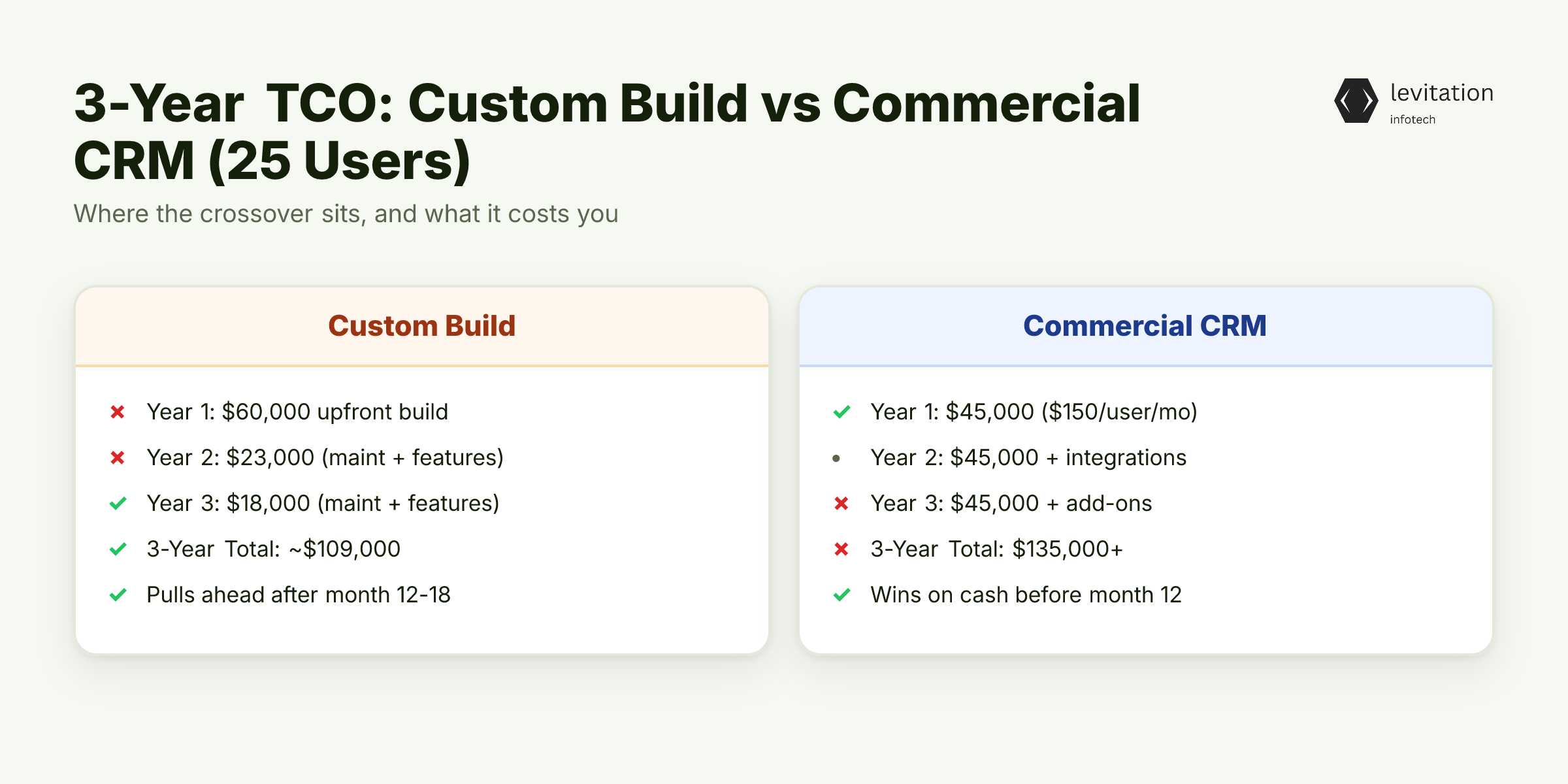
Layer the actual numbers on a 25-user custom CRM. That's the size where the build-vs-buy math starts to matter for most Indian SMEs. - Build: $60,000 - Year One maintenance: $8,000 - Year Two maintenance + features: $8,000 + $15,000 = $23,000 - Year Three maintenance + features: $8,000 + $10,000 = $18,000 - Three-year TCO: roughly $109,000
Now compare to a commercial CRM at $150 per user per month for the same 25 seats. That's $45,000 a year, or $135,000 over three years. Then add the custom integrations and add-ons you will inevitably need.
We've seen this trap play out before. Founders assume they are saving money, then discover the Zoho CRM cost trap in Year Two the hard way.
The crossover point sits between month 12 and month 18. Before that, commercial wins on cash. After that, custom pulls ahead. But only if your build is stable, your maintenance is fixed, and your feature spend is governed. This is why "crm tco india" is the search that separates serious founders from brochure readers. For a deeper look at the CRM development cost in India line items, the data tells a clear story.
The math is in your favour when the contract is structured correctly. Five clauses separate the projects that survive from the ones that quietly bleed out after go-live.
Building the Escape Hatch: How to Structure Your Build to Survive Year Two
Five clauses separate a custom CRM that survives Year Two from one that becomes a write-off.
Clause 1: Pin maintenance to a fixed monthly retainer, not hourly billing. Time-and-materials maintenance is how Year-Two bills triple overnight. A fixed retainer forces the vendor to manage scope, not bill against it.
Clause 2: Define a feature-credit pool in the build contract. Bundling a pool of included change requests converts unpredictable creep into a known line item your CFO can plan around.
Clause 3: Own the source code and repository from day one, with an escrow clause. Vendor lock-in is the real reason Year-Two retainers stay high. If you don't own the code, you don't own the timeline.
Clause 4: Require a documented architecture and deployment runbook. A proper handoff with full documentation prevents your team from having to reverse-engineer decisions the partner already made. The custom CRM build is only the start. The handoff is the product.
Clause 5: Vet the partner's retention rate, not their sales deck. A strong client retention track record tells you the partner built the relationship around the Year-Two conversation, not the Year-One signature. Anyone can win a build. Few can keep the system stable for three years.
When the contract is right, the math stops being a threat and starts being a moat. Teams that work with partners who treat the CRM application as a long-term system tend to escape the Year-Two trap entirely. They see the CRM as a system, not a delivery milestone.
What Changes When You Get the Year-Two Math Right
The CRM stops being a line item your CFO questions every quarter. It becomes infrastructure, like your website or your ERP. Adoption climbs because the system fits how your Indian SME actually sells, not how a Silicon Valley vendor thinks you should.
You start saying yes to integrations and features commercial CRMs would charge per-seat for. WhatsApp workflows that match how your reps talk to leads. Regional language interfaces for your Tier 2 and Tier 3 sales teams. India-first payment and GST logic that off-the-shelf tools handle poorly. CRM integration stops being a quarterly fight and becomes a roadmap item.
Three years in, you are paying for maintenance and targeted upgrades, not fighting a vendor over a runaway scope document. Your CRM system feels like a moat, not a debt. And the next time a founder asks how you made custom CRM work, you have a real answer, not a war story.
This is the work we do at Levitation: helping engineering teams ship custom systems that survive the second and third year, not just the launch demo.
Frequently Asked Questions
Q: How much does a custom CRM actually cost in India for a 25-user SME?
A: A solid 25-user custom CRM in India typically runs near $60,000 for the build. Add $8,000 a year for maintenance and a $15,000 buffer for Year-Two feature work. The full three-year TCO usually lands near $109,000, depending on integrations and compliance scope.
Q: At what point does a custom CRM become cheaper than Salesforce or Zoho?
A: For most Indian SMEs, the crossover happens between 12 and 18 months. Before that, commercial CRMs win on upfront cost. After that, the custom build pulls ahead. You pay maintenance plus targeted upgrades instead of per-seat licensing that scales with headcount.
Q: What is the biggest hidden cost in a custom CRM build?
A: Maintenance combined with unplanned feature requests. Industry data pegs Year-Two feature work at roughly $15,000 on top of an $8,000 maintenance floor. That figure is what catches most founders off guard, because vendors rarely quote it in the original proposal.
Q: How long does custom CRM development take in India with an external partner?
A: With an experienced external partner, a production-grade custom CRM for an Indian SME typically deploys in 6-18 months. The timeline depends on scope, integration complexity, and how much is in the original spec versus pushed to a later phase.
Q: Is a custom CRM worth it for a small Indian business, or should we just buy Zoho?
A: If your sales process is standard and you have fewer than 10 users, Zoho or a similar commercial CRM is the right call. The per-seat economics beat a custom build at that scale. Once you cross 20-25 users, have proprietary workflows, or operate in a regulated sector like healthcare or finance, a well-structured custom CRM usually wins on three-year TCO.
About the author
Mayank Singh is a software developer at Levitation Infotech, where he builds web and AI-powered applications across the company’s fintech, healthcare, and enterprise projects.