


TL;DR: Six of ten custom CRM projects in India exceed their quoted budget by 100% or more. The cause is almost never coding quality. The blowout comes from a vague brief, undefined scope, and a contract that lets change requests pile up unchecked. A phased build with a fixed-scope contract, written acceptance criteria, and a capped change-request process is the pattern that keeps projects close to the original quote.
Key Takeaways: - The 2x overrun is a structural scoping problem, not a vendor failure or bad code. - Most overruns are born in the brief: a feature wishlist is not a buildable spec. - Scope creep, vague fixed-price contracts, and unsupervised sign-offs each compound the overrun. - A phased build with sales-team validation prevents the bulk of the waste from unvalidated features. - Fixed-scope contracts with a change-request cap and separate migration line items lock the quote.
The 60% Overrun Is a Predictable Pattern, Not Bad Luck
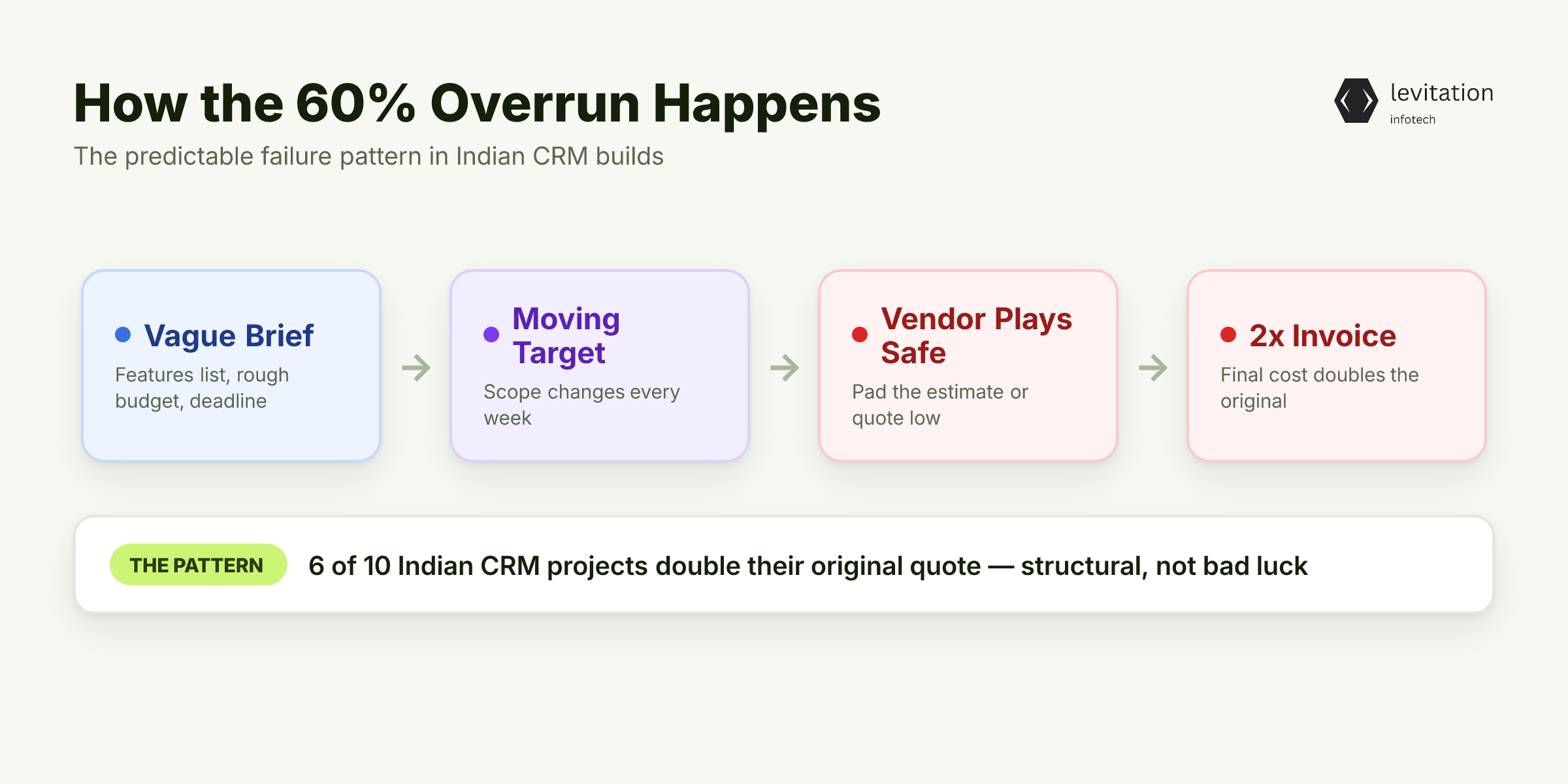
Six out of ten custom CRM projects in India blow past their original quote by 100% or more. The doubling is so common it has become a pattern, not a fluke.
A founder who signs on to a build and then receives an invoice at twice the original amount has not been unlucky. They are part of the documented majority.
The overrun is rarely a coding problem. Indian vendors can write CRM code. Founders are not naive buyers.
The failure is structural: how Indian CRM engagements are scoped, briefed, and contracted. When process controls are in place, the failure rate drops sharply.
Those controls are not exotic. They are missing because the brief is treated as an afterthought.
Most founders treat the requirements document as a formality. They walk into vendor conversations with a list of features, a rough budget, and a deadline.
Vendors are then asked to quote against a moving target. When the brief changes weekly, the only safe move for the vendor is to pad the estimate. Or quote low and recover later.
Both paths lead to a 2x outcome. The same failure pattern documented in ERP implementations shows up here, with the same root cause: an unowned requirements process.
The pattern is consistent across industries. What moves the outcome is the presence or absence of certain controls in the engagement process.
The first control point sits earlier in the engagement than most founders expect.
The Brief Is Where Most CRM Projects Actually Die
Most failed custom CRM engagements do not fail in development. They fail in the brief, before any code is written.
A founder's mental model of a CRM is a feature wishlist: lead capture, pipeline view, email integration, mobile app, AI scoring. A development partner needs something different.
They need acceptance criteria, integration dependencies, compliance obligations, and a definition of "done" for each module. The gap between those two documents is where scope ambiguity lives.
When the brief is thin, three things happen at once: - Sales, ops, and IT each bring their own wishlist to the first sprint reviews. - Requirements shift the moment stakeholders see the first build. - Vendors cannot quote accurately, so they either pad estimates or quote low and recover later.
This is also where CRM software development engagements start their slide. The vendor is not incompetent. They are working from a brief that does not yet exist.
Poor contract planning makes it worse. A fixed-price quote against an undefined scope is an open invitation for change requests.
The vendor writes a low number to win. The founder signs. Months later, the invoice arrives with a 100% uplift and a stack of approvals.
Neither side is lying. Both are following a process that was never going to end differently.
Coordination gaps compound the problem. Sales wants WhatsApp integration. Ops wants Slack alerts. IT wants audit logs and SSO.
None of these are unreasonable. None of them were in the original brief. Each one triggers a change request.
Each change request shifts the timeline. Each timeline shift pushes a deadline that triggers another change request. The cycle is structural, not personal.
The three mechanisms look like separate problems. They trace to specific moments in the engagement, not to the development team.
Three Mechanisms That Double Your CRM Cost
The doubling effect comes from three mechanisms that operate in parallel. Knowing them by name is the first step to neutralising them.
Mechanism 1: Scope Creep Disguised as Must-Have
Many enterprise CRM projects spend budget on features that never get used. The original quote covered a real, validated workflow.
The build expanded to include a "might need this" AI dashboard, a custom mobile app, and a gamified leaderboard. Months after launch, the dashboard has a handful of logins, the app is on a few phones, and the leaderboard was never opened.
This is not malicious. It is the natural drift of an unsupervised requirements list. The cost it creates is real: the original quote covered only part of what was built.
The rest was layered on through change requests. Each individually reasonable, collectively catastrophic. Tracking the actual custom CRM cost requires catching this drift early, not at delivery.
Mechanism 2: The Fixed-Price-That-Isn't
This is the most common path to the 2x outcome. A vendor quotes a fixed number to win the deal.
The number looks competitive. The founder signs. Inside the contract, acceptance criteria are vague.
"Lead pipeline works" is not an acceptance criterion. It is a wish. The same fixed-bid pattern that stalls SaaS builds does the same thing to CRM projects.
When the build is two months in, the vendor surfaces items "buried in the brief" and prices them as change requests. Each one is small.
The cumulative effect pushes the bill past the original quote by mid-project. By delivery, the founder compares the change-request total to the original quote and sees the 2x number staring back.
The vendor's CRM development cost in India structure made the doubling inevitable.
Mechanism 3: Ineffective Supervision
Founders sign off on weekly builds without independent review. The vendor demos a working screen.
The founder nods. The build moves on. Nobody checks whether the feature matches the original acceptance criteria.
The reason: the original acceptance criteria were never written.
This is the silent killer. Drift compounds quietly. By the time the final invoice arrives, the work delivered has drifted from the original brief.
The change requests are valid because the brief never held still. Schedule delays, design changes, and late-stage scope modifications each compound the overrun in isolation.
Stacked together, they produce the doubling effect documented across the industry.
Neutralising any one of the three cuts the doubling risk; controlling all three holds the original quote.
The Phased Build That Keeps Budgets Honest
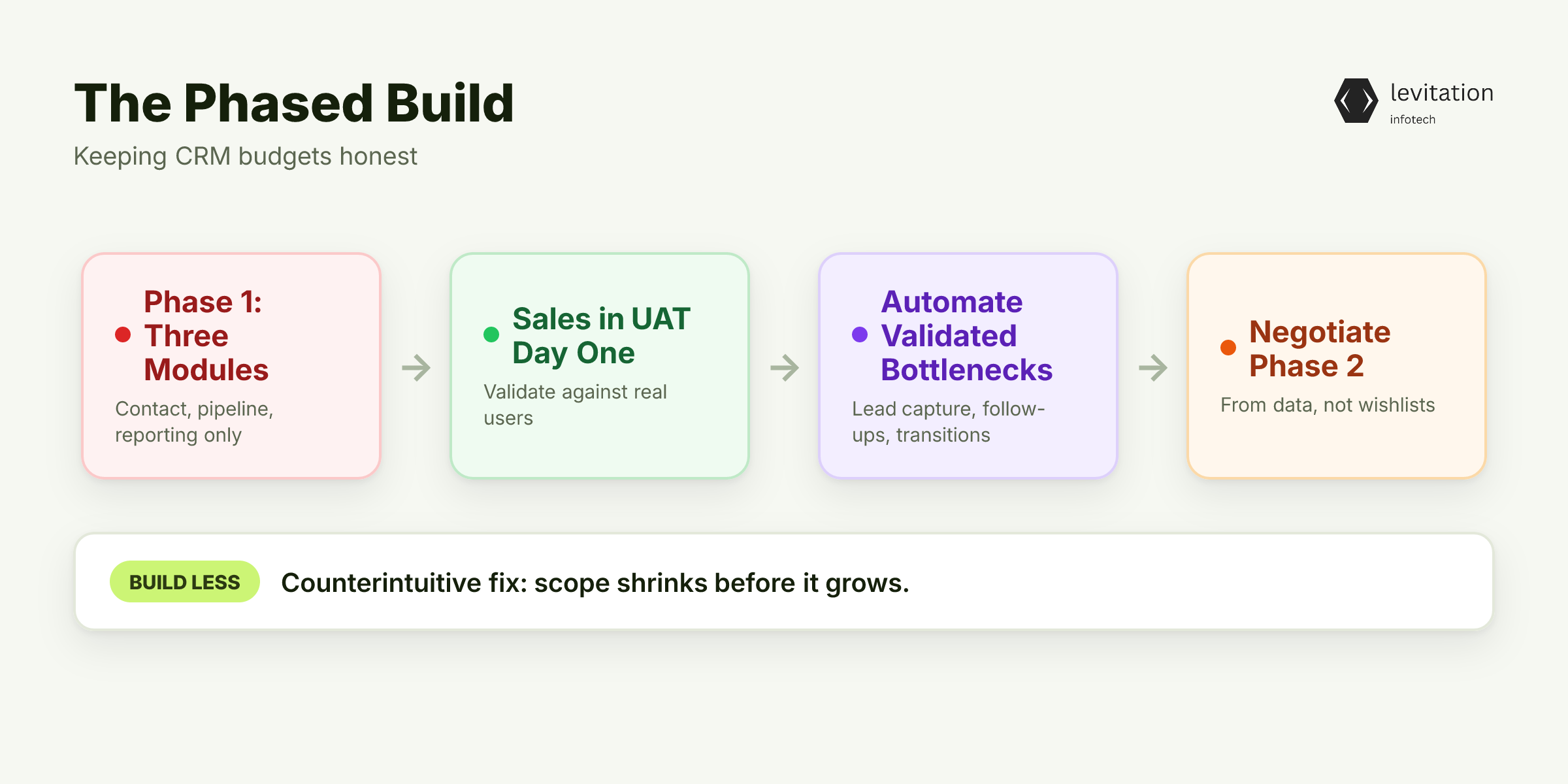
The fix is counterintuitive. Build less, on purpose.
Phase 1: Three modules, no more. Contact management, deal pipeline, and basic reporting. That is the entire Phase 1 scope.
This is the custom CRM foundation that gets validated against real sales users before any further money is committed.
The temptation is to add "just one more" feature. Resist it. Every additional module in Phase 1 is a module that has not been tested against actual sales behaviour.
The waste pattern in enterprise CRM projects comes from building features before validating workflows.
Involve sales from day one. The pattern shared by Indian CRM projects that land on budget is consistent: frontline users are in UAT from the first sprint.
Not at the end. From the beginning. When a sales rep clicks through the pipeline view in week two and says "this does not match how I close deals," the project saves itself.
A quarter of wasted development never happens.
Automate only validated bottlenecks. Companies that stay on budget keep the initial setup simple. They automate what is already a manual bottleneck.
Lead capture, follow-up reminders, and deal stage transitions. They do not automate hypothetical workflows that "might be useful."
The CRM system gets smarter as the team uses it, not before.
Negotiate Phase 2 from a position of knowledge. Once Phase 1 is live and validated, the founder knows exactly what works, what is missing, and what the team will use.
The Phase 2 conversation is no longer a wishlist. It is a data-driven scope expansion based on observed usage. This is how custom CRM pricing in India stays predictable.
Each phase is sized to a real, measured need.
The phased approach also creates a natural break point. If the vendor's Phase 1 work is poor, the founder walks away at a small fraction of a full-build budget already spent.
If the work is good, Phase 2 is a continuation with a partner the founder has actually seen perform.
Contract Terms That Lock Down the Quote
A phased build without the right contract is just a fixed-price deal with a smaller first bill. The contract is where the second half of the 2x gets locked in, or blocked.
Demand a fixed-scope contract with a written change-request process. Every addition gets priced and approved in writing before work starts.
This single clause is the most effective control against the 2x outcome. It converts scope changes from ambushes into negotiated events.
It also forces the founder to confront the cost of every "just one more feature." This is the same control that your CRM budget needs to stop sabotaging delivery.
Define acceptance criteria before development starts. Each module gets a written definition of "done."
"Lead pipeline works" is not acceptance. "Lead moves through five stages, each stage triggers an email, and pipeline view loads under two seconds for 10,000 records" is acceptance.
Vague acceptance is what allows ineffective supervision to compound into cost overruns. Strong acceptance is what makes weekly demos auditable.
Cap change-request pricing. A cap that ties change-request cost back to the original scope forces both sides to prioritise instead of accumulate.
The vendor cannot pile on a stream of small change requests. The founder cannot demand a continuous stream of small additions.
The cap creates mutual discipline, which is exactly what CRM integration projects need to stay on budget.
Quote data migration, integrations, and security review as separate line items. These are the categories where most Indian CRM budgets get blindsided.
Bundled into a "Phase 1" estimate, they are invisible until they hit the invoice. Listed separately, they force a real conversation about scope before development starts.
This is also where CRM pricing accuracy lives or dies.
The firms that hold their quotes share one trait: their contracts make scope changes expensive in time, not just in money.
How Successful Indian CRM Projects Stay Within Budget
Projects that land on budget share three traits. They write a requirements document with acceptance criteria before vendor selection.
They deliver in phases, with Phase 1 deliberately small. They sign a fixed-scope contract with a capped change-request process and signed approvals.
The pattern is unglamorous. It involves sales from the outset, not the end. It automates only validated workflows, not hypothetical ones.
It costs the founder a few weeks of writing discipline to save them 100% of the budget overrun.
The cost of CRM development lands close to the original quote when these controls are in place. Without them, the same project hits the documented 60% overrun rate.
The difference is not the vendor, the team, or the technology. It is whether the engagement was structured to surface scope decisions before they became invoices.
The 60% overrun rate is not inevitable. It is the price of skipping the process work that makes custom CRM application delivery predictable.
A serious engineering partner will tell you the same thing: the cheapest CRM build is the one that does not need to be rebuilt.
Frequently Asked Questions
Q: How much does it cost to build a CRM in India?
A small to mid-size custom CRM in India costs a fraction of enterprise SaaS pricing for Phase 1. The Phase 1 scope covers contact management, pipeline, and reporting.
Larger enterprise builds cost more depending on integration count, data migration scope, and security requirements, not just feature count.
Q: Why do most custom CRM projects go over budget?
The primary driver is scope ambiguity in the initial brief. It forces vendors to either pad estimates or recover costs through change requests.
Schedule delays, late design changes, and features that many projects end up not using compound the overrun.
Q: How can I keep my CRM project within budget?
Write a requirements document with acceptance criteria. Deliver in phases.
Use a fixed-scope contract with a documented change-request process. Involve sales users from day one.
This is the pattern shared by Indian CRM projects that land close to the original quote.
Q: Is custom CRM cheaper than Salesforce in India?
For most mid-market companies, a scoped custom CRM is cheaper than enterprise SaaS TCO when measured over a multi-year horizon.
The savings only hold, however, if the custom project is delivered on budget.
Q: What is CRM setup cost separate from development?
Implementation covers data migration, third-party integrations, user training, and deployment. It is a meaningful share of total project cost on top of development.
These line items are where most Indian CRM budgets get blindsided, so they should be quoted separately rather than bundled into the build estimate.
Sources
Research and references cited in this article:
- Custom CRM Development Cost in 2026: Pricing Breakdown & Timeline
- CRM Development Cost India 2026 (Custom vs SaaS)
- Custom CRM Development Company: Building Scalable Customer Systems - SynapseIndia
- CRM Implementation Cost Breakdown in 2026 - Ditstek Innovations
- Insights on Custom CRM Development Cost
- 2026 Project Cost Overruns - Reasons, How to Prevent and Manage
- Cost Overrun: What is, How to Prevent & Predict it
- Reasons for Project Overruns
- An Analysis of Factors Contributing to Cost Overruns in the ...
- PDF Categories and Factors of Cost Overrun in Construction Projects
- CRM Implementation: Step-by-Step Guide for SMBs 2026
- 10 CRM System Examples 2026: Features & Use Cases
About the author
Mayank Singh is a software developer at Levitation Infotech, where he builds web and AI-powered applications across the company’s fintech, healthcare, and enterprise projects.